
TL;DR:
- Shopify topic clusters use a hub-and-spoke model to improve ranking across product categories through linked pillar and cluster pages. Building 10 to 15 cluster pages per pillar, mapped to distinct search intents, creates a durable SEO strategy that addresses the buyer journey effectively. Most stores mistake category clustering and neglect ongoing updates, but integrating schema and seasonal planning enhances visibility and growth.
A Shopify topic cluster is a content architecture where one pillar page covers a broad category and multiple cluster pages target related subtopics, all linked together to signal topical authority to Google. This structure, often called the hub-and-spoke model, is the most reliable way to rank a Shopify store across an entire product category rather than just a single keyword. Brands like Dick's Sporting Goods and Wolters Kluwer have built authority through clusters, proving the model works at scale. For Shopify merchants, the examples of topic clusters for Shopify below show exactly how to apply this to your store, from fashion to supplements to home goods.
1. What makes up a Shopify topic cluster?
A Shopify topic cluster uses a hub-and-spoke structure: one pillar page linked to multiple cluster pages, each targeting a subtopic or long-tail query. The pillar page covers the category broadly, while each cluster article goes deep on one specific angle.
Here is what each component looks like in practice:
- Pillar page: 2,000 to 4,000 words, targets a broad category keyword, lives on a collection page or a long-form blog post, links out to all cluster articles
- Cluster articles: 1,000 to 1,500 words each, target narrower subtopics, link back to the pillar and to each other where relevant
- Internal linking: Every cluster page links to the pillar; the pillar links to every cluster. This hub-and-spoke linking tells Google that your site owns the topic.
- Intent mapping: Each keyword gets tagged by intent. Informational queries go to blog posts. Transactional and commercial queries go to product or collection pages.
Pro Tip: Tag every keyword in your cluster by intent before you write a single word. Mixing transactional and informational content on the same page is the fastest way to confuse Google and cannibalize your own rankings.
2. Fashion and apparel cluster example
Pillar: "Women's Linen Tops: The Complete Buying Guide" (collection page, 2,500 words)
Cluster pages built around this pillar:
- "How to style linen tops for summer" (blog post, informational)
- "Linen vs. cotton tops: which fabric is better?" (blog post, commercial)
- "Best linen tops for travel" (blog post, commercial)
- "Women's linen button-down shirts" (collection page, transactional)
- "How to care for linen clothing" (blog post, informational)
This cluster captures shoppers at every stage. The blog posts pull in top-of-funnel readers searching for style advice. The collection pages convert shoppers who are ready to buy. Each page links back to the pillar, reinforcing the store's authority on linen tops as a category.
3. Health and wellness cluster example

Pillar: "Collagen Supplements: Benefits, Types, and How to Choose" (blog post, 3,000 words)
Cluster pages:
- "Marine collagen vs. bovine collagen: what's the difference?" (blog post, commercial)
- "Best collagen supplements for skin" (collection page, transactional)
- "How much collagen should you take daily?" (blog post, informational)
- "Collagen powder vs. capsules" (blog post, commercial)
- "Does collagen actually work? What the research says" (blog post, informational)
Health and wellness stores benefit from this model because shoppers research extensively before buying. Clusters aligned to buyer journey stages create a content funnel that moves readers from curiosity to purchase without losing them to a competitor's site.
4. Home goods cluster example
Pillar: "Linen Bed Sheets: Everything You Need to Know" (collection page, 2,200 words)
Cluster pages:
- "Linen vs. cotton sheets: which is right for you?" (blog post, commercial)
- "How to wash linen bed sheets" (blog post, informational)
- "Best linen sheets for hot sleepers" (blog post, commercial)
- "King size linen bed sheets" (collection page, transactional)
- "What thread count means for linen sheets" (blog post, informational)
Home goods stores often have deep product catalogs. Clustering by category rather than by individual SKU gives each cluster enough topical breadth to rank across multiple search queries. A single "king size linen sheets" product page will never outrank a well-built cluster on its own.
5. How to align clusters with buyer intent
Search intent is the single most important variable in Shopify cluster design. Mapping intent to page types prevents keyword cannibalization and makes your content architecture logical for both users and search engines.
Here is how intent maps to Shopify page types:
- Informational intent ("how to wash linen sheets") maps to blog posts and guides
- Commercial intent ("best linen sheets for hot sleepers") maps to blog posts with product recommendations or comparison tables
- Transactional intent ("buy king size linen sheets") maps to collection pages and product pages
- Navigational intent ("YourBrand linen sheets") maps to brand or collection pages
Pro Tip: If two pages in your cluster target the same intent with similar keywords, one of them is redundant. Merge them or differentiate the angle before publishing.
6. Comparison of topic cluster models for Shopify
Not every store needs the same cluster structure. Here is how the main models compare:
| Model | Best for | Pros | Cons |
|---|---|---|---|
| Pillar and spoke | Small to mid-size stores | Simple to build and manage | Limited depth for large catalogs |
| Hub with sub-pillars | Large stores with broad categories | Captures more keyword surface area | Requires significant content volume |
| Mesh clustering | Content-heavy stores | Strong lateral linking signals | Complex to manage and audit |
| Persona-segmented clusters | Stores with distinct buyer types | Highly targeted content | Risk of overlap between segments |
Most Shopify stores starting out should use the pillar-and-spoke model. Once you have 10 to 15 cluster pages per pillar, you can add sub-pillars to expand into adjacent subtopics.
7. Best practices for maintaining and scaling your clusters
Shopify content hubs typically plan 3 to 5 major topic clusters connected to products. That is a manageable starting point, but the real work is keeping those clusters current and growing.
| Practice | What it means in practice |
|---|---|
| Seasonal publishing | Publish cluster content 30 to 60 days before peak demand periods |
| Annual content audits | Update pillar pages and cluster articles every 12 months |
| Living pillar pages | Add new cluster spokes to the pillar as you publish them |
| Schema markup | Add CollectionPage, ItemList, and FAQPage schema to collection-based pillars |
| Editorial content on collection pages | Write 50 to 100 words above the product grid and 200 to 300 words below |
Pillar pages work best when treated as living indexes. Aim for 10 to 15 cluster pages per pillar, and update the pillar every time you add a new spoke. This signals freshness to Google and keeps your internal linking structure tight.
Shopify collection pages that include FAQ blocks with FAQPage schema are better positioned to capture voice search and AI-generated answer results. Adding structured data to your cluster hubs is one of the highest-leverage technical moves you can make without touching your theme code.
Pro Tip: Use seasonal demand patterns to prioritize which clusters to build first. A home goods store should have its "linen sheets for summer" cluster live by April, not July.
Key takeaways
Shopify topic clusters built around product categories, with pillar pages of 2,000 to 4,000 words and 10 to 15 cluster articles mapped to distinct search intents, produce the most durable organic traffic gains.
| Point | Details |
|---|---|
| Cluster around categories | Build clusters on product categories, not individual SKUs, to capture multiple intent facets. |
| Map intent before writing | Tag every keyword by informational, commercial, or transactional intent before creating content. |
| Treat pillars as living pages | Update pillar pages regularly and add new cluster spokes as you publish them. |
| Use schema on collection pages | Add CollectionPage and FAQPage schema to cluster hubs to improve indexing and featured snippet capture. |
| Publish ahead of demand | Launch seasonal cluster content 30 to 60 days before peak buying periods for maximum ranking time. |
Why most Shopify stores get topic clusters wrong
I have reviewed content strategies for dozens of Shopify stores, and the most common mistake is always the same: merchants build clusters around individual products instead of categories. A cluster on "blue merino wool crew neck sweater size medium" will never generate meaningful organic traffic. A cluster on "merino wool sweaters" will. The distinction sounds obvious, but it is easy to slip into product-level thinking when you are close to your own catalog.
The second mistake is publishing a pillar page and stopping there. A pillar without cluster pages is just a long blog post. The SEO value comes from the network of linked content, not from any single page. I have seen stores with excellent pillar pages that rank for almost nothing because they never built the supporting cluster articles.
The third thing I would push back on is the idea that you need to build every cluster at once. Start with one cluster per major product category. Get it to 8 to 10 cluster pages before moving to the next. Depth beats breadth every time in the early stages of a content program. You can read more about writing posts that rank to sharpen the execution on each individual cluster article.
— Rodney
Build your Shopify topic clusters faster with Blockpress
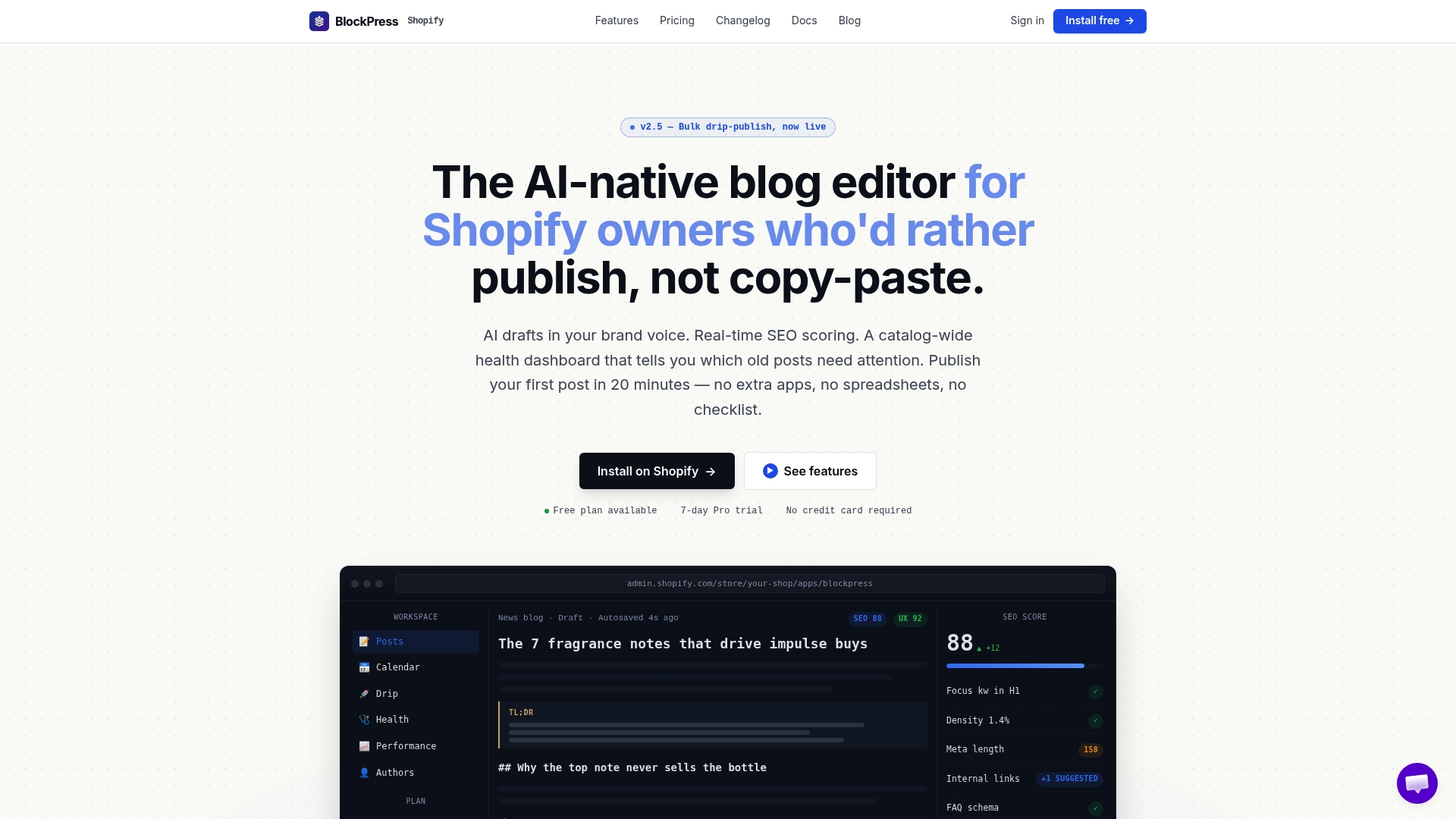
Blockpress is an AI-native blog editor built directly into Shopify, designed to make building and maintaining topic clusters practical for store owners who are not full-time content teams. You get real Google keyword data, live SEO scoring, and AI-generated article drafts without leaving your Shopify admin. That means you can plan your pillar page, draft cluster articles, and manage internal linking all in one place. Blockpress also includes bulk drip-publishing and per-article performance analytics, so you can see which cluster pages are driving traffic and which need updating. If you are ready to stop guessing and start building clusters that rank, explore Blockpress and see how it fits your store.
FAQ
What are topic clusters in Shopify SEO?
A topic cluster is a group of content pages organized around one pillar page, all linked together to build topical authority on a specific subject. In Shopify, clusters typically combine collection pages, blog posts, and product pages targeting different search intents within the same category.
How many cluster pages do I need per pillar?
Aim for 10 to 15 cluster pages per pillar for strong topical authority signals. Starting with 5 to 8 well-written cluster articles is enough to see early ranking improvements while you build out the full cluster.
Should I use blog posts or collection pages as my pillar?
It depends on the keyword. Transactional category keywords ("women's linen tops") work best with a collection page as the pillar. Informational category keywords ("collagen supplement guide") work best with a long-form blog post as the pillar.
How do I avoid keyword cannibalization in my clusters?
Tag every keyword by search intent before assigning it to a page. When two pages target the same intent with overlapping keywords, merge them or differentiate the angle. Clear intent boundaries between pages eliminate most cannibalization issues.
How often should I update my topic cluster content?
Update pillar pages and high-traffic cluster articles at least once per year. For seasonal clusters, review and refresh content 30 to 60 days before each peak demand period to maintain rankings during high-traffic windows.