

Most content marketers and SEO specialists treat their disciplines like separate departments with separate goals. One team chases rankings; the other chases engagement. The result is wasted budget, orphan content, and a site that neither ranks well nor converts. Understanding why content strategy aligns with SEO is not an abstract concept. It is the operational difference between publishing that compounds over time and publishing that disappears. This article breaks down the foundational logic, the 2026 search realities reshaping both fields, and the practical workflows that make integration work.
Table of Contents
-
Why content strategy aligns with SEO: the foundational logic
-
How 2026 search realities changed the integration requirement
-
Tactical alignment: making SEO and content workflows work together
Key Takeaways
| Point | Details |
|---|---|
| SEO and content strategy are one system | Treating them as separate workflows produces orphan content, missed rankings, and wasted effort. |
| Topical authority beats keyword volume | Building pillar-cluster architectures signals coherent expertise to both Google and AI search systems. |
| Two search surfaces now require measurement | Google and AI platforms like ChatGPT use different authority signals, so your content audit must cover both. |
| Author expertise is a ranking signal | Named authors with verifiable credentials strengthen E-E-A-T and improve AI citation likelihood. |
| Governance prevents content decay | Regular audits, pruning, and lifecycle management protect domain-level quality under Google’s Helpful Content system. |
Why content strategy aligns with SEO: the foundational logic
Content strategy, as a discipline, covers the planning, governance, and lifecycle management of content across a site. It answers questions like: What do we publish? For whom? How often? Who owns quality control? SEO, on the other hand, focuses on technical optimization, keyword research, and the ranking signals that make content discoverable. Both disciplines are incomplete without the other.
Here is what happens when they operate in silos:
-
SEO produces a keyword list with no editorial framework, so writers produce thin posts that rank briefly and then drop.
-
Content teams publish freely without keyword intent data, creating well-written articles that no one finds.
-
Neither team governs the content lifecycle, so old posts accumulate, diluting domain authority over time.
-
Internal linking gets treated as an afterthought, leaving pages isolated instead of reinforcing each other.
Without a unified strategy, teams publish excessively without measurable impact, creating exactly the kind of content bloat that suppresses rankings at the domain level.
The practical solution is to treat content strategy as the operating system that runs SEO goals. Every content brief should include keyword intent, search volume context, audience need, and a defined place in the site architecture. Every publication decision should be traceable to a ranking or business objective.
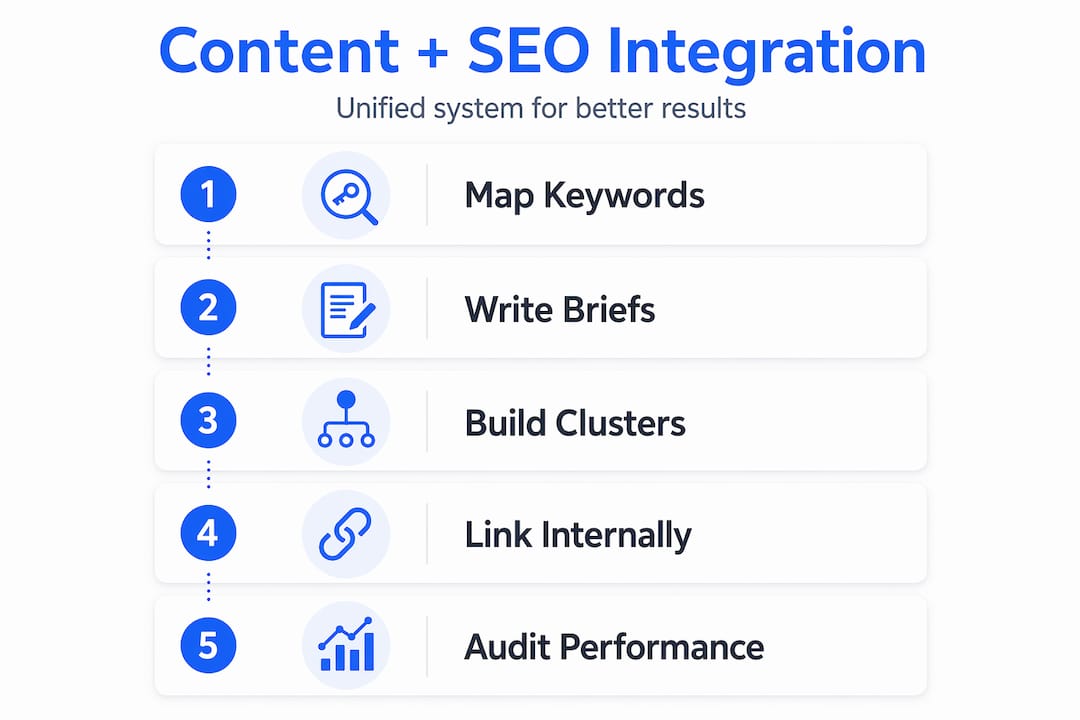
Pro Tip: Before your next content sprint, map every planned article to a specific keyword cluster and a position in your pillar-cluster architecture. If an article does not fit, either reposition it or cut it.
How 2026 search realities changed the integration requirement
The importance of content strategy has never been more concrete than it is right now. Two major shifts have made siloed SEO and content work genuinely risky.
Google’s Helpful Content system raises the stakes for every page
Google’s Helpful Content system suppresses rankings at the domain level when unhelpful content dominates a site. This is not a page-level penalty. It is a site-wide quality signal. One section of low-quality, keyword-stuffed posts can drag down well-optimized pages elsewhere on the same domain. Content strategy is the governance mechanism that prevents this. Without it, a single overzealous content sprint can quietly undermine months of SEO work.

AI search surfaces require a different kind of authority
Measuring performance in 2026 means tracking two distinct surfaces: Google organic search and AI platforms like ChatGPT and Perplexity. These systems use different authority signals. Google still relies heavily on backlinks and technical SEO. AI search prioritizes topical depth and credibility, without using link graphs the same way. A piece of content can rank on page one of Google and never get cited by an AI model, or vice versa.
| Signal type | Google organic | AI search (ChatGPT, Perplexity) |
|---|---|---|
| Backlinks | High importance | Low direct importance |
| Topical depth | Important | Critical |
| Author attribution | Growing (E-E-A-T) | High importance |
| Technical SEO | High importance | Moderate |
| Unique expertise | Increasingly valued | Primary differentiator |
Topical authority has replaced keyword volume as the core metric
Pillar-cluster content architectures provide comprehensive topic coverage that signals coherence and authority to both crawlers and AI retrieval systems. A single high-volume keyword post no longer competes the way it once did. Google now favors depth, originality, and unique perspectives that AI cannot synthesize from existing web content. This means your content strategy must define ownable topical lanes and build systematic coverage within them, not chase whatever keyword has high volume this month.
Pro Tip: For AI search readiness, write “citation-shaped” claim statements with clearly named entities. AI models extract and credit specific content fragments, so a precisely worded factual claim is more likely to surface than a vague paragraph.
Tactical alignment: making SEO and content workflows work together
Knowing the theory is one thing. Executing it across a real team is another. Here is how the integration actually works in practice.
Step 1: Unify keyword research and content briefs
Disjointed workflows produce content that either fails to rank or fails to convert. The fix is a single brief that combines keyword intent, search volume, audience need, competitive gap analysis, and editorial direction. SEO specialists provide the data layer; content strategists provide the narrative and structural layer. Neither brief should exist without the other.
Step 2: Build pillar-cluster architecture with enforced internal linking
Purposeful internal linking transfers authority and clarifies content relationships, positively affecting both rankings and user engagement. Pillar pages cover a broad topic with depth. Cluster pages cover specific subtopics and link back to the pillar. Every new piece of content should link to at least one existing piece and receive at least one inbound internal link from a related page.
| Content type | Purpose | Internal link rule |
|---|---|---|
| Pillar page | Broad topic authority | Links to all cluster pages |
| Cluster page | Subtopic depth | Links to pillar and related clusters |
| Supporting post | Specific question or use case | Links to nearest cluster page |
Step 3: Build author credibility into the content system
Named authors with verifiable credentials improve trust signals and AI citation likelihood. Author bio pages, consistent bylines, and linked credentials are not cosmetic features. They are E-E-A-T signals that Google and AI systems use to evaluate content trustworthiness. Make author attribution a non-negotiable part of your content governance process.
Step 4: Audit for both Google visibility and AI citations
AI-powered search visibility metrics do not always correlate with Google organic traffic. You need to measure both. A dual-surface audit reviews Google Search Console data alongside AI citation tracking to identify where your content is winning, where it is invisible, and where it needs structural improvement.
The compounding benefits of a unified approach
When content strategy and SEO operate as one system, the benefits compound in ways that neither discipline achieves alone.
-
Authority flywheel: Quality content earns rankings, rankings drive traffic, traffic signals relevance, relevance attracts links, and links reinforce authority. Each cycle strengthens the next.
-
Domain-level protection: Consistent, deep topical coverage creates durable ranking advantages that isolated page-level optimizations cannot replicate. You are building a reputation, not just a ranking.
-
AI citation eligibility: Credible, well-attributed, entity-rich content gets cited by AI systems. This is a distribution channel that did not exist three years ago, and it rewards exactly the kind of content that good strategy produces.
-
Reduced content waste: Governance processes prevent orphan content, duplicate coverage, and topic dilution. Every published piece earns its place.
-
Team alignment: When SEO and content teams share a brief, a calendar, and a measurement framework, they stop working against each other and start compounding each other’s output.
The role of content in SEO is not supplementary. It is structural. Without strategic content, SEO has nothing to optimize. Without SEO, content has no discovery mechanism.
A practical roadmap for integration
Getting from siloed to integrated does not require a reorganization. It requires a process change. Here is a realistic starting point.
-
Run a dual-surface content audit. Pull Google Search Console data and manually check which of your key topics appear in AI-generated answers. Identify gaps on both surfaces before planning new content.
-
Map your topical lanes. Define three to five topic clusters your site will own. Resist the temptation to cover adjacent topics just because they have search volume. Domain-level topical ownership requires focus, not breadth.
-
Build or rebuild your pillar pages. Each topical lane needs a comprehensive pillar page that links to all supporting cluster content. This is the architectural spine of your SEO content marketing effort.
-
Standardize your content brief. Every piece of content should start from a single brief that includes keyword data, audience intent, content type, internal linking requirements, and author attribution.
-
Establish a content governance calendar. Schedule quarterly audits to prune underperforming content, update outdated posts, and identify new cluster opportunities. Content planning for SEO is not a one-time event. It is an ongoing operational process.
-
Promote content proactively. Content discovered and cited via social, email, and outreach builds authority faster on both Google and AI platforms. Distribution is part of the strategy, not an afterthought.
Pro Tip: When pruning content, do not default to deletion. Consolidating two thin posts into one authoritative piece often recovers ranking potential while reducing the domain-level quality drag from low-value pages.
My take: the silo is the real SEO problem
I have worked with enough content and SEO teams to say this plainly: the silo is the problem. Not the algorithm. Not the competition. The silo.
When I see a site struggling to rank despite good writing and solid technical SEO, the diagnosis is almost always the same. The content team is publishing what feels interesting. The SEO team is optimizing what is already live. Nobody owns the architecture. Nobody is asking whether the site actually signals authority on any specific topic.
What I have found actually works is treating the content brief as a contract between strategy and SEO. When both disciplines sign off on the same document before a word is written, the output is different. It ranks because it was designed to rank. It engages because it was written for a real person with a real question.
The shift from chasing metrics to building genuine expertise is uncomfortable for teams that are used to measuring output by volume. But the compounding effect of topical authority is real. I have seen sites with half the content volume outrank much larger competitors simply because every piece they published reinforced the same topical signals. That is not luck. That is what happens when content strategy and SEO are treated as one discipline instead of two.
— Rodney
How Blockpress makes this integration practical
If you are running a Shopify store and trying to close the gap between content strategy and SEO execution, Blockpress was built for exactly that problem.
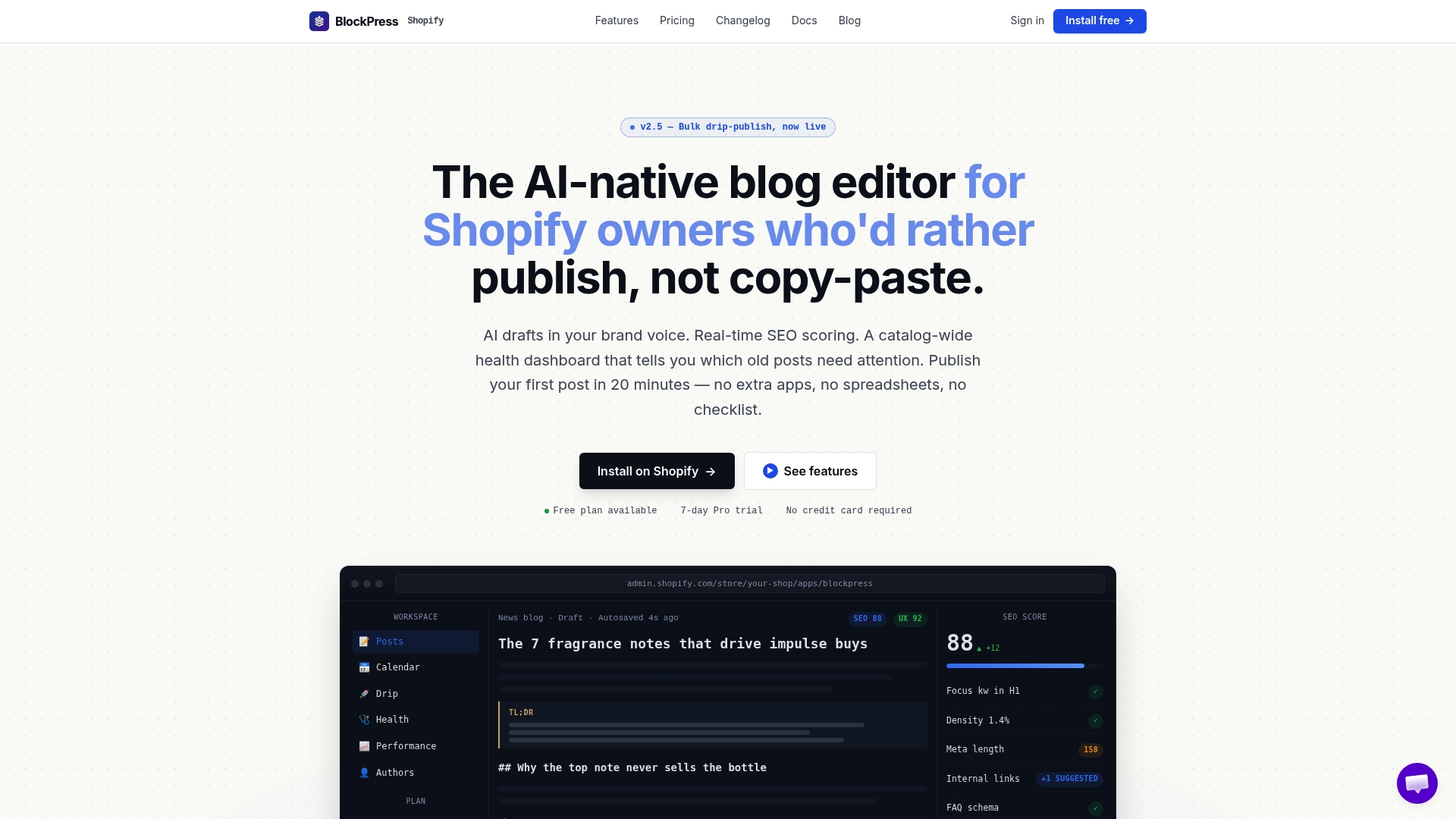
Blockpress is an AI-native blog editor built directly into Shopify. It gives you real Google keyword data, live SEO and UX scoring, AI-generated article drafts, and per-article performance analytics without leaving your store. Author bio pages are built in, which means your E-E-A-T signals are covered from day one. The content planning features support pillar-cluster architecture and internal linking workflows natively. Bulk drip-publishing and article health audits handle the governance layer that most Shopify merchants currently manage across three separate apps. See the full feature set and pricing to find the plan that fits your publishing volume.
FAQ
What does it mean for content strategy to align with SEO?
It means every content decision, from topic selection to internal linking to author attribution, is made with search visibility and ranking goals in mind. The two disciplines share a brief, a calendar, and a measurement framework rather than operating independently.
Why is topical authority more important than keyword volume now?
Google and AI search systems favor content that demonstrates deep, coherent expertise on a specific topic. A pillar-cluster architecture covering a topic thoroughly outperforms a collection of isolated keyword-targeted posts, because it signals domain-level authority rather than opportunistic coverage.
How do you measure content performance across Google and AI search?
Track Google organic traffic and rankings through Google Search Console, then separately audit which of your key topics and claims appear in AI-generated answers on platforms like ChatGPT and Perplexity. These surfaces use different authority signals and require separate evaluation.
What is the biggest mistake teams make when integrating SEO and content strategy?
Running two separate briefs. When SEO produces a keyword list and content produces an editorial plan independently, the output either ranks but does not convert, or engages readers but gains no organic reach. A unified brief solves this before a single word is written.
How does author attribution affect SEO rankings?
Named authors with verifiable credentials strengthen E-E-A-T signals, which Google uses to evaluate content trustworthiness. Clear author attribution also increases the likelihood that AI systems will cite specific content, improving visibility on AI search surfaces.