
TL;DR:
- Effective ecommerce blog ranking relies on proper crawling, authentic expertise signals, and site-wide trustworthiness. Google prioritizes technical SEO, original firsthand content, and intent-aligned topics to enhance visibility and authority. Maintaining consistent, valuable content rooted in genuine knowledge ensures long-term search performance in 2026 and beyond.
Most ecommerce store owners assume that adding the right keywords to a blog post is enough to rank on Google. It is not. Understanding how Google ranks ecommerce blog posts requires looking at three distinct layers: whether Google can actually crawl and index your content, whether that content signals genuine expertise and relevance, and whether your site as a whole earns Google's trust. Get any one of these wrong, and even a well-written post stays buried. This guide walks through each layer with specific, practical guidance you can apply directly to your Shopify blog.
Table of Contents
- Key Takeaways
- How Google ranks ecommerce blog posts: the technical foundation
- Content quality signals: E-E-A-T and information gain
- Matching searcher intent across the purchase journey
- Technical SEO and page experience factors
- Building editorial trust and maintaining ranking over time
- My take: what actually drives ecommerce blog rankings in 2026
- Take your ecommerce blog SEO further with Blockpress
- FAQ
Key Takeaways
| Point | Details |
|---|---|
| Crawlability comes first | A post that Google cannot crawl or index cannot rank, regardless of content quality. |
| E-E-A-T signals matter deeply | Visible author credentials and first-hand experience are the top-weighted signals in ecommerce SEO. |
| Intent matching drives rankings | Blog posts must address the full purchase journey, including comparisons, FAQs, and sizing guides. |
| Site-wide quality affects individual posts | A domain loaded with thin content drags down even your strongest articles. |
| Technical SEO acts as a tie-breaker | Core Web Vitals, schema markup, and mobile performance separate you from close competitors. |
How Google ranks ecommerce blog posts: the technical foundation
Before Google can rank your post, it has to find and read it. Google ranks content through three sequential steps: crawling, indexing, and then ordering results for a query. Skip step one, and nothing else matters.
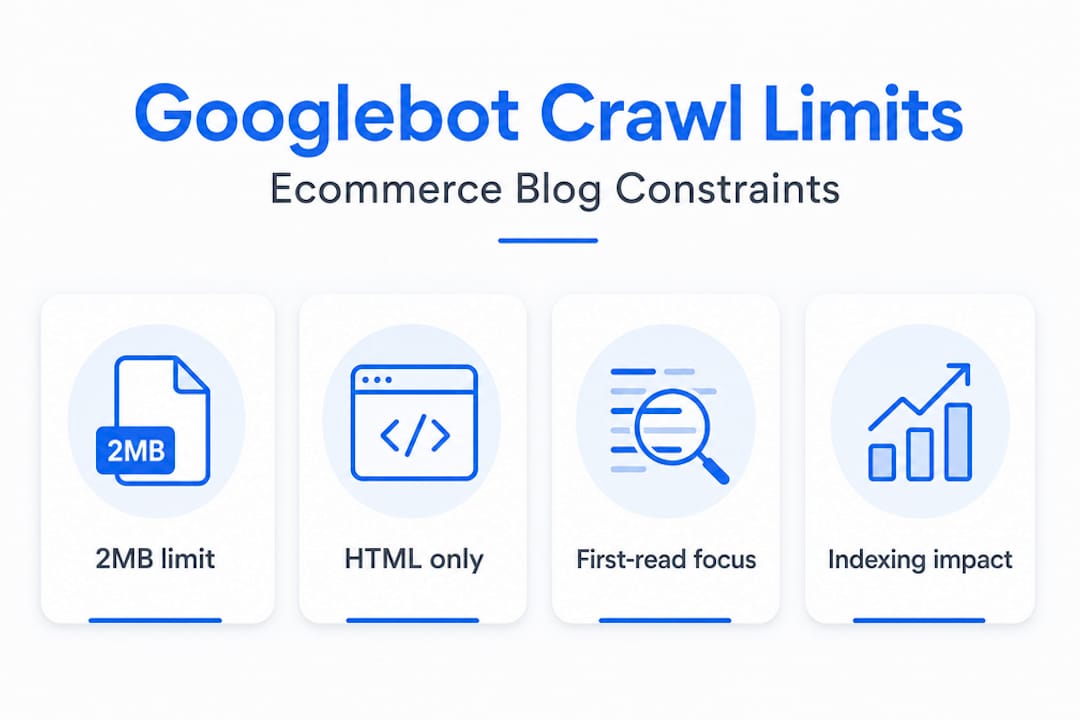
Googlebot has a specific constraint worth knowing. It fetches only the first 2MB of a page's HTML during any single crawl. If your blog template loads navigation, sidebars, promotional banners, and JavaScript widgets before the article body, your actual content may fall outside that 2MB window. Google indexes what it sees first, not what loads last.
JavaScript rendering creates a compounding problem for many ecommerce stores. Shopify themes and third-party apps often rely on client-side rendering, and JavaScript-heavy blogs risk incomplete indexing because Googlebot processes JS in a separate, delayed queue. The fix is straightforward: prioritize server-side rendering for blog pages, or place your article body near the top of your HTML output.
Key technical actions to take before anything else:
- Place article body content as early as possible in your HTML structure
- Avoid lazy-loading your main content block
- Test your pages in Google Search Console's URL Inspection tool to see what Googlebot actually renders
- Check that your blog posts return a 200 status and are not blocked in robots.txt
Pro Tip: Use Google Search Console's "Inspect URL" feature on your most important blog posts. The rendered HTML view will show you exactly what Googlebot sees, including which content falls within its readable range.
Content quality signals: E-E-A-T and information gain
Google does not just check whether your post contains the right words. It evaluates the quality of the content itself using a framework called E-E-A-T, which stands for Experience, Expertise, Authoritativeness, and Trustworthiness. E-E-A-T evaluates author credentials and visible evidence of first-hand experience as indirect but significant quality signals.
For ecommerce blogs specifically, recent data shows a notable shift. Experience and Trustworthiness now outweigh pure domain authority in AI-driven search retrieval. First-hand content like product demos, real customer data, or hands-on testing carries more weight than comprehensive "overview" articles written from a distance.
Here is how E-E-A-T applies in practice versus what most ecommerce blogs actually do:
| What Google rewards | What most ecommerce blogs publish |
|---|---|
| First-hand product testing with real data | Generic product descriptions repurposed as blog posts |
| Named author with visible credentials | Anonymous "Admin" or no byline at all |
| Transparent editorial review process | No editorial policy stated |
| Original customer data or survey results | Repeated statistics from third-party articles |
Information gain is the other critical content quality factor. Google favors original analysis over generic listicles, and posts that bring genuinely new insights, proprietary data, or unique examples consistently outperform rehashed content. In Google's March 2026 core update, original research drove roughly 22% visibility gains while AI-generated and thin content faced sharp declines.
Pro Tip: Add a "tested by" or "last reviewed by" note with a named author and date near the top of every blog post. This single change visibly improves perceived E-E-A-T and takes under five minutes to implement.
Matching searcher intent across the purchase journey
Keyword research is only half the job. What actually moves rankings is matching your content to what the searcher is trying to accomplish, at each stage of the path from awareness to purchase. Ecommerce blogs that ignore intent alignment consistently lose ground in core updates.
Think about how your customers research before buying. They are not searching for product pages. They are searching for answers to questions like "best running shoes for wide feet," "how does X compare to Y," or "does this supplement work for weight loss." These are informational queries with purchase intent behind them, and blog posts are the right format to capture them.
Topics worth building content around for an ecommerce blog:
- "How to choose" and buying guides for your product category
- Comparison posts (your product vs. alternatives, or comparing product types)
- Sizing, fit, or compatibility guides
- FAQs that address objections before purchase
- "Best X for Y" posts targeting specific customer segments
Building topical clusters around these queries matters as much as writing individual posts. Internal linking to product and category pages strengthens your site's topical authority and routes organic traffic toward conversion pages. A standalone blog post disconnected from your product ecosystem earns far less than the same post linked to three related category pages.
For a deeper look at how to structure individual posts for both ranking and conversion, see this guide on writing Shopify blog posts.
Technical SEO and page experience factors
Even great content needs a technically sound page to sit on. Google uses hundreds of ranking signals across content relevance, site structure, and technical SEO, and in competitive ecommerce niches, page experience factors often act as the deciding margin.
Here are the four most important technical priorities for ecommerce blog posts:
- Core Web Vitals. Largest Contentful Paint (LCP) and Cumulative Layout Shift (CLS) directly affect how Google scores your page experience. A post that loads slowly or shifts around as it loads signals a poor user experience.
- Mobile optimization. Google indexes the mobile version of your pages first. Test every blog post template on a real mobile device, not just a desktop browser's developer tools.
- Schema markup. Schema like Article, BreadcrumbList, and FAQ improves both indexing clarity and your eligibility for rich results in Google search. FAQ schema in particular can expand your listing's visual footprint significantly.
- Crawl path hygiene. Broken internal links, redirect chains, and pages blocked by noindex tags can prevent your blog content from being properly understood within your site structure.
| Technical factor | Why it matters | Quick fix |
|---|---|---|
| LCP over 2.5 seconds | Signals slow page; can suppress rankings | Compress images, defer non-critical scripts |
| Missing Article schema | Reduces rich result eligibility | Add JSON-LD Article markup to blog template |
| No mobile optimization | First index is mobile-first | Audit with Google's Mobile-Friendly Test |
| Orphan blog posts | Reduces crawl priority and topical signals | Add internal links from related posts and category pages |
Building editorial trust and maintaining ranking over time
Rankings are not a one-time achievement. They require ongoing attention, particularly as Google's helpful content system evaluates site-wide content health rather than individual posts in isolation. A single strong article on a domain full of thin content will underperform its potential.
Practical habits that protect and grow your rankings:
- Run a content audit every quarter. Identify low-traffic posts and either improve them with original depth or consolidate them into stronger pieces.
- Avoid publishing AI-generated posts that lack original insight or real-world examples. Recovery from those ranking drops requires consolidating thin content into fewer expert-authored pieces.
- Publish consistently within your niche. Google Discover prioritizes consistent clusters of niche-focused content over sporadic one-off posts.
- Keep author bios, review dates, and editorial policies visible and up to date.
Pro Tip: When consolidating weak posts, use a 301 redirect from the old URL to the improved article. This preserves any backlinks those pages earned and channels their authority to the stronger piece.
My take: what actually drives ecommerce blog rankings in 2026
I have watched a lot of Shopify merchants treat their blog as a checkbox, something to fill with keyword-targeted posts and then forget. The stores that consistently rank well do something different. They treat the blog as a living part of the store's product ecosystem, not a separate content project.

What I have learned is that the ecommerce blogs struggling most right now are the ones that outsourced their content to generic AI tools without adding any real operational knowledge. The posts that perform are grounded in what the store owner actually knows: how their products perform in real conditions, what questions their customers actually ask before buying, and what the honest trade-offs are between their options.
Google's 2026 updates made this gap more visible than ever. Stores that publish less frequently but with genuine first-hand depth are outranking stores with much larger content libraries built on thin, templated posts. If you run an ecommerce store, your competitive advantage is that you know your products better than any generic content writer. That knowledge, structured well and published consistently, is what ranks.
— Rodney
Take your ecommerce blog SEO further with Blockpress
If you are a Shopify merchant serious about ranking, Blockpress gives you every tool you need inside a single editor. From live SEO and UX scoring to real Google keyword data, AI-generated drafts you can build on with your own expertise, and built-in author bio pages that support your E-E-A-T signals, Blockpress is built for exactly the kind of content strategy covered in this article.
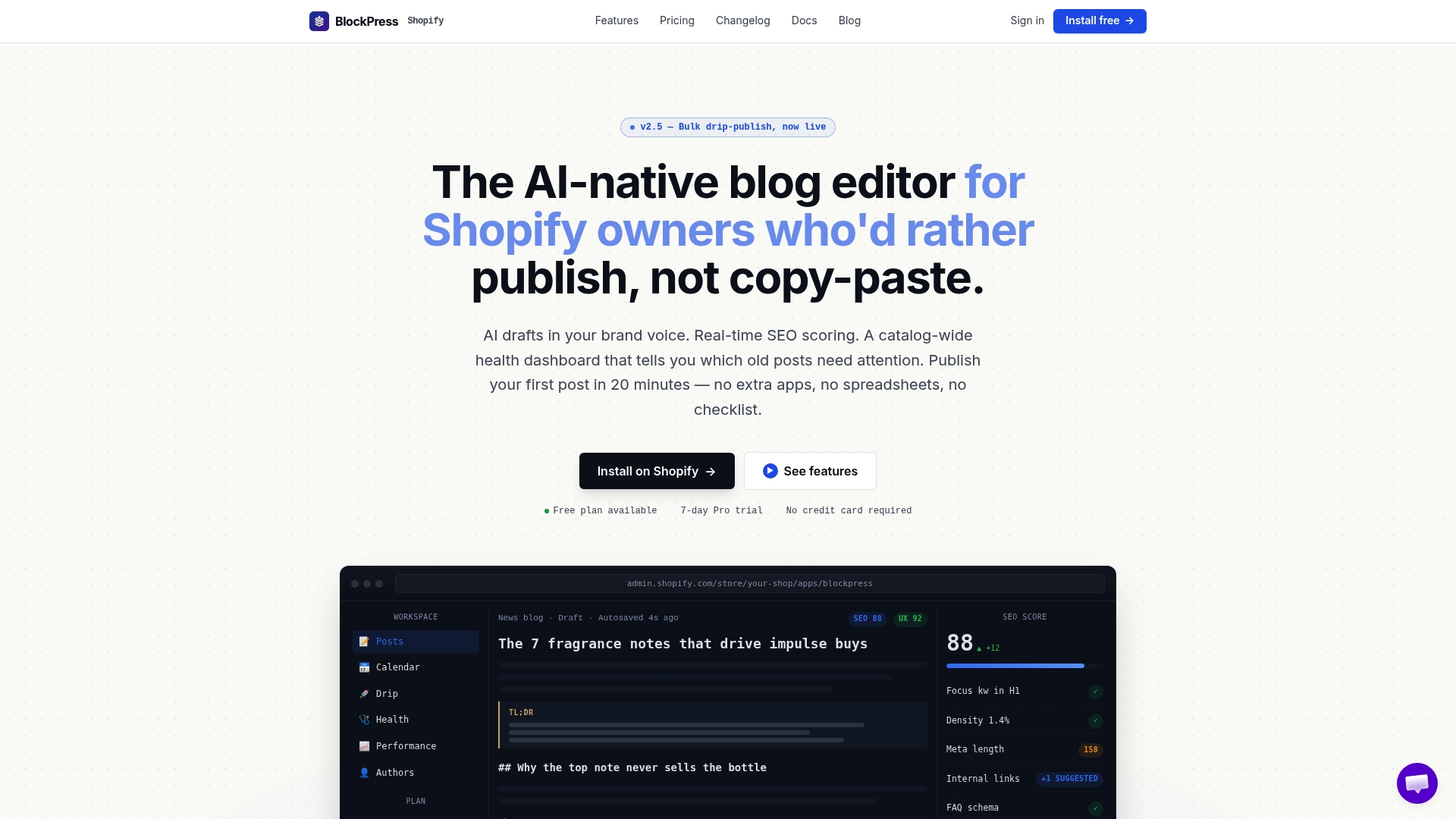
You can also access per-article performance analytics and article health audits that flag technical and content issues before they cost you rankings. No extra apps, no switching between platforms. Explore Blockpress features to see how it fits your workflow, or check the pricing page to get started.
FAQ
How does Google decide whether to crawl an ecommerce blog post?
Google discovers blog posts through sitemaps and internal links, then crawls them based on crawl budget and site authority. Posts not linked from any other page or blocked in robots.txt are less likely to be crawled and indexed.
What is E-E-A-T and why does it matter for ecommerce blogs?
E-E-A-T stands for Experience, Expertise, Authoritativeness, and Trustworthiness. For ecommerce blogs, visible author credentials and first-hand product experience are the strongest quality signals Google uses to evaluate content.
Does publishing AI-generated content hurt ecommerce blog rankings?
Yes, if the content is thin or lacks original insight. Google's helpful content system evaluates site-wide quality, so large volumes of AI-generated posts without real depth can suppress rankings for your entire domain.
How does internal linking affect ecommerce blog ranking?
Internal links from blog posts to product and category pages strengthen topical authority and help Google understand your site's content structure. Posts without internal links are effectively isolated and underperform their potential.
What schema markup should ecommerce blogs use?
Article, BreadcrumbList, and FAQ schema are the most relevant for blog posts. These improve indexing clarity and make your posts eligible for rich results, which increases click-through rates from search.