
TL;DR:
- Shopify blogs build organic traffic and brand authority, while landing pages focus on converting specific audiences. Using both formats strategically, with proper internal linking and message alignment, maximizes marketing effectiveness and campaign success. Consistent content creation and optimized landing pages significantly improve traffic, conversions, and long-term growth.
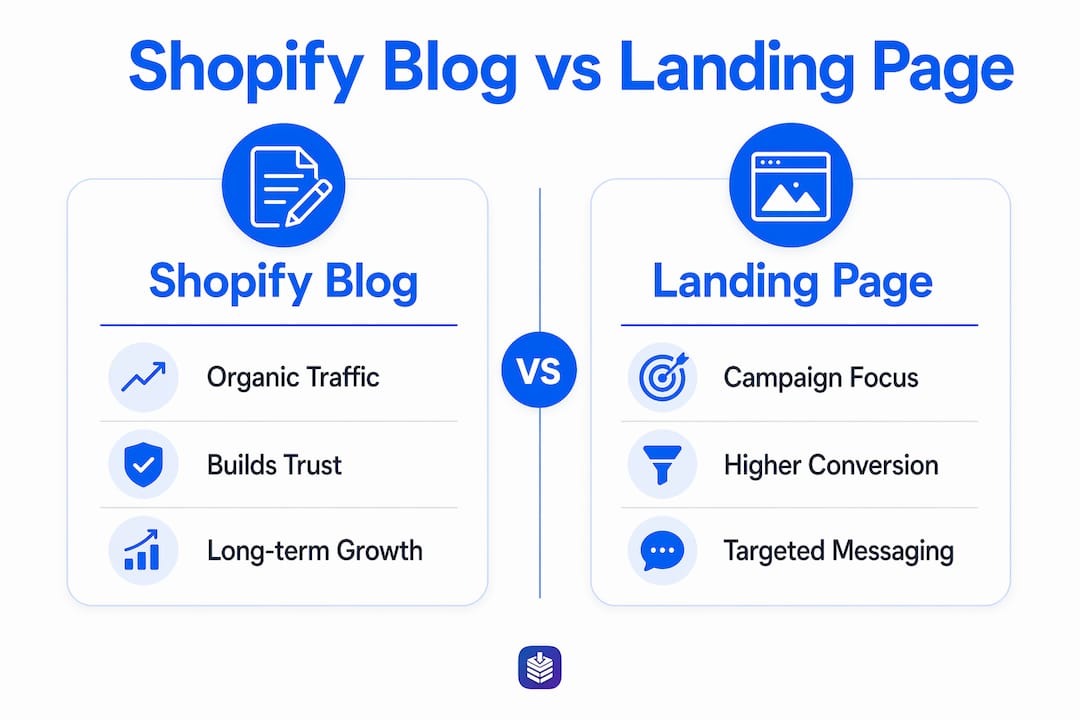
A Shopify blog is defined as a content channel that builds organic traffic and brand authority over time, while a landing page is a focused, single-objective page built to convert a specific audience. The Shopify blog vs landing page decision is not about which format is better overall. It is about which format serves your current marketing goal. Shopify blogs build trust, authority, and brand voice while supporting customer journey questions. Landing pages strip away distractions and drive one action. Most successful Shopify stores use both, with tools like BlockPress helping merchants get more from their blog content without juggling multiple apps.
What are the key differences between Shopify blogs and landing pages?
Blogs and landing pages serve fundamentally different functions in your Shopify marketing strategy. Understanding those differences prevents you from sending the wrong visitor to the wrong page.

| Feature | Shopify Blog | Landing Page |
|---|---|---|
| Primary purpose | Educate, attract, build trust | Convert a specific audience |
| Content length | 800 to 2,500+ words | 300 to 1,000 words |
| SEO treatment | Indexed, keyword-targeted, linked | Often noindexed for paid campaigns |
| Traffic source | Organic search, social shares | Paid ads, email, direct campaigns |
| Navigation | Full site navigation present | Navigation removed or minimized |
| Call to action | Multiple, soft CTAs | One focused CTA |
Blog posts are dynamic, regularly updated assets. Each post targets a specific keyword, answers a reader question, and earns indexed pages that compound in value over months. Blogs serve top-of-funnel intent, meaning visitors are researching, comparing, or learning rather than ready to buy immediately.
Landing pages are campaign-specific assets. They exist to match the exact message of an ad or email, remove every distraction, and push one visitor toward one action. A landing page for a Black Friday skincare bundle looks nothing like a blog post about skincare routines, even if both live on the same Shopify store.
Internal linking is where the two formats connect. URLs with 40+ internal links receive four times more traffic than pages with few links. That means your blog posts should actively link to your landing pages, product pages, and collection pages to distribute SEO equity and guide visitors deeper into your funnel.
When should you use a blog versus a landing page?
Choosing between a blog and a landing page depends on the customer journey stage and your campaign goal, not on personal preference or platform capability. Here is how to map each format to the right situation.
Use a Shopify blog when:
- You are targeting cold organic traffic through Google search with informational queries like "best protein powder for beginners."
- You want to build topical authority in your niche over time through a cluster of related posts.
- You need to nurture prospects who are not yet ready to buy but are researching options.
- You are publishing brand storytelling content, tutorials, or product education that supports multiple products.
- You want long-term compounding returns from a single piece of content.
Use a landing page when:
- You are running paid social ads on Meta, TikTok, or Google and need message match between the ad and the destination.
- You are promoting a limited-time offer, product launch, or seasonal campaign.
- You are collecting email leads through a specific lead magnet or discount offer.
- You are sending traffic from an email campaign to a dedicated offer page.
- Cold paid traffic converts 30 to 60 percent better on landing pages than on product pages. That gap alone justifies building a dedicated page for every paid campaign.
Pro Tip: Map your traffic source before you build the page. Cold paid traffic goes to a landing page. Warm branded traffic goes to a product or collection page. Organic traffic with informational intent goes to a blog post. Mixing these up is the most common Shopify funnel mistake.
How to build and optimize both for best results
Getting results from either format requires more than just publishing content. Here is a practical approach for each.
Setting up your Shopify blog
- Build an editorial calendar targeting keywords with clear search intent. Use tools like Google Search Console or BlockPress, which surfaces real Google keyword data directly inside your Shopify editor.
- Write posts that answer one specific question per article. A post titled "How to Choose a Standing Desk for Small Spaces" outperforms a generic "Standing Desk Guide" every time.
- Add internal links in every post. Link to related blog posts, product pages, and collection pages using descriptive anchor text.
- Optimize your meta title, meta description, and header structure before publishing. BlockPress provides live SEO scoring so you can fix issues before the post goes live.
- Publish consistently. Google rewards sites that produce regular, indexed content.
Building high-converting landing pages
- Match your headline exactly to the ad copy that sent the visitor there. Message alignment between ad and page is the single biggest factor in landing page conversion.
- Remove the main site navigation. Every extra link is an exit opportunity.
- Include one CTA. A landing page with two competing CTAs splits attention and reduces conversions.
- Integrate with apps like Klaviyo for email capture, Recharge for subscription offers, or Yotpo for social proof. These integrations add credibility without adding friction.
- Simplifying your offer by removing distractions can increase conversion rates by up to 12 percent. That is a meaningful lift from a structural change alone.
Pro Tip: Run A/B tests on your landing page headline before testing anything else. The headline determines whether a visitor reads further. Landing pages are bespoke campaign assets built for testing, so use that advantage.
One important consideration: personalized landing pages that dynamically adjust content based on visitor data require data integration, segmentation rules, and ongoing testing resources. Static landing pages are far simpler to build and still deliver strong results for most Shopify merchants.
Common mistakes that hurt your blog and landing page results
Most Shopify merchants do not fail because they chose the wrong format. They fail because they execute the right format poorly.
- Sending paid traffic to product pages. Sending cold paid social traffic to product pages instead of landing pages is the most common Shopify funnel mistake. Product pages are built for catalog browsing, not campaign conversion.
- Skipping internal links on blog posts. A blog post with no internal links is a dead end. Every post should link to at least two or three related pages on your store.
- Adding multiple CTAs to a landing page. One page, one goal. A landing page asking visitors to buy, subscribe, and follow your Instagram simultaneously converts none of those actions well.
- Neglecting blog post performance data. Publishing without reviewing which posts drive traffic, time on page, or conversions means you cannot improve. Tools like BlockPress offer per-article performance analytics so you can see exactly which posts earn their keep.
- Treating your blog as a product catalog. Blog posts that read like product descriptions do not rank for informational queries. Write for the reader's question first, then introduce your product as the answer.
Pro Tip: Audit your existing blog posts every quarter. Look for posts with high impressions but low click-through rates. Those posts need better meta titles and descriptions, not more content.
Key takeaways
Shopify blogs build long-term organic traffic and trust, while landing pages convert specific campaign audiences through focused messaging and a single call to action.
| Point | Details |
|---|---|
| Match format to funnel stage | Use blogs for top-of-funnel organic traffic and landing pages for paid campaign conversions. |
| Internal linking multiplies results | Linking blog posts to product and landing pages distributes SEO equity and guides visitors forward. |
| Message match drives conversions | Landing page headlines must mirror the ad copy that sent the visitor there. |
| One CTA per landing page | Multiple calls to action split attention and reduce overall conversion rates. |
| Blog consistency compounds | Regular, indexed blog posts build topical authority that grows in value over time. |
Why I think most Shopify stores underuse both formats
I have reviewed enough Shopify stores to notice a consistent pattern. Merchants either blog without a strategy, publishing posts that target no specific keyword and link to nothing, or they build landing pages that look great but send mixed messages because the ad and the page headline do not match.
The stores that grow fastest treat their blog and their landing pages as two separate but connected systems. Blog content feeds organic traffic into the top of the funnel. Landing pages capture the bottom. Internal links connect the two. When you fix an underperforming Shopify blog by adding proper internal links and keyword targeting, you often see traffic improvements within weeks, not months.
The other thing I would push back on is the idea that landing pages are only for big ad budgets. Even a small email campaign to 500 subscribers converts better when it lands on a focused page rather than a product page surrounded by navigation and unrelated products. The format works at any scale.
— Rodney
Take your Shopify blog further with BlockPress
If your blog is not driving organic traffic or converting readers into customers, the problem is usually execution, not effort.
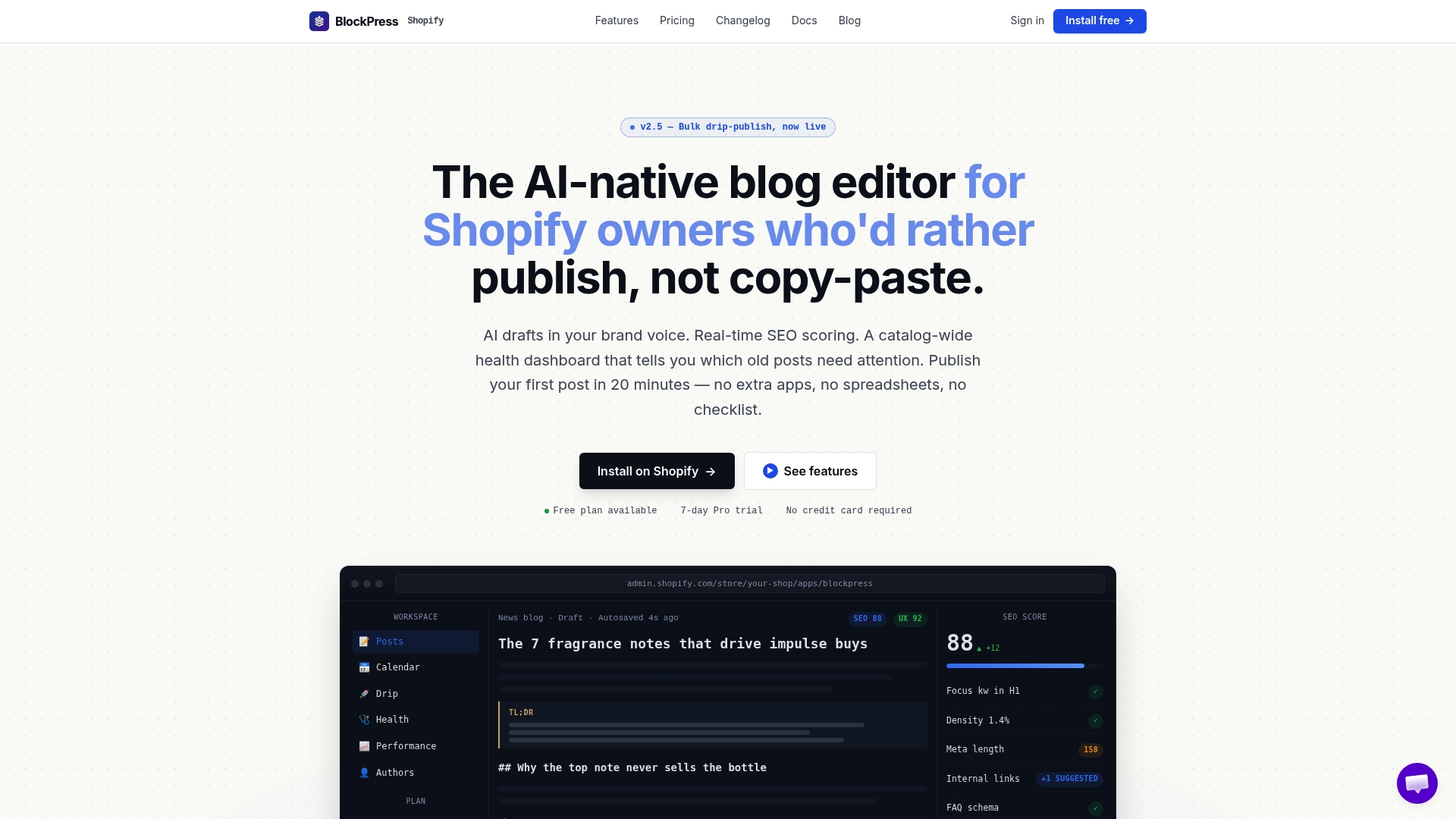
BlockPress is an AI-native blog editor built directly into Shopify. It gives you real Google keyword data, live SEO and UX scoring, AI-generated article drafts, bulk publishing, and per-article analytics, all inside one editor without leaving your store. Most merchants replace three separate apps the moment they start using it. If you want to build a blog that ranks and converts, BlockPress is the fastest way to get there. See the full feature set here or get started at BlockPress today.
FAQ
What is the main difference between a Shopify blog and a landing page?
A Shopify blog is an ongoing content channel designed to attract organic search traffic and build brand authority over time. A landing page is a focused, campaign-specific page built to convert one audience with one offer.
Which is better for paid ads: a blog or a landing page?
Landing pages are better for paid ads. Cold paid traffic converts 30 to 60 percent better on landing pages than on product pages, and the same logic applies when comparing landing pages to blog posts.
Can a Shopify blog post also act as a landing page?
In some cases, yes. Hybrid pages that combine detailed product information with landing page messaging work well for high-intent keywords. However, for most paid campaigns, a dedicated landing page with no navigation and a single CTA will outperform a blog post.
How often should I publish on my Shopify blog?
Consistency matters more than volume. Publishing one well-researched, keyword-targeted post per week builds more authority than publishing five thin posts. Use an editorial calendar and track performance with tools like BlockPress to prioritize topics that drive results.
Do landing pages hurt my Shopify SEO?
Not if you manage them correctly. Landing pages built for paid campaigns are typically noindexed, which keeps them out of Google's index. Blog posts, by contrast, should always be indexed and optimized for organic search.