
TL;DR:
- AI-driven blog drafting accelerates content creation by automating outlining and initial writing, reducing costs and time. However, human editing remains essential to ensure quality, maintain brand voice, and achieve high search performance. Using AI across the entire content lifecycle and enforcing rigorous governance maximizes return on investment and preserves content integrity.
AI-powered blog drafting is the process of using artificial intelligence to automate early content creation stages, including outlining, structuring, and initial writing. This is why marketers use AI for blog drafts: it cuts production time, increases output volume, and reduces cost per article without sacrificing quality when paired with human editing. 87% of marketing teams have adopted AI tools by early 2026, up from 61% in 2024. That shift reflects a fundamental change in how content teams operate, not just a passing experiment.
Why marketers use AI for blog drafts: speed and less friction
AI removes the structural friction that slows content teams down. According to Salesforce, AI handles outlining, data analysis, and rough drafts while humans add nuance and voice. That division of labor means your team stops staring at blank pages and starts editing finished structures.
The efficiency gains are concrete:
- Teams using AI produce a median of 17 articles monthly and save 11 hours per week per person.
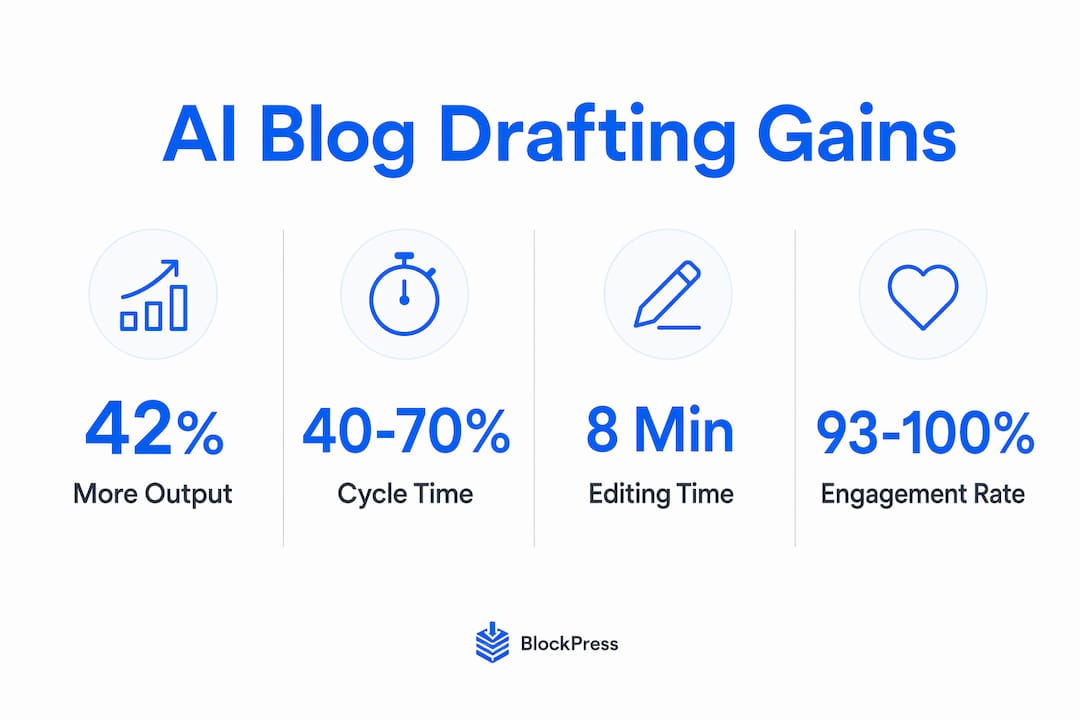
- Production costs drop by 42% compared to fully manual workflows.
- AI resolves repetitive tasks like formatting, FAQ generation, and header structuring in seconds.
- Cycle time reductions of 40–70% are reported across teams that integrate AI into their publishing workflow.
The practical result is that a marketer who previously published four posts a month can realistically publish ten or more, without adding headcount.
Pro Tip: Build a reusable AI prompt library for your most common post types, such as product roundups, how-to guides, and comparison posts. Standardized prompts produce more consistent drafts and cut editing time further.

Understanding the content publishing workflow behind AI-assisted posts helps you identify exactly where automation adds the most value for your team.
Does AI content actually perform well?
Human editing is the variable that determines whether AI-generated blog content succeeds or fails. Human-edited AI content achieves 93–100% of the engagement and search performance of fully human-written content. Unedited AI content underperforms by 18–24%. That gap is significant and entirely preventable.
The time investment for editing is also far lower than writing from scratch. Human review takes 8 minutes per 1,000 words versus 47 minutes to write the same content manually. You get most of the quality at a fraction of the time.
| Content type | Engagement vs. human-written | Time per 1,000 words |
|---|---|---|
| Human-edited AI draft | 93–100% | ~8 minutes |
| Unedited AI draft | 76–82% | ~0 minutes |
| Written from scratch | 100% | ~47 minutes |
The risks of skipping the editing step go beyond engagement scores. Pure AI content without human enrichment risks lower search authority, brand voice inconsistency, and factual errors. The best AI workflows combine AI-generated outlines and FAQs with human editorial enrichment involving client-specific data, proprietary insights, and voice adaptation.
Pro Tip: Treat every AI draft as a first draft from a junior writer. Your job is to add the one insight, story, or data point that only your brand can provide. That addition is what separates your post from every other AI-generated article on the same topic.
How to use AI tools across the full content lifecycle
AI's role in content marketing extends well beyond writing the first draft. The most effective teams use AI across the entire lifecycle, from topic research to publishing.
- Topic ideation. AI analyzes search trends and audience behavior to surface topics with real demand. This replaces guesswork with data-driven decisions before a single word is written.
- SEO structuring. AI generates FAQ schema, meta descriptions, and header hierarchies that align with search intent. AI-template-assisted pages rank 14% faster due to structured SEO and FAQ schema.
- Content variant testing. AI produces multiple headline and intro variations quickly, letting you test which angle drives more clicks without extra writing time.
- Workflow automation. AI connects topic research, drafting, and scheduling into a single pipeline, reducing handoffs and approval delays.
- Brand governance at scale. Advanced teams encode brand voice and content guidelines as structured data so AI agents generate on-brand content automatically. BCG finds that top performers using multi-agent AI orchestration realize 20–30% cost efficiency gains and 3x ROI.
The gap between basic and advanced AI use is real. 96% of CMOs report significant AI transformation, but 42% still use AI only for isolated tasks. Teams that integrate AI end-to-end consistently outperform those treating it as a one-off drafting shortcut.
Measuring ROI from AI blog drafting
The output numbers from AI adoption are well documented. Teams see a 42% increase in article output alongside a 42% reduction in production costs. Brands publishing four or more AI-assisted blog posts weekly see 3.5x higher organic traffic growth than those publishing one post per week. That is not a marginal improvement.
Cycle time reductions of 40–70% translate directly into faster campaign launches and quicker responses to trending topics. A content team that previously needed two weeks to publish a post can now publish in days.
The risk is measuring only volume. Tracking output alone can mask brand damage. Quarterly content audits using a rubric that checks brand voice, factual accuracy, and engagement metrics are the standard practice for teams that sustain quality at scale. Only 30% of marketing organizations are mature enough to scale AI effectively, per Gartner 2026. The other 70% are publishing more content without the governance to protect quality.
Key Takeaways
AI blog drafting delivers measurable gains in speed, output, and cost, but human editing and organizational readiness determine whether those gains translate into lasting search performance and brand authority.
| Point | Details |
|---|---|
| AI cuts production time sharply | Teams save 11 hours per week per person and reduce costs by 42% with AI-assisted drafting. |
| Human editing closes the quality gap | Edited AI content reaches 93–100% of human-written performance; unedited content underperforms by up to 24%. |
| AI works across the full lifecycle | Use AI for topic research, SEO structuring, and workflow automation, not just first drafts. |
| Volume without governance is risky | Quarterly audits of brand voice and factual accuracy prevent quality drift at scale. |
| Maturity drives ROI | Teams integrating AI end-to-end see 3x ROI versus those using it for isolated tasks. |
AI is a writing partner, not a ghostwriter
I've watched a lot of marketing teams make the same mistake: they treat AI as a ghostwriter and stop editing. The output looks fine at first. Then, six months later, every post sounds identical, the brand voice has evaporated, and organic rankings start slipping. The tool did exactly what it was asked to do. The problem was the ask.
The teams I've seen get real results from AI blog drafting treat it as a structural partner. AI builds the frame. Humans add the weight-bearing details: the proprietary data, the specific customer story, the opinion that only your brand can credibly hold. That combination is what makes a post worth reading and worth ranking.
The other thing I'd push back on is the idea that AI is only for beginners or high-volume content farms. The benefits of AI for blogs are just as real for a focused Shopify store publishing two posts a week as they are for a large media team. The efficiency gain frees up time for the strategic work that actually moves the needle.
Build your voice brief before you build your prompt library. Document your tone, your off-limit phrases, your preferred sentence length. Feed that brief to every AI session. You will get dramatically better first drafts and spend far less time editing out the generic filler that makes AI content feel hollow.
— Rodney
Blockpress brings AI drafting into your Shopify store
Blockpress is built for Shopify merchants who want the speed of AI drafting without losing control of brand voice or SEO quality.
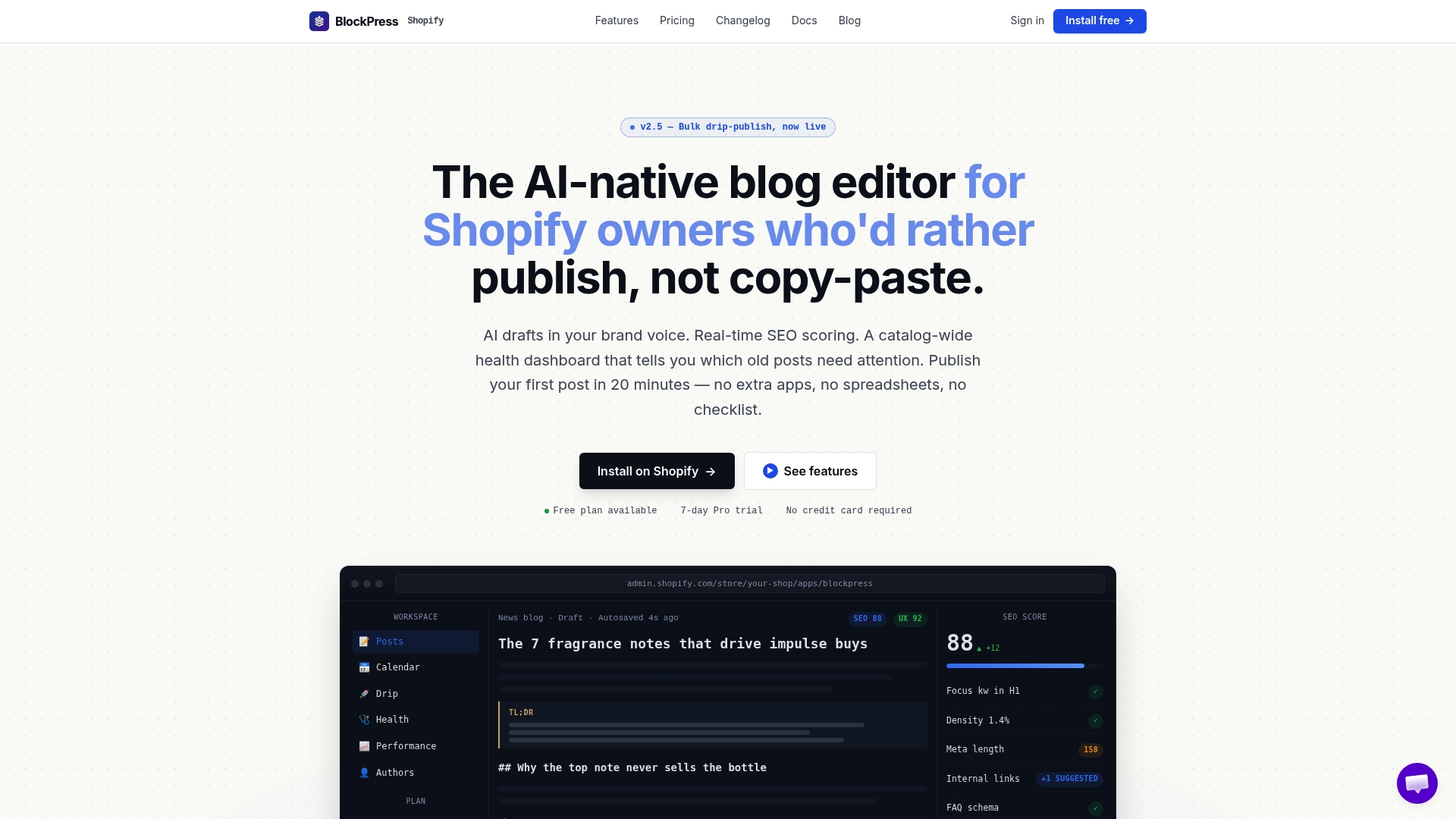
With Blockpress, you get AI-generated article drafts alongside real Google keyword data, live SEO and UX scoring, and article health audits, all inside your Shopify store. You do not need three separate apps to replicate what Blockpress does natively. The editor pairs AI drafting with human editing tools so every post you publish meets your quality standard. Check out Blockpress pricing to see which plan fits your publishing volume.
FAQ
Why do marketers use AI for blog drafts?
AI automates the most time-consuming parts of content creation, including outlining, structuring, and initial drafting, so marketing teams publish more content faster and at lower cost. Teams using AI produce a median of 17 articles monthly and save 11 hours per week per person.
Does AI-generated blog content rank on Google?
Human-edited AI content achieves 93–100% of the search performance of fully human-written content. Unedited AI content underperforms by 18–24%, so human review is the critical step.
How much time does AI actually save per blog post?
Human review of an AI draft takes about 8 minutes per 1,000 words, compared to 47 minutes to write the same content from scratch. That time difference compounds significantly across a full content calendar.
What is the biggest risk of using AI for blog content?
Publishing AI drafts without human editing or brand governance leads to quality drift, where posts gradually lose brand voice and factual accuracy. Quarterly content audits using a scoring rubric are the standard fix.
Do you need technical skills to use AI blog drafting tools?
Most AI blog drafting tools are designed for marketers, not developers. Platforms like Blockpress integrate AI drafting directly into the publishing workflow, so you can generate and edit drafts without any technical setup.