
TL;DR:
- AI drafts ecommerce blog posts faster but require human refinement to generate traffic and avoid penalties. Producing high-quality, original content with real expertise and data is essential for SEO success and traffic growth. The best tools integrate keyword data, SEO scoring, and author support within Shopify for efficient workflow.
AI drafts ecommerce blog posts by generating structured first drafts in minutes, but the content only earns traffic when humans refine it with real expertise and original insight. The hybrid approach delivers 3–5x faster production than writing from scratch, giving ecommerce marketers more output without sacrificing quality. Google does not penalize AI content by default. It penalizes mass-produced, low-value pages that exist only to manipulate rankings. Knowing that distinction is what separates stores that grow organic traffic from those that lose it.
What you need before AI drafts your ecommerce blog posts

Preparation determines whether AI-generated drafts become published assets or wasted effort. Skipping this stage is the most common reason ecommerce blogs stall after an initial burst of AI content.
Start with these four prerequisites:
- A clear content goal per post. Define whether the article targets top-of-funnel awareness, mid-funnel comparison, or bottom-of-funnel purchase intent before you prompt the AI. A post about "best running shoes for flat feet" needs a different structure than "how to clean running shoes."
- Keyword research tied to real search data. AI tools with integrated SEO keyword analysis produce drafts that align with actual ranking factors. Without keyword data, the AI writes for no one in particular.
- A defined brand voice document. AI models mirror whatever tone you give them. A one-page voice guide covering vocabulary, sentence length, and product terminology keeps every draft consistent with your store's identity.
- An editorial review process. Assign a human editor to every draft before it publishes. This is not optional. Human-in-the-loop workflows save 50–60% of writing time while maintaining the content quality that search engines reward.
Pro Tip: Build a topic cluster map before generating any drafts. Group your ecommerce blog ideas into pillar topics and supporting posts. AI fills in supporting posts quickly, and the internal linking structure you create boosts the authority of every page in the cluster.
How to generate and refine AI drafts into publish-ready posts
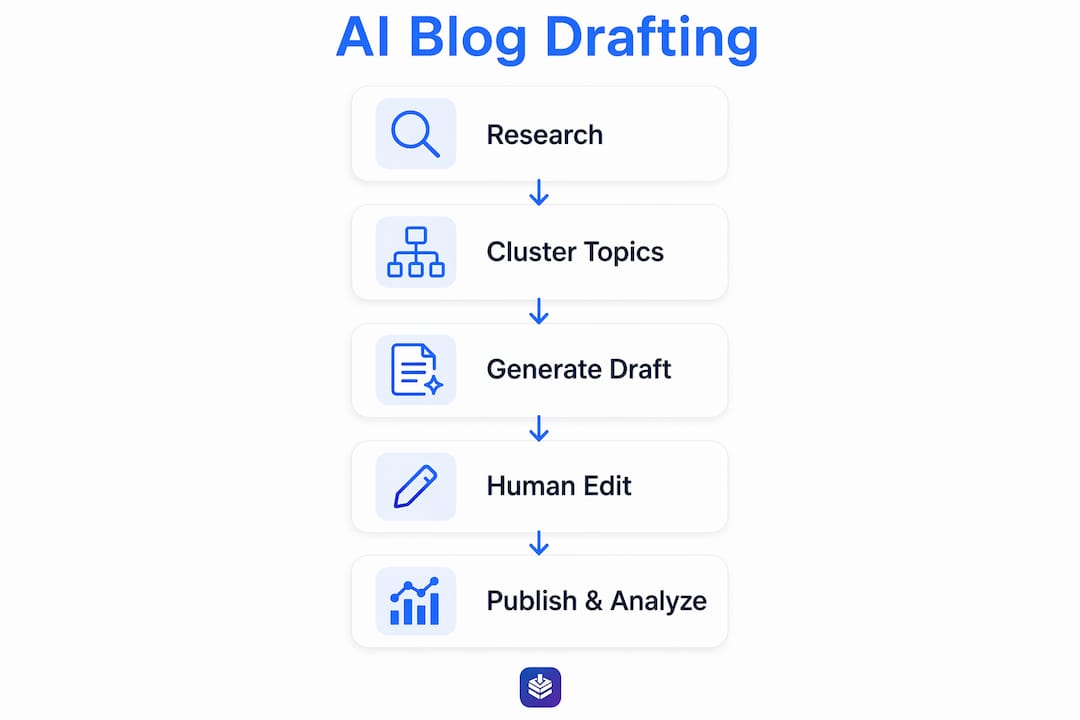
A repeatable workflow separates ecommerce marketers who get consistent results from those who publish inconsistently. Follow these five steps every time.
-
Create a detailed outline first. Write the H2 and H3 headings yourself, or use a keyword-aware tool to generate them. Feed this outline to the AI as the prompt structure. The AI then fills each section rather than deciding the architecture on its own.
-
Generate the draft and read it critically. AI models produce fluent text that can sound authoritative while being factually thin. Read every paragraph asking: "Does this add something a competitor's post does not?" If the answer is no, flag it for rewriting.
-
Add original data, merchant experience, and brand voice. This is the step most ecommerce marketers skip. AI models lack actual experience. Insert your store's real numbers, customer quotes, product test results, or supplier insights. This is what Google's E-E-A-T framework (Experience, Expertise, Authoritativeness, Trust) rewards.
-
Run on-page SEO optimization. Check the primary keyword in the title, meta description, first 100 words, and at least two H2 headings. Add internal links to related product pages and blog posts. Review the technical SEO requirements for ecommerce blogs, including schema markup and page speed.
-
Get editorial sign-off before publishing. A second human read catches factual errors, brand inconsistencies, and thin paragraphs the AI filled with generic claims. Including real author bylines and credentials also improves trust signals with Google's quality raters.
Pro Tip: Disclose AI assistance in your editorial note or author bio. Google's quality raters treat transparency as a positive credibility signal, not a penalty trigger.
Common pitfalls when using AI drafts for ecommerce blogs
The biggest risk is not using AI. The biggest risk is publishing AI drafts without editing them.
Google defines scaled content abuse as mass-producing low-value pages regardless of whether a human or AI wrote them. The intent and the added value are what matter, not the tool used to create the content.
Sites publishing more than 1,000 unedited AI articles have seen traffic drops of 40–90% after spam algorithm updates in 2024 and 2025. That is not a warning about AI. It is a warning about volume without editorial governance.
Watch for these specific mistakes:
- Publishing templated posts at scale. If every post follows the same AI structure with swapped keywords, Google recognizes the pattern. Thin, templated content triggers scaled content abuse filters.
- Ignoring E-E-A-T signals. A post about "best protein powders for athletes" written entirely by AI with no author credentials, no real testing data, and no original analysis fails the experience and expertise criteria that Google's March 2026 core update enforces.
- Skipping fact-checking. AI models hallucinate product specs, pricing, and statistics. Publishing incorrect product information damages customer trust and can create legal exposure for ecommerce stores.
- No editorial governance. Assign content ownership. Every published post needs a named author, a review date, and a clear update schedule.
How AI-assisted content affects ecommerce SEO and traffic
The data on AI content and SEO is now clear enough to act on.
| Scenario | Traffic Outcome |
|---|---|
| 50–100 AI posts with substantive human editing | +30–80% traffic gains |
| Large-scale unedited AI content farms | 40–90% traffic drops |
| Thin pages consolidated with first-party data | Up to 83% traffic recovery |
Sites publishing 50–100 AI-assisted articles with real human editing saw traffic increases of 30–80% after the March 2026 core update. That result is not from the AI. It is from the editorial layer on top of it.
Recovery from a traffic penalty takes time. Content recovery typically runs 2–6 months, though stores that consolidate thin pages and add first-party data have documented 83% traffic recovery in as few as 17 days. The fastest path back is always the same: fewer posts, more depth, real expertise added to every page.
Google's current position is that original data and analysis are required for ranking success. Rephrasing existing top results, even with polished AI prose, no longer earns rankings the way it did before 2024.
What to look for in AI tools for ecommerce blog drafting
Not all AI writing platforms serve ecommerce marketers equally. The feature set matters as much as the output quality.
Prioritize platforms that include:
- Real keyword data integrated into the drafting interface. You need to see search volume, keyword difficulty, and related terms while you write, not after.
- Live SEO scoring. A content score that updates as you edit tells you whether the draft is moving toward or away from ranking potential.
- Outline and content gap analysis. The best tools show you what competing posts cover that yours does not, so you can close those gaps before publishing.
- Author bio and byline support. E-E-A-T compliance requires named authors with credentials. The platform should make adding and displaying author information easy.
- Shopify-native integration. Ecommerce marketers lose time switching between a blog editor, an SEO tool, and their store admin. A platform built directly into Shopify removes that friction entirely.
Blockpress covers all of these features inside a single Shopify-native editor, including AI-generated drafts, real Google keyword data, live SEO and UX scoring, and author bio pages. You can review the full Blockpress feature set to see how each capability maps to the workflow above.
Key Takeaways
The most effective ecommerce blog strategy uses AI to generate first drafts and human editors to add the original expertise, data, and brand voice that Google actually rewards.
| Point | Details |
|---|---|
| AI speeds up drafting | AI generates first drafts 3–5x faster, freeing time for editorial refinement. |
| Human editing is non-negotiable | Adding original data, author credentials, and brand voice is what earns rankings. |
| Scaled content abuse is the real risk | Publishing unedited AI posts at volume triggers Google penalties, not AI use itself. |
| Edited AI content drives traffic growth | Sites with 50–100 human-edited AI posts saw 30–80% traffic gains after March 2026. |
| Tool choice shapes outcomes | Platforms with integrated keyword data and live SEO scoring produce better drafts from the start. |
Why I think most ecommerce stores are using AI content backwards
Most merchants I talk to are using AI to replace their writing process entirely. That is the wrong direction. The stores seeing real traffic growth are using AI to replace the blank page, then spending the time they saved on the part AI cannot do: adding real product knowledge, customer data, and merchant perspective.
The E-E-A-T framework is not a checklist. It reflects what readers actually trust. A post about "how to size a wetsuit" written by a store that sells wetsuits and includes fit data from 500 real customer orders will always outrank a polished AI draft that summarizes what other sites already say. I have seen this play out consistently. The hybrid AI-human workflow is not a compromise. It is the only approach that compounds over time.
— Rodney
Blockpress: AI blog drafting built for Shopify stores
Ecommerce marketers who want faster blog production without the SEO risk need a tool that handles both sides of the equation.
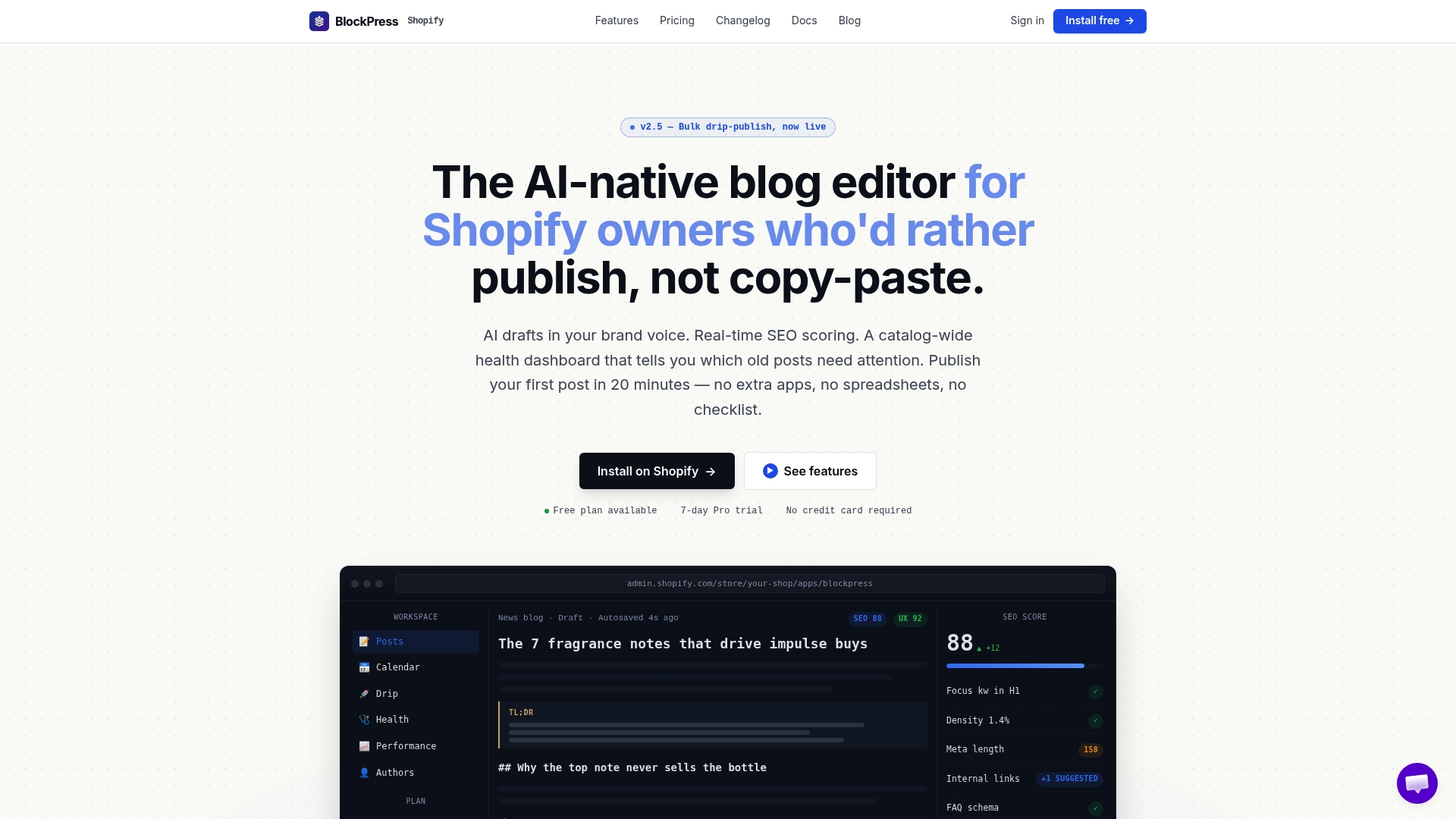
Blockpress is an AI-native blog editor built directly into Shopify. It generates article drafts, pulls real Google keyword data, and scores your content for SEO and readability before you publish. Bulk drip-publishing, article health audits, per-article performance analytics, and author bio pages are all included in one editor. You never leave your store admin. If you are ready to produce more content without sacrificing quality, start with Blockpress and see how the workflow fits your store.
FAQ
Does Google penalize AI-written ecommerce blog posts?
Google does not penalize AI content. It penalizes scaled content abuse, meaning mass-produced, low-value pages designed to manipulate rankings regardless of how they were written.
How much faster does AI draft blog posts compared to manual writing?
AI generates first drafts 3–5x faster than manual writing. That speed advantage only translates to results when a human editor adds original data and brand voice before publishing.
What is E-E-A-T and why does it matter for ecommerce blogs?
E-E-A-T stands for Experience, Expertise, Authoritativeness, and Trust. Google uses these signals to evaluate content quality, and ecommerce blogs need real author credentials and original product knowledge to meet the standard.
How long does it take to recover from an AI content penalty?
Traffic recovery from a scaled content abuse penalty typically takes 2–6 months. Stores that consolidate thin pages and add first-party data have recovered up to 83% of lost traffic in as few as 17 days.
What features should I look for in an AI blog tool for my Shopify store?
Look for integrated keyword data, live SEO scoring, outline generation, author bio support, and native Shopify integration. These features keep your workflow inside one platform and your content aligned with ranking factors from the start.