
TL;DR:
- Blog content drives awareness, lead generation, and sustained growth by functioning as a full-funnel marketing asset. Strategic, multi-post clusters optimized for AI citation and buyer intent build long-term authority and organic traffic that continually supports product success. Consistent updates and early planning maximize the value of blog content well beyond the initial launch period.
Blog content is the most reliable driver of awareness, lead generation, and long-term discoverability across the product launch lifecycle. While a press release gets a 2–3% pickup rate and costs up to $1,500, a well-structured blog post becomes a living asset that AI engines, search algorithms, and buyers return to for months. Understanding how blog content supports product launches means recognizing it as a full-funnel tool, not just an announcement channel. This article covers the post types, timing, and content structures that marketing professionals and product managers use to turn launches into sustained growth.
How does blog content build awareness before a product launch?
Pre-launch blog content does one job: it makes your audience aware of the problem your product solves before you ask them to buy. Launching cold to an unprimed audience consistently produces low conversion rates. Buyers who have never encountered the problem framing you use will not respond to a launch announcement, no matter how polished it is.

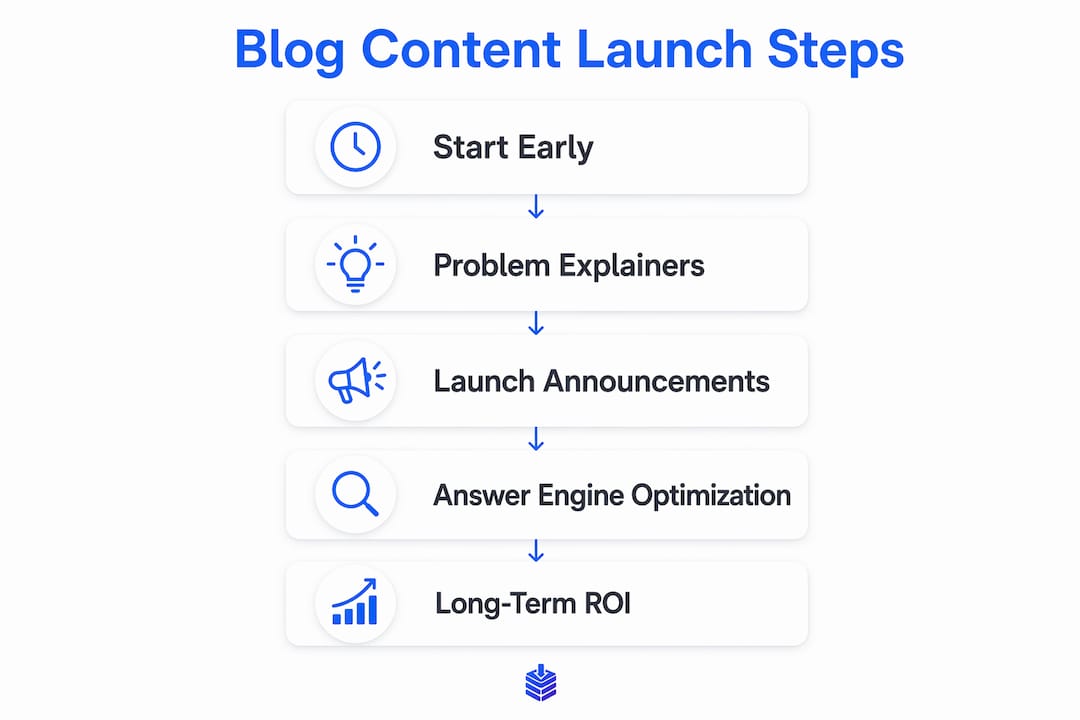
The recommended approach is a phased campaign. According to FeedSquad's product launch content strategy research, you should start content at least 2 weeks before launch day. High-impact campaigns run for four weeks and publish 80–100 posts across platforms. That volume sounds aggressive, but it reflects how much content it takes to build genuine mental availability across a fragmented audience.
The pre-launch phase should focus on these post types:
- Problem explainers: Articles that describe the pain point your product addresses, without mentioning your product at all. These rank on informational queries and pull in readers who are not yet aware they need a solution.
- Behind-the-scenes posts: Content about your build process, team decisions, or design philosophy. These create emotional investment before launch day.
- Industry context posts: Data-driven pieces that frame the market problem at scale. These position your brand as a credible authority, not just a vendor.
Pro Tip: Schedule your problem explainer posts first. If your audience cannot articulate the problem clearly, your launch announcement will not resonate. Blog education is what makes your call-to-action land.
What blog post types drive the most impact at launch?
A product launch content strategy built on a single announcement post leaves most of its potential on the table. Multi-post content clusters of 3–5 posts anchored to a launch turn short-term buzz into evergreen SEO assets. Each post in the cluster answers a different buyer question and targets a different stage of intent.
The five post types that consistently perform across launches are:
- Launch announcement: The official post. Lead with the product name, the core benefit, and a direct call to action. Keep it under 800 words.
- Problem explainer: Published pre-launch. Ranks on informational queries and feeds the top of your funnel for months after launch.
- Workflow guide: A step-by-step post showing how your product fits into an existing process. This is the post your sales team will share most.
- Use case post: A specific scenario where your product solves a real problem for a defined customer type. One use case per post performs better than a list of five.
- Comparison post: Positions your product against the category, not just competitors. Buyers in the decision stage search for these explicitly.
Structuring each post for Answer Engine Optimization (AEO) is now a non-negotiable. AEO is the practice of formatting blog content so AI tools like ChatGPT, Perplexity, and Google's AI Overviews can extract and cite it directly. Content optimized for AI answer engines achieves 2.8x higher citation rates, and AI-referred traffic converts at 4.4x the rate of traditional organic traffic. That is a significant multiplier for any launch campaign.
To optimize for AEO, place a direct answer in the first 40–60 words of each post. Use clear, question-style H2 headings that mirror how buyers search. Avoid burying your core claim in paragraph three.
Pro Tip: Your blog post is the "ground truth" that AI engines and journalists cite when covering your product. Owned content with clear headings consistently outperforms press releases for sustained AI and search discoverability.
Earned media and social posts amplify your blog content, but they do not replace it. Earned media combined with owned blog content creates the cross-referenced evidence AI engines need to cite your product confidently. Your blog is the anchor. Everything else points back to it.
How does blogging drive lead generation and long-term ROI?
The lead generation case for blogging is well established. Businesses with active blogs generate 67% more leads monthly, and B2B companies see an average 748% ROI over three years. Those numbers reflect compounding returns, not one-time spikes.
The quality gap between organic blog leads and outbound leads is equally significant. Blog-driven organic leads close at 14.6% compared to 1.7% for outbound leads. That difference exists because a reader who finds your blog through a search query has already self-qualified. They are looking for a solution. Outbound contacts have not.
| Lead Source | Close Rate | Cost Profile |
|---|---|---|
| Organic blog traffic | 14.6% | Low ongoing cost after publication |
| Outbound (cold email, ads) | 1.7% | High per-contact cost, no compounding |
| Press release pickup | 2–3% pickup rate | $500–$1,500 per release |
Beyond direct conversion, blogging builds what marketers call mental availability. 95% of buyers are not currently in-market at any given time. Blog content reaches those future buyers during the awareness and preference formation stage, earning your brand a place on their shortlist before they ever start comparing options. That is the long game, and it is the one most launch campaigns ignore.
Marketing automation driven by blog content yields an average 4.3x return on marketing investment over three years. Blog posts feed email nurture sequences, retargeting audiences, and sales enablement libraries long after launch day.
How do you operationalize a blog content strategy for a launch?
Execution is where most launch content strategies break down. The plan exists, but the publishing cadence slips, posts go live without internal links to product pages, and the cluster never gets completed. A content publishing workflow removes that friction by defining who publishes what and when.
Here is a practical framework for a four-week launch campaign:
- Weeks 1–2 (pre-launch): Publish problem explainer and industry context posts. Set up internal links pointing to a coming-soon or waitlist page. Align CTAs with email capture, not purchase.
- Week 3 (launch week): Publish the launch announcement and at least one use case post. Update all pre-launch posts with links to the announcement. Activate social and email amplification.
- Week 4 and beyond (sustain): Publish the workflow guide and comparison post. Monitor which posts drive the most traffic to your product page and update them with stronger CTAs.
AI tools can automate ideation, drafting, scheduling, and updating of launch blog clusters, increasing scale and consistency. For Shopify merchants, this means you can build and publish a full five-post cluster without managing three separate apps or leaving your store dashboard.
The metrics that matter most for launch blog performance are organic sessions to product pages, assisted conversions from blog posts, and keyword ranking velocity for your target terms. Track these weekly during the launch window, not monthly.
Pro Tip: Never publish a launch announcement without at least two supporting posts already live. Buyers who click through to your blog and find only one post will not trust that you are a serious operator. Depth signals credibility.
Key takeaways
Blog content supports product launches most effectively when it is planned as a multi-post cluster, published in phases, and structured for both AI citation and buyer intent.
| Point | Details |
|---|---|
| Start content early | Begin publishing problem explainer posts at least two weeks before launch day. |
| Build content clusters | Publish 3–5 posts per launch covering different post types and buyer questions. |
| Optimize for AEO | Place direct answers in the first 40–60 words and use question-style H2 headings. |
| Blog leads convert higher | Organic blog leads close at 14.6% versus 1.7% for outbound, making blogs the better lead source. |
| Sustain post-launch | Update and expand posts after launch to maintain rankings and support ongoing funnel activity. |
Blogs are not launch assets. they are product marketing assets.
Most teams treat blog posts as launch deliverables. They write the announcement, maybe a use case, and then move on. That is the wrong frame entirely.
A blog post published at launch has its highest SEO value six to twelve months later. The buyers who find it then are often further along in their decision process than anyone who saw the launch announcement. I have watched teams spend significant budget on launch-day PR and paid ads, then let their blog content go stale within 30 days. The organic traffic that could have fed their pipeline for years just dried up.
The teams that get the most out of launch content treat every post as a living document. They update statistics, add new use cases, and refresh CTAs as the product evolves. They also write for buyer questions, not for internal product terminology. Nobody searches for your feature name. They search for the problem it solves. That distinction changes everything about how you structure a post.
The integration of blog content with AI discovery is the next frontier. Buyers are increasingly starting their research in ChatGPT or Perplexity rather than Google. If your blog is not structured for AI citation, you are invisible in that channel. Learning how to optimize existing blog posts for both search and AI is now a core launch competency, not an optional SEO task.
— Rodney
Launch faster with Blockpress
If you are managing product launch content on Shopify, Blockpress is built for exactly this workflow.
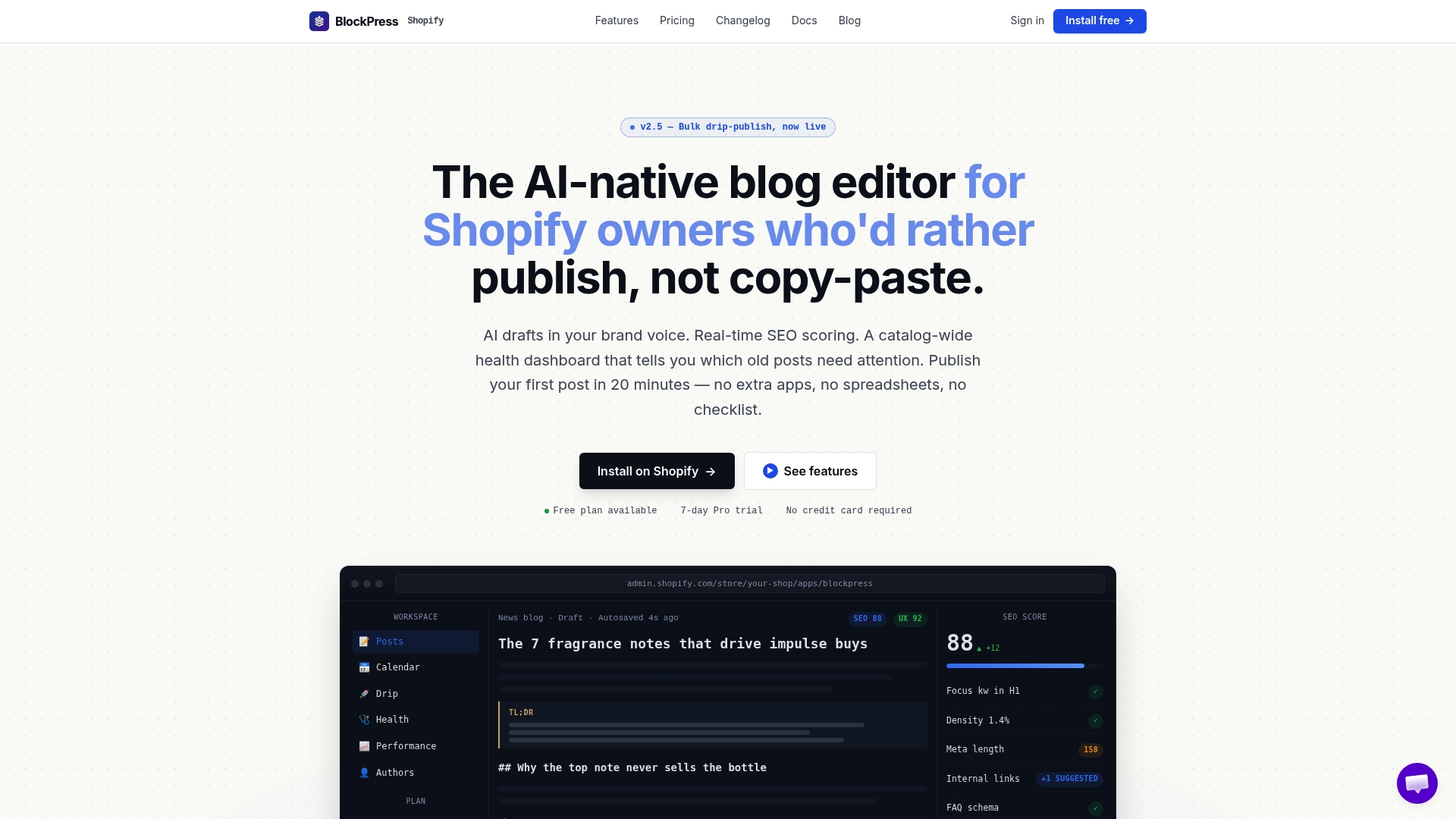
Blockpress is an AI-native blog editor built directly into Shopify. It gives you real Google keyword data, live SEO and UX scoring, AI-generated article drafts, and bulk drip-publishing, all without leaving your store. You can build a full five-post launch cluster, schedule it across your pre-launch and sustain phases, and track per-article performance from one dashboard. No third-party apps. No copy-pasting between tools. Explore Blockpress pricing to see which plan fits your launch cadence, or visit Blockpress to see the full feature set.
FAQ
How early should you start blogging before a product launch?
Start publishing blog content at least two weeks before launch day. High-impact campaigns run for four weeks and publish across multiple platforms to build problem awareness before the announcement goes live.
What is a content cluster in a product launch strategy?
A content cluster is a group of 3–5 related blog posts anchored to a single launch. Each post covers a different angle, such as a problem explainer, use case, or comparison, and they link to each other to build topical authority.
How does blog content support lead generation during a launch?
Blog-driven organic leads close at 14.6% compared to 1.7% for outbound leads. Readers who find your blog through search have already self-qualified, which makes them significantly more likely to convert.
What is answer engine optimization and why does it matter for launches?
Answer Engine Optimization (AEO) is the practice of structuring blog content so AI tools like ChatGPT and Perplexity can extract and cite it directly. Content optimized for AI answer engines achieves 2.8x higher citation rates, which expands your launch's reach into AI-driven search channels.
Can blog content keep working after a product launch ends?
Yes. Blog posts compound in value over time through organic search rankings and AI citations. Updating posts with new data, use cases, and CTAs after launch turns them into long-term lead generation assets rather than one-time announcements.