
TL;DR:
- Shopify blog post types that convert include buying guides, product comparisons, tutorials, and customer spotlights. These formats align with buyer intent and drive higher conversion rates. Using structured content and AI-optimized strategies improves traffic, trust, and sales.
Shopify blog post types that convert are specialized content formats, including buying guides, product comparisons, how-to tutorials, and customer spotlights, proven to drive sales rather than just traffic. High-converting blog post formats like these achieve 4–8% conversion rates compared to the 1–3% industry average for generic content. That gap exists because these formats match buyer intent directly. They answer real questions, build trust through specificity, and place calls-to-action where readers are ready to act. With AI-driven search and Answer Engine Optimization (AEO) reshaping how content gets discovered in 2026, the right blog post format is no longer optional. It is your primary sales tool.
1. Why buying guides are the highest-ROI Shopify blog posts
Buying guides are the single most effective blog post format for Shopify stores because they meet shoppers at the exact moment they are deciding what to purchase. A shopper searching "best yoga mats for beginners" is not browsing. They are ready to buy, and a well-structured buying guide captures that intent directly.

The structure of a high-converting buying guide follows a clear sequence: problem introduction, buying criteria, top product picks, a comparison table, a FAQ section, and a CTA. Each of these sections serves a specific purpose in moving the reader from awareness to purchase. Skip the criteria section and you lose credibility. Skip the CTA and you lose the sale.
| Section | Purpose |
|---|---|
| Problem introduction | Confirms the reader is in the right place |
| Buying criteria | Builds authority and filters options |
| Top picks | Delivers the recommendation |
| Comparison table | Speeds up the final decision |
| FAQ | Handles last-minute objections |
| CTA | Converts the decision into a click |
Pro Tip: Offer a downloadable comparison spreadsheet inside your buying guide. Readers who download it give you their email address, and you get a warm lead who has already signaled purchase intent.
2. How product comparison posts build trust and convert on Shopify
Product comparison posts work because they do the hard thinking for the buyer. When someone searches "Product A vs Product B," they are close to a decision and just need a final push. Ranking for those "vs" queries pulls high-intent traffic that converts at a much higher rate than informational searches.
The key to a comparison post that actually converts is honesty. Listing only positives destroys credibility. Readers recognize a sales pitch disguised as a comparison. Discussing real trade-offs, such as price differences, weight, or durability limits, builds the kind of trust that turns a reader into a buyer.
A strong comparison post includes:
- A side-by-side specs table
- Pros and cons for each product
- A clear "best for" recommendation per use case
- Internal links to each product page on your Shopify store
Pro Tip: Add a "Who should buy this?" summary box at the top of each comparison. Readers scan first, then read. That box keeps them on the page long enough to reach your CTA.
3. Why how-to and tutorial posts increase brand trust and support sales
Tutorial posts target informational search queries, which represent the largest share of Google searches. They pull readers into your store who are not yet ready to buy but are actively learning about a product category you sell. Done right, a tutorial post converts that curiosity into a sale without feeling like a pitch.
The most effective tutorials embed product mentions naturally. A post titled "How to set up a home gym on a budget" can reference your resistance bands, foam rollers, and weight racks as part of the solution, not as an advertisement. That approach works because the product solves the problem the reader came to fix.
Tutorials also benefit from user-generated content embedded within them. Adding a customer photo or quote showing the product in use adds social proof at the exact moment a reader is considering whether to try it. That combination of practical instruction and real-world proof is hard to beat.
- Show the product being used, not just described
- Link to your product page at the point of first mention
- Include a "what you need" list at the top with linked products
- Add a customer photo or review near the conclusion
Pro Tip: Structure your tutorial so the product appears as the natural solution to the problem, not as an afterthought. Place your first internal product link within the first 200 words.
4. Using customer spotlight posts to boost conversion
Customer spotlight posts are the most underused format in Shopify content strategies. They function as SEO content, social proof, and relationship-building tools simultaneously. A single well-written customer story can outperform a product page for conversion because it answers the question every buyer has: "Does this actually work for someone like me?"
Integrating user-generated content into blog posts increases average time-on-page by 35–50%, which correlates directly with higher purchase intent. More time on page means more exposure to your CTAs, more trust built, and more likelihood of a click to a product page.
Effective customer spotlight formats include:
- Before-and-after success stories with photos
- Customer Q&A interviews featuring product use cases
- Community roundups featuring multiple customers around a theme
- Photo features with short quotes and product links
Pro Tip: End every customer spotlight with a CTA that mirrors the customer's outcome. If the story is about saving time, your CTA should say "Save time too" rather than a generic "Shop now."
5. Comparing Shopify blog post types that convert: which to use when?
Not every blog post type fits every goal. Choosing the right format depends on where your audience is in the buying process and what you need the post to accomplish.
| Post type | Conversion potential | Audience intent | Best use case |
|---|---|---|---|
| Buying guide | High (4–8%) | Ready to buy | New product launches, gift season |
| Comparison post | High | Deciding between options | Competitive product categories |
| Tutorial/how-to | Medium | Learning, early research | Brand awareness, email capture |
| Customer spotlight | Medium to high | Seeking validation | Building trust, repeat buyers |
The strongest Shopify content strategies mix all four types across a content calendar. Buying guides and comparison posts drive direct conversions. Tutorials and customer spotlights build the trust that makes those conversions possible. Answer-first content structure across all four formats also improves your chances of being cited by AI search engines, which now influence a meaningful share of purchase decisions.
A few practical rules for choosing:
- Use buying guides and comparisons during peak buying seasons
- Publish tutorials consistently to build organic search traffic year-round
- Add a customer spotlight at least once per month to maintain social proof
- Pair every tutorial with an internal link to a related buying guide
Pages optimized for AEO score 200% higher conversion rates and are cited 78% more by AI search engines. That means structuring every post with a direct answer in the first 60 words is no longer just good SEO practice. It is a conversion tactic.
Key takeaways
The highest-converting Shopify blog post types are buying guides, product comparisons, tutorials, and customer spotlights, each targeting a distinct stage of the buyer journey.
| Point | Details |
|---|---|
| Buying guides lead on ROI | They convert at 4–8% by matching high purchase intent with structured product recommendations. |
| Comparison posts build credibility | Honest trade-off discussions rank for "vs" queries and pull decision-ready traffic. |
| Tutorials expand reach | They capture early-stage buyers and convert through natural product integration. |
| UGC increases time-on-page | Customer spotlights boost time-on-page by 35–50%, raising purchase intent. |
| AEO structure lifts all formats | Answer-first posts earn more AI citations and double conversion rates across post types. |
What I have learned from Shopify blogs that actually sell
The most common mistake I see Shopify merchants make is writing blog posts that describe products instead of solving problems. A buying guide that reads like a product catalog does not convert. A buying guide that walks someone through a real decision, with honest trade-offs and a clear recommendation, does.
The second mistake is burying the CTA. Strong CTA placement after the introduction, mid-article, and at the conclusion captures readers at every stage of engagement. Some readers decide fast. Some need the full article. If your only CTA is at the bottom, you are losing the fast deciders.
Generic filler content is the third problem. Vague claims and padded paragraphs signal low authority to both readers and search engines. Specific data, first-person product experience, and honest comparisons do the opposite. They signal that you know your category and can be trusted.
One tactic worth testing: publish a version of your best buying guide on Medium or a similar platform first, then link back to your Shopify store. That secondary distribution builds domain authority signals and funnels readers who find you outside of Google directly into your store.
— Rodney
How Blockpress helps you publish blog posts that convert
Shopify's default blog editor gives you a text box. Blockpress gives you a full content engine built directly inside your store.
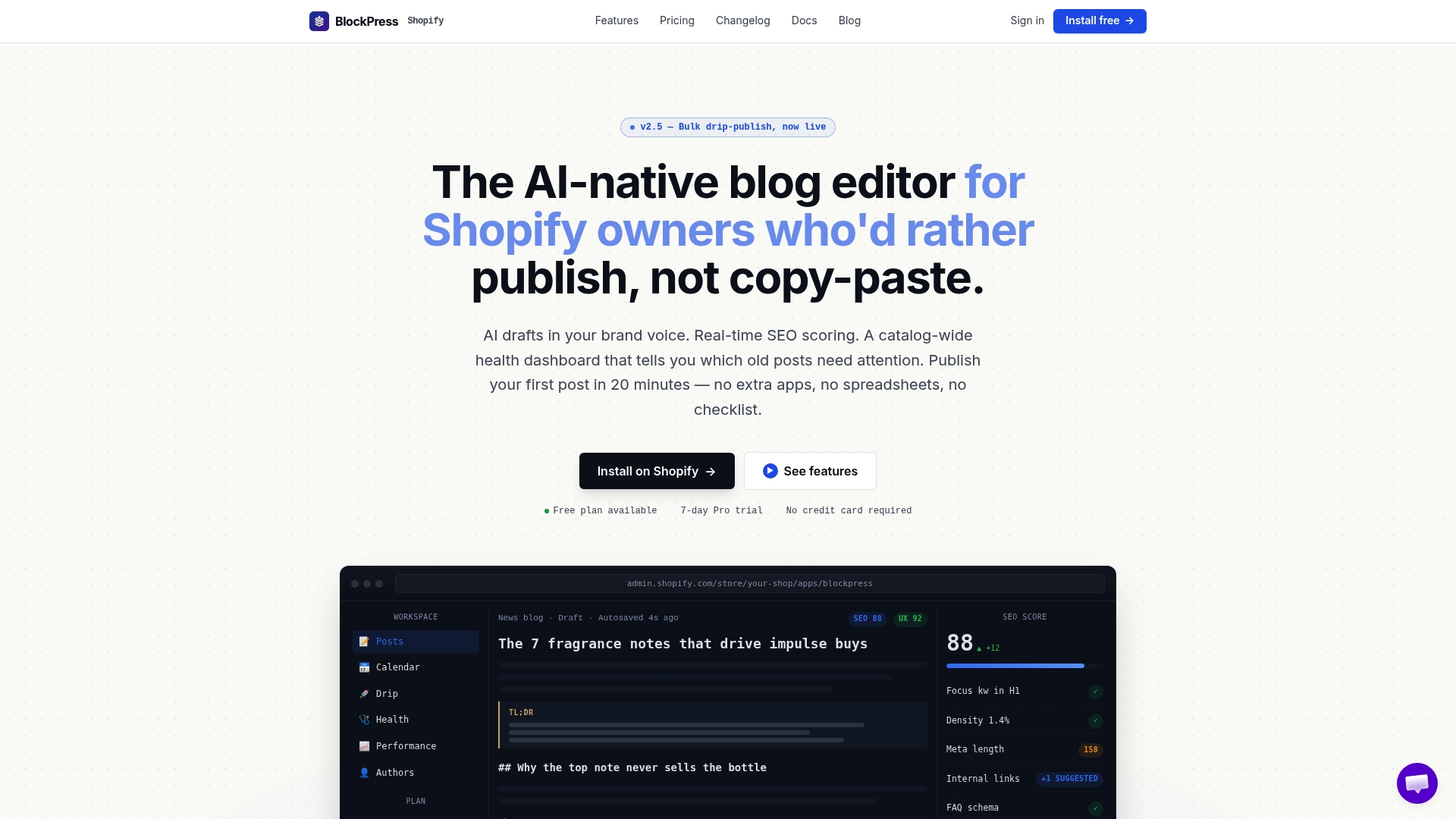
Blockpress provides real Google keyword data, live SEO and UX scoring, AI-generated article drafts, and per-article performance analytics, all without leaving Shopify. You can see which post types are driving traffic and which ones are underperforming, then act on that data immediately. The article health audit feature flags structural issues before you publish, so your buying guides, comparison posts, and tutorials are built to convert from day one. If you are serious about turning your Shopify blog into a sales channel, Blockpress is the tool built for exactly that.
FAQ
What blog post types convert best on Shopify?
Buying guides and product comparison posts convert at 4–8%, well above the 1–3% average for generic content. Tutorials and customer spotlights support conversions by building trust and increasing time-on-page.
How do I structure a Shopify buying guide for conversions?
Include a problem introduction, buying criteria, top product picks, a comparison table, a FAQ section, and a CTA. Each section moves the reader one step closer to a purchase decision.
Does user-generated content improve Shopify blog conversions?
Yes. UGC integrated into blog posts increases time-on-page by 35–50%, which correlates with higher purchase intent and more clicks to product pages.
What is Answer Engine Optimization and why does it matter for Shopify blogs?
AEO is the practice of structuring content to answer questions directly in the first 60 words, making it easier for AI search engines to extract and cite. AEO-optimized pages achieve 200% higher conversion rates and 78% more AI citations.
How often should I publish each blog post type?
Publish buying guides and comparison posts around peak buying seasons and new product launches. Aim for at least one tutorial per week for consistent organic traffic, and one customer spotlight per month to maintain social proof.