

TL;DR:
- Most e-commerce blogs fail to convert because of a structural misalignment between content and reader intent. Optimizing inline forms, adding "what you should do next" sections, and tracking post-level data can significantly increase conversions, while email marketing amplifies revenue. Addressing intent mismatch and friction points before micro-optimizations yields the most impactful results.
Blog traffic converts to sales when content matches visitor intent and every step between reading and buying is deliberately designed. Most Shopify merchants generate traffic but stall on conversion because they treat their blog as a publishing channel rather than a sales funnel. The industry benchmark for blog conversion sits at 2–3% for traffic-to-lead, yet many stores operate at 0.3–0.8%. That gap is not a traffic problem. It is a structural one. Tools like GA4, content upgrades, and intent-matched CTAs close it faster than any paid ad campaign.
How blog traffic converts to sales: the metrics that matter
Understanding conversion rate optimization (CRO) for blogs starts with knowing which numbers to track. Most marketers watch pageviews and stop there. That tells you almost nothing about revenue potential.
The metrics that actually predict sales performance are:
- Traffic-to-lead rate: The percentage of blog visitors who complete a micro-conversion, such as an email signup or content download. The benchmark is 2–3%; below 1% signals a structural problem.
- Traffic-to-sale rate: Direct purchases attributed to blog-entry sessions. This is typically lower, around 0.5–1.5%, but compounds significantly with email nurture.
- Scroll depth: How far readers get through your post. If 70% of readers leave before reaching your CTA, the CTA placement is the problem, not the offer.
- Time on page: A proxy for content quality and intent match. Under 90 seconds on a 1,500-word post means the content is not serving the reader's actual question.
- Micro-conversions: Affiliate link clicks, video plays, internal link clicks, and comment submissions. These signal engagement and predict downstream purchase behavior.
| Metric | Healthy Benchmark |
|---|---|
| Traffic-to-lead rate | 2–3% |
| Email signup rate (generic form) | 0.5–1.5% |
| Email signup rate (content upgrade) | 5–15% |
| Traffic-to-sale rate | 0.5–1.5% |
| Scroll depth to CTA | 60%+ |
Pro Tip: Set up GA4 scroll depth events at 25%, 50%, 75%, and 90% thresholds for each post. This tells you exactly where readers drop off and where to place your highest-priority CTA.

How to align content with reader intent to increase conversions
The primary reason blogs fail to convert is not weak design or poor copywriting. It is a mismatch between what the content promises and what the CTA asks the reader to do next.
Intent segmentation splits your blog traffic into two categories. Informational intent covers queries like "how to choose a standing desk" or "best skincare routine for dry skin." Commercial intent covers queries like "standing desk vs. sit-stand converter" or "buy retinol serum online." These two groups need completely different conversion paths.
Here is how to match content type to the right conversion action:
- Informational posts: Offer a content upgrade that extends the value of the article. A post about "how to build a capsule wardrobe" converts best with a downloadable checklist, not a direct product link. Post-specific content upgrades can boost email signup rates by 4.2x compared to generic subscribe forms.
- Commercial posts: Use direct product comparison tables, "best for" summaries, and buy-now CTAs. Readers searching "X vs. Y" are close to a decision. Push them toward it.
- Service or category pages linked from posts: Internal links from informational posts to commercial intent content create a natural buyer journey progression and increase affiliate and product conversions.
- Problem-aware posts: Match the CTA to the problem. A post about "why my Shopify store isn't getting sales" should link to a diagnostic tool or audit offer, not a generic homepage.
When 80% or more of your blog traffic comes from informational keywords without targeted commercial CTAs, you create an intent mismatch that kills conversion regardless of traffic volume.
Pro Tip: Audit your top 10 traffic posts in GA4. For each one, identify the keyword that drives the most sessions and ask: does the CTA on this post match what someone searching that keyword actually wants next? If not, swap the CTA before touching anything else.
What conversion path optimizations actually move the needle?
Getting the intent right is step one. Removing friction from the path to conversion is step two. These two levers together account for the majority of CRO gains on blog content.
The most impactful structural changes are:
- Inline forms over sidebar forms: Sidebar forms are ignored. Embedding a two-field inline form directly within the post body, at a natural pause point around the 40–60% scroll mark, outperforms sidebar placement consistently. Reducing form steps from four to two raises completions by 47% within 30 days.
- "What you should do next" sections: Adding a context-aware next-step section at the end of an article increased conversions by 43% in a 2026 case study. This works because it removes the reader's decision fatigue by telling them exactly what to do.
- Exit-intent and scroll-triggered popups: These work best when the offer matches the post topic. A generic "subscribe for updates" popup on a product comparison post wastes the moment. A popup offering a comparison PDF earns the click.
- Mobile optimization: More than half of blog traffic arrives on mobile. Multi-step forms, small tap targets, and slow load times destroy mobile conversion rates before the reader even sees your offer.
| Tactic | Conversion Impact |
|---|---|
| Generic sidebar form | 0.5–1.5% signup rate |
| Inline post-specific content upgrade | 5–15% signup rate |
| Standard article ending | Baseline |
| "What you should do next" section | +43% conversions |
| Four-field form | Baseline completions |
| Two-field inline form | +47% completions |
Pro Tip: Start with the "what you should do next" section on your three highest-traffic posts. It costs nothing to add and the conversion lift is immediate and measurable.
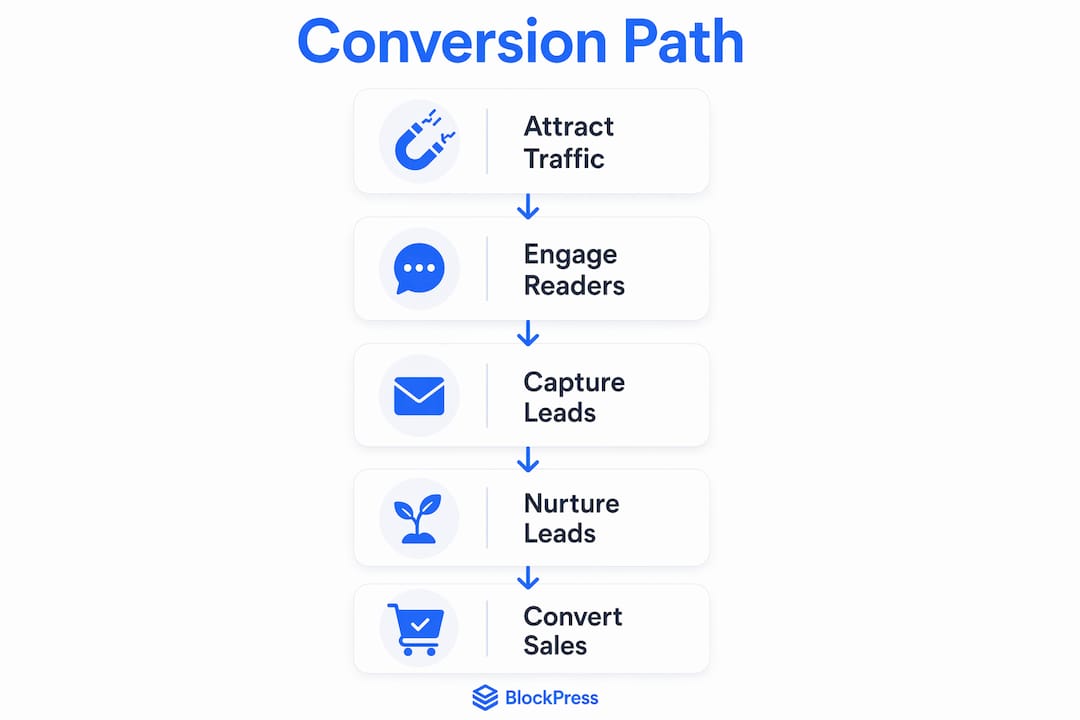
How to track and measure blog conversions effectively
Tracking is where most e-commerce blogs fall apart. Without post-level data, you are optimizing blind.
Follow this framework to build a reliable measurement system:
- Set up GA4 conversion events for CTA button clicks, form views, form submissions, and thank-you page visits. Tag each event with the post slug so you can isolate performance by article.
- Use UTM parameters on every outbound product or affiliate link inside your posts. This lets GA4 and your e-commerce platform attribute revenue directly to specific blog posts. Tracking CTA clicks and UTM parameters is the foundation of data-driven blog optimization.
- Run a monthly conversion audit on your top 20 traffic posts. Sort by sessions, then look at conversion rate per post. Posts with high traffic and low conversion are your highest-leverage optimization targets.
- Test one variable at a time. Change the CTA copy on one post, wait two weeks, then measure. Changing the form, the offer, and the headline simultaneously makes it impossible to know what worked.
Post-level performance analytics are the difference between a blog that earns its keep and one that just generates pageviews. Blockpress provides per-article analytics built directly into the Shopify editor, so you never have to cross-reference three separate tools to understand what a post is actually doing.
How email marketing turns blog readers into paying customers
Email is the highest-converting channel for blog-driven sales. Email subscribers convert at 8–15% on affiliate recommendations, compared to 1–3% from unsubscribed blog visitors. That gap exists because email builds trust and repeat engagement that a single blog visit cannot.
The practical approach to turning blog readers into email subscribers and then into buyers looks like this:
- Layer your content by purpose. Traffic content attracts new readers. Trust content (case studies, tutorials, comparisons) builds credibility. Revenue content (product roundups, affiliate reviews) converts. Service content (FAQs, how-tos) retains. Each type plays a different role in the funnel.
- Match your email sequence to the lead magnet. If someone downloads a "skincare ingredient checklist," the follow-up sequence should deliver ingredient education before introducing product recommendations. Jumping straight to a sales email breaks the trust the lead magnet built.
- Track micro-conversions inside email. Open rates, click rates, and secondary content visits from email all signal purchase readiness. Readers who click three or more links across your email sequence are significantly more likely to buy than first-visit blog readers.
- Use content upgrades for email capture on every high-traffic informational post. A post-specific checklist or cheatsheet converts far better than a generic newsletter signup, and it pre-qualifies the subscriber around a specific topic you can sell into.
Pro Tip: Create a simple three-email welcome sequence for every lead magnet you offer. Email one delivers the resource. Email two provides one additional tip related to the topic. Email three introduces your most relevant product or offer. This sequence alone outperforms most elaborate nurture programs.
Key takeaways
Blog traffic converts to sales through intent-matched content, friction-free conversion paths, and a disciplined email nurture system working together.
| Point | Details |
|---|---|
| Intent alignment is the foundation | Match every CTA and lead magnet to the specific keyword intent driving each post. |
| Inline forms outperform sidebars | Two-field inline forms with post-specific offers convert at 5–15% versus 0.5–1.5% for generic forms. |
| "What next" sections drive conversions | A guided next-step section at article end increases conversions by 43% without additional traffic. |
| Email multiplies blog revenue | Email subscribers convert at 8–15% on product recommendations versus 1–3% for raw blog visitors. |
| Post-level tracking is non-negotiable | GA4 event tracking and UTM parameters reveal which posts generate revenue and which need fixing. |
Why most blogs fix the wrong things first
I have reviewed hundreds of e-commerce blogs, and the pattern is almost always the same. The merchant has spent time on button colors, headline fonts, and popup timing. Meanwhile, 80% of their traffic lands on informational posts with a CTA that pushes readers directly to a product page they are not ready to buy from.
The structural issues kill conversion before any micro-optimization gets a chance to work. Fixing the intent mismatch, shortening the form, and adding a "what you should do next" section will outperform six months of A/B testing button copy. Every time.
The other thing most guides skip: compounding. A 1% improvement in email signup rate on a post getting 5,000 monthly visits is 50 additional subscribers per month. At an 8% email-to-sale conversion rate, that is four additional sales monthly from one post. Multiply that across your underperforming Shopify blog posts and the math becomes very convincing very quickly.
Start with your highest-traffic posts. Fix the intent mismatch. Add the inline form. Build the email sequence. Then measure. The data will tell you exactly where to go next.
— Rodney
Turn your Shopify blog into a conversion engine with Blockpress
If you are managing your Shopify blog across multiple apps just to get keyword data, SEO scoring, and post analytics in one place, there is a better way.
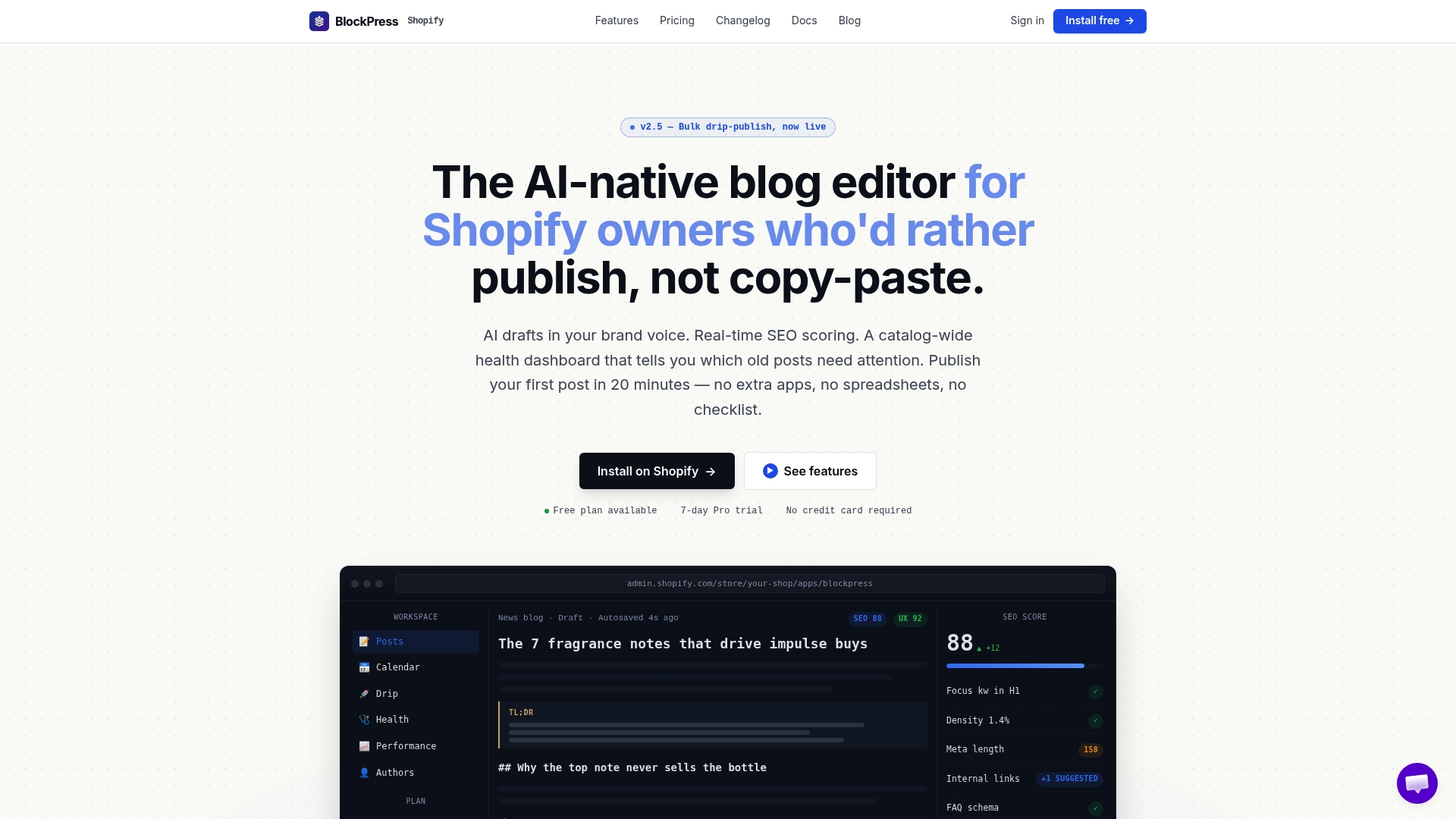
Blockpress is an AI-native blog editor built directly into Shopify. It gives you real Google keyword data, live SEO and UX scoring, AI-generated drafts, and per-article performance analytics without leaving your store. You can see which posts are driving traffic and which are converting, then act on that data immediately. The full feature set covers everything from article health audits to bulk drip-publishing, replacing the three-app stack most merchants rely on today. If your blog is generating traffic but not revenue, Blockpress gives you the tools to close that gap.
FAQ
What is a good blog conversion rate for e-commerce?
The industry benchmark for blog traffic-to-lead conversion is 2–3%. Most e-commerce blogs underperform at 0.3–0.8%, which signals a structural issue with intent alignment or conversion path design rather than a traffic volume problem.
Why does my blog get traffic but no sales?
The most common cause is intent mismatch. When informational keyword traffic lands on posts with direct product CTAs, readers are not ready to buy and bounce without converting. Fix this by matching your CTA to the reader's stage in the buying journey.
How do content upgrades improve blog conversions?
Post-specific content upgrades, such as checklists or cheatsheets tied to the article topic, convert at 5–15% compared to 0.5–1.5% for generic subscribe forms. The specificity of the offer signals relevance and earns the signup.
How does email marketing connect to blog sales?
Email subscribers convert at 8–15% on product and affiliate recommendations, versus 1–3% for unsubscribed blog visitors. Capturing emails through blog content and nurturing with a matched sequence is the most reliable path from blog traffic to revenue.
How do I track which blog posts are generating sales?
Set up GA4 conversion events for CTA clicks and form submissions, and apply UTM parameters to every outbound product or affiliate link. This attributes revenue directly to individual posts and shows you exactly where to focus your optimization efforts.