
Yes, AI drafts need human editing because only a person can verify claims, preserve brand voice, and take responsibility for what gets published. CASRAI's guidance on AI-assisted drafting is blunt about it: AI cannot be listed as an author, and humans stay accountable for every fact in an AI-assisted piece. Major publisher policies echo the same standard. Before you publish anything an AI tool touched, run this check:
- Can you name the source for every statistic and quote?
- Does the piece sound like your brand, or like every other AI output on the web?
- Would you put your name on this if someone challenged a claim in it?
Key Takeaways
Human editors remain essential to AI-assisted content because only a person can verify claims, preserve brand voice, and accept accountability for what gets published.
| Point | Details |
|---|---|
| AI drafts require verification | Treat every AI-generated fact, quote, or citation as unverified until you confirm it against a primary source. |
| Four passes beat one | Run structural, fact-check, voice, and copyedit passes separately to catch different error types. |
| Voice drift compounds late | Sample the back third of long AI drafts, where repetition and generic phrasing tend to concentrate. |
| Disclosure protects credibility | Follow CASRAI-style disclosure practices when AI shaped a section's structure or first draft. |
| Blockpress shortens the loop | An integrated editor keeps prompting, version history, and SEO checks in one place inside Shopify. |
Table of Contents
- Why AI Drafts Need Human Editing to Catch What Machines Miss
- What Happens When You Skip Editing AI-Generated Content
- The Defensible Workflow for AI-Assisted Drafting
- How Many Editing Passes Does an AI Draft Actually Need?
- Tools and Safeguards That Make This Workflow Practical
- Treat AI as a Collaborator, Not a Shortcut
- A Native Editor Can Shorten the Gap Between Draft and Publish
- Sources
- FAQ
Why AI Drafts Need Human Editing to Catch What Machines Miss
AI is genuinely good at a handful of things: producing a clean structure fast, drafting transitions, and cleaning up grammar. It's unreliable at the things that actually make content trustworthy: accuracy, nuance, and a voice readers recognize as yours.
| AI handles well | AI struggles with |
|---|---|
| Speed and first-draft structure | Verifying facts and figures |
| Basic grammar and readability | Nuance and context |
| Formatting and outline logic | Consistent brand voice |
| Generating variations quickly | Citing real sources correctly |
Editage's editorial team has flagged fabricated references as a recurring problem in AI-assisted manuscripts. It's not a rare glitch. It's a predictable failure mode of how these models generate text.

Pro Tip: Feed the AI your own notes, sources, and a specific claim you want to make, rather than asking it to "write about X." You get a scaffold to edit instead of a set of invented facts to hunt down.
Assign AI the outline, the first pass at phrasing, and the grammar cleanup. Never let it originate an unverified statistic, a quote, or a claim you haven't already confirmed yourself.
What Happens When You Skip Editing AI-Generated Content
Publishing an AI draft untouched creates risk in five ways:
- Hallucinated facts and fake citations that damage credibility the moment a reader checks them
- Misattributed quotes or sources that expose you to correction requests or legal exposure
- Loss of brand voice, making your content indistinguishable from competitors
- Authorship and ethics questions, since AI cannot hold responsibility for what it generates
- Confidentiality issues when proprietary information gets fed into public AI tools
A 2026 consensus panel on generative AI in medical manuscript writing recommended strict limits on AI-generated references and mandatory disclosure, specifically because unverified AI output was already causing integrity problems in submitted work. This logic applies beyond medical publishing as well: Rocket Web Designer's analysis notes that scaled, unedited AI content tends to read as thin and generic, which can put both search rankings and reader trust at risk.
These risks translate into real outcomes. Editors reject submissions outright. Search engines demote content that reads as low-value. Readers stop trusting a brand once they catch one fabricated stat.
The Defensible Workflow for AI-Assisted Drafting
The fix isn't avoiding AI. It's building a workflow where a human stays accountable at every stage. Here's the sequence that holds up under scrutiny:
- Start with your own notes. Write down the claim, the evidence, and the point of the section before you open the AI tool. Editorial guidance on AI-assisted writing consistently frames this step as the difference between AI accelerating your thinking and AI replacing it.
- Prompt from that foundation. Give the AI your verified claims and ask it to draft around them, not invent new ones.
- Treat the output as scaffolding, not prose. Nothing goes live in its original AI phrasing.
- Rewrite in your own voice. This is where the piece stops sounding like every other AI draft on the internet.
- Fact-check independently. Confirm every number, quote, and citation against a primary source. Don't trust the AI's own footnotes.
- Do a final closed-tool revision. Read the piece once more without AI assistance to catch anything that slipped through.
Each step exists for a reason. Starting from your own notes keeps authorship with you, not the model. Treating AI output as scaffolding stops you from publishing invented specifics by accident. Independent fact-checking is the step Heinz Marketing's research on AI content says most teams skip when they're moving fast, and it's the one that causes the most damage when skipped.
Pro Tip: Picture the workflow as a funnel: notes and evidence go in, AI produces a scaffold, you rewrite and verify, then it publishes. Add a disclosure note wherever your editorial policy requires one, typically right where AI assistance shaped a section's structure or first draft.
How Many Editing Passes Does an AI Draft Actually Need?
A publish-ready post usually needs four distinct passes, not one long edit. Trying to fix structure, facts, and voice simultaneously is how errors slip through.
- Structural pass (15 to 20 minutes). Check the argument's logic, section order, and whether the piece delivers on its headline.
- Fact-check and citation pass (20 to 40 minutes). Confirm every claim against a primary source, per CASRAI's disclosure standards. Flag anything you can't independently verify.
- Voice and style pass (15 to 25 minutes). Rewrite sentences that sound generic. Add specific examples an AI wouldn't know to include.
- Copyedit and accessibility pass (10 to 15 minutes). Check grammar, alt text, heading hierarchy, and readability, following practices USC Libraries outlines for proofreading.
For a typical 1,200 to 1,800 word post, budget 60 to 100 minutes total across all four passes. That's less time than most teams spend rewriting a fact-checked disaster after the fact.
Tools and Safeguards That Make This Workflow Practical
A few categories of tools make the workflow above sustainable instead of exhausting:
- Citation verifiers to confirm sources actually say what the draft claims
- Provenance-aware search to trace a statistic back to its origin before you publish it
- Version history and audit logs, so you can show exactly what changed between the AI scaffold and the final piece
- Access controls for any proprietary or confidential inputs you feed into a drafting tool
Require disclosure at submission when your policy calls for it, and keep sensitive material out of open AI tools entirely. Version history alone solves half the accountability problem: you can always show what a human changed and why.
Five Quick Tests to Catch AI-Origin Problems Fast
Run these in under two minutes on any AI-assisted draft:
- Does a citation actually exist when you search for it?
- Does the phrasing sound generic enough to have come from any brand?
- Are the specifics oddly precise without a clear source?
- Does the voice drift or repeat itself further into the piece?
- Would a knowledgeable reader spot something wrong on the first read?
Pro Tip: Problems concentrate in the back half of long AI drafts, where voice drift and repetition tend to creep in. Sample the last third of any draft before you approve the whole thing.
If two or more tests fail, escalate to a full fact-check before it goes anywhere near publish.
Treat AI as a Collaborator, Not a Shortcut
I treat AI the way I'd treat a fast, occasionally unreliable research assistant: useful for speed, useless for judgment. That shapes every editorial decision I make. The moment I hand over verification, or let a draft keep a voice that isn't mine, I've handed over accountability too, and that's exactly what publisher policy and plain professional standards say I can't do.
The workflow in this piece isn't a suggestion. It's the difference between defensible content and a retraction waiting to happen. Skip the humanizer tricks. Do the verification instead.
A Native Editor Can Shorten the Gap Between Draft and Publish
Blockpress cuts the back-and-forth between an AI scaffold and a defensible final draft because prompting, version history, and SEO scoring live in the same editor instead of three separate apps.
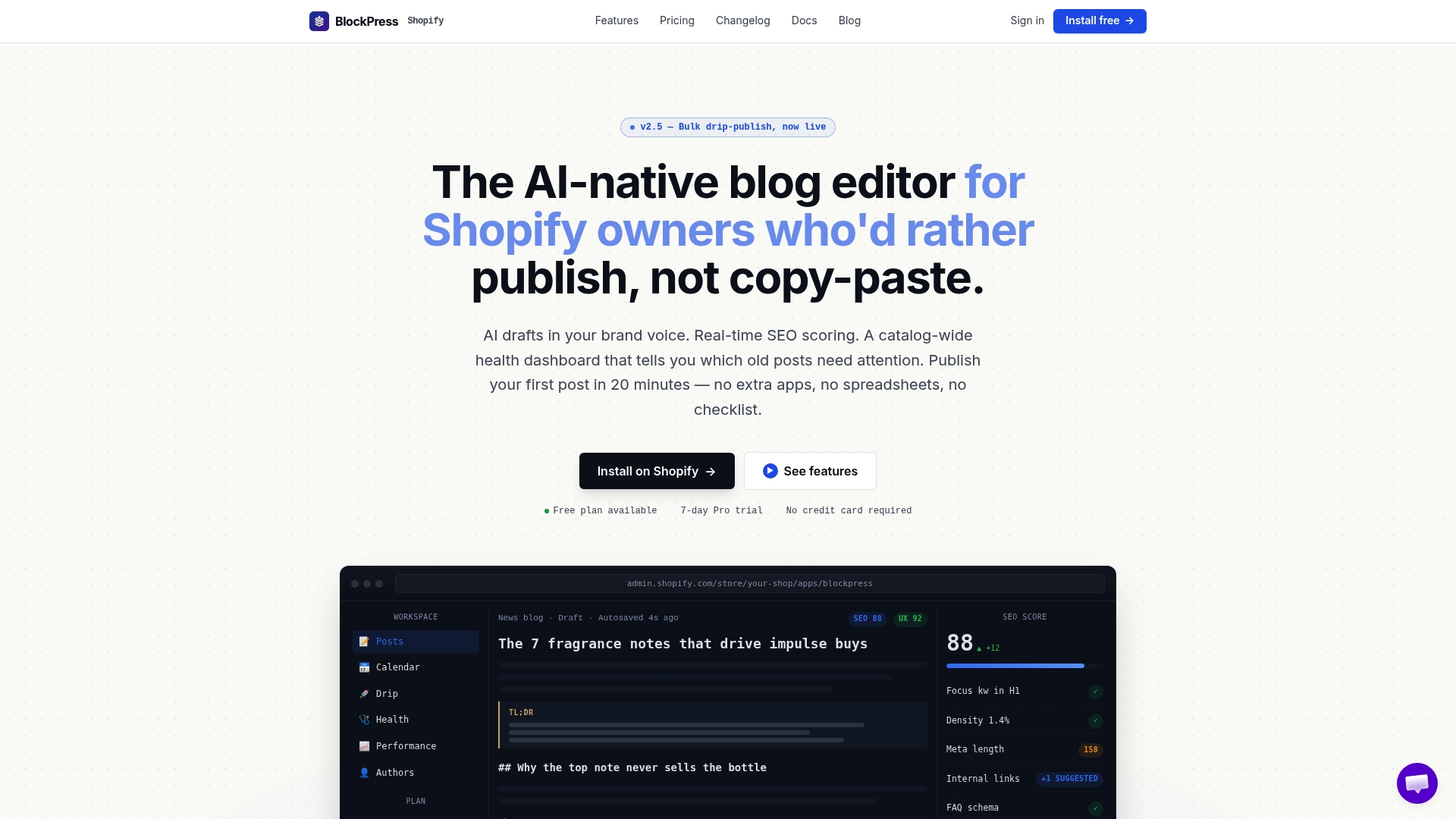
That matters most in the fact-check and rewrite passes described above, where switching tools costs you time and context; using the best AI tools for content repurposing can help streamline these steps efficiently. Blockpress keeps your drafting notes, AI output, and revision history in one place inside Shopify, so you can trace exactly what changed at each pass. If you're managing this workflow across a growing blog, it's worth checking the features to see whether a native editor fits your current publishing controls, or reviewing pricing to see what a tighter editing loop would look like for your team.
Sources
- CASRAI — AI-assisted drafting best practices
- Editage — Why AI-assisted writing still needs human editing
FAQ
Does AI Need Human Input to Produce Reliable Content?
Yes. AI output improves substantially when a person supplies verified notes, a specific claim, and evidence before drafting starts, rather than letting the model originate facts on its own.
Is It Okay to Have AI Edit My Writing?
AI can help with grammar and structural suggestions, but it shouldn't make final calls on accuracy or voice. Run its suggestions through your own fact-check and style review before publishing.
Does AI Need Human Intervention Before Publishing?
Yes, according to CASRAI's guidance, which states AI cannot be an author and humans must review all AI-assisted material for accuracy before it goes live.
How Long Should Editing an AI Draft Take?
For a 1,200 to 1,800 word post, plan on 60 to 100 minutes across four passes: structural review, fact-checking, voice editing, and final copyedit.
Can an Editor Like Blockpress Help With This Workflow?
Blockpress keeps AI drafting, version history, and SEO scoring inside one Shopify editor, which shortens the time between an AI scaffold and a fully verified, human-edited post.