

TL;DR:
- Blog support provides the domain authority, topical depth, and fresh content that enhances Google Business Profile rankings.
- Consistently publishing locally relevant, expert-level posts and integrating them with GBP maximize visibility and authority.
A Google Business Profile (GBP) is the single most visible local SEO asset your business controls, but it cannot rank at its full potential without blog support. The reason why Google My Business needs blog support comes down to one core limitation: GBP alone provides signals, but your website's blog provides the depth, relevance, and authority that Google uses to validate those signals. Businesses that treat their GBP and blog as separate tools leave significant local visibility on the table. The ones that integrate both build a compounding content ecosystem that outperforms competitors in the Local Pack, Google Maps, and AI-driven local answers.
Why Google My Business needs blog support for local rankings
Local Pack visibility depends on GBP quality signals like relevance and prominence. Your profile supplies the structured data: business name, category, hours, and reviews. But Google also evaluates your broader web presence to confirm that your business is genuinely authoritative in its category and location. A blog on your domain provides that corroborating evidence.
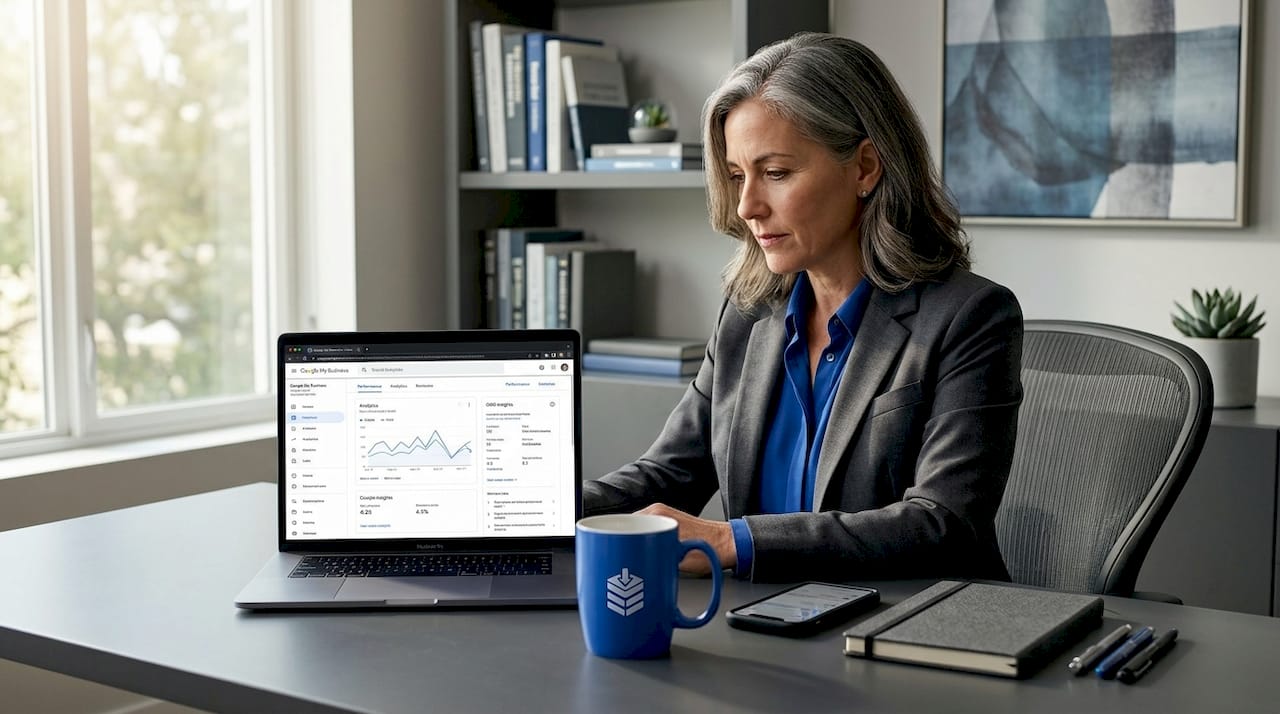
Near me and category searches account for 86% of GBP visibility. That statistic tells you exactly what your blog topics should target. When a potential customer searches "emergency plumber near me" or "best Italian restaurant downtown," Google cross-references your GBP category with the content on your website. A blog post titled "What to Do When a Pipe Bursts in Your Home" reinforces your plumbing category far more than a bare GBP listing ever could.
Blogs also supply raw material for your GBP's own content assets. Here is how that works in practice:
- GBP posts: Pull key insights from a recent blog post and publish them as a GBP update. This keeps your profile active without creating content from scratch.
- FAQs: Use the questions your blog answers to populate the Q&A section of your GBP. Google surfaces these answers directly in search results.
- Service descriptions: Blog content that explains a service in depth gives you precise, tested language to use in your GBP service descriptions.
- Photo captions: Blog posts about local projects or events generate photo opportunities with keyword-rich captions that reinforce location relevance.
Pro Tip: Keeping GBP posts updated is directly linked to increased consumer trust and local SEO performance. Set a calendar reminder to publish one GBP post per week, sourced from your latest blog content.
Does blog quality matter more than blog volume?
Google's Helpful Content system evaluates content at the domain level, not the post level. Site-wide content quality influences ranking across your entire domain, meaning a handful of thin, SEO-first blog posts can suppress your GBP visibility even if your profile itself is fully optimized. This is one of the most misunderstood risks in local SEO.
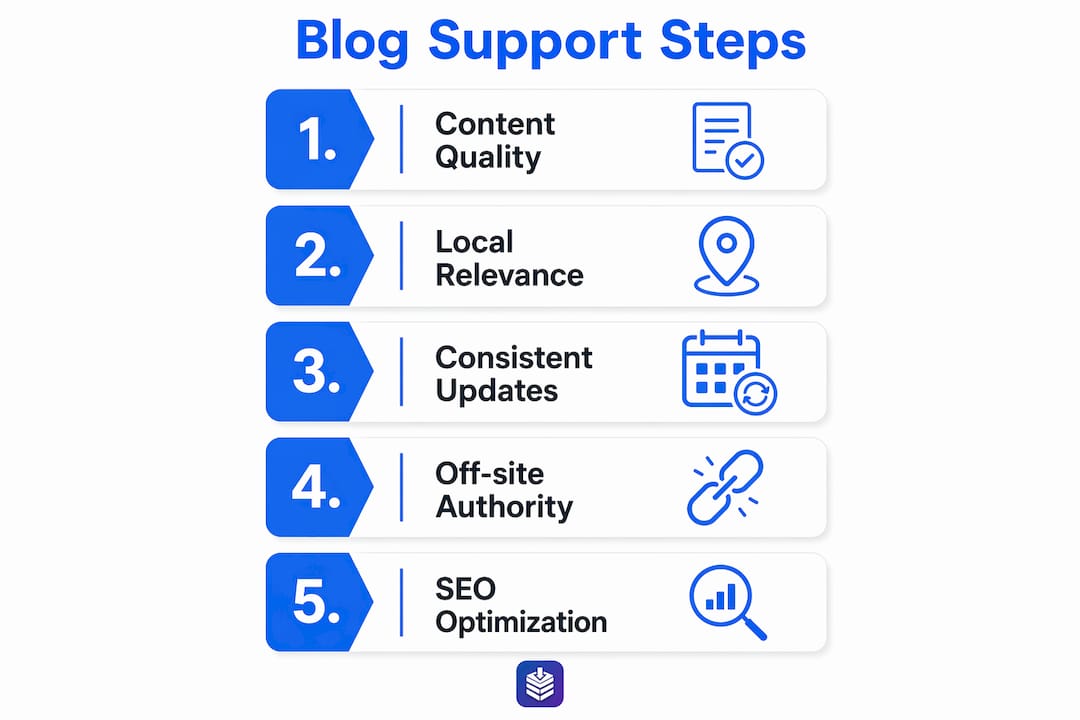
The standard Google applies is people-first content: does the post demonstrate real expertise, answer a genuine question, and leave the reader better informed? Generic posts like "Top 5 Reasons to Hire a Plumber" written without any original insight fail this test. A post like "Why Chicago's Aging Clay Pipes Cause Basement Flooding Every Spring" passes it because it reflects local knowledge and specific expertise.
To meet Google's Helpful Content criteria, follow this sequence:
- Start with a real customer question. Pull questions from your GBP Q&A, Google Search Console, or conversations with your team. These are the questions real people are asking.
- Write from direct experience. Include specific details, local context, and outcomes you have personally observed. Generic advice is easy to produce and easy for Google to discount.
- Avoid thin content at scale. Publishing 20 short posts with no original insight is worse than publishing 5 thorough ones. Google's system penalizes domains where unhelpful content is the majority.
- Build E-E-A-T signals. Author bios, cited sources, and original case studies all contribute to Experience, Expertise, Authoritativeness, and Trustworthiness. These signals matter for local SEO as much as for national rankings.
Pro Tip: Develop locally informed walkthroughs and case studies rather than generic SEO posts. A post documenting a real project in your city builds E-E-A-T and local relevance simultaneously.
What blogging alone cannot fix for your GBP
Blogging is not a standalone fix for GBP rankings. Entities with fewer than roughly 50 brand mentions across the web remain largely invisible to AI-driven local search, regardless of how much blog content they publish. This is the "quiet failure" pattern: a business publishes posts consistently, sees no ranking movement, and concludes that blogging does not work. The actual problem is that off-site authority was never established.
The table below shows what blogging can and cannot accomplish on its own:
| Factor | Blogging alone | Blogging with off-site authority |
|---|---|---|
| GBP relevance signals | Improves significantly | Improves significantly |
| Local Pack prominence | Minimal impact | Strong positive impact |
| AI-driven local answers | Limited visibility | Substantially higher inclusion |
| Citation consistency | No effect | Requires separate NAP audit |
| Schema and sameAs graph | No effect | Requires technical setup |
Publishing blogs without verifying off-site citations and fixing schema leads to indexed but non-authoritative sites. The correct sequence is: audit and fix your NAP (name, address, phone) consistency across directories, set up correct LocalBusiness schema with complete sameAs links, build genuine brand mentions through PR and partnerships, and then scale your blog output. Reversing this order wastes your content investment.
How to integrate blog support into your GBP optimization
A practical blogging strategy for local SEO starts with your GBP categories, not with keyword tools. Your GBP categories define how Google classifies your business. Your blog should produce content that deepens that classification with locally specific, expert-level detail.
Here is how to build that integration:
- Map blog topics to GBP categories. If your GBP lists "HVAC contractor" as a primary category, your blog should cover HVAC topics specific to your service area: local climate considerations, common equipment failures in your region, and seasonal maintenance guides.
- Use blog posts as GBP post source material. Every blog post you publish should generate at least one GBP post. Summarize the key takeaway in 150 words and link back to the full post. This creates a content loop that keeps both your blog and your GBP active.
- Populate GBP FAQs from blog content. Map each GBP category to precise customer questions and answer them in blog posts first. Then extract those answers for your GBP Q&A section. This approach avoids generic content and builds aligned messaging across both platforms.
- Coordinate update timing. Publish a blog post and a corresponding GBP post in the same week. Google interprets simultaneous activity across your domain and profile as a freshness signal.
Pro Tip: Effective blogging builds authority over time through compounding pages of searchable expertise. Treat your blog as a long-term asset, not a short-term traffic tactic. Consistency over 12 months outperforms a burst of 20 posts in a single month.
Key takeaways
A Google Business Profile reaches its ranking ceiling without blog support because blogs supply the domain-level authority, topical depth, and fresh content that GBP signals alone cannot provide.
| Point | Details |
|---|---|
| Blogs reinforce GBP signals | Locally relevant blog content validates your GBP category and prominence with Google. |
| Quality beats volume | One thorough, people-first post outperforms ten thin posts under Google's Helpful Content system. |
| Off-site authority comes first | Fix citations and schema before scaling blog output to avoid quiet ranking failures. |
| Content integration multiplies impact | Use each blog post to fuel GBP posts, FAQs, and service descriptions simultaneously. |
| Consistency compounds over time | A steady publishing cadence builds domain authority that accelerates GBP visibility month over month. |
The part most local businesses get backwards
Most local businesses I see treat their GBP as the strategy and their blog as an afterthought. They spend hours optimizing their profile, collecting reviews, and uploading photos, then wonder why competitors with weaker profiles outrank them. The answer is almost always domain authority backed by consistent, helpful content.
What I have found is that the businesses winning in local search in 2026 are not the ones with the most GBP posts. They are the ones whose websites demonstrate genuine expertise in their category and location. A roofing company in Denver that publishes detailed posts about hail damage repair, local building codes, and insurance claim processes builds a level of topical authority that no amount of GBP optimization alone can replicate.
The other pattern worth noting: businesses that fix their off-site citations first and then launch a blog see results in 60 to 90 days. Businesses that blog first and fix citations later often wait six months or more with little movement. Sequence matters as much as effort.
— Rodney
Start building your blog-GBP content system with Blockpress
If you are ready to put this strategy into practice, Blockpress makes it significantly easier to execute consistently.
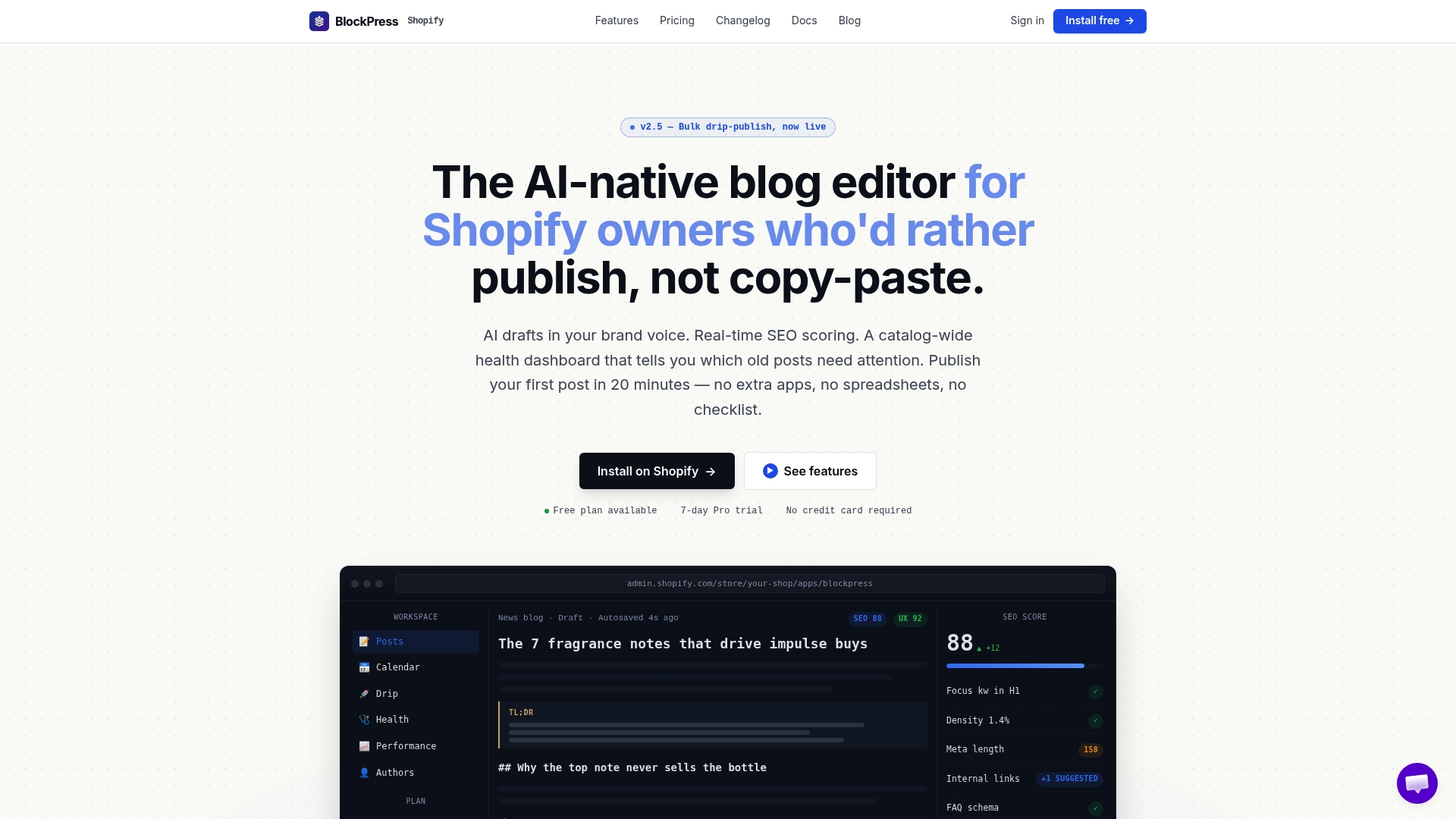
Blockpress is an AI-native blog editor built directly into Shopify. It gives you real Google keyword data, live SEO scoring, AI-generated article drafts, and per-article performance analytics, all without leaving your store. For business owners who want to build a blog that supports their GBP and local SEO rankings, Blockpress replaces the three separate apps most merchants use with one integrated tool. You can check the full feature breakdown here to see exactly how it supports a people-first content strategy. Consistent, optimized blog content is the foundation of long-term GBP visibility, and Blockpress is built to help you produce it.
FAQ
What is blog support for Google Business Profile?
Blog support for Google Business Profile means publishing locally relevant, helpful content on your website that reinforces your GBP's relevance and prominence signals. This content supplies Google with additional evidence that your business is authoritative in its category and location.
How often should I publish blog posts to support my GBP?
Consistency matters more than frequency. Publishing one well-researched, people-first post per week and converting it into a GBP post delivers stronger results than publishing in bursts. Keeping both your GBP and blog updated consistently is linked to higher consumer trust and local SEO performance.
Can a bad blog hurt my Google Business Profile rankings?
Yes. Google's Helpful Content system evaluates content quality at the domain level. Unhelpful content can suppress your entire domain's visibility, including results tied to your GBP. Thin or generic blog posts create more risk than no blog at all.
Do I need to fix citations before starting a blog?
Fixing citation consistency and schema should come before scaling blog output. Publishing blogs without verified off-site citations leads to indexed but non-authoritative content that fails to move GBP rankings.
What blog topics best support a Google Business Profile?
Topics mapped directly to your GBP categories and local customer questions perform best. Blog content aligned with service categories and near me search intent reinforces GBP relevance more effectively than general industry content.