
TL;DR:
- Effective AI product storytelling combines a factual spec block at the start with a narrative section below. This approach, supported by a governed review process inside Shopify, ensures accuracy and brand trust.
The most effective approach to AI writing tools for product storytelling is a two-part structure: a factual specification block in the first 60–120 words, followed by a narrative story block below. Run it through a governed, human-reviewed workflow inside a Shopify-native editor like Blockpress—enabling scale while maintaining brand trust.
Start here:
- Pick 3 best-selling SKUs and draft each using the spec-first + narrative template
- Review every draft before publishing — never push raw AI output live
- Use Blockpress to generate, QA, and publish directly inside your Shopify store
Pro Tip: Set up your first 3 drafts as a pilot. If the spec block answers the buyer's top question in the first two sentences, you're on the right track.
Table of Contents
- Why do AI writing tools fail at product storytelling without governance?
- What does the two-part product story structure look like?
- How do you build prompt templates for product storytelling?
- What does a safe editorial workflow look like at scale?
- How does a Shopify-native editor change the publishing workflow?
- Which metrics tell you if AI product stories are working?
- What does rolling out AI product storytelling actually cost?
- Key Takeaways
- The part most store owners get wrong
- Blockpress makes this workflow native to your Shopify store
- Useful sources
- FAQ
Why do AI writing tools fail at product storytelling without governance?
AI accelerates draft volume and surfaces the natural-language phrasing buyers actually use, which improves how AI assistants retrieve and cite your content. That's the upside. The downside shows up fast when there's no governance layer.
The most common failure modes:
- Unreviewed raw drafts that contain inaccurate product claims (e.g., "waterproof" when the spec says "water-resistant")
- Identical sentence patterns across dozens of SKUs, which signals thin content to both search engines and AI retrievers
- Schema/content mismatch — when your JSON-LD and visible copy disagree, AI assistants treat it as a low-trust signal
- Generic prompts at scale that produce marketing copy instead of citable, factual answers
The fix isn't less AI — it's a governed production workflow. Real product data inputs, brand constraints, channel-specific review, and publish decisions based on risk are what separate high-performing AI product content from content that erodes brand trust.
Brand voice consistency at scale requires more than one prompt. You need vocabulary constraints, structural templates, and product-level data inputs so outputs stay distinct across hundreds of SKUs.

What does the two-part product story structure look like?
Specification-first openings tend to outperform marketing-first openings for AI assistant citation. Here's the exact layout to use.
Above-the-fold specification block (first 60–120 words)
- SKU and one-line product definition ("The Trail Runner X is a waterproof trail shoe for technical terrain")
- 3 scannable spec bullets framed as outcomes ("Keeps feet dry up to 2 hours of submersion," "Weighs 9.2 oz per shoe")
- Availability and price snapshot
- One direct answer to the buyer's most common question
Below-the-fold narrative block
- Benefit-led opening sentence (hand-edited, not AI-default)
- Short usage vignette showing the product in context
- One proof point: a rating, a sales milestone, or a specific review phrase
- Closing use-case CTA linking to the product detail page (PDP)
Layout rule: H1 plus the spec snapshot in the first 60–120 words, schema JSON-LD that matches visible facts exactly, then narrative sections with headings framed as buyer questions. Natural language coverage that mirrors how buyers ask questions outperforms keyword-stuffed copy every time.
| Block | Position | Primary Purpose |
|---|---|---|
| Specification block | Above the fold, first 60–120 words | AI retrieval and buyer orientation |
| Narrative block | Below the fold | Emotional resonance and conversion |
| FAQ schema block | End of page | Structured extraction by AI crawlers |
| Proof point | After FAQ | Corroboration for AI citation |
How do you build prompt templates for product storytelling?
Good prompt architecture has three layers: a system instruction, a product brief, and generation constraints. Skip any layer and you get generic output.
The three-layer prompt architecture
- System instruction — brand DNA, tone rules, and forbidden phrases (e.g., "never use 'perfect for any occasion'")
- Product brief — who buys it, the one problem it solves, three specs that close the sale, and one proof point
- Generation constraints — word count, required structure (spec block then narrative), scannability rules
Three paste-ready templates
Template 1: Bulk brief template
You are a product copywriter for [Brand]. Write a 120-word product story.
Line 1: Define the product in one sentence using [SKU], [material], [key spec].
Lines 2–4: Three outcome-focused spec bullets.
Lines 5–8: One benefit-led narrative sentence, one usage vignette, one proof point.
Forbidden phrases: [list your brand's banned words].
If the brief is incomplete, flag it — do not pad with generic copy.
Template 2: Single-SKU storytelling prompt
Product: [Name]. Buyer: [persona]. Problem solved: [one sentence].
Specs that close: [spec 1], [spec 2], [spec 3]. Proof: [review phrase or rating].
Write a 150-word product story: spec block first (60 words), narrative below (90 words).
Open the narrative with a sentence I will hand-edit. Flag any claim you cannot verify.
Template 3: FAQ extraction prompt
Based on this product brief: [paste brief].
Write 4 buyer FAQs in plain conversational language.
Format: Q: [question] / A: [one direct sentence answer with a concrete spec].
Use phrasing from these real reviews: [paste 3–5 review phrases].
Output ready for FAQPage JSON-LD schema.
Mining your support tickets and review logs for real buyer language and feeding those phrases into Template 3 is the highest-leverage tactic most stores skip entirely.
Pro Tip: Always hand-edit the first sentence of every published story. Vary the opening pattern across SKUs — spec-led, question-led, and scenario-led openings each perform differently by product category.
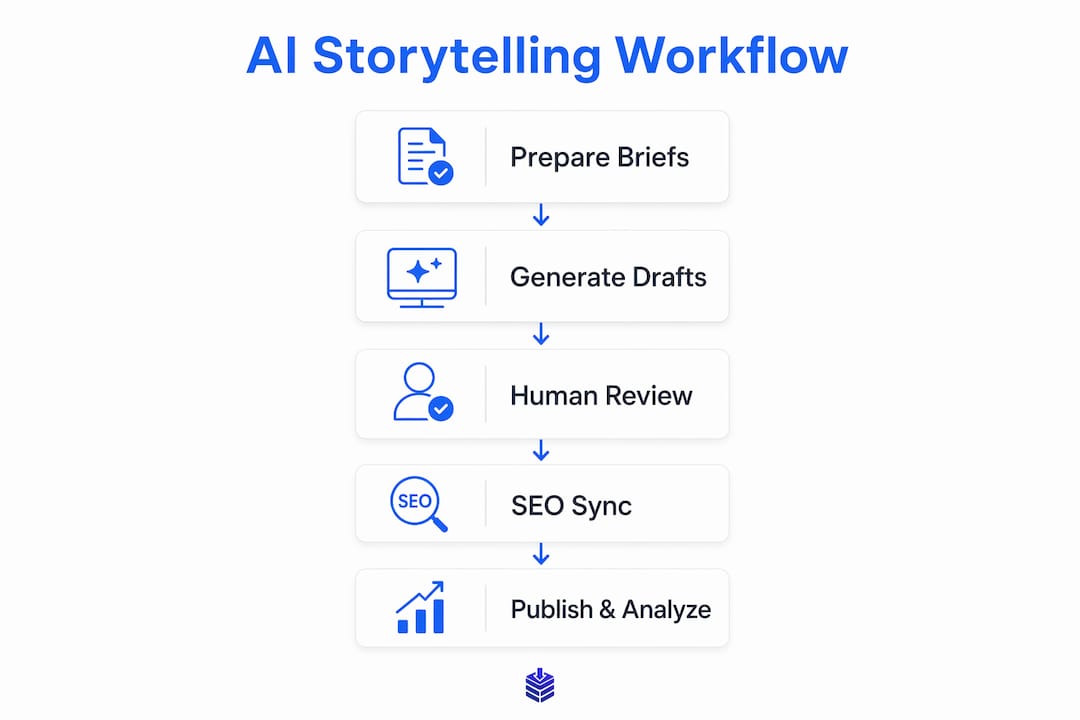
What does a safe editorial workflow look like at scale?
A content publishing workflow for AI product stories needs four defined roles and three gate rules.
Roles:
- Product content owner — writes briefs, runs prompts, owns first draft
- Brand reviewer — checks voice consistency and forbidden phrases
- Legal/claims reviewer — required for health, safety, or performance claims
- Publisher — final schema check and publish approval
Gate rules:
- Auto-fail: any factual mismatch between draft copy and catalog/schema data
- Manual review: any health, safety, or efficacy language
- Explicit sign-off: any synthetic testimonial or testimonial-like phrasing
Never publish AI-generated content that reads like a customer quote unless a real, named, cited customer said it. Synthetic UGC destroys trust faster than thin copy does.
Pro Tip: Build a 10-item launch checklist for your first batch: claim verification, schema sync, FAQ check, voice sample, performance tag, internal link, author bio, publish date, version save, and post-publish spot check.
How does a Shopify-native editor change the publishing workflow?
A Shopify-native editor removes the copy-paste gap between your AI drafts and your live store. Blockpress handles this end-to-end: in-editor AI drafts, live Google keyword data, SEO and UX scoring, schema auto-sync, product references pulled directly from your catalog, and bulk drip-publishing, all without leaving Shopify.
Practical integration steps:
- Map each product SKU to a brief template before generating drafts
- Enable schema JSON-LD export and verify parity with visible copy on every publish
- Set a publishing cadence: drip-publish for new SKUs, bulk-publish for catalog refreshes
- Configure author bio pages and version history so every draft is auditable
Features worth checking in any tool: internal-link suggestions, article health audits, and per-article performance analytics. These three tell you whether a published story is earning its place or quietly underperforming.
Pro Tip: Use Blockpress's article health audits after the first 30 days. Stories that score low on content uniqueness or schema parity are your first candidates for a structural rewrite.
Which metrics tell you if AI product stories are working?
Track these five metrics from day one, and run at least two A/B tests in your first 60 days.
- Organic search impressions — baseline before and after publishing the spec-first structure
- CTR from AI referral sources — Perplexity, ChatGPT, and Google AI Overviews referral traffic in GA4
- Time on page — narrative block quality shows up here
- Conversion rate and assisted conversions — tie blog stories to PDP visits and purchases
- AI citation hits — track branded mentions in AI assistant responses where measurable
Quotation-friendly phrasing structured for generative engine optimization can increase AI visibility by up to 40% compared to traditional SEO copy.
| Test | Variable | Metric to Watch |
|---|---|---|
| Opening line | Spec-first vs. benefit-first | AI citation rate, CTR |
| FAQ inclusion | FAQ block vs. none | AI Overview appearances |
| Spec depth | Short snapshot vs. expanded spec | Time on page, conversion |
Run each test for at least 4 weeks before drawing conclusions. Use Blockpress's per-article analytics to compare performance without needing a separate dashboard.
What does rolling out AI product storytelling actually cost?
Timeline:
- Weeks 1–4: Prepare briefs, brand rules, and prompt templates for your pilot SKUs
- Weeks 5–12: Run and validate first 50 SKUs; adjust prompts based on QA feedback
Team:
- Catalogs under 500 SKUs: 1 content lead, 1 product subject-matter expert, 1 editor
- Larger catalogs: add an automation or operations resource to manage bulk publishing
Cost guidance:
- Tool subscription: tiered SaaS pricing (Blockpress offers a free plan with paid tiers for advanced features and higher generation quotas, billed through the Shopify App Store)
- Per-article human editing time: 1–3 minutes for straightforward SKUs; 10–20 minutes for high-consideration or health-adjacent products
- Schema implementation: one-time dev time if not handled natively by your editor
The biggest hidden cost is brief preparation, not editing; stores investing in clean, complete product briefs upfront can significantly reduce editing time on subsequent SKUs.
Key Takeaways
AI writing tools for product storytelling work best when spec-first structure, governed review, and Shopify-native publishing are combined into a single repeatable workflow.
| Point | Details |
|---|---|
| Spec-first structure | Lead every story with factual specs in the first 60–120 words for stronger AI retrieval. |
| Governed workflow | Never publish raw AI drafts; use defined roles, gate rules, and a launch checklist. |
| Prompt architecture | Three-layer prompts (system, brief, constraints) produce more consistent, citable output. |
| Measure and iterate | Track AI referral CTR, time on page, and conversion rate; run A/B tests on opening lines and FAQ inclusion. |
| Blockpress for Shopify | Blockpress handles in-editor AI drafts, schema sync, and bulk publishing natively inside Shopify. |
The part most store owners get wrong
Most Shopify merchants treat AI as a content shortcut rather than a production system. The result is a catalog full of drafts that sound similar, make claims the spec sheet doesn't support, and never get cited by AI assistants because the structure isn't built for extraction.
The stores that get this right start small and get disciplined fast. A few best-sellers, clean briefs, the prompt templates above, and a real review gate form an effective pilot. From there, the workflow scales because the rules are already in place.
The two traps I see most often: publishing without verifying claims against the actual catalog data, and letting a single prompt run across hundreds of SKUs without variation. Both are fixable. The first requires a gate rule. The second requires rotating your opening patterns and feeding SKU-specific review language into every brief.
One practical reminder: brand voice fingerprinting matters more at 200 SKUs than it does at 20. Build your vocabulary constraints and forbidden-phrase list before you scale, not after. And hand-edit the lead sentence on every story you publish. That one habit keeps your content from reading like it came off an assembly line.
Blockpress makes this workflow native to your Shopify store
If you've read this far, you have the structure, the prompts, and the governance checklist. The missing piece for most store owners is a place to run it all without juggling three separate apps.
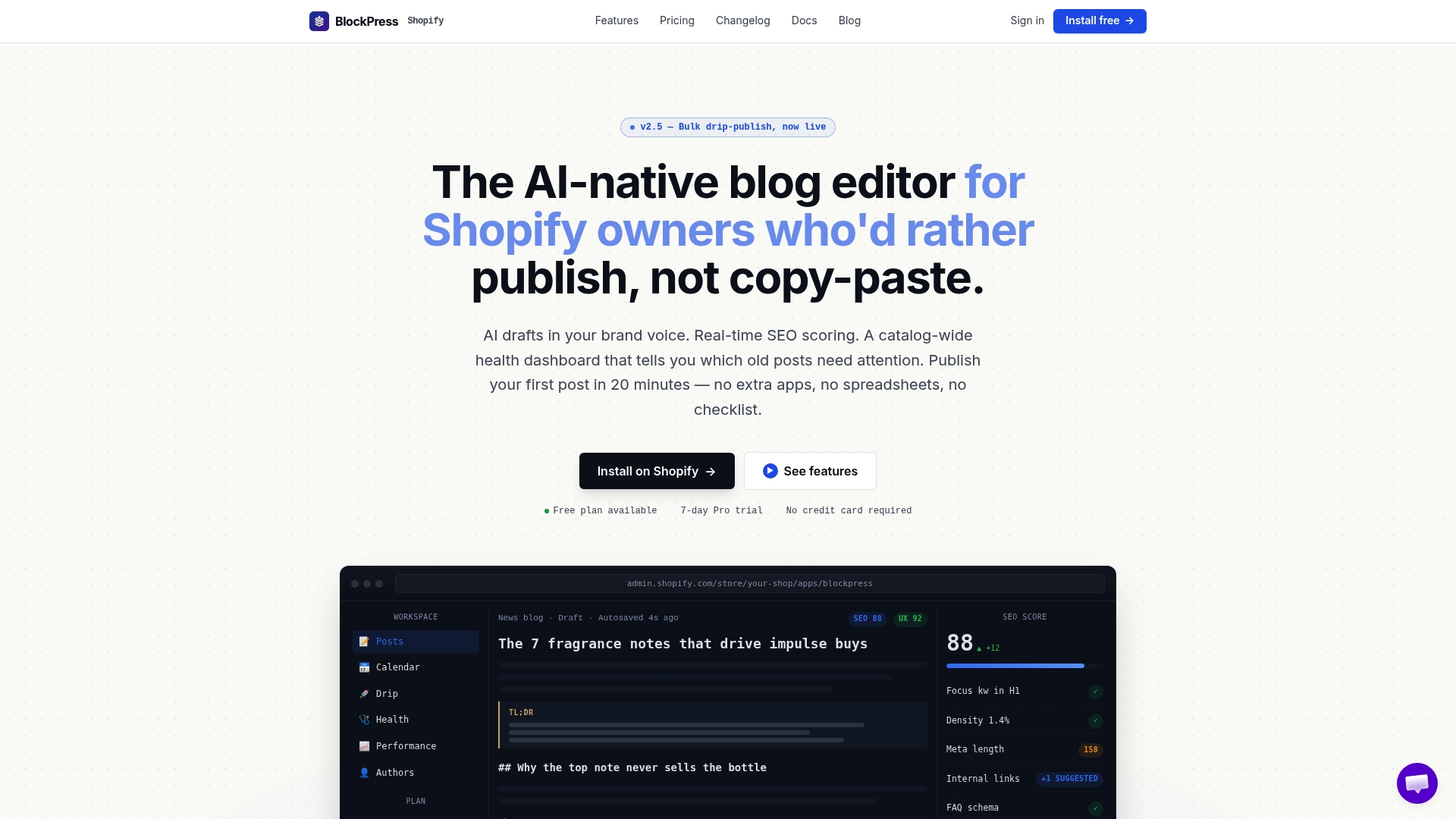
Blockpress puts AI drafts, live Google keyword data, SEO and UX scoring, schema sync, internal-link suggestions, article health audits, and bulk drip-publishing inside your Shopify editor. You write the brief, generate the draft, review it against your checklist, and publish, without leaving your store. There's a free plan to start, and paid tiers unlock higher generation quotas and advanced analytics. View pricing and start your free plan or go straight to the Blockpress app to install it in your store today.
Useful sources
Research and tactical guidance:
- Writing product descriptions for AI — source for the spec-first, 60–120 word opening rule
- AI product content and brand trust — governance and human-review workflow principles
- AI brand voice at scale — layered vocabulary and template system
- Optimize product pages for AI — buyer-language mining and FAQ schema strategy
- Schema parity and AI trust signals — structured data and visible copy alignment
- GEO and AI search visibility — generative engine optimization tactics and the ~40% visibility lift figure
Blockpress resources:
- How AI drafts ecommerce blog posts — step-by-step workflow integration guide
- Content publishing workflow guide — editorial governance and role definitions
- Why product pages need supporting content — rationale for blog-story investment
- Blockpress app and features — full feature list and free plan details
FAQ
What is the best structure for AI-generated product stories?
Lead with a factual specification block in the first 60–120 words, then follow with a benefit-led narrative. This spec-first structure improves AI retrieval and citation rates compared to marketing-first openings.
Should I publish AI product descriptions without editing them?
No. Always run AI drafts through a human review gate that checks factual accuracy against your catalog, flags health or safety claims, and verifies schema parity before publishing.
How do AI writing tools improve product storytelling for Shopify stores?
They accelerate draft volume and surface natural buyer language, but only when paired with brand constraints and product-level data inputs. Blockpress integrates this workflow natively inside Shopify with live SEO scoring and schema sync.
What metrics show whether AI product stories are working?
Track organic impressions, CTR from AI referral sources (ChatGPT, Perplexity, Google AI Overviews), time on page, and assisted conversions. Run A/B tests on opening lines and FAQ inclusion for at least 4 weeks each.
How long does it take to roll out AI product storytelling for 50 SKUs?
Expect 2–4 weeks to prepare briefs and brand rules, then 4–8 weeks to generate, review, and publish the first 50 SKUs depending on product complexity and team size.