
TL;DR:
- Supporting content on product pages answers shopper questions, builds trust, and improves search engine rankings. It significantly reduces buyer hesitation and increases conversion rates by addressing objections with reviews, FAQs, and clear specifications. Regularly testing and updating content ensures sustained growth, making product pages effective sales assets.
Supporting content is defined as any page element beyond a product title and price that answers shopper questions, builds trust, and signals relevance to search engines. Product pages without it fail on two fronts: they lose buyers who lack confidence, and they lose rankings because thin pages cannot satisfy search intent. Understanding why product pages need supporting content is the first step toward fixing one of the most common conversion problems in e-commerce.
Why product pages need supporting content to reduce buyer hesitation
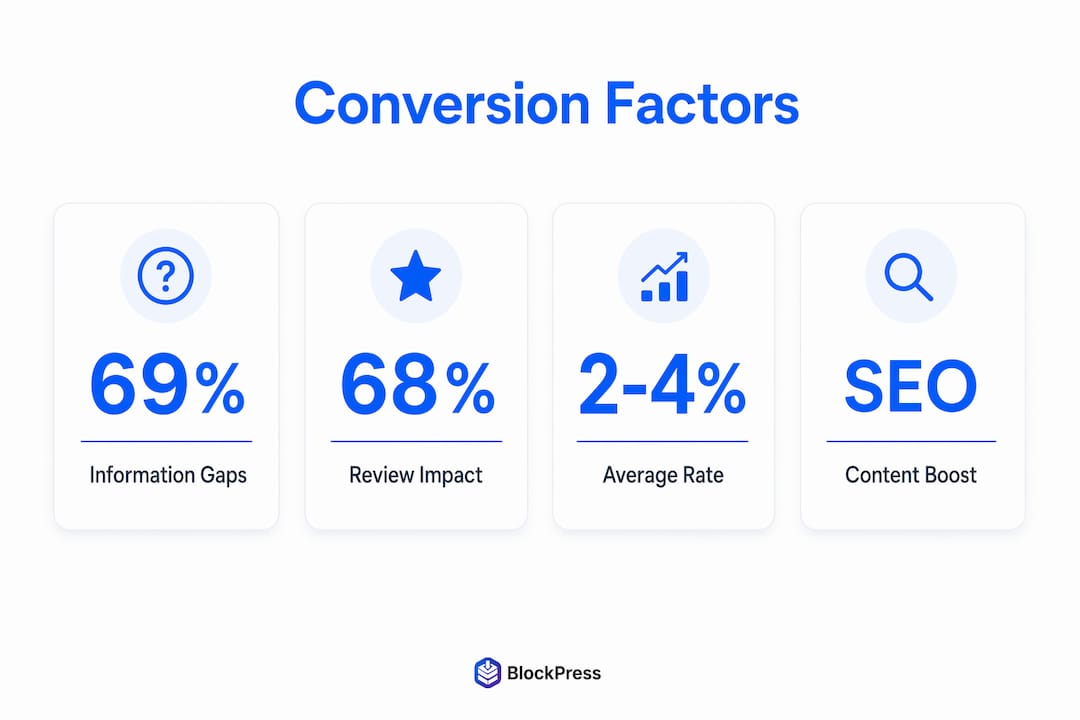
69% of shoppers abandon product pages because the page does not give them enough information to feel confident. That single statistic explains why average e-commerce conversion rates sit between 2.5% and 3%. The gap between a visitor and a buyer is almost always a gap in information.

Every element on a product page either earns or erodes trust. The page functions as a silent salesperson with no human present to answer follow-up questions. Supporting content fills that role.
The most common purchase objections are predictable. Shoppers want to know if the product fits their situation, whether returns are easy, and whether other people have had a good experience. Supporting content addresses each of these directly:
- Social proof: Customer photos, videos, and written reviews answer "will this work for me?" Products with 11–30 reviews convert 68% higher than those without any. That is a significant lift from content you do not have to write yourself.
- FAQs: A well-placed FAQ section handles the objections that would otherwise kill the sale. Questions about sizing, compatibility, and shipping timelines belong on the page, not in a support inbox.
- Clear specifications: Ambiguous product details create doubt. Precise dimensions, materials, and compatibility notes remove it.
- Transparent return policies: Risk reversal copy placed near the add-to-cart button directly reduces hesitation at the moment it matters most.
Pro Tip: Place your return policy and a one-line trust statement within visual range of your add-to-cart button. Shoppers who see risk reversal at the point of decision convert at a higher rate than those who have to search for it.
Pages with incomplete product information and poor visual hierarchy cause the majority of shoppers to leave before reaching the cart. Supporting content is not decoration. It is the structure that keeps buyers moving forward.
How supporting content improves SEO on product pages
Supporting content enriches product pages with the keyword depth and structured signals that search engines need to rank and display them correctly. A page with only a product title, a price, and a short description is thin content. Thin content ranks poorly and rarely earns featured snippets or rich results.
The SEO benefits of product page content work through three mechanisms:
- Keyword coverage: Detailed descriptions, FAQs, and user-generated content (UGC) naturally include the long-tail phrases shoppers type into Google. A FAQ answer about "does this fit a 2022 Honda Civic" captures search traffic that a product title never could. Understanding how Google ranks ecommerce pages helps you write content that matches those signals.
- Structured data eligibility: Schema markup and structured data enable eligibility for rich results in search, including star ratings, price displays, and availability badges. These rich results increase click-through rates without directly changing your ranking position.
- Page speed balance: Adding video increases add-to-cart rates on mobile by 12–18%, but pages that take longer than 2.5 seconds to load see significant conversion drops. Pages that also fail Core Web Vitals on mobile can be crawled less frequently, reducing SEO benefits even when the written content is strong.
| Content type | SEO benefit | Conversion benefit |
|---|---|---|
| Detailed descriptions | Keyword depth, reduced thin content risk | Answers product questions |
| Customer reviews and UGC | Fresh content signals, long-tail coverage | Social proof, 68% higher conversion |
| FAQs | Featured snippet eligibility | Objection handling |
| Schema markup | Rich result eligibility, higher CTR | Trust signals in search results |
| Product videos | Dwell time improvement | 12–18% add-to-cart lift on mobile |
The insight worth internalizing here is that SEO-rich copy and conversion-focused design are not in conflict. The objections that reduce conversion are often the same queries driving search traffic. Answering them on the page serves both goals at once. For a deeper look at capturing this traffic, the guide on featured snippets for ecommerce is worth reading alongside your product page audit.
Effective strategies for organizing supporting content
The most effective product pages sequence content by buyer awareness level. Top-performing pages serve highlights to new visitors, social proof to warm visitors, and risk reversal to buyers who are ready to purchase. This sequencing removes friction before doubt forms.
A practical structure for most product pages looks like this:
- Above the fold: Product name, hero image, key benefit statement, price, and add-to-cart button. Cold traffic needs to understand the product immediately.
- Mid-page: Feature-benefit bridges that connect product attributes to real outcomes. "Waterproof to 50 meters" becomes "wear it in the pool, the shower, or a rainstorm."
- Social proof block: Customer photos, star ratings, and selected reviews placed after the features section. Warm visitors who are comparing options need to see that others have made this decision and been satisfied.
- FAQ section: Handles the final objections for buyers who are close to purchasing but need one more confirmation.
- Risk reversal: Return policy, warranty, and shipping details near the bottom CTA.
Pro Tip: Avoid loading your product page with excessive personalization modules or recommendation carousels that compete with the primary CTA. Each additional element is a potential exit point. Every piece of supporting content should move the buyer toward the cart, not away from it.
Treating each visitor according to their awareness stage and providing the right depth of content creates a more effective product page experience. The goal is not to add more content. The goal is to add the right content in the right order.
How to measure and improve supporting content over time
Product pages are living assets, not static brochures. Brands that treat product pages as continuously optimized assets outperform those relying solely on paid acquisition budgets. The difference is a habit of testing and updating.
Track these KPIs at the individual page level:
- Conversion rate by variant: Your baseline for measuring whether any content change is working.
- Scroll depth: If most visitors never reach your FAQ or social proof section, those elements are not doing their job. Either move them up or improve what comes before them.
- CTA click-through rate: Measures whether your supporting content is building enough confidence to drive action.
- Add-to-cart rate vs. purchase rate: A large gap between these two numbers often signals a problem with shipping costs, return policies, or trust signals near checkout.
Continuous testing of CTA placement, hero images, and messaging leads to steady conversion improvements over time. Prioritize tests on your highest-traffic pages first. A 1% conversion improvement on a page with 10,000 monthly visitors is worth far more than the same improvement on a page with 500. Run one test at a time so you can isolate what actually moved the number.
Key Takeaways
Supporting content is the single most effective way to close the information gap that causes 69% of shoppers to abandon product pages before converting.
| Point | Details |
|---|---|
| Information gaps kill conversions | 69% of shoppers leave product pages because they lack enough information to feel confident. |
| Social proof drives measurable lift | Products with 11–30 reviews convert 68% higher than those with none. |
| SEO and conversion share the same content | Answering buyer objections on the page also captures the long-tail search queries that drive organic traffic. |
| Sequence content by awareness level | Cold traffic needs highlights; warm traffic needs social proof; ready buyers need risk reversal. |
| Treat pages as living assets | Regular A/B testing of CTAs, images, and messaging produces steady conversion gains over time. |
The case for taking supporting content seriously
Most Shopify merchants I work with underinvest in supporting content for one reason: they think of their product page as a listing, not a sales conversation. They add a title, a few bullet points, and a photo, then wonder why their paid traffic does not convert.
The shift I always recommend is simple. Ask yourself what a knowledgeable salesperson would say if a customer walked into a store and picked up that product. They would explain what makes it different, share a story from another customer, address the obvious concern about returns, and confirm the size or fit. That entire conversation belongs on your product page.
Shopper expectations have risen. Buyers in 2026 arrive with more options and less patience for pages that make them work to find basic information. The stores winning on organic search and paid traffic are the ones that have built product pages rich enough to answer every reasonable question before it becomes a reason to leave. That is not a content project. It is a conversion strategy.
Blockpress makes supporting content easier to build
Building product-supporting blog content at scale is where most Shopify merchants run out of time. Writing detailed guides, FAQs, and comparison articles that feed traffic back to your product pages takes consistent effort.
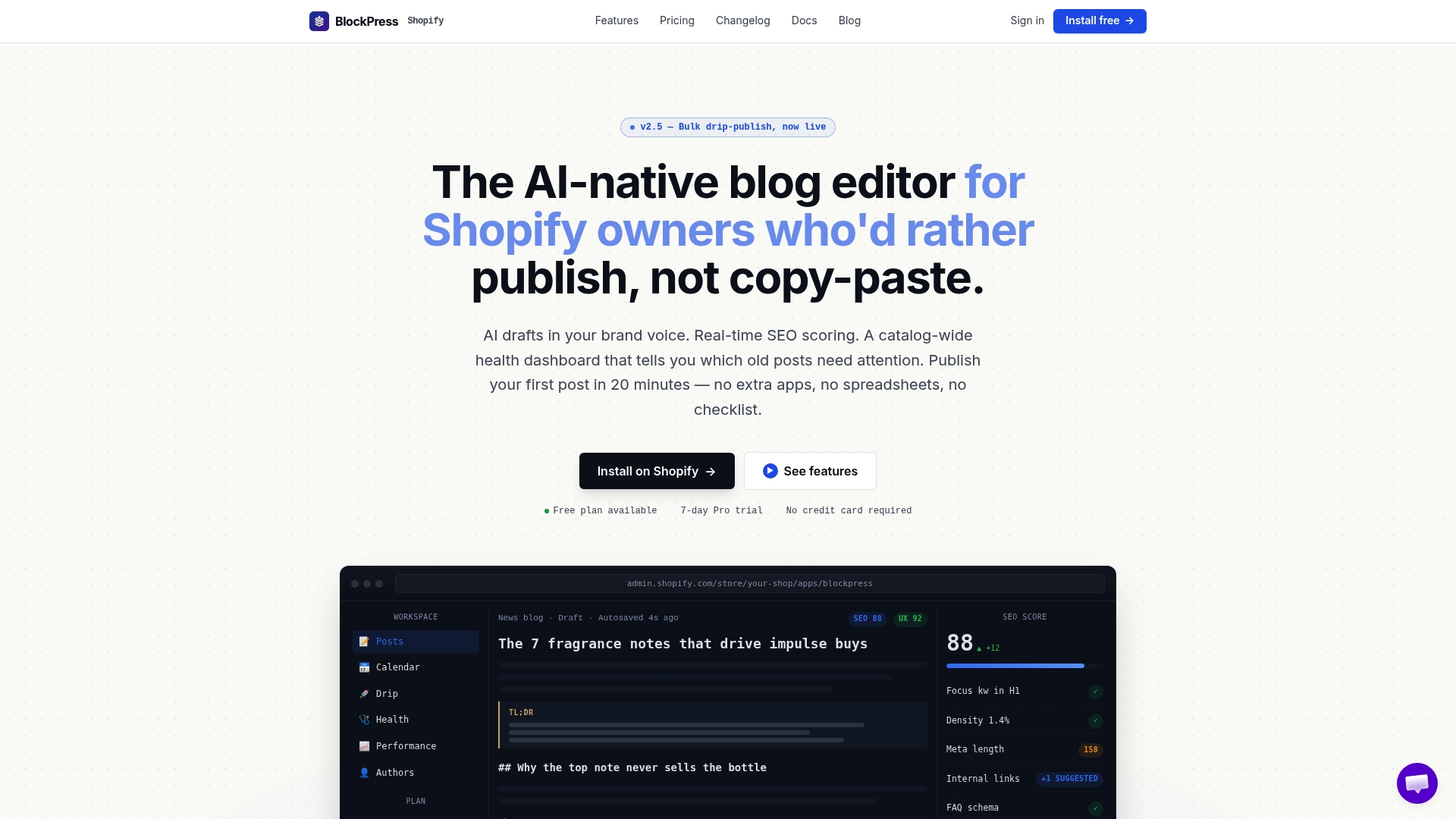
Blockpress is an AI-native blog editor built directly into Shopify. It gives you real Google keyword data, live SEO scoring, AI-generated article drafts, and per-article performance analytics without leaving your store. You can audit existing content, identify thin pages, and publish supporting articles that rank and convert. If you want to build the content layer that your product pages are missing, Blockpress is built for exactly that workflow. You can also review the full feature set to see how it fits your current setup.
FAQ
Why do product pages have low conversion rates?
69% of shoppers abandon product pages due to insufficient information. Average e-commerce conversion rates sit between 2.5% and 3% largely because most pages do not answer enough buyer questions.
What counts as supporting content on a product page?
Supporting content includes customer reviews, FAQs, detailed specifications, product videos, return policies, and comparison guides. These elements answer objections and build the confidence needed to complete a purchase.
How does supporting content improve SEO?
Detailed descriptions, UGC, and FAQs add keyword depth that thin product pages lack. Schema markup also makes pages eligible for rich results, which increases click-through rates from search.
How much does social proof affect conversion rates?
Products with 11–30 reviews convert 68% higher than those with no reviews. Customer photos and videos can boost conversion rates by up to 29%.
How often should you update product page supporting content?
Update supporting content whenever conversion data shows a drop, when new customer questions appear in support tickets, or when a competitor introduces a feature your page does not address. Treat product pages as assets that need regular audits, not one-time builds.