

TL;DR:
- High-converting store blogs focus on specific actions like signups, add-to-carts, or purchases, not just traffic. Key strategies include matching CTAs to content, optimizing timing with scroll-triggered popups, and adding social proof near CTA placements. Successful examples show long-term nurturing, local or lifestyle content, and authentic engagement, depending on the store’s product and audience.
High-converting store blogs are defined by their ability to drive measurable actions: email signups, add-to-carts, or purchases tracked through Shopify Analytics and GA4. Traffic numbers alone tell you nothing useful. What matters is whether a reader takes a specific next step after reading your content. Brands like Wild Rye Baking, Polysleep, Shock Surplus, and Skimpies have built blogs that do exactly that, each using a distinct strategy worth studying. This article breaks down the best eCommerce blog posts by real stores, compares their approaches, and shows you how to apply the same tactics.
What makes a store blog high-converting?
A high-converting blog is a system, not a single post. Blog CRO combines design, content structure, CTA mechanics, and list-building into a coordinated approach that moves readers toward a specific action.
The most common reason blogs fail to convert is misaligned CTAs. Swapping a generic lead magnet for a post-specific offer can lift conversion rates by up to 7x. That gap between a generic "Download our guide" and a targeted "Get the exact recipe kit used in this post" is where most store blogs leave money behind.
Key criteria that separate high-converting blogs from low-performing ones:
- CTA timing: Scroll-triggered popups at 60% depth average 3.8% conversion, compared to 1.9% for page-load popups. Readers who reach the halfway point are engaged. Interrupt them too early and you lose them.
- Social proof placement: Customer reviews increase conversion rates by 43% when integrated into the buying journey. Place reviews near CTAs, not buried at the bottom.
- Minimal friction design: One clear next action per post. Competing links, sidebar ads, and unrelated popups split attention and reduce conversions.
- Education-first content: Posts that answer real customer questions build trust over time. That trust converts, but often on a delay.
Pro Tip: Before redesigning your blog layout, audit your CTA placement first. Most conversion gains come from timing and offer alignment, not visual redesigns.
Top examples of high-converting ecommerce store blogs
These five stores represent distinct successful store blog examples worth reverse-engineering.
1. Wild Rye Baking
Wild Rye Baking built its blog around professional baking tutorials written in a warm, conversational tone. The content answers specific technique questions that home bakers search for, then connects those answers directly to product pages. The strategy works because the reader arrives with a problem, gets a real solution, and sees the product as the natural next step. Community-building through comments and social sharing extends each post's reach without paid promotion.

2. Polysleep
Polysleep uses hyperlocal marketing combined with sleep hygiene content to drive conversions. Posts target Canadian city-level search terms while covering topics like sleep temperature and mattress firmness. Product mentions appear naturally within educational content rather than as hard sells. This approach reduces buyer resistance because the reader feels informed rather than sold to. The result is a blog that earns trust before asking for the purchase.
3. Weston Table
Weston Table blends editorial lifestyle content with seasonal product refreshes. Posts read like a food and entertaining magazine, with high-quality photography and recipe-driven storytelling. Seasonal content updates keep older posts relevant and drive repeat visits. The conversion pathway runs from recipe inspiration to product discovery to purchase, with internal links doing the heavy lifting between content and catalog.
4. Shock Surplus
Shock Surplus built an 8-figure content business by treating its blog as the top of a multi-month email funnel. Educational posts about car parts and suspension upgrades capture email signups. Those subscribers then receive sequenced email flows that convert to sales over 3–6 months. This model requires patience. Most stores expect blog posts to convert within days. Shock Surplus proves the real payoff comes from nurturing readers over time.
"Treat email sign-ups from blog content as a conversion bridge requiring nurture and retention touchpoints over 3 to 6 months for real sales impact." — Shopify Shock Surplus Case Study
5. Skimpies
Skimpies reached No. 1 TikTok brand status through organic TikTok Live selling over six months without spending on paid ads. Live streams collapsed the traditional sales funnel by combining content, trust-building, and purchase in a single session. Blog content supported the brand story between live events. The lesson here is that high-converting content does not have to be long-form. Authentic, real-time content can outperform polished editorial when the audience connection is strong.
Comparing high-converting store blog strategies
These stores share common patterns, but their execution differs in ways that matter for your own planning.
| Store | Content type | CTA approach | Conversion timeline |
|---|---|---|---|
| Wild Rye Baking | Tutorial and technique posts | In-content product links | Short to medium |
| Polysleep | Educational sleep hygiene | Subtle product nudges | Medium |
| Weston Table | Lifestyle and seasonal editorial | Internal links to catalog | Medium to long |
| Shock Surplus | Deep-dive educational posts | Email capture to nurture flow | 3–6 months |
| Skimpies | TikTok Live and brand content | Live purchase prompts | Immediate |
The universal pattern across all five: every post answers a specific customer question and connects that answer to a clear next action. None of them publish content without a conversion destination in mind.
The key differentiator is timeline. Shock Surplus and Polysleep play a long game with email nurture sequences. Skimpies compresses the funnel to near-zero with live content. Weston Table sits in the middle, using seasonal refreshes to keep readers returning. Your store's best approach depends on your product complexity and average purchase consideration time. A $30 product needs a shorter funnel than a $1,200 mattress.
Analytics and A/B testing separate the stores that grow from those that plateau. Testing CTA placement, offer type, and scroll depth triggers gives you data to act on rather than assumptions to argue about. You can optimize existing posts using the same diagnostic approach these brands use internally.
How to apply these lessons to your own store blog
Start with a diagnostic, not a redesign. Open Google Analytics 4 and filter your blog posts by landing page. Any post with a conversion rate under 1% is a candidate for immediate improvement.
Steps to apply high-conversion blog strategies:
- Audit your CTAs: Replace generic offers with post-specific ones. A post about coffee brewing should offer a brewing guide or a discount on a grinder, not a generic newsletter signup.
- Fix your CTA timing: Move popups from page-load to 60% scroll depth. This single change can nearly double your popup conversion rate based on Wisepops benchmark data.
- Add social proof near CTAs: Place customer reviews or star ratings within two scrolls of your primary CTA. Reviews reduce buyer uncertainty before readers reach your product page.
- Build an email capture flow: Use double opt-in with a discount incentive to improve list quality. Province of Canada saw significant gains from adding a discount code to their opt-in CTA.
- Plan for a 3–6 month nurture sequence: Map out the email flow that follows each signup. Blog-driven signups rarely convert in the first week. Build the sequence before you publish the post.
- Use internal links strategically: Connect each post to a relevant product page or collection. Learn how a Shopify internal linking strategy keeps readers moving through your site.
Pro Tip: Match your content length to your product's purchase consideration time. High-ticket items need longer, more detailed posts. Impulse buys need shorter, faster-moving content with an immediate CTA.
Key takeaways
The most effective store blogs combine post-specific CTAs, timed social proof, and a multi-month email nurture sequence to convert readers into buyers.
| Point | Details |
|---|---|
| CTA alignment drives conversions | Match every CTA to the specific topic of the post, not a generic offer. |
| Scroll depth timing matters | Trigger popups at 60% scroll depth to capture engaged readers. |
| Social proof reduces friction | Add customer reviews near CTAs to lift buying confidence before the product page. |
| Email nurture extends the funnel | Plan for 3–6 months of email follow-up after a blog-driven signup. |
| Analytics before redesign | Audit GA4 conversion data first; fix CTA placement before changing blog design. |
What I've learned from watching store blogs convert (and fail)
Most store owners measure their blog by pageviews. That is the wrong number. I have seen blogs with 50,000 monthly visitors and a 0.2% conversion rate sitting next to blogs with 8,000 visitors converting at 3.1%. The second blog is worth more to the business by a wide margin.
The hardest part of blog CRO is not the technical setup. It is the patience required to let educational content work. Shock Surplus did not build an 8-figure business from blog posts that converted in 48 hours. They built email lists, sequenced their follow-ups, and let the relationship develop. Most store owners abandon that model after 60 days because they cannot see the pipeline filling.
TikTok Live changes the equation in a specific way. It collapses the trust-building timeline from months to minutes. But it only works when the host is genuinely knowledgeable and the audience is already warm. You cannot fake that authenticity. Skimpies succeeded because Bette Bentley knew her product and her customer deeply. The live format exposed that knowledge in real time.
The practical takeaway: measure conversion pathways, not traffic. Build CTAs that match post intent. Give your email nurture sequence enough time to work. And if you want to understand how blog traffic converts to sales at a mechanical level, study the funnel before you publish another post.
— Rodney
Build your high-converting blog with Blockpress
If you are ready to put these strategies into practice, Blockpress is built for exactly this kind of work. Blockpress is an AI-native blog editor that lives inside Shopify, giving you real Google keyword data, live SEO and UX scoring, and per-article performance analytics without switching between apps.
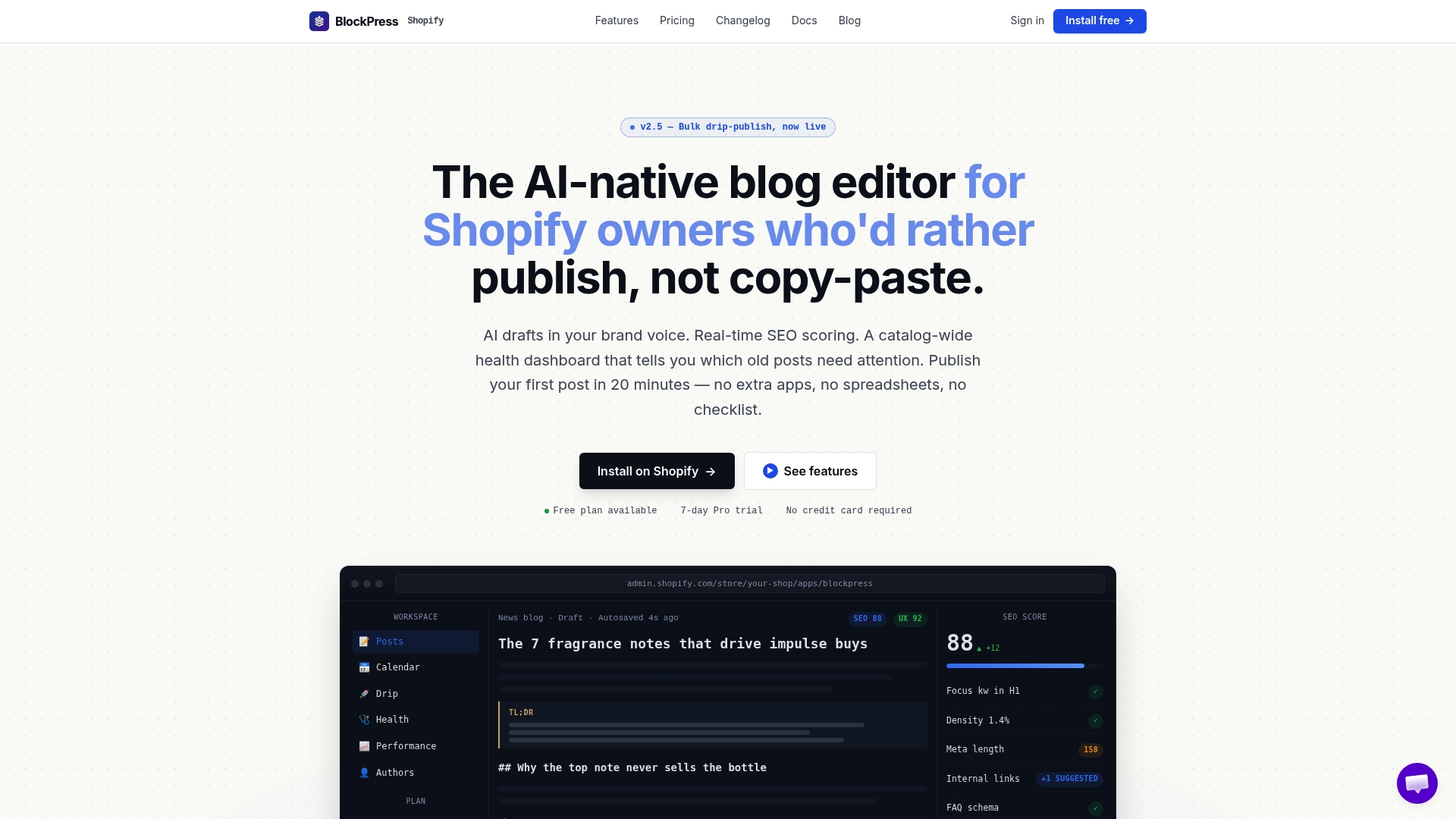
You can test CTA placement, audit post health, and track which posts actually drive signups and purchases, all from one editor. Blockpress replaces the three separate tools most merchants cobble together to do what it handles natively. Check out the full feature set or explore Blockpress pricing to find the plan that fits your store.
FAQ
What makes a store blog "high-converting"?
A high-converting store blog drives measurable actions like email signups, add-to-carts, or purchases. Shopify defines success by conversion-oriented metrics tracked through GA4, not raw traffic.
How do I know if my blog CTAs are underperforming?
Filter your blog posts by landing page in Google Analytics 4. Any post with a conversion rate under 1% has a CTA alignment or timing problem worth fixing before anything else.
How long does it take for blog content to convert?
Educational blog content often converts over 3–6 months through email nurture sequences. Shock Surplus's content-to-sales pipeline shows that patience and sequencing are required for blog-driven revenue.
Does social proof really impact blog conversions?
Yes. Adding customer reviews to the conversion journey increased overall conversion rates by 43% in a documented Shopify store case study, with new product conversions rising from under 1% to 2.1% within the first month.
What is the best CTA format for a store blog?
Post-specific offers outperform generic lead magnets significantly. Replacing a generic CTA with an offer aligned to the post topic can lift conversion rates by up to 7x, based on diagnostic testing data from Automate the Journey.