
There's no single magic hour when everyone should hit publish. Social platforms have real, measurable windows tied to how people scroll each one. Blog posts work differently: the exact hour barely moves the needle, but when you push that post out to email and social does. The next action is simple. Pick your platform windows below as a starting point, then pull your own analytics to confirm or override them.
TL;DR:
- Publishing on social platforms should align with your audience’s peak scrolling times, which vary significantly by channel and often differ from generic advice.
- Blog post timing is less critical for long-term reach, except for immediate promotion or in response to time-sensitive news; focus on promotion timing instead.
- Building your own schedule requires analyzing platform insights, email engagement, and website traffic data, then testing and refining over multiple cycles.
- Consistent cadence and systematic testing of publish times outperform trying to find a perfect hour, especially when combined with platform-specific windows.
- Automating scheduling and analytics within tools like BlockPress simplifies testing, measuring, and adjusting your publishing timing in a sustainable, data-driven way.
Table of Contents
- What's the Best Time to Publish on Each Platform?
- Do Blog Posts Need the Same Timing Strategy as Social Posts?
- How Do You Find Your Own Best Publishing Times?
- How Do You Test and Validate Your Publishing Schedule?
- How Does Cadence Fit Into a Sustainable Editorial Calendar?
- How Does the 5:3:2 Rule Affect Your Posting Schedule?
- How BlockPress Handles Scheduling and Testing in Practice
- The Real Problem With Most Timing Advice
- Publish, Schedule, and Test Timing Without Leaving Shopify
- Sources
- FAQ
What's the Best Time to Publish on Each Platform?
Platform algorithms reward early engagement, so the best time to publish on any given channel is whenever your specific audience is already scrolling, not some fixed clock hour that applies to everyone. Buffer's analysis of millions of posts found that platform-specific windows consistently outperform generic advice, and the differences between platforms are big enough to matter.
Here's how the major channels break down, along with why each window works the way it does.
- Facebook: Weekday mornings and midday, roughly 9 a.m. to 1 p.m., Tuesday through Thursday. Facebook's feed still favors posts that pick up early comments and reactions, and midday is when a lot of people check the app on a break.
- Instagram: Weekday mornings around 9 to 11 a.m., plus a second bump in the early evening between 6 and 8 p.m. Buffer's Instagram-specific data pulled from over two million posts found Thursday at 9 a.m. and Wednesday at noon and 6 p.m. outperforming other slots, though the report is upfront that account-level Instagram Insights should override any generic chart.
- TikTok: Evenings from 7 to 9 p.m. on weekdays, with weekend mornings, Saturday and Sunday between 9 and 11 a.m., as a secondary window. TikTok's For You feed rewards fast completion rates, and evening and weekend viewing sessions tend to run longer than quick weekday check-ins.
- LinkedIn: Midweek afternoons, Tuesday through Thursday, roughly 1 to 3 p.m. That's when professional audiences take a break between meetings, and LinkedIn's feed still leans heavily on recency for business content.
- X (formerly Twitter): Weekday mornings, 8 to 10 a.m., when people check the platform alongside news and commute time. X content has one of the shortest shelf lives of any major platform, often measured in hours, so timing matters more here than almost anywhere else.
- YouTube: Evenings after 6 p.m. on weekdays and weekend mornings. Longer-form video benefits from viewers who have settled in for a session rather than a quick scroll.
- Pinterest: Weekday afternoons and weekends. Pinterest content has an unusually long shelf life, often surfacing in searches for months, so timing affects the initial push more than the long tail.
Sprout Social's 2026 report lands on a similar overall pattern, recommending mid-day to late-afternoon windows across most platforms, with midweek days outperforming Monday and Friday consistently. Sprout Social also publishes its methodology, pulling engagement data across a large sample of business accounts rather than a handful of case studies, which is why its numbers tend to track closely with Buffer's despite being separate datasets.
A quick note on the caveats. Both datasets aggregate results across thousands of accounts in different industries, time zones, and audience sizes. A B2B software account with a mostly American East Coast audience is going to see different peak hours than a consumer fashion brand with global reach. Treat every window above as a hypothesis, not a rule.
That skepticism isn't just caution for caution's sake. Practitioners on Reddit's social media marketing community have pushed back for years on recycled "best time" charts, pointing out that most of them get reposted year after year with little updating and rarely account for account-specific audience behavior. The charts above are a reasonable starting point precisely because they're built on fresh, large-sample data. But they're a floor, not a ceiling.
Do Blog Posts Need the Same Timing Strategy as Social Posts?
No. Blog publish timing and social post timing follow completely different logic, and treating them the same way is one of the most common scheduling mistakes marketers make. Social feeds are built around real-time relevance. A post published at the wrong hour loses most of its potential reach within a day or two because the algorithm has already moved on. Blog posts don't work that way.

Most blog traffic accumulates slowly through search over weeks and months, not in the first few hours after publishing. According to SocialRails' timing guide, the exact hour you hit publish on a blog post is usually irrelevant to its long-term performance, because search engines index and rank content based on quality, relevance, and topical authority rather than publish timestamp. A post's ranking trajectory over six months has almost nothing to do with whether it went live at 9 a.m. or 9 p.m.
There are two real exceptions where blog timing does matter:
- Time-sensitive or news-driven coverage. If you're covering a product launch, an industry announcement, or anything with a short news cycle, publishing quickly and early in the cycle genuinely affects how much traffic you capture before the story goes cold.
- The promotion moment. The instant you hit publish matters far less than when you push that post to your email list and social channels. That's the moment audience attention is actually available, and it's where platform-specific windows become relevant again, just applied to the promotion, not the post itself.
The practical takeaway: publish blog content whenever it's finished and fully edited. Don't hold a finished post for three days because Tuesday at 10 a.m. tested better somewhere. Instead, schedule the email send and social shares into the windows your own audience actually responds to.
How Do You Find Your Own Best Publishing Times?
Generic charts get you started, but your own audience data will always beat someone else's aggregate. Here's the process for building a schedule based on your actual numbers instead of borrowed ones.
- Pull platform-native insights first. Instagram Insights, Facebook Page Insights, TikTok Analytics, LinkedIn Analytics, YouTube Analytics, and X's built-in analytics all show when your specific followers are online, broken down by day and hour. Export at least 90 days of data if the platform allows it, since a single week can be skewed by a viral outlier or a holiday.
- Check your email open and click windows. Most email platforms report open rate and click-through rate by hour sent. Look for the two or three-hour window where both metrics peak together, not just opens, since a high open rate with a low click rate tells you people are seeing the subject line but not engaging with the content.
- Layer in GA4 and Search Console. GA4's day-and-hour breakdown under engagement reports shows when your website traffic actually spikes, which is useful for timing promotional pushes that drive to a blog post. Search Console won't tell you an hour to publish, but its performance trends over weeks help confirm whether a topic and format are working, independent of timing.
- Rank your channels by response speed. Email usually reacts fastest, often within the first hour of a send. Your primary social platform, whichever one drives the most referral traffic, comes next. Secondary platforms can follow a day or two later without losing much value.
- Document the combined schedule in your calendar. Once you've got a prioritized order, email first, primary platform second, secondary platforms trailing, write it into your editorial calendar so the sequence repeats automatically instead of getting re-decided every week.
Pro Tip: Don't just look at your top-performing hour. Look at your top three, then check whether they cluster around the same time of day across different days of the week. A single spike could be one lucky post; a cluster is a real pattern worth building a schedule around.
How Do You Test and Validate Your Publishing Schedule?
Charts and dashboards give you a starting hypothesis. A structured test tells you whether it actually holds for your audience. Here's a simple way to run one without overcomplicating it.
- Set up a two-window A/B test. Pick two candidate times, say 9 a.m. and 6 p.m., and alternate posts of similar type and quality between them over two to three weeks. Keep everything else constant: similar topic category, similar format, similar caption length. If you vary quality along with timing, you won't know which variable caused the difference.
- Track the right metrics for the first 24 to 72 hours. For social posts, watch engagement rate and referral traffic back to your site. For blog posts tied to a promotional push, watch email click-through rate alongside the referral spike. Longer term, watch search impressions in Search Console over the following month to see if the promotion window affected discovery at all.
- Aggregate across at least eight to ten posts before drawing conclusions. A single post skews easily. Wait until you've got a reasonable sample in each time window before deciding one clearly wins.
- Adjust and rerun quarterly. Audience behavior shifts with seasons, algorithm updates, and your own follower growth. A window that worked in the spring can quietly underperform by fall.
One experimental idea worth flagging rather than adopting outright: some 2026 commentary has floated publishing blog content during very early "pre-index" hours to catch AI crawler and indexing patterns before daytime traffic arrives. It's an interesting hypothesis, but it's unproven. Treat it as something to A/B test on a handful of posts, not something to build your whole calendar around.
How Does Cadence Fit Into a Sustainable Editorial Calendar?
Consistency beats precision. A predictable publishing rhythm your audience can rely on will usually outperform a perfectly timed post that arrives on no particular schedule at all. BloggingWizard's synthesis of multiple timing studies reaches the same conclusion: cadence and promotion discipline matter more than chasing an ideal hour.
What that cadence looks like depends on your team size:
- Solo creator: One blog post a week, promoted across two to three social touches spaced over the following three days rather than all at once.
- Small marketing team: Two to three blog posts a week, each with a coordinated email send and staggered social posts across the primary and secondary platforms identified earlier.
- DTC brand with active content operations: Daily or near-daily social content built around a weekly blog anchor, with promotional posts spaced so no single day carries more than one direct sales push.
If you're publishing in bulk, say clearing a backlog of ten blog posts at once, resist the urge to release them all on the same day. Drip-publishing that content over one or two weeks prevents saturating your own feed and gives each post room to actually get read and shared instead of competing with the nine others you just dropped.
How Does the 5:3:2 Rule Affect Your Posting Schedule?

The 5:3:2 rule solves a scheduling problem most accounts run into without realizing it: too much promotional content, too close together, wearing out an audience's patience. The rule recommends a weekly mix of five curated pieces (content from other sources relevant to your audience), three original pieces (your own blog posts, product content, or research), and two humanizing posts (behind-the-scenes, team, or personal content). Business frames it as a fatigue-reduction heuristic more than a rigid formula.
Applied to scheduling, that mix changes what goes where during the week:
- Curated content works well in lower-attention windows, early morning or slower midweek afternoons, since it's lighter and doesn't need peak visibility to land.
- Original content, including your own blog posts, belongs in the peak windows covered earlier, when you want maximum eyes on something you built.
- Humanizing content performs well in evening or weekend windows, when audiences are less in work mode and more receptive to something informal.
Launches and campaigns are the exception. During a product launch week, shift the ratio temporarily toward original and promotional content, then pull back to the standard mix once the push ends. Holding a promotional-heavy schedule for more than a week or two is usually what triggers the audience fatigue the 5:3:2 rule was built to prevent.
How BlockPress Handles Scheduling and Testing in Practice
Running the process above by hand, pulling analytics, testing windows, spacing bulk releases, takes real hours every week. BlockPress builds those steps into the editor itself: drip-publishing spaces out bulk releases automatically, per-article performance analytics show which posts are actually driving traffic, and the built-in editorial calendar keeps promotion sequencing visible. Teams using the 20-minute publishing workflow skip the back-and-forth between separate scheduling and analytics apps, which is usually where testing schedules quietly fall apart.
The Real Problem With Most Timing Advice
Most "best time to post" content treats timing as the whole strategy, when it's really just one input feeding a bigger promotion decision. The conventional advice, find the magic hour, set it, forget it, undersells how much account-specific variation exists even within a single platform. Two Shopify stores in the same category can have completely different peak windows depending on where their customers actually live and when they shop.
What the research actually supports is a shift in priority: spend less energy hunting for the perfect hour and more energy building a system that tests, measures, and adjusts. A mediocre time slot with a consistent weekly cadence and a tested promotion sequence will outperform a "perfect" hour applied inconsistently. The 5:3:2 mix and platform-specific windows both matter, but they're inputs into that system, not replacements for it.
If you take one thing from this: stop treating publish time as a decision you make once and never revisit. Treat it as a variable you test quarterly, because your audience, and the platforms they're on, keep changing whether your calendar does or not.
— Rodney
Publish, Schedule, and Test Timing Without Leaving Shopify
Most Shopify merchants juggle three separate tools to schedule content, check performance, and manage a publishing calendar, on top of whatever they're already using to write the posts. Some integrated tools put all of it inside the admin interface you already work in every day, so testing a publish window doesn't mean exporting data into a spreadsheet and importing it back into another app.
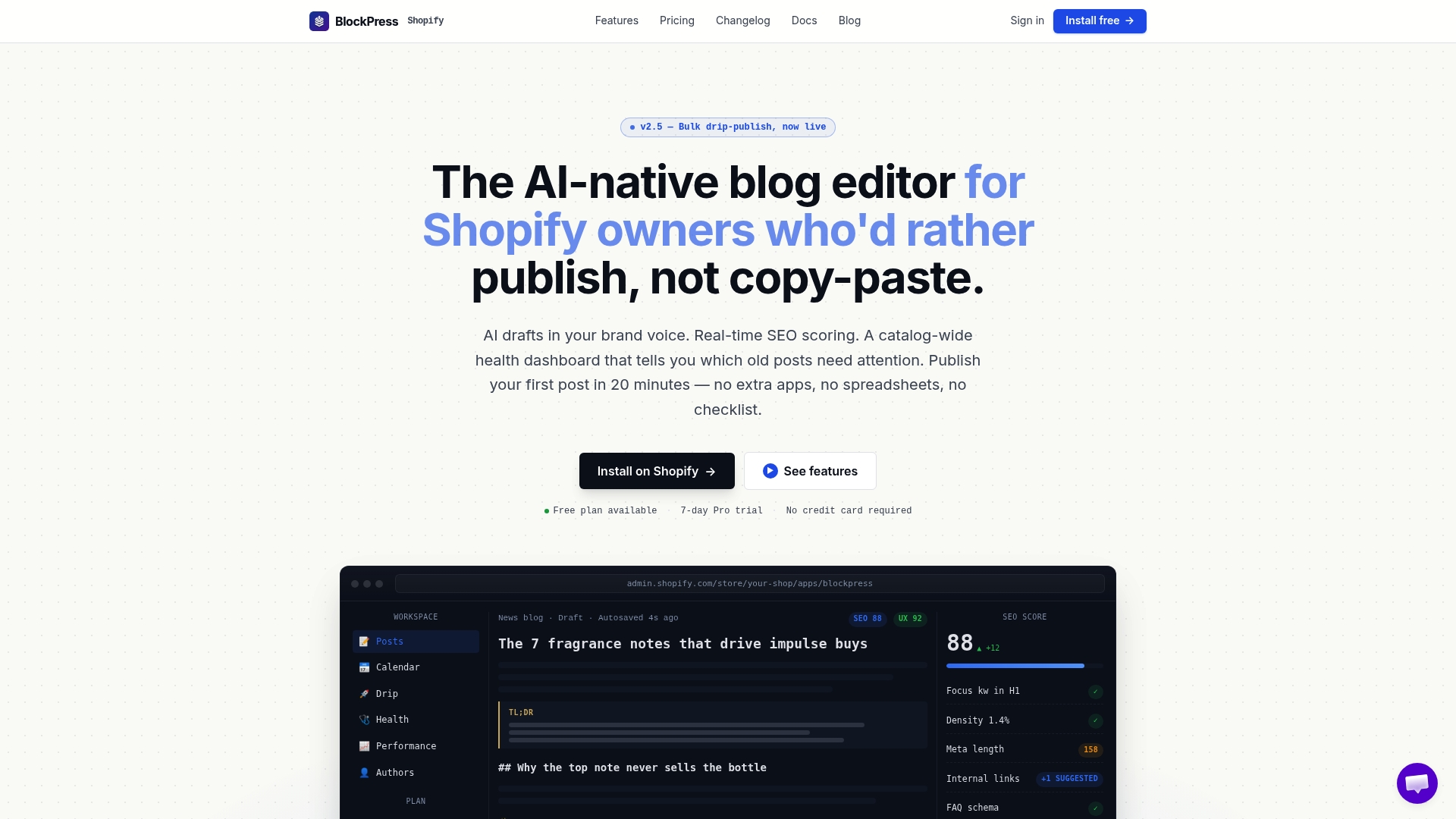
Certain blog tools include bulk drip-publishing for spacing out backlog content, per-article performance analytics for checking which windows actually convert into traffic, and a scheduling calendar built around the cadence principles covered above. They are designed for users who want to run the testing process in this article without adding another subscription to the stack. For sharper caption variations across platforms while you're testing timing, AmmarAI's post generator is a useful companion tool for spinning one idea into platform-specific formats quickly.
Start by checking the BlockPress product page to see how drip-publishing and analytics fit your current Shopify blog, or browse the changelog for the latest scheduling features before you build out your next quarter's calendar.
Sources
Cross-check any schedule against primary data rather than a single blog post's word. Buffer and Sprout Social both publish large-sample platform timing studies updated regularly, SocialRails and BloggingWizard cover blog-specific timing in more depth, and each platform's own Insights or Analytics dashboard remains the most reliable source for your specific account.
- Best Time to Post on Social Media in 2026 | Buffer
- Best times to post on social media in 2026 | Sprout Social
- When to publish blog posts: An honest guide to timing | SocialRails
FAQ
What Is the 5:3:2 Rule for Social Media Posts?
The 5:3:2 rule recommends a weekly content mix of five curated posts, three original posts, and two personal or behind-the-scenes posts to reduce promotional fatigue and keep an audience engaged across different content types.
Is 7:30 PM a Good Time to Post?
It can be, particularly on TikTok and YouTube where evening viewing sessions tend to run longer, but it depends heavily on your specific audience's time zone and habits. Check your own platform insights before assuming any single hour applies to your account.
What Time of Day Is Generally Best for Posting?
Across most large datasets, midday to early evening on weekdays, particularly Tuesday through Thursday, tends to outperform early mornings, late nights, and weekends, though the exact peak hour still varies by platform and audience.
What Is the 5:3:1 Rule on Instagram?
Definitions vary across sources, and it's often confused with the 5:3:2 content-mix rule. If you've seen a "5:3:1" framework referenced, check the original source's exact definition before applying it, since no single standardized version dominates current guidance.
Does the Best Time to Publish Matter for Blog Posts?
Not much for the publish hour itself, since most blog traffic builds gradually through search over months. What matters more is when you promote the post through email and social, and running that promotion consistently through a tool like BlockPress's editorial calendar keeps the sequence from slipping.