
TL;DR:
- Effective on-page SEO in 2026 requires optimizing content, technical signals, and trust factors to rank in search engines and AI answer systems. It emphasizes matching search intent, meeting Core Web Vitals thresholds, and implementing structured data to enhance visibility and click-through rates. Building trust through transparent author information and aligning title tags with headings strengthens overall search performance.
On-page SEO is defined as the practice of optimizing a page's content, HTML structure, and technical signals to rank in both traditional search engines and AI-powered answer engines. The on-page SEO elements checklist for 2026 goes beyond keywords. It covers Core Web Vitals thresholds, E-E-A-T signals, schema markup, and front-loaded direct answers of 40–60 words that AI systems like ChatGPT and Perplexity can extract and cite. Get these elements right, and your pages earn traffic from both Google and the AI tools reshaping how people find information.
1. What are the critical content and intent elements for 2026?
Search intent is the foundation of every page that ranks. Google classifies intent as informational, commercial, or navigational. Your page must match the dominant intent for its target query, or no amount of technical polish will move it up the results.
Keyword density is no longer a ranking factor. Modern SEO focuses on entity salience and topical completeness, with target entity presence above 0.10 and strong topic focus above 0.30. That means covering the full topic, not repeating a phrase.
- Map every page to one dominant search intent before writing.
- Cover related entities and subtopics, not just the primary keyword.
- Use your primary keyword in the title tag and H1, and keep them thematically aligned.
- Add a named author with credentials and first-hand experience to strengthen E-E-A-T signals.
- Link to related content using the pillar and cluster model to show topical depth.
Pro Tip: Write a 40–60 word direct answer at the top of every article. AI answer engines pull from the first section of a page, so front-loading your core claim increases your chance of being cited.
2. How to optimize technical SEO elements and Core Web Vitals

Technical performance is a direct ranking signal. Core Web Vitals thresholds for 2026 require Largest Contentful Paint under 2.5 seconds, Interaction to Next Paint under 200 milliseconds, and Cumulative Layout Shift below 0.1. Missing any one of these puts you at a disadvantage in competitive SERPs.
| Metric | Threshold | What it measures |
|---|---|---|
| LCP (Largest Contentful Paint) | Under 2.5s | How fast the main content loads |
| INP (Interaction to Next Paint) | Under 200ms | How quickly the page responds to input |
| CLS (Cumulative Layout Shift) | Below 0.1 | Visual stability as the page loads |
Mobile usability and HTTPS are also confirmed ranking factors. A page that shifts layout on mobile or loads over an insecure connection loses both rankings and user trust. Check your robots.txt file to confirm AI crawlers like GPTBot are not blocked. Blocking them removes your content from AI answer pools entirely.
Pro Tip: Use Google Search Console's Core Web Vitals report to identify failing URLs by device type. Fix mobile issues first. Mobile traffic drives the majority of searches for most sites.
3. What structured data and schema markup are essential in 2026?
Structured data tells both search engines and AI systems exactly what your content is about. Pages using product schema markup in JSON-LD see an average 31% higher click-through rate due to enhanced SERP features like star ratings, pricing, and availability. That CTR lift compounds over time into significantly more organic traffic.
The most useful schema types for website owners and digital marketers in 2026 include:
- Article schema for blog posts and editorial content.
- Product schema for ecommerce pages with price, availability, and review data.
- BreadcrumbList schema to improve site navigation in search results.
- HowTo and FAQPage schema for instructional content. Note that FAQPage no longer generates rich results in Google Search, but the structured data still helps AI systems parse your Q&A content.
- Person schema for author pages, linking to verified profiles via sameAs.
Always implement schema as JSON-LD structured data. Google recommends JSON-LD over Microdata because it sits in the page head and does not interfere with HTML structure. Validate every schema block with Google's Rich Results Test before publishing.
4. Which linking strategies and URL practices support rankings?
Internal linking shapes how Google understands your site's structure and distributes authority across pages. Use descriptive anchor text with relevant keywords, not generic phrases like "click here." A pillar page should link to all cluster pages on that topic, and each cluster page should link back to the pillar.
URLs must be short, readable, and keyword-focused. Drop stop words, session IDs, and unnecessary parameters. A URL like /blog/on-page-seo-checklist-2026 outperforms /blog/post?id=4821&cat=seo in both readability and crawlability.
- Keep URLs under 60 characters where possible.
- Use hyphens to separate words in URL slugs.
- Write meta descriptions between 130 and 160 characters to avoid truncation in search results.
- Make every meta description unique. Duplicate descriptions reduce CTR across multiple pages.
- Avoid keyword stuffing in meta descriptions. Write for the reader, not the algorithm.
Meta descriptions do not directly influence rankings, but they significantly affect CTR. Higher CTR sends positive engagement signals that support long-term SEO performance. Treat every meta description as a short ad for the page.
Pro Tip: Check your on-page SEO mistakes for duplicate title tags and meta descriptions. These are among the most common and most damaging errors on ecommerce sites.
5. How to strengthen E-E-A-T signals across your site
E-E-A-T stands for Experience, Expertise, Authoritativeness, and Trust. Trust is the most critical E-E-A-T factor, outweighing expertise and authoritativeness in Google's quality assessment. A technically perfect page on a site with no trust signals will underperform a well-structured page on a credible domain.
- Create a detailed About page that explains who runs the site and why they are qualified.
- Add a Contact page with a real email address or phone number.
- Publish an Editorial Policy that describes how content is created, reviewed, and updated.
- Write author bios that include credentials, professional background, and links to verified social profiles.
- Disclose sponsored content and affiliate relationships clearly on every relevant page.
- Implement author schema markup using @type=Person with sameAs links to LinkedIn, Google Scholar, or other verified profiles.
Google's John Mueller has clarified that Search Quality Rater Guidelines show the quality standard Google aims for, not a direct ranking instruction set. That distinction matters. Build trust for real users, and the algorithmic signals follow. A useful resource for small business owners working through this is the small business SEO checklist that covers trust-building alongside content optimization.
6. How to align title tags and H1 headings for maximum control
Title tag and H1 alignment is one of the highest-leverage on-page fixes available. Aligning your title tag with your H1 heading reduces Google's rewriting of your title from 76% to 20.6%. When Google rewrites your title, you lose control over how your page appears in search results, which directly affects CTR.
Keep title tags between 50 and 60 characters. Use your primary keyword near the front. The H1 should match the title tag thematically, though it does not need to be word-for-word identical. Every page needs exactly one H1. Use H2 and H3 headings to organize subtopics and signal content structure to both crawlers and readers.
For a detailed breakdown of how these elements work together on Shopify blogs, the Shopify blog SEO checklist covers each heading level with practical examples.
7. How to monitor AI referral traffic and iterate
Monitoring AI referral traffic from ChatGPT and Perplexity is now a standard part of any SEO audit. These platforms send referral traffic that shows up in your analytics under direct or referral sources, depending on your setup. Identifying which pages get cited by AI tools tells you what content structure and format those systems favor.
Check your analytics monthly for traffic from AI sources. Pages that earn AI citations tend to have clear structure, front-loaded answers, and valid JSON-LD schema. Use that pattern to update underperforming pages. SEO in 2026 is iterative. Publish, measure, and refine based on what the data shows.
For a winning on-page SEO checklist that covers foundational steps alongside these advanced signals, external guides can supplement your audit process with additional perspectives.
Key takeaways
The most effective on-page SEO strategy for 2026 combines technical performance, entity-based content, structured data, and trust signals to satisfy both Google and AI answer engines.
| Point | Details |
|---|---|
| Intent over keywords | Match page content to dominant search intent; entity coverage beats keyword density. |
| Core Web Vitals | Hit LCP under 2.5s, INP under 200ms, and CLS below 0.1 to meet 2026 thresholds. |
| Schema markup pays off | JSON-LD product schema drives a 31% higher CTR through enhanced SERP features. |
| Trust leads E-E-A-T | Author bios, editorial policies, and contact pages are the highest-impact trust signals. |
| Title and H1 alignment | Matching title tags to H1 headings cuts Google's title rewrite rate from 76% to 20.6%. |
What I've learned optimizing for 2026 search
The biggest shift I've seen is that SEO is no longer a checklist you run once at publish. It's a continuous audit cycle. Pages that ranked well in 2024 are losing ground not because of algorithm penalties but because they were built for keyword matching, not topic authority.
The sites I see winning in 2026 have one thing in common: they treat every page as a trust document. The author is named. The sources are linked. The schema is valid. The content answers the question in the first paragraph, not the fifth.
AI answer engines have made front-loading non-negotiable. If your core answer is buried in paragraph seven, AI systems skip it. That's traffic you never see and can't measure unless you're watching AI referral data closely.
My honest advice: run a full on-page audit every quarter. Fix Core Web Vitals first because they affect every page. Then work through E-E-A-T signals, schema, and internal linking. The technical and editorial sides of SEO are no longer separate disciplines. They have to work together.
— Rodney
How Blockpress helps you apply this checklist inside Shopify
Putting this entire website optimization checklist into practice takes time, especially when you're managing a Shopify store alongside content creation. Blockpress is an AI-native blog editor built directly into Shopify that handles the SEO layer while you focus on the content.
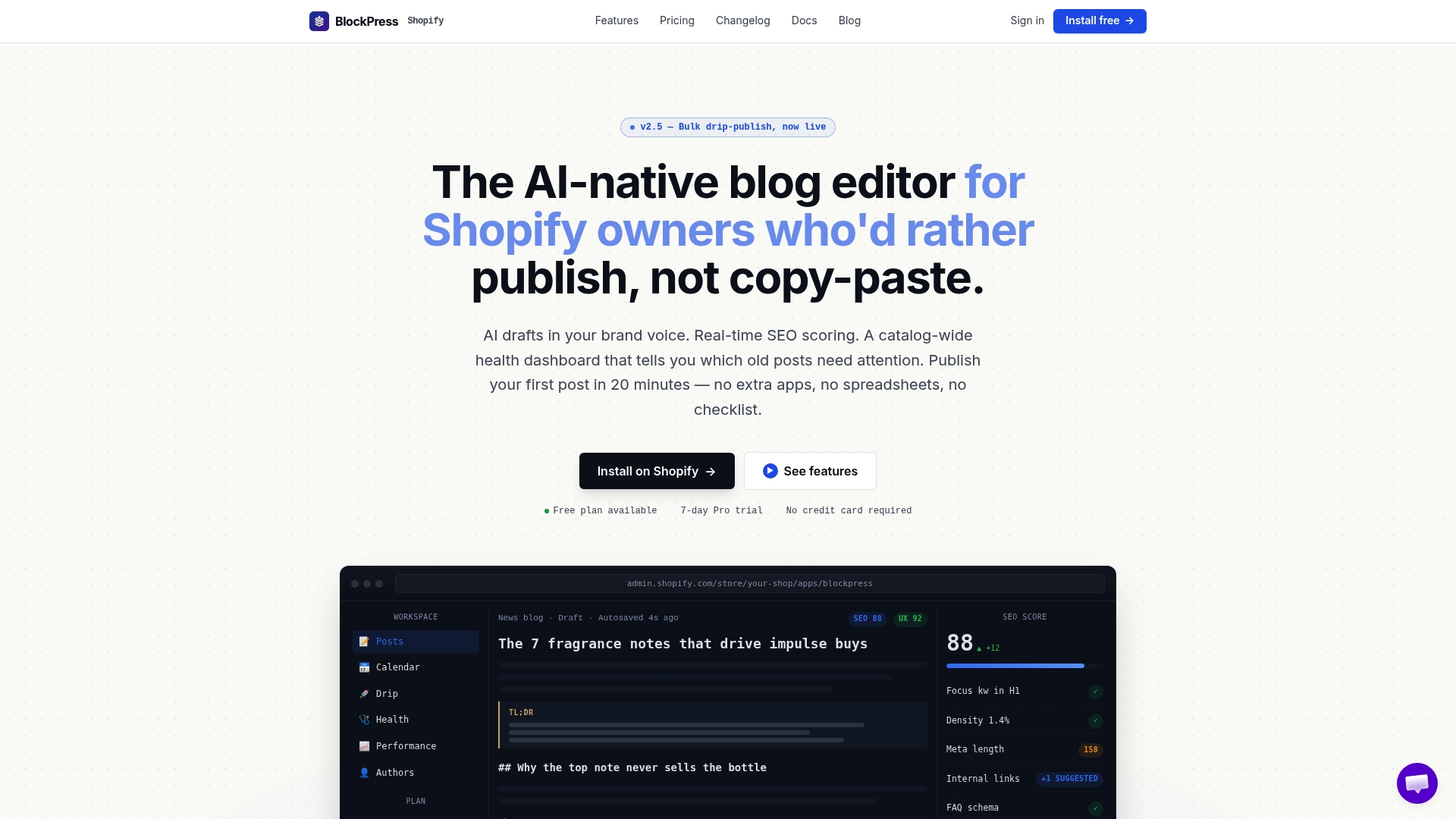
Blockpress gives you live SEO and UX scoring as you write, real Google keyword data, AI-generated article drafts, and article health audits that flag missing meta descriptions, weak headings, and internal linking gaps. It also supports author bio pages, which directly supports your E-E-A-T signals without needing a separate app. If you're ready to apply 2026 SEO best practices without juggling three separate tools, Blockpress is built for exactly that workflow. You can also review the full feature set to see how each capability maps to the checklist items covered here.
FAQ
What is on-page SEO in 2026?
On-page SEO in 2026 is the practice of optimizing a page's content, HTML elements, and technical signals to rank in both traditional search engines and AI-powered answer engines. It includes Core Web Vitals, E-E-A-T signals, schema markup, and intent-matched content.
Does keyword density still matter for SEO?
Keyword density is no longer a ranking factor. Google now prioritizes entity salience and topical completeness, with target entity presence above 0.10 for relevance and above 0.30 for strong topic focus.
What Core Web Vitals thresholds apply in 2026?
Google's 2026 thresholds require LCP under 2.5 seconds, INP under 200 milliseconds, and CLS below 0.1. Pages that fail these thresholds are at a competitive disadvantage in search rankings.
How long should a meta description be?
Meta descriptions perform best between 130 and 160 characters. They do not directly influence rankings but significantly affect click-through rates, which support long-term SEO performance.
What is the most important E-E-A-T factor?
Trust is the most critical E-E-A-T factor, outweighing expertise and authoritativeness. Transparent author bios, editorial policies, and verified contact information are the highest-impact trust signals for 2026.