
TL;DR:
- A small business SEO checklist emphasizes fixing technical issues, optimizing on-page elements, creating high-quality content, enhancing local SEO, and building authoritative backlinks to see ranking improvements rapidly. Prioritizing technical health and Google Business Profile optimization produces faster results than content development alone. Consistent AI-focused structuring and regular performance tracking are essential for maintaining visibility in 2026 search environments.
A small business SEO content checklist is a structured audit framework covering technical health, on-page optimization, content quality, local presence, and backlink profile. According to research, fixing 5 to 10 blocking problems across these five areas produces visible ranking improvements within 60 to 90 days. That timeline matters for small businesses that cannot afford to wait six months for results. This guide walks you through each pillar of the checklist, with specific actions for 2026's search environment, including generative engine optimization (GEO) alongside traditional Google rankings.

1. What technical SEO checks should every small business run?
Technical SEO is the foundation every other checklist item depends on. Without it, even excellent content fails to rank. Start here before touching a single title tag or meta description.
- Core Web Vitals: Google measures Largest Contentful Paint (LCP), Interaction to Next Paint (INP), and Cumulative Layout Shift (CLS). Failing these metrics directly suppresses rankings. Use Google PageSpeed Insights to identify the specific elements slowing your pages.
- XML sitemap and robots.txt: Submit a clean XML sitemap in Google Search Console. Confirm your robots.txt file is not accidentally blocking key pages from crawling.
- Canonical tags: Every page needs a self-referencing canonical tag. Duplicate content without canonicals splits ranking signals across multiple URLs.
- Crawl errors and redirect chains: Audit broken links and fix redirect chains longer than one hop. Each extra redirect adds latency and dilutes link equity.
- Indexing triage: Indexing diagnostics in Google Search Console distinguish between "crawled but not indexed" and "discovered but not indexed." Each status requires a different fix. The first often signals thin content; the second signals crawl budget issues.
- Schema markup: Add LocalBusiness, Article, FAQ, or HowTo schema where appropriate. Schema markup enhances both traditional rankings and AI overview eligibility when it accurately reflects your page content.
Pro Tip: Run a free site health check monthly to catch new crawl errors before they compound into larger indexing problems.
2. How to optimize on-page SEO for rankings and AI citations
On-page SEO covers every element Google and AI engines read directly on your page. Well-organized content clarifies search intent and improves rankings. Small fixes here often produce the fastest visible gains.
- Title tags: Write a unique, keyword-rich title for every page. Keep it under 60 characters. Front-load the primary keyword.
- Meta descriptions: Write a compelling 150 to 160 character summary with a clear value proposition. Meta descriptions do not directly affect rankings, but they drive click-through rates.
- Heading structure: Use one H1 per page. Write H2s as questions that match user search intent. Follow each question heading with a direct-answer paragraph. This structure is the primary format AI overviews pull from.
- Image optimization: Compress images to reduce page load time. Add descriptive alt text that includes relevant keywords naturally.
- URL structure: Keep URLs short, lowercase, and descriptive. Remove stop words and session IDs.
- Internal linking: Link related pages using intent-matched anchor text. A topic cluster approach with strong internal links signals topical authority to both Google and AI engines.
- Structured data: Add FAQ schema to pages with question-and-answer content. Add HowTo schema to instructional posts. Structured data and direct-answer passages measurably boost AI citation chances.
Pro Tip: Review your Shopify blog SEO checklist to confirm every post covers title tags, heading structure, and internal links before publishing.
3. What content quality factors drive sustainable SEO and AI visibility?
Content quality in 2026 means more than word count or keyword density. AI visibility and traditional Google rankings require distinct optimization approaches, and your content strategy needs to serve both.
The most effective structure is the pillar-and-cluster model. Build one comprehensive pillar page on a broad topic, then publish 6 to 15 supporting posts that each target a specific subtopic. Internal links connect them. This architecture signals topical authority to Google and helps AI engines understand the full scope of your expertise.
| Content factor | What it means in practice |
|---|---|
| Topic clusters | One pillar page plus 6 to 15 supporting posts, all internally linked |
| Original data | Surveys, case studies, or proprietary analytics that no competitor can replicate |
| Fresh updates | Revisit top-performing posts every 6 months to update stats and examples |
| AI editorial control | Editorial oversight of AI-generated content is mandatory to avoid Google's helpful content penalties |
| Engagement tracking | Track scroll depth and time on page tied to content IDs to identify which posts deserve promotion |
Track AI citation frequency monthly alongside traditional rank tracking. AI visibility measurement is now a standard content audit metric, not an optional extra. Tools like Perplexity and ChatGPT can be queried manually to check whether your brand appears in answers for target topics.
4. How can small businesses leverage local SEO in 2026?
Local SEO is the highest-ROI channel for businesses serving a specific geography. Google Business Profile (GBP) is the single most important asset to optimize first.
- Claim and complete your GBP: Fill every field. Add accurate business name, address, phone number (NAP), primary and secondary categories, business hours, and a keyword-rich description.
- Photos and posts: Upload fresh photos monthly. Publish GBP posts weekly to signal an active, credible business.
- Review strategy: A review profile with at least 50 reviews and an average rating above 4.5 significantly drives local pack rankings. Automate review requests via SMS or email after each transaction to build velocity. Responding to every review, positive or negative, signals engagement to Google.
- Citation consistency: List your business on Yelp, Apple Maps, Bing Places, and industry-specific directories. NAP data must be identical across every listing.
- Hyper-local content: Create service area landing pages for each city or neighborhood you serve. Include local landmarks, community references, and location-specific keywords.
- Local schema: Add LocalBusiness schema to your website and confirm it matches your GBP data exactly. Schema discrepancies create trust issues that can suppress local rankings rather than improve them.
Optimizing your Google Business Profile with regular posts and a steady review flow is the top priority for local visibility in 2026.
5. What backlink actions build authority for small businesses?
Backlinks remain a core ranking signal. Quality matters far more than quantity. One link from a respected local news outlet or industry association outperforms 50 links from low-authority directories.
- Earn relevant links: Target local chambers of commerce, industry blogs, supplier websites, and local media. Relevance to your niche and geography amplifies the ranking impact.
- Guest posting: Write genuinely useful articles for industry publications. Avoid sites that exist solely to sell links. Google identifies and discounts those patterns.
- Partnerships: Co-create content with complementary businesses. A bakery and a wedding planner, for example, can each earn links by collaborating on a local vendor guide.
- Avoid black-hat tactics: Private blog networks (PBNs) and paid link schemes carry manual penalty risk. The short-term gain is not worth a Google penalty that can take months to recover from.
- Monitor your profile: Use Google Search Console's links report or a tool like Ahrefs to track new and lost backlinks monthly. Disavow toxic links that appear after a site audit.
Integrate backlink monitoring into your quarterly SEO audit. Backlink diversity, meaning links from different domains and content types, is a stronger signal than volume from a single source.
Key takeaways
A strong 2026 SEO content checklist requires technical health, on-page precision, authoritative content, local optimization, and a quality backlink profile working together to produce measurable ranking gains.
| Point | Details |
|---|---|
| Fix technical issues first | Resolve crawl errors, indexing gaps, and Core Web Vitals before optimizing content. |
| Structure content for AI | Use question H2s, direct-answer paragraphs, and FAQ schema to earn AI overview citations. |
| Build topic clusters | Publish pillar pages with 6 to 15 supporting posts and strong internal links for topical authority. |
| Prioritize Google Business Profile | Complete every GBP field, post weekly, and automate review requests to dominate local pack results. |
| Track AI visibility monthly | Monitor AI citation frequency alongside traditional rankings as a standard content audit metric. |
Why I'd start with GBP and technical SEO before anything else
Most small business owners I've worked with want to jump straight to content. That instinct is understandable. Content feels creative and tangible. But publishing great articles on a site with crawl errors or a neglected Google Business Profile is like stocking a store that has no sign outside. The work disappears.
My honest recommendation is to spend the first two weeks on technical triage and GBP optimization. Fix what Google Search Console flags. Complete every field in your Business Profile. Get your review velocity moving. These two areas produce ranking signals faster than any content you could publish in the same window.
The AI visibility piece is where I see the most confusion right now. Many business owners treat generative engine optimization as a separate project. It is not. Question-style headings and direct answers that earn featured snippets are the same format AI engines pull from. Optimize for one and you largely optimize for both.
The one area where I'd push back on conventional SEO advice is AI-generated content. The tools are genuinely useful for drafts and outlines. But editorial control over AI-generated content is not optional. Google's helpful content system penalizes generic, low-expertise output regardless of who or what wrote it. Your brand voice and original analysis are what separate you from every competitor using the same AI tools.
— Rodney
How Blockpress makes this checklist easier to execute
Running a full SEO content checklist manually across every blog post is time-consuming. Blockpress is built directly into Shopify and handles the most labor-intensive parts automatically.
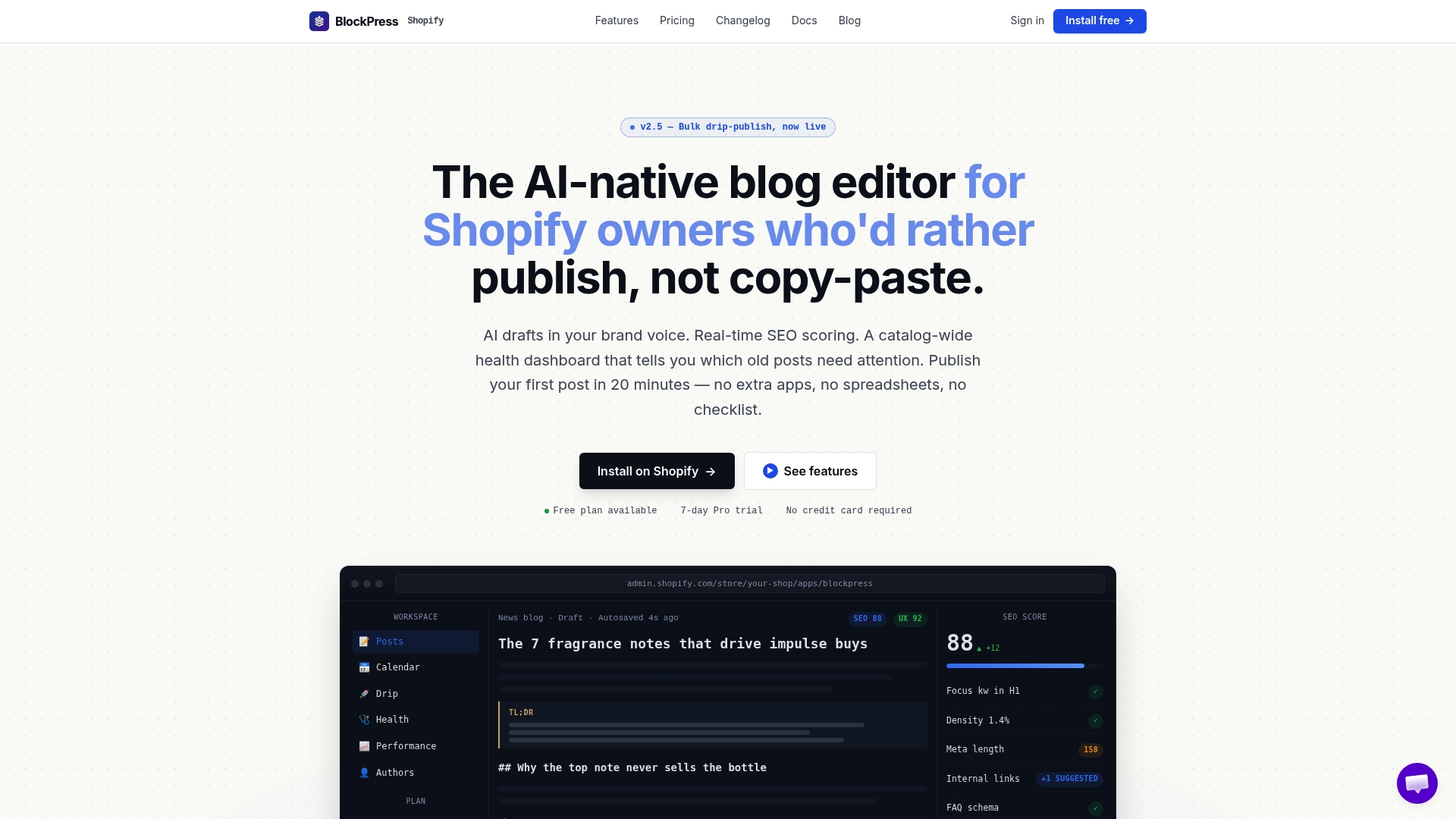
Blockpress gives you live SEO and UX scoring as you write, real Google keyword data inside the editor, and AI-generated article drafts you can edit with full editorial control. It supports structured data output, internal linking prompts, and per-article performance analytics so you can track which posts are earning traffic and which need updating. For Shopify merchants running a blog as part of their content and SEO strategy, Blockpress replaces the three separate apps most stores use to replicate what it does natively. See everything it offers on the Blockpress features page.
FAQ
What are the five pillars of a small business SEO checklist?
The five pillars are technical health, on-page optimization, content quality with AI alignment, local SEO, and backlink profile. Fixing 5 to 10 blocking issues across these areas produces visible improvements within 60 to 90 days.
How does AI search change SEO for small businesses in 2026?
AI engines like ChatGPT and Perplexity pull answers from pages with question-style headings, direct-answer paragraphs, and structured data. Tracking AI citation frequency monthly is now a standard part of any content audit.
How many Google reviews does a small business need for local rankings?
A review profile with at least 50 reviews and an average rating above 4.5 significantly improves local pack rankings. Automate review requests via SMS or email after each transaction to build that volume faster.
Is AI-generated content safe to publish for SEO?
AI-generated content is safe when you apply strong editorial oversight. Google's helpful content system penalizes generic output regardless of origin, so every AI draft needs original analysis and a consistent brand voice before publishing.
What is the fastest on-page SEO fix for a small business?
Rewriting title tags to include the primary keyword and stay under 60 characters is the fastest fix with the most direct ranking impact. Pair that with a clear H1 and one internal link per post for immediate gains.