
Yes — Shopify stores can reliably train AI to speak in their brand voice by combining a compact Brand Brain with Shopify's native AI features and a controlled pilot. Start by fixing knowledge accuracy, then write a short voice spec, then run a limited pilot on product pages and cart chat before expanding anywhere else. A tool like BlockPress can speed up the content and voice drafting piece without leaving Shopify.
TL;DR:
- A structured Brand Brain system ensures AI consistently reflects your store's unique voice by separating factual knowledge from tone.
- Native Shopify tools like Inbox, Sidekick, and Knowledge Base can handle basic support needs before requiring third-party apps for multichannel or advanced automation support.
- Training your chatbot involves fixing knowledge accuracy first, then gradually tuning voice with real customer conversations and weekly QA to prevent tone drifts.
- Measuring voice adherence through scoring a sample of replies and tracking operational metrics like containment rate and CSAT helps maintain consistent on-brand communication.
- Using tools like BlockPress aligns your blog content with your chatbot voice, reinforcing brand consistency across all written customer interactions without extra apps.
Table of Contents
- What Does "AI Brand Voice" Mean for a Shopify Store?
- Shopify's Native AI Tools vs. Third-Party Chatbot Apps
- Build a Brand Brain: The System That Keeps AI On-Brand
- How to Train Your Shopify Chatbot to Match Your Brand Voice
- Measuring Whether Your Chatbot Actually Sounds Like You
- Your 2 to 8 Week Pilot Rollout Checklist
- What Most Merchants Get Wrong About This
- Draft On-Brand Content and Measure It Without Leaving Shopify
- Sources
- FAQ
What Does "AI Brand Voice" Mean for a Shopify Store?
An AI brand voice for Shopify is the set of rules that tells a chatbot or AI writing tool exactly how to phrase answers, not just what facts to state. Two stores can give a customer the identical shipping fact and sound completely different doing it. One writes, "Your order ships within 2 business days." The other writes, "Hang tight! We're packing your order now and it'll be on its way within 2 business days." Same fact, different brand.
Voice lives in specific, measurable signals:
- Sentence length and rhythm (short and punchy versus longer and explanatory)
- Vocabulary choices ("swap" versus "exchange," "heads up" versus "please note")
- Emoji and punctuation habits
- Apology style when something goes wrong
- How upsells and cross-sells get phrased without sounding pushy
When these signals drift between your website chat, your email replies, and your product pages, customers notice the seams. A shopper who gets a warm, casual answer from Sidekick on a product page and then a stiff, corporate reply from a support agent an hour later starts to wonder if they're dealing with the same company. That inconsistency shows up as hesitation at checkout and lower trust in post-purchase follow-up.
This is why knowledge training and voice training need to stay separate in your head, even though they happen in the same tool. Knowledge training teaches the AI what's true (return windows, sizing charts, shipping zones). Voice training teaches it how to say that truth in a way that sounds like you. Skip the first step and you get a chatbot that sounds great but lies confidently. Skip the second and you get a chatbot that's accurate but generic.
Shopify's Native AI Tools vs. Third-Party Chatbot Apps
Shopify has built a surprisingly capable native stack for merchants who don't want to shop for a separate chatbot platform on day one.
Shopify Inbox is free and handles real-time chat directly on your storefront, including instant answers to common questions, cart-aware replies that reference what's actually in a shopper's cart, and order tracking and instant answers pulled from store data. Shopify Sidekick goes further, suggesting drafted replies and even helping with store admin tasks by reasoning over your product catalog and order history. Shopify Knowledge Base auto-generates factual answer sets about your store and tracks which customer questions it can't yet answer, which is exactly how you find the gaps in your FAQ before a customer does.
For a lot of stores, that trio is enough:
- Catalogs under a few hundred SKUs with straightforward order and shipping questions
- Single-channel support (just the website, no WhatsApp or Instagram DM volume)
- Teams without a dedicated CX or automation budget
You need a third-party app when you're managing support across multiple channels, need CRM integration for loyalty or subscription logic, or require automation workflows Shopify's native tools don't cover, like proactive win-back messages triggered by browsing behavior. The practical rollout order is to pilot with Inbox, Sidekick, and Knowledge Base first, prove the voice and accuracy work, then decide if a third-party app earns its keep for the specific gap it fills.
Build a Brand Brain: The System That Keeps AI On-Brand
A single prompt telling an AI to "sound friendly and professional" produces mediocre output every time, because the AI has nothing concrete to reference. A Brand Brain, a modular system of files the AI reads before every task, solves this by giving it persistent context instead of a re-typed briefing.
The system breaks into six layers:
- Positioning — what you sell, who you sell it to, and what makes you different from the store next to you in a search result
- Voice rules — sentence length preferences, banned words, punctuation habits, formality level
- Personas — the two or three customer types you actually talk to most
- Product intelligence — specs, materials, sizing quirks, and the questions customers ask most about each
- Objections — the five things that make people hesitate before buying, and your approved response to each
- Guardrails — legal or safety language you must never alter (return policy wording, health claims, warranty terms)
File-based, modular context beats pasting a prompt into a chat window every time you need output, because each file loads only when it's relevant to the task at hand, and it never needs re-briefing. Ask the AI to write a product description and it pulls positioning and product intelligence. Ask it to draft a chatbot reply and it pulls voice rules and objections.
At minimum, build a written voice spec, a brand dictionary of approved and banned terms, separate registers for each channel you use, and a set of example replies for your highest-volume customer intents (shipping status, returns, sizing, and the delight moments like an unexpected delay apology).
Pro Tip: Write your voice spec as if you're briefing a new hire on their first day, not as marketing copy. "Never use the word 'obviously' because it makes customers who ask basic questions feel dumb" is more useful than "be warm and approachable."
How to Train Your Shopify Chatbot to Match Your Brand Voice
Training voice into a chatbot is not a one-time setup. It's a sequence, and skipping steps is how merchants end up with a bot that sounds off no matter how much they tweak the prompt.
1. Fix the foundation first. Clean up your product data, write canonical answers to your top 20 FAQs, and confirm your support logic (return windows, escalation triggers) is accurate before you touch tone at all. Merchant teams should avoid tuning personality before accuracy — a charming chatbot that gives wrong return dates costs you more than a bland one that's correct.
2. Gather your training inputs. Pull real customer conversations from your support inbox, not hypothetical ones. Scenario-based training using actual support logs beats a list of adjectives every time, because real conversations show you the actual phrasing customers respond well to.
3. Configure the system. Load your knowledge sources (product data, policies, FAQ answers) first, then layer your Brand Brain voice files on top as a wrapper. Set clear escalation rules: what triggers a handoff to a human, and what the bot says when it hands off ("Let me get my colleague Sarah to help with that" beats a cold "Transferring you now").
4. Pilot on a limited scope. Run the trained voice on product detail pages and cart chat only, not your whole support inbox. Capture a sample of 50 to 100 real conversations weekly for QA review.
Some working notes from that pilot phase:
- Adjust for channel: website chat can be more structured, while a WhatsApp or Instagram reply needs to be shorter and warmer to match the platform's own norms
- Keep a running list of "almost right" replies. These teach you more than the outright failures
- Route anything involving refunds over a certain dollar amount to a human by default, regardless of how confident the bot sounds
- Iterate weekly rather than monthly. Voice drift compounds fast when nobody's watching
Measuring Whether Your Chatbot Actually Sounds Like You
Voice work is worthless if you can't tell whether it's working, and "it feels better" isn't a metric you can report to your team.
Build a simple voice adherence score by pulling a random sample of 20 to 30 chatbot replies each week and scoring them against your voice spec on a 1 to 5 scale: does it match your approved vocabulary, does it avoid banned phrases, does the sentence length feel like you. Have two people score the same batch independently and compare notes. Disagreement between scorers usually means your voice spec itself needs to be more specific.
Then track the operational numbers that tell you whether the voice work is translating into business results:
- Containment rate — the share of conversations the bot resolves without human escalation
- CSAT — customer satisfaction scores tied specifically to chat interactions
- Chat-driven conversion — purchases that happen after a chat interaction on a product or cart page
- Escalation rate — how often and why conversations get handed to a human
Industry guidance recommends tracking these metrics weekly rather than treating voice as a set-it-and-forget-it project.
Pro Tip: Run a weekly failure review where you read the ten worst-scoring conversations out loud in a team meeting. It surfaces voice problems faster than any spreadsheet. Pair that with a full monthly voice audit against your written spec, and build your growth roadmap around whichever metric moved the least.
Your 2 to 8 Week Pilot Rollout Checklist
Pick your pilot scope before anything else. The highest-impact spot is usually product detail pages and cart chat on your top 10 to 20 SKUs by traffic, on a single channel.
- Write your voice spec and brand dictionary (Week 1)
- Draft 50 sample replies covering your top intents (Week 1 to 2)
- Sync your canonical knowledge base and close obvious FAQ gaps (Week 2)
- Set handoff and escalation rules in writing (Week 2 to 3)
- Launch the pilot on your chosen scope only (Week 3 to 4)
- Run weekly QA sampling and score voice adherence (Week 4 to 6)
- Review containment, CSAT, and conversion numbers against a go/no-go bar you set in advance (Week 6 to 8)
| Pilot Element | What "Ready" Looks Like |
|---|---|
| Voice spec | Written, with banned and approved terms listed |
| Sample replies | 50+ drafted and reviewed for top intents |
| Knowledge sync | Canonical FAQ answers verified accurate |
| Handoff rules | Escalation triggers documented, not assumed |
| QA plan | Weekly sampling scheduled with a named owner |
If containment and CSAT hold steady or improve after eight weeks, expand to a second channel. If either drops, go back to your knowledge accuracy before you touch voice again.
What Most Merchants Get Wrong About This
Merchants tend to treat brand voice as a personality problem when it's really a systems problem. You don't fix inconsistent chatbot tone by writing a better prompt. You fix it by giving the AI the same structured context a well-trained new hire would get on their first week: what's true, how we say it, and where the lines are. Skip the accuracy work and tune personality first, and you'll ship a chatbot that's charming and wrong, which erodes trust faster than a bot that's dull and correct.
The gap most stores never close is between "sounds fine in a demo" and "held up over six months of real customer questions." That only happens with a written voice spec, a real QA cadence, and someone accountable for reviewing failures weekly. A modular Brand Brain approach is one of the more reliable ways to get there because it separates the fact layer from the tone layer, which is where most bots quietly fall apart. On the content side, tools built for product storytelling in a consistent brand voice solve a nearly identical problem, since your blog and your chatbot should sound like the same company anyway.
— Rodney
Draft On-Brand Content and Measure It Without Leaving Shopify
BlockPress gives you the same brand-voice discipline your chatbot needs, but for your blog and content calendar, without paying for three separate apps to replicate one editor's job. It generates on-brand drafts using your product and positioning data, scores each draft for SEO and UX before you publish, and audits your existing articles for gaps the same way Shopify's Knowledge Base flags unanswered chatbot questions.
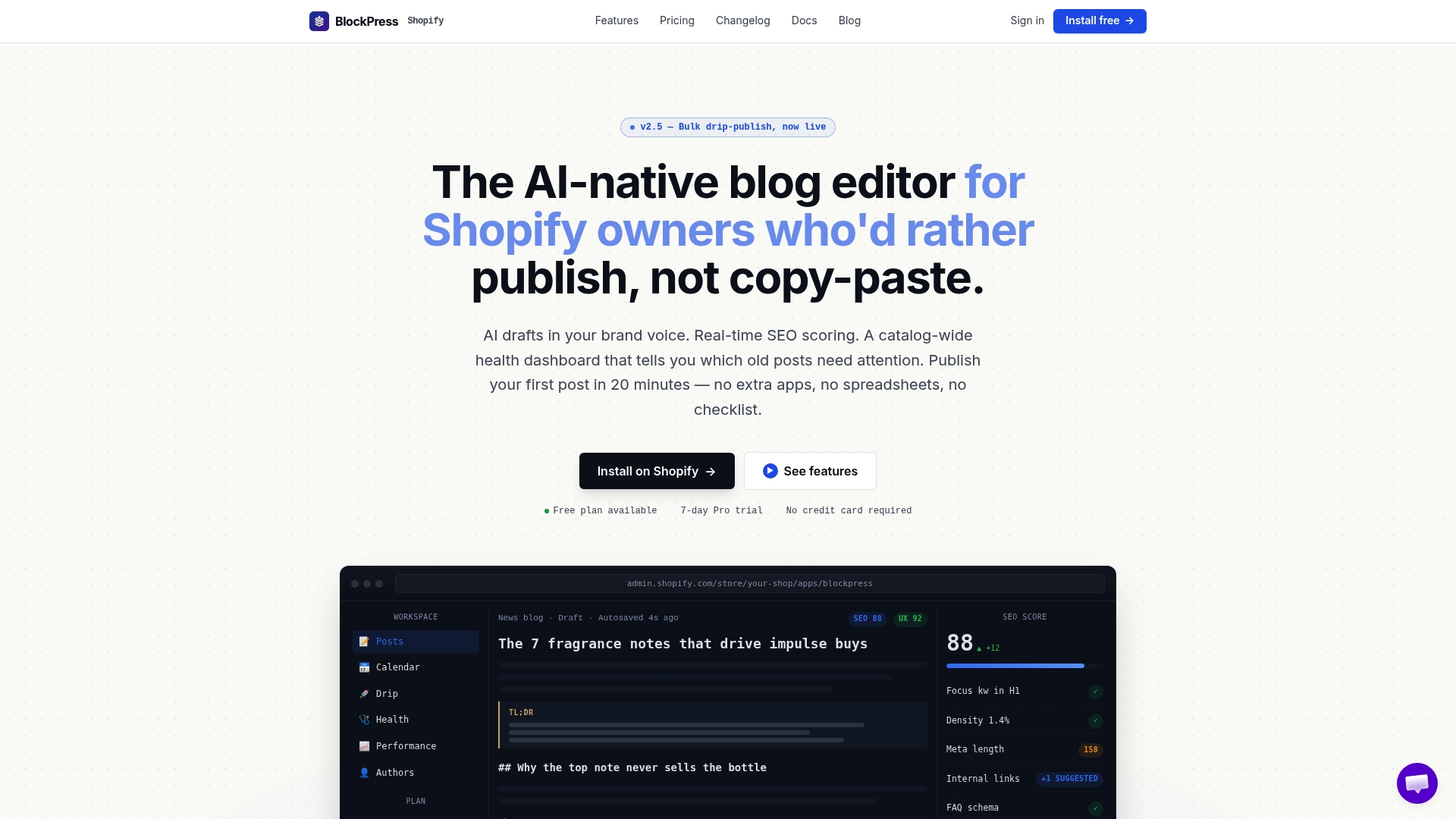
Once your Brand Brain voice spec exists for your chatbot, feed the same voice rules into BlockPress and your blog content stops sounding like a different company wrote it. Install BlockPress, run one article draft against your voice dictionary, and check the per-article analytics against your traffic a few weeks later to see whether the voice consistency shows up in engagement. Every plan starts with a free tier to test the workflow before you commit to anything, and the full feature breakdown shows exactly how the SEO scoring and drafting tools connect inside your Shopify admin.
Sources
FAQ
What Is a Brand Brain in AI Brand Voice Work?
A Brand Brain is a modular set of files covering positioning, voice rules, personas, product intelligence, objections, and guardrails that gives AI persistent, structured context instead of a repeated prompt.
Should I Start With Shopify Inbox or a Third-Party Chatbot App?
Start with Shopify Inbox, Sidekick, and Knowledge Base for a pilot; add a third-party app only if you need multichannel support, CRM integration, or automation workflows the native tools don't cover.
How Long Should a Shopify AI Voice Pilot Run?
Run a focused pilot for 2 to 8 weeks on a limited scope like product pages and cart chat, then use containment rate, CSAT, and conversion data to decide whether to expand.
Can BlockPress Help With Brand Voice, Not Just Chatbots?
Yes. BlockPress applies the same brand-voice discipline to blog and product content drafting inside Shopify, using live SEO and UX scoring so your written content and chatbot sound like the same brand.
What Should I Fix Before Tuning Chatbot Tone?
Fix knowledge accuracy first, meaning clean product data and verified canonical FAQ answers, since a charming chatbot that gives wrong information does more damage than a plain but accurate one.