
TL;DR:
- Brand authority in SEO is a trust signal indicating a brand's credibility through consistent schema and third-party validation. It influences AI citations, click-through rates, and resilience during search algorithm updates. Building authority requires focused schema, author credibility, corroboration, and structured content, especially for Shopify stores.
Brand authority in SEO is the machine-validated trust and entity confidence that leads search engines and generative AI systems to preferentially cite a brand's content. It is not a backlink count or a keyword ranking. It is the cumulative signal that your brand is a real, corroborated entity worth surfacing to users. The verdict: brands with consistent entity signals, third-party corroboration, and extraction-ready content win more AI overview placements, higher click-through rates, and stronger resilience when Google updates hit. With AI-driven search (Google's AI Overviews, SGE-style generative answers) now reshaping how results are presented, the shift is no longer about being clicked. As Advertising Week frames it, the new battleground is being cited. Moz Brand Authority, E-E-A-T signals, and consistent schema markup are the practical levers. For Shopify stores, tools like Blockpress make implementing those levers faster.
Table of Contents
- Why brand authority matters for your SEO results
- How brand authority differs from Domain Authority and topical authority
- How brand authority is measured in practice
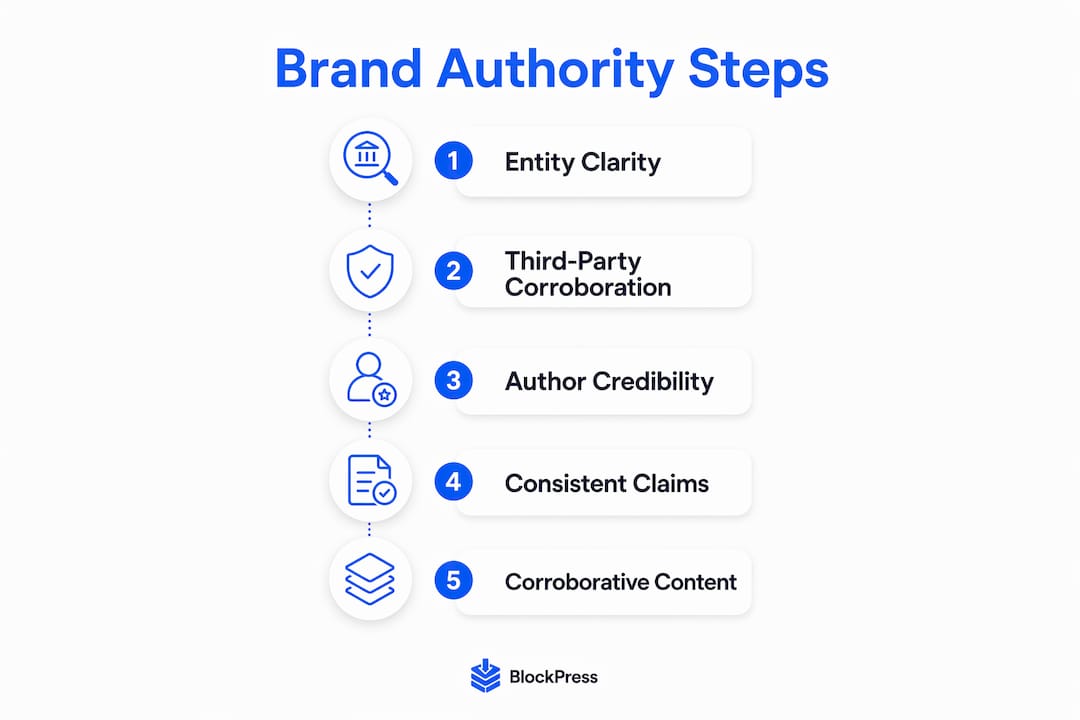
- How to build brand authority: a prioritized checklist
- What AI-driven search looks for in your brand
- Applying brand authority tactics to your Shopify store
- KPIs to track your brand authority progress
- Key Takeaways
- The case for brand authority as a strategic priority
- Blockpress speeds up brand authority work for Shopify stores
- FAQ
Why brand authority matters for your SEO results
Brand authority produces concrete, measurable outcomes across multiple channels. When it improves, you typically see movement in several areas at once.
- AI citations and featured answer placement. AI systems are conservative by design. They prefer corroborated brand entities because a model's own credibility is at stake when it cites an external source. Brands with clear entity graphs and third-party validation get pulled into AI overviews more often.
- Higher CTR on branded and non-branded queries. Recognized brands earn more clicks at the same rank position. Users trust names they have seen cited elsewhere, so branded SERP features (sitelinks, knowledge panels) lift CTR further.
- Improved organic conversions. A brand users already trust converts at a higher rate than an unfamiliar domain, even when both rank on page one.
- Resilience to ranking volatility. Market-driven signals like direct brand searches and unsolicited mentions act as a buffer. Brands with strong authority tend to recover faster after core updates.
Realistic timelines: citation share and branded CTR can show early movement within a couple of months of fixing entity and author signals. Branded search volume growth usually takes several months of consistent corroboration work.
Pro Tip: Fix entity ambiguity and author credibility first. These two issues block AI citations faster than any other factor, and resolving them costs far less than a full link-building campaign.
How brand authority differs from Domain Authority and topical authority
These three concepts are often conflated, and conflating them leads to misallocated budgets.
Domain Authority (DA) is a third-party, backlink-based score (Moz's version runs 1–100) that predicts ranking potential for a given domain. It measures the strength of your link profile, not whether anyone trusts your brand. You can build DA through link acquisition while having zero brand recognition in your market.
Brand authority operates at the entity level. It reflects how consistently and clearly your brand is identified across the web, how many reputable third parties corroborate your claims, and whether AI systems can resolve your entity without ambiguity. A newer brand with strong press coverage, consistent schema, and active author pages can have meaningful brand authority well before its DA climbs.

Topical authority is about depth and cluster dominance within a subject area. It is earned by publishing comprehensive, interlinked content that covers a topic from multiple angles. Topical authority helps you rank for a category of queries; brand authority determines whether AI systems trust you enough to cite you in answers.
| Dimension | Domain Authority | Brand Authority | Topical Authority |
|---|---|---|---|
| Unit of evaluation | Domain link profile | Named entity (brand/person/org) | Topic cluster coverage |
| Primary inputs | Backlinks, referring domains | Schema, citations, reviews, author credentials | Content depth, internal linking, cluster completeness |
| Failure mode | Link decay, toxic links | Entity ambiguity, contradictory claims | Thin coverage, orphaned pages |
| Best proxy KPI | Moz DA or similar score | Branded search volume, citation share | Ranking coverage across cluster queries |
When to prioritize each: If you are struggling to rank at all, DA work (link building) is the floor. Once you rank but lose clicks to recognized competitors, brand authority work closes that gap. Topical authority is the right investment when you want to own an entire subject area rather than individual keywords.
How brand authority is measured in practice
No single score captures brand authority completely, but you can build a reliable picture from a combination of proprietary tools and practical proxies.
Moz Brand Authority is a 1–100 proprietary score that measures a domain's broader brand strength using search features and brand-term detection across Google results. Moz describes it as a measure of brand salience and demand, distinct from DA. It is a useful benchmark, but its methodology is not fully transparent, so treat it as one input rather than the definitive answer.
Track these signals directly:
| Signal | What it indicates |
|---|---|
| Branded search queries | Indicative of brand recognition |
| Third-party citations | Mentions or links from reputable external sources |
| Author credentials and bio pages | Attribution to credible experts |
| Schema completeness | AI resolution of your entity without ambiguity |
| Review volume and ratings | Trust signals supporting E-E-A-T and AI confidence |
| Unlinked brand mentions | Non-hyperlinked corroborations tracked via alerts |
Regularly monitor branded queries in Google Search Console, citation counts from backlink tools, and review aggregates from profile sites. Watch for significant drops in metrics or schema validation errors, and audit entity consistency across your main web properties.
How to build brand authority: a prioritized checklist
Work through these in order. The first three are quick wins; the rest are longer investments.
-
Fix entity schema (Week 1–2, low cost). Add or correct Organization, Person, and Service schema on your site. Inconsistent or missing markup is the single fastest way to confuse AI retrieval systems. Use Google's Rich Results Test to validate. This is largely in-house work; no agency budget needed.
-
Publish author-led expert content (Month 1 onward, moderate cost). Every post should have a named author with a bio page that lists credentials, publications, and social profiles. Author credibility directly feeds E-E-A-T and is one of the signals AI models check when deciding whether to cite a source.
-
Earn corroborating third-party citations (Month 1–3, variable cost). Press mentions, research citations, and references from industry publications are the strongest corroboration signals. Brands that rely only on on-domain signals remain fragile, as Apex Visibility notes. Pitch data-driven stories or expert commentary to trade publications in your niche. Earned outreach takes time but costs less than paid placements.
-
Collect structured reviews and ratings (Month 1–2, low cost). Reviews on Google, Trustpilot, or industry-specific aggregators provide Trust signals that both users and AI models can verify. Set up a post-purchase review request sequence and respond to reviews publicly.
-
Structure content for extraction (Month 1 onward, low cost). Format posts with clear definitions, FAQ sections, and decision tables. Answer-structured content is more likely to be extracted and cited by generative systems than long narrative prose. Think of every post as needing at least one extractable answer block.
-
Build a linked content cluster (Month 2–4, moderate cost). Group related posts around a core topic and interlink them. This reinforces topical authority alongside brand authority and gives AI systems a coherent entity graph to navigate. See SEO-driven blog strategies for cluster formats that perform well.
-
Audit for entity consistency quarterly (Ongoing, low cost). Contradictory service names, missing author pages, or inconsistent location claims are a principal failure mode for brand authority. Run a quarterly check across your site, Google Business Profile, and any third-party directories where your brand appears.
Pro Tip: Use targeted third-party corroboration — a quote in an industry report, a mention in a trade publication, a data citation from a university — to accelerate the trust signals that LLM retrieval systems weight most heavily. One strong external citation often outperforms ten new blog posts.
What AI-driven search looks for in your brand
Google's AI Overviews and similar generative systems do not rank pages the way traditional search does. They retrieve content from entities they have already resolved and trust. That distinction changes your strategy.

AI systems prefer brands with clear entity graphs: a named organization, identified authors, defined services, and consistent location data, all corroborated by reputable third parties. When those elements are present and non-contradictory, the system can confidently cite your content without risking its own credibility.
Your AI citation readiness checklist:
- Consistent schema across every page: Organization, Person, and Service markup that matches your on-page claims exactly.
- Author credentials visible and linked: Bio pages with verifiable credentials, not just a name in a byline.
- Third-party corroboration: At least a handful of reputable external sources that mention your brand, ideally with specific claims (not just a link).
- Answer-structured content: Definitions at the top of posts, FAQ sections, and decision tables that give AI systems something extractable. Featured snippets and AI citations often come from the same content formats.
- Non-contradictory sitewide claims: If your homepage says you serve three cities and your contact page lists one, that ambiguity reduces citation probability.
Personalized video and multimedia content are also emerging as corroboration signals. Brands that appear across formats (text, video, audio) with consistent entity signals build a richer graph for AI systems to reference. The authority loop between content formats and AI search presence is worth tracking as generative search matures.
Pro Tip: When pitching to industry publications, ask editors to include your brand name and a specific claim (not just a generic mention). A cited statistic or named expert quote from your team is far more useful to AI retrieval than a passing reference.
Applying brand authority tactics to your Shopify store
Ecommerce stores face a specific challenge: product pages rarely earn citations, but blog content can, provided it is structured correctly and attributed to credible authors.
Practical checklist for Shopify teams:
- Add Organization and Product schema to your store and verify it in Google Search Console.
- Create author bio pages for every content contributor. Link each post to its author's bio. This single step often produces the fastest E-E-A-T improvement for stores that have been publishing anonymously.
- Keep your brand name, service descriptions, and location claims identical across your Shopify store, Google Business Profile, and any marketplace listings (Amazon, Etsy, etc.).
- Earn cross-site corroboration: press mentions, review aggregator profiles (Google, Trustpilot), and supplier or partner pages that reference your brand.
- Structure every blog post with a clear definition or answer at the top, a FAQ section, and at least one decision table or comparison where relevant.
A repeatable workflow: write a content brief targeting a specific question your customer asks, draft the post with an answer-structured format (definition first, FAQ at the end), attach an author bio with credentials, add schema markup, then do outreach to one or two relevant publications for a citation or mention. Monitor citation share and branded query volume monthly to track whether the work is landing.
How Google ranks ecommerce blog posts covers the E-E-A-T and ranking factors specific to this context in more detail. For stores running AI-assisted drafts, keeping content extraction-ready is covered in the ecommerce blog drafting guide.
Blockpress supports this workflow directly: it provides author bio pages, automated SEO checks on every post, AI-generated drafts formatted for extraction, and per-article performance analytics, all without leaving your Shopify admin.
KPIs to track your brand authority progress
Tracking brand authority requires a small set of metrics checked at different cadences. Here is a monitoring plan you can follow without a dedicated analytics team.
-
Branded search volume (Weekly). Pull from Google Search Console. A sustained upward trend over 8–12 weeks is an early positive signal. A sudden drop of more than 15% in a week warrants immediate investigation.
-
Branded CTR (Weekly). Also in Search Console. If impressions hold but CTR drops, your SERP appearance (title, description, sitelinks) may need attention.
-
Citation share in AI overviews (Monthly). Manually check 10–15 queries where you want to appear. Track how often your brand is cited versus competitors. This is currently a manual process; no tool fully automates it yet.
-
Unlinked brand mentions (Monthly). Use Google Alerts or a tool like Mention to track brand name appearances across the web. Unlinked mentions still contribute to entity corroboration and can be converted to links through outreach.
-
Branded SERP features (Monthly). Check whether your brand triggers a knowledge panel, sitelinks, or a People Also Ask block. Gaining or losing these features is a strong signal of entity resolution status.
-
Author and expert mentions (Quarterly). Track how often your named authors or executives are cited in third-party publications. Growing author visibility feeds both E-E-A-T and AI citation probability.
Triggers that should prompt immediate action:
- Schema validation errors appear in Google Search Console's rich results report.
- A named author's bio page is removed or de-indexed.
- Branded query volume drops more than 15% week over week.
- A major third-party citation (press mention, directory listing) is removed or changed.
- Your brand's knowledge panel disappears or shows incorrect information.
Key Takeaways
Brand authority in SEO is an entity-level trust signal built from consistent schema, third-party corroboration, and author credibility, and it is now the primary factor determining whether AI systems cite your content.
| Point | Details |
|---|---|
| Entity clarity comes first | Fix Organization, Person, and Service schema before investing in content volume. |
| Corroboration beats owned content | Third-party citations and press mentions carry more weight than additional blog posts on your own domain. |
| Moz Brand Authority as a benchmark | Use the 1–100 Moz Brand Authority score as one input alongside branded search volume and citation share. |
| AI citations require extraction-ready content | Format posts with definitions, FAQ sections, and decision tables so generative systems can pull clear answers. |
| Blockpress for Shopify implementation | Blockpress automates author bio pages, SEO checks, and answer-structured drafts to speed up brand authority work for Shopify stores. |
The case for brand authority as a strategic priority
Most SEO teams I see still treat brand authority as a soft, unmeasurable concept — something marketing handles while SEO focuses on links and rankings. That framing is costing them citations.
The practical argument for prioritizing brand authority is straightforward: entity problems block AI citations regardless of how good your content is. A post that answers a question perfectly will not get cited if the AI system cannot confidently resolve who wrote it, what organization it represents, or whether the claims are corroborated anywhere else. Fixing those problems is often faster and cheaper than a link-building campaign, and the results compound over time in ways that links alone do not.
When pitching this to stakeholders, frame it around risk and compounding return. Brand authority protects traffic during core updates because market-validated signals (branded searches, unsolicited mentions, author recognition) are harder for Google to discount than link profiles. A 3–6 month pilot focused on entity schema, author pages, and two or three earned press citations is a low-cost way to demonstrate movement in branded CTR and citation share before committing to a larger program.
The sequencing matters: fix entity ambiguity first (schema, author pages, consistent claims), then invest in corroboration (press outreach, review aggregation), then scale content with retrieval utility in mind. Teams that skip the first step and go straight to content volume end up with a lot of posts that AI systems ignore.
Blockpress speeds up brand authority work for Shopify stores
Building brand authority on Shopify takes coordination across content, schema, author pages, and analytics. Most stores manage that with three or four separate apps, which means data lives in different places and checks get missed.
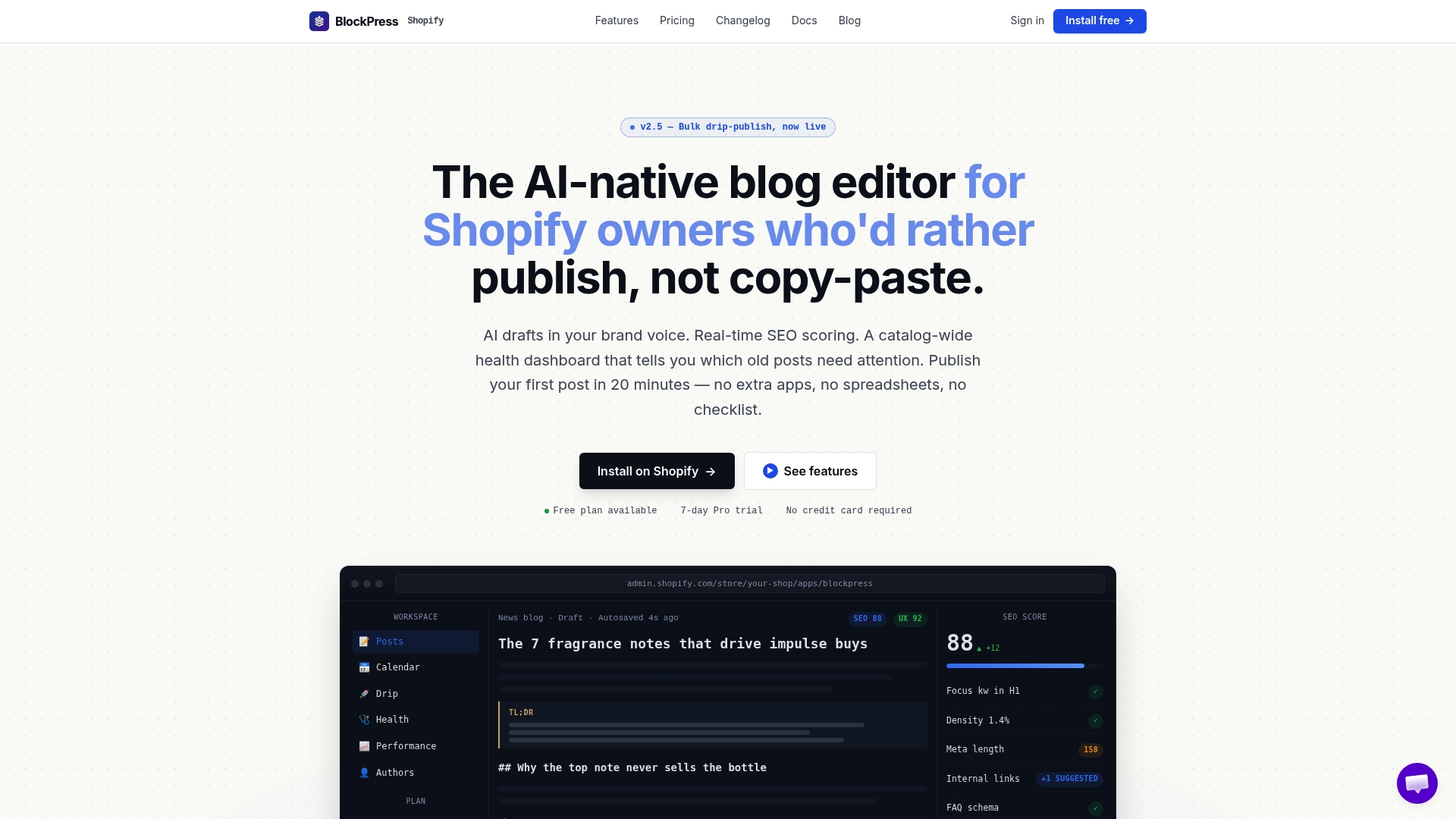
Blockpress consolidates that workflow inside your Shopify admin. You get author bio pages built in, automated SEO and UX scoring on every post, AI-generated drafts formatted for extraction (definitions first, FAQ sections included), bulk drip-publishing, and per-article performance analytics. The 12 SEO checks that matter most for brand authority signals run automatically on every post before it publishes.
If you want to move faster on the entity and content checklist without adding more tools to your stack, try Blockpress and see how it fits your store's workflow.
Useful sources
- Advertising Week: Brand Authority vs Domain Authority — Frames the shift from clicks to citations and explains why AI systems prefer corroborated entities. Start here for the strategic context.
- Moz: What Is Brand Authority and How Is It Calculated? — The primary reference for the Moz Brand Authority score, its inputs, and how to interpret it as a measurement tool.
- Moz Blog: Introducing Brand Authority — Explains the rationale behind the score and its use cases for practitioners building measurement dashboards.
- Apex Visibility: What Brand Authority Actually Means — The most practically detailed source in this list. Covers entity graphs, retrieval utility, and the Entity Confidence × Retrieval Utility formula. Essential for implementation.
- Search Engine Land: Brand Authority in AI Search — Explains why market-driven signals (brand searches, unsolicited mentions) matter more than owned content volume for AI citations.
- Sydekar: What Is Brand Authority in AI Search? — Practical breakdown of E-E-A-T as the foundation for AI citation eligibility, with emphasis on Trust signals.
- Brandastic: How Brands Build Authority in an AI Search World — Covers schema and entity markup in detail; useful for the technical checklist and understanding how inconsistency reduces citation rates.
- EvenDigit: Brand Authority vs Domain Authority — Clear comparison of the two metrics with decision guidance on when to prioritize each.
FAQ
What is brand authority in SEO?
Brand authority in SEO is the level of trust and entity confidence a brand has earned from both users and search engines, built through consistent schema, third-party corroboration, expert-led content, and verifiable author credentials. It determines how likely AI systems and search engines are to cite your content in answers and featured placements.
What is the difference between brand authority and Domain Authority?
Domain Authority is a third-party, backlink-based score that predicts ranking potential; brand authority is an entity-level trust signal built from corroboration, schema, reviews, and author credibility. A site can have high DA with no brand recognition, or strong brand authority with a modest link profile.
How is brand authority measured?
Moz Brand Authority provides a 1–100 proprietary score based on search features and brand-term detection. Practical proxies include branded search volume in Google Search Console, citation share in AI overviews, unlinked brand mentions, and schema completeness validated through Google's Rich Results Test.
What is a good brand authority score?
Moz Brand Authority scores vary widely by industry and brand size; more useful than any single score is a consistent upward trend in branded search volume and citation share over a 3–6 month period. More useful than any single score is a consistent upward trend in branded search volume and citation share over a 3–6 month period.
How does brand authority affect AI search citations?
AI systems prioritize brands with clear, non-contradictory entity graphs and third-party corroboration because citing an unreliable source reflects on the model itself. Answer-structured content (definitions, FAQs, decision tables) combined with consistent schema and verified author credentials gives your brand the best chance of appearing in AI overviews and generative answers.