
TL;DR:
- Effective SEO blog strategies combine content clustering, internal linking, and regular updates to improve organic rankings. Building topical authority and matching content to user intent are essential for sustained growth. Regular audits and a structured content system ensure long-term ranking success.
SEO-driven blog strategies are content plans built explicitly to maximize organic rankings and user engagement. The best examples combine content clustering, internal linking, topical authority, and user-focused optimization into a single repeatable system. Google's E-E-A-T framework (Experience, Expertise, Authoritativeness, Trustworthiness) defines the quality standard every blog post must meet to compete in organic search. Content creators and marketers who apply these techniques consistently see compounding traffic gains that paid channels simply cannot replicate.
1. Examples of SEO-driven blog strategies: content clustering
Content clustering is the most structurally sound SEO blogging technique available. A pillar page covers a broad topic in depth, while cluster articles each target a specific subtopic. Together, they signal comprehensive topic coverage to search engines.
To build a cluster, choose a pillar topic with strong search volume and clear subtopics. Map every subtopic as a separate article, then connect all cluster articles to the pillar with internal links. This structure improves crawlability, topical authority, and keyword coverage simultaneously.
- Pillar page: Covers the broad topic (e.g., "Shopify SEO Guide")
- Cluster articles: Target specific subtopics (e.g., "Shopify image alt text," "Shopify meta descriptions")
- Internal links: Every cluster article links to the pillar, and the pillar links back to each cluster
Pro Tip: Define clear keyword boundaries for each cluster article. Overlapping keyword targets cause cannibalization, where two pages compete for the same query and neither ranks well.
2. Strategic internal linking between blog posts

Internal linking with descriptive anchor text between pillar and cluster pages enhances crawlability and signals topic relatedness to search engines. Orphaned pages, those with no inbound links, break the cluster structure and create SEO gaps.
Follow these four linking patterns for every cluster you build:
- Link every cluster article to its pillar page using the pillar's primary keyword as anchor text.
- Link the pillar page back to each cluster article using the cluster's target keyword.
- Link related cluster articles horizontally to reinforce context between subtopics.
- Audit for orphan pages monthly and add at least one inbound link to any page missing them.
Adding missing internal links moved 8 of 15 pages from page 2 to page 1 in three weeks within a single topical cluster. That result shows how much structural linking matters, even without new content.
Pro Tip: Run a regular SEO audit every quarter to catch broken links, orphan pages, and anchor text gaps before they compound into ranking losses.
3. Building topical authority with comprehensive content
Topical authority is the degree to which search engines trust your site as a definitive source on a subject. Sites with strong topical authority rank for a wider range of related keywords naturally and recover better from algorithm updates like Google's Helpful Content updates.
Comprehensive content means covering the full breadth and depth of a topic. That includes in-depth guides, FAQs, pricing information, and honest comparisons. Leaving out pricing pages, for example, signals incomplete coverage to search engines and reduces trust.
- Cover every stage of the buyer's question: awareness, consideration, and decision
- Include pricing or cost-related content, even if it is a custom pricing note
- Add FAQs to each pillar page to capture long-tail queries
- Publish in-depth guides that go beyond surface-level definitions
Topical authority is no longer self-declared, but proof-backed. Brands need third-party validation to rank for high-volume searches. AI systems and search engines look for external evidence to verify expertise beyond your own domain.
The practical implication: actively seek backlinks, press mentions, and third-party reviews. Off-site proof amplifies everything you publish on-site.
4. User-focused content optimization techniques
Content optimized for user intent outperforms content optimized purely for keyword density. Search intent falls into three categories: informational (how-to guides), commercial (comparisons and reviews), and transactional (buy now, pricing pages). Matching your content format to the right intent type is a core SEO blogging technique.
- Informational intent: Long-form guides, tutorials, and FAQs
- Commercial intent: Comparison articles, "best of" lists, and honest reviews
- Transactional intent: Product pages, pricing guides, and case studies
Refreshing old content with new statistics and clearer advice, as HubSpot does routinely, helps maintain or improve rankings over time. A page that ranked well two years ago can lose ground without updates. Schedule a content refresh every six months for your highest-traffic posts.
Pro Tip: Use author bio pages and schema markup to reinforce E-E-A-T signals. Search engines use these on-site signals to verify that real experts wrote your content.
5. Editorial calendars aligned with SEO goals
An editorial SEO calendar enables planning pillar pages, cluster posts, evergreen updates, and bottom-funnel articles in a sustainable, repeatable schedule. Without one, most blogs publish reactively and end up with content gaps that weaken topical authority.
A well-structured calendar maps content types to publishing frequency. Pillar pages require more production time and publish less often. Cluster articles publish more frequently to build out topic depth. Evergreen updates slot in quarterly. This balance keeps your blog growing without burning out your team.
6. Evergreen URLs and stable content architecture
Evergreen URLs avoid dates or version numbers in the slug. A URL like /shopify-seo-guide outperforms /shopify-seo-guide-2023 because you can update the content without changing the URL and losing accumulated link equity. Stable URLs also make internal linking easier to maintain over time.
Pair evergreen URLs with a clear site architecture. Every blog post should sit no more than three clicks from the homepage. Deeper pages receive less crawl budget and rank less consistently. A flat, logical structure benefits both users and search engine crawlers.
7. Comparing hub-and-spoke vs. standalone article models
The hub-and-spoke model suits sites with broad topic coverage and enough content volume to build full clusters. Standalone articles work better for narrow niches or low-resource teams publishing fewer than four posts per month.
| Feature | Hub-and-spoke model | Standalone articles |
|---|---|---|
| Topical coverage | Broad and deep | Narrow and focused |
| Scalability | High | Low |
| Maintenance effort | High | Low |
| Internal linking | Structured and deliberate | Minimal |
| Best for | Established content teams | Early-stage blogs |
Pro Tip: Combine both models. Start with two or three standalone articles to test a topic's traffic potential, then build a full cluster around the one that performs best.
8. Tracking per-article performance to refine strategy
Effective blog strategies require per-article analytics, not just site-wide traffic reports. Knowing which posts drive the most organic sessions, which have high bounce rates, and which convert visitors to customers tells you exactly where to invest next. How blog traffic converts to sales depends on this feedback loop between content performance and publishing decisions.
Review each post's click-through rate, average position, and time on page monthly. Posts with high impressions but low click-through rates need stronger title tags and meta descriptions. Posts with strong traffic but low conversions need better calls to action or tighter alignment with transactional intent.
Key Takeaways
The most effective SEO-driven blog strategies combine content clustering, deliberate internal linking, proof-backed topical authority, and regular content refreshes into one consistent system.
| Point | Details |
|---|---|
| Content clustering builds authority | Pillar pages plus cluster articles signal comprehensive topic coverage to search engines. |
| Internal linking drives rankings | Adding missing internal links can move pages from page 2 to page 1 within weeks. |
| Third-party proof is required | Off-site mentions, backlinks, and reviews validate topical authority beyond your own domain. |
| User intent shapes content format | Match informational, commercial, or transactional intent to the right content type for each post. |
| Per-article analytics guide investment | Monthly performance reviews reveal which posts to refresh, expand, or retire. |
What I've learned about SEO blog strategy after years in the field
The biggest mistake I see content teams make is treating SEO as a checklist rather than a system. They optimize a title tag, add a few keywords, and call it done. Real SEO-driven content marketing requires structural thinking: how does this post connect to everything else on the site?
Topical authority takes longer to build than most teams expect. You will not see results in two weeks. You might not see them in two months. But when a cluster reaches critical mass, rankings compound in a way that individual articles never do. I have watched sites go from ranking for 50 keywords to 500 within a single quarter, purely by filling in cluster gaps and fixing internal linking.
The part nobody talks about enough is link hygiene. Internal links break, anchor text drifts from the target keyword, and orphan pages accumulate quietly. A quarterly content audit is not optional if you want a cluster to hold its rankings. Treat it like maintenance on a physical asset.
Patience and consistency separate the blogs that rank from the ones that plateau. Publish on a schedule, refresh on a schedule, and audit on a schedule. The algorithm rewards reliability.
— Rodney
Blockpress makes SEO blog execution faster for Shopify stores
Executing these strategies manually across dozens of posts is time-consuming. Blockpress is an AI-native blog editor built directly into Shopify that brings real Google keyword data, live SEO scoring, article health audits, and per-article analytics into one editor.
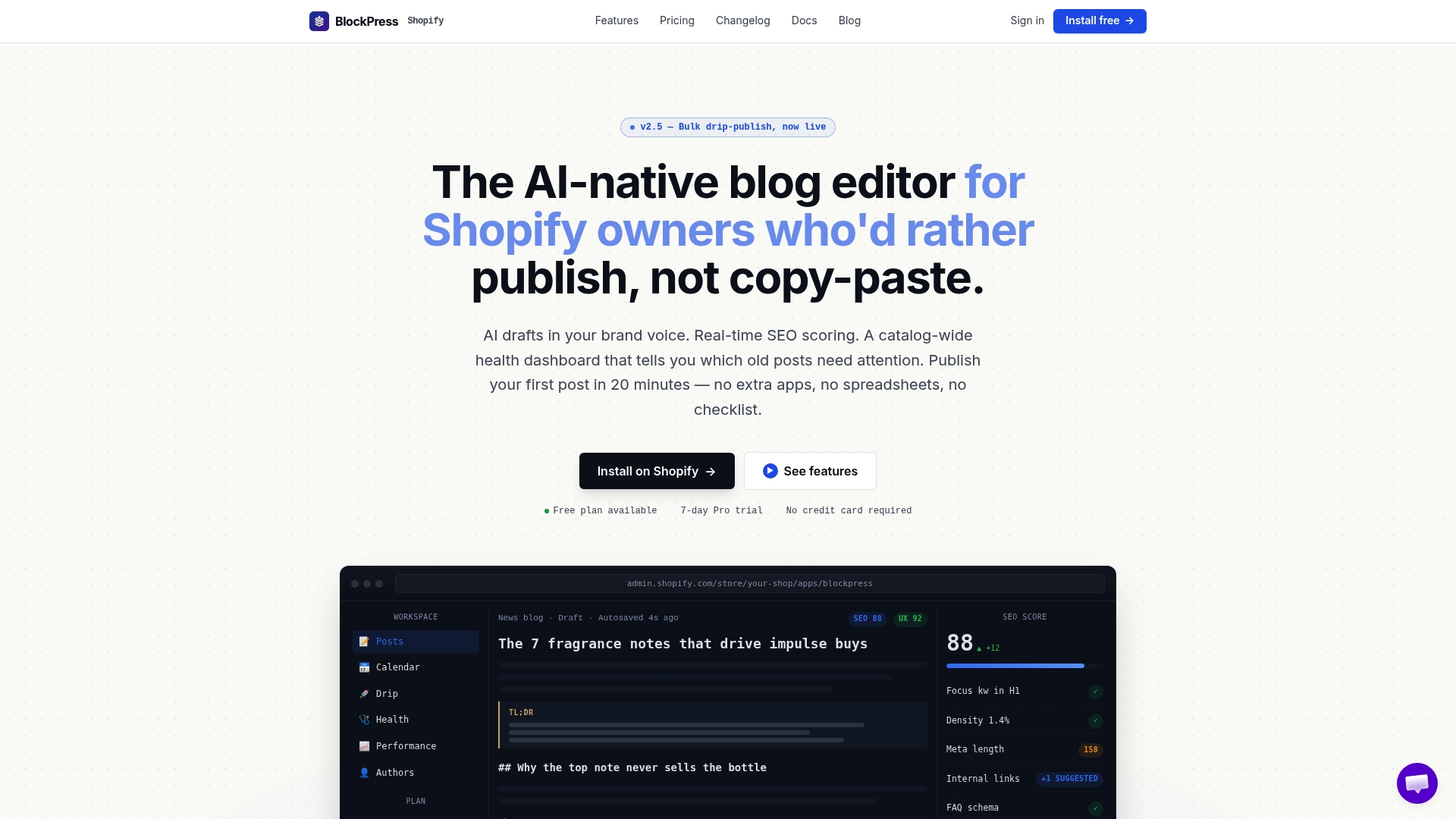
You can build and manage content clusters, track internal linking gaps, and publish AI-generated drafts without leaving your Shopify store. Blockpress replaces the three separate apps most merchants use to replicate what it does natively. If you want to put these SEO blog techniques into practice without the manual overhead, the Blockpress platform is built for exactly that.
FAQ
What is an SEO-driven blog strategy?
An SEO-driven blog strategy is a content plan designed to maximize organic search rankings and user engagement through structured topic coverage, internal linking, and intent-matched content.
How does content clustering improve SEO?
Content clustering groups a pillar page with supporting cluster articles, which signals comprehensive topic coverage to search engines and strengthens topical authority across related keywords.
How often should you refresh blog content?
Refresh high-traffic posts every six months and run a full content audit quarterly to catch outdated statistics, broken links, and keyword drift before they affect rankings.
What is topical authority and why does it matter?
Topical authority is the trust search engines assign to your site as a reliable source on a subject. Sites with strong topical authority rank for more related keywords and recover faster from algorithm updates.
How do internal links affect blog rankings?
Internal links with descriptive anchor text connect pillar and cluster pages, improve crawlability, and signal topic relatedness to search engines, directly supporting higher rankings across the cluster.