

TL;DR:
- An SEO audit systematically evaluates a blog's technical health, content, and visibility to identify and prioritize fixes that boost traffic. Most blogs struggle because of structural issues like crawlability, orphaned content, or misaligned search intent, rather than content volume. Regular, phased audits focusing on crawl, content, and authority improvements can significantly increase organic traffic within 30 to 90 days.
An SEO audit is a systematic evaluation of your blog's technical health, content quality, and search visibility that converts blocking issues into a prioritized fix list tied directly to traffic growth. Most bloggers who struggle with flat organic traffic are not publishing too little. They are publishing content that Google cannot crawl, index, or match to real search intent. Understanding how SEO audits improve blog performance means recognizing that audits diagnose and prioritize the exact obstacles standing between your posts and page one. Tools like Google Search Console, Semrush, and HubSpot give you the data. The audit gives you the plan.
What key areas do SEO audits analyze to improve blog ranking?
A complete SEO audit covers six distinct areas, and each one can independently block your blog from ranking. Miss any one of them and you leave traffic on the table.
- Technical health. Crawlability, indexability, Core Web Vitals, and mobile usability form the foundation. If Googlebot cannot reach a page or if a page loads too slowly on mobile, no amount of great writing will save it. Mobile usability issues directly affect both rankings and bounce rates.
- Content quality and search intent alignment. Google rewards pages that match what the searcher actually wants. A post targeting "best running shoes" that reads like a product catalog instead of a buying guide will underperform regardless of keyword density.
- Internal linking health. Orphaned posts (pages with no internal links pointing to them) are invisible to both Google and readers. Contextual links embedded in paragraph text pass authority and create crawl paths that lift the entire site.
- Search visibility signals. This includes SERP feature eligibility (featured snippets, People Also Ask boxes) and, increasingly in 2026, AI-driven discovery through platforms like Google's AI Overviews and Perplexity.
- Authority signals. Backlink profiles and brand mentions tell Google how trusted your domain is. Audits surface toxic links to disavow and gap opportunities to pursue.
Pro Tip: Run a Google Search Console coverage report before touching any content. Pages labeled "Crawled — currently not indexed" are your highest-priority targets because fixing indexation issues unlocks organic visibility that already exists but is being blocked.
Most blogs lose SEO performance due to structural and relevance problems rather than content volume. An audit tells you exactly which category your problem falls into.

How do prioritized SEO audit strategies accelerate results?
Not all audit findings deserve equal attention. Semrush's tiered prioritization model focuses resources on the fixes that unblock the most traffic first, then layers in enhancements once the foundation is solid.
- Tier 1: Crawl and indexing blockers. Fix broken pages, redirect chains, noindex tags applied by mistake, and pages stuck in "Crawled — currently not indexed" status. These are ceilings on your organic visibility. Nothing else matters until Google can actually reach and index your content.
- Tier 2: Content quality and keyword gaps. Rewrite posts with intent mismatch, consolidate thin content, and fill keyword gaps identified through Search Console impression data. This is where most of the ranking movement happens.
- Tier 3: Authority and AI visibility. Build or reclaim backlinks, optimize for featured snippets, and structure content for AI-driven discovery. These gains compound on top of the clean foundation from Tiers 1 and 2.
The two-phase workflow from The Seo Engine's 600-blog audit study puts this into calendar terms. Days 1 to 14 focus on intent alignment and rewriting posts that already have Search Console impressions but low clicks. Days 15 to 30 focus on internal linking, specifically recovering orphaned posts with contextual paragraph links. This sequence produces the largest measurable improvements at the 30, 60, and 90-day marks.
Pro Tip: Start every audit cycle by exporting your Search Console Performance report filtered to queries with positions 3 to 10. These pages already have Google's attention. Fixing their titles and meta descriptions is the fastest path to new clicks without writing a single new post.
What measurable results can bloggers expect from fixing audit issues?
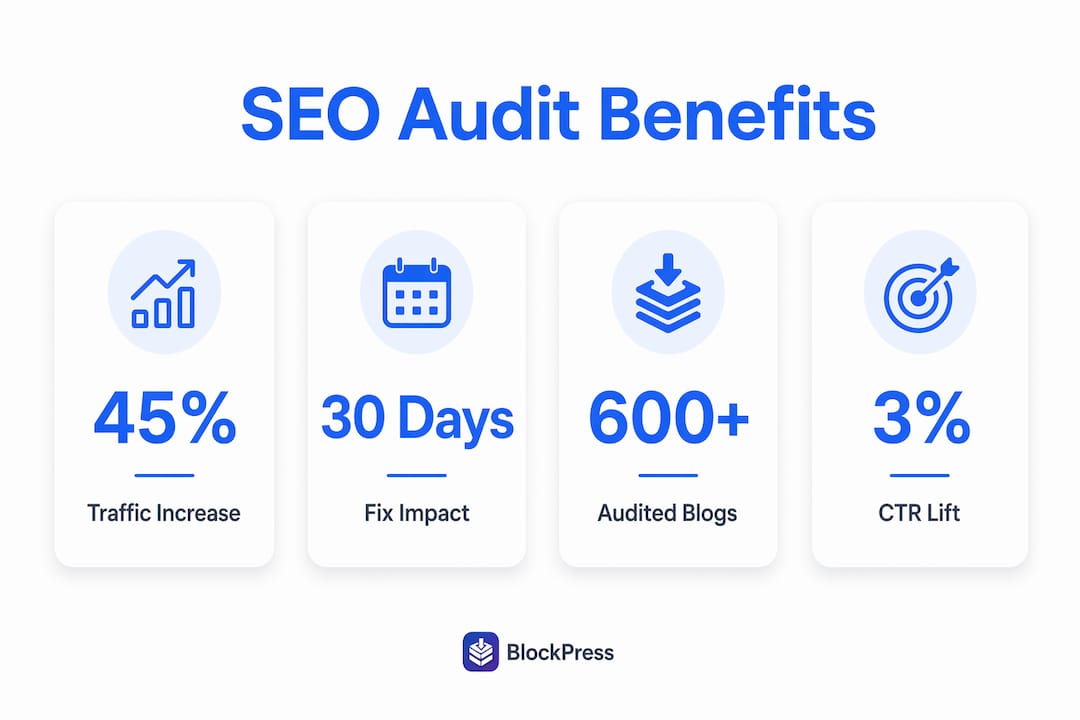
The benefits of SEO audits are not theoretical. An analysis of 600 audited blogs by The Seo Engine found measurable median improvements for each resolved issue within 60 to 90 days. The data is specific enough to use as a planning benchmark.
| Issue fixed | Typical result | Timeframe |
|---|---|---|
| Intent mismatch rewrite | Significant lift in average ranking position | 30 to 60 days |
| Orphaned content recovery | Increased crawl frequency and impressions | 30 to 60 days |
| Meta description and title optimization | CTR improvement from under 3% to 5 to 10% | 14 to 30 days |
| Core Web Vitals and page speed | Reduced bounce rate, ranking stabilization | 30 days |
| Thin content consolidation | Organic clicks up to 52% in some cases | 60 to 90 days |
Pages sitting at positions 3 to 10 with CTR under 3% represent hidden traffic that already exists. Rewriting their titles and meta descriptions to better match search intent can push CTR to 5 to 10%, generating significant new clicks without any new content creation.
One factor most bloggers overlook is Google's Helpful Content Update signal. This is a site-wide score based on the ratio of helpful to unhelpful content across your entire domain. Improving only your top posts is not enough. Pruning or significantly improving low-quality posts raises your domain's overall helpfulness score, which lifts rankings across all your content. Recovery after pruning typically takes weeks to months as Google reassesses the domain.
How to turn SEO audit findings into a blog improvement plan
Audit data is only useful when it becomes a repeatable workflow. Here is how to operationalize your findings into a plan that moves metrics.
- Start with indexability triage. Pull your Search Console coverage report. Resolve every "Crawled — currently not indexed" page before touching metadata or content. Wasted optimization effort on non-indexed pages is one of the most common audit mistakes.
- Align content to intent. Sort your top 20 posts by impressions in Search Console. For each one, confirm the page format matches the search intent behind the primary keyword. A listicle ranking for a "how to" query will consistently underperform a step-by-step guide.
- Overhaul internal linking. Use a site crawl tool to identify orphaned posts. Add contextual links from high-authority pages to those orphaned posts within paragraph text, not just navigation menus or footers. This is one of the highest-impact internal linking tactics available without creating new content.
- Fix metadata at scale. Audit every post's title tag and meta description against its target keyword and current Search Console CTR. Prioritize pages with impressions above 500 per month and CTR below 3%.
- Set measurement checkpoints. Track clicks, impressions, average position, and CTR in Search Console at 30, 60, and 90 days after each fix batch. Quarterly audit cadence keeps your blog healthy without overwhelming your content calendar.
Key takeaways
SEO audits improve blog performance by diagnosing and fixing the specific technical, content, and structural issues that prevent Google from indexing, ranking, and surfacing your posts to the right readers.
| Point | Details |
|---|---|
| Indexability comes first | Fix "Crawled — currently not indexed" pages before any content or metadata work. |
| Tier your fixes | Address crawl blockers, then content gaps, then authority signals for compounding gains. |
| Orphaned content costs you | Add contextual internal links to unlinked posts to restore crawl paths and topical authority. |
| Sitewide helpfulness matters | Pruning or improving low-quality posts raises your domain's helpful content ratio across all rankings. |
| Measure at 30/60/90 days | Technical fixes show results faster than content depth improvements; plan checkpoints accordingly. |
Why audits changed how I think about blog growth
Most bloggers treat publishing as the primary growth lever. Write more, rank more. That logic breaks down the moment you look at audit data from real blogs. The Seo Engine's 600-blog study confirmed what I have seen repeatedly: the blogs with the most content often have the worst structural health. Hundreds of orphaned posts, dozens of pages stuck in "not indexed," and a meta description strategy that amounts to leaving the field blank.
The mindset shift that actually moves the needle is treating your blog like a product that needs regular maintenance, not a content factory that just needs more output. Google's Helpful Content algorithm makes this concrete. A domain with 200 posts where 80 are thin or outdated is actively penalizing the 120 good ones. Pruning or improving those 80 posts is more impactful than publishing 20 new ones.
The other thing I would push back on is the idea that audits are a one-time project. They are a quarterly health check. Technical issues accumulate. Search intent shifts. New posts create new orphaned content. The blogs that sustain traffic growth are the ones that audit on a schedule, not just when rankings drop.
— Rodney
How Blockpress makes audit-driven SEO easier for Shopify blogs
Running a thorough SEO audit and then executing every fix across dozens of posts is time-consuming work, especially when you are managing a Shopify store at the same time.
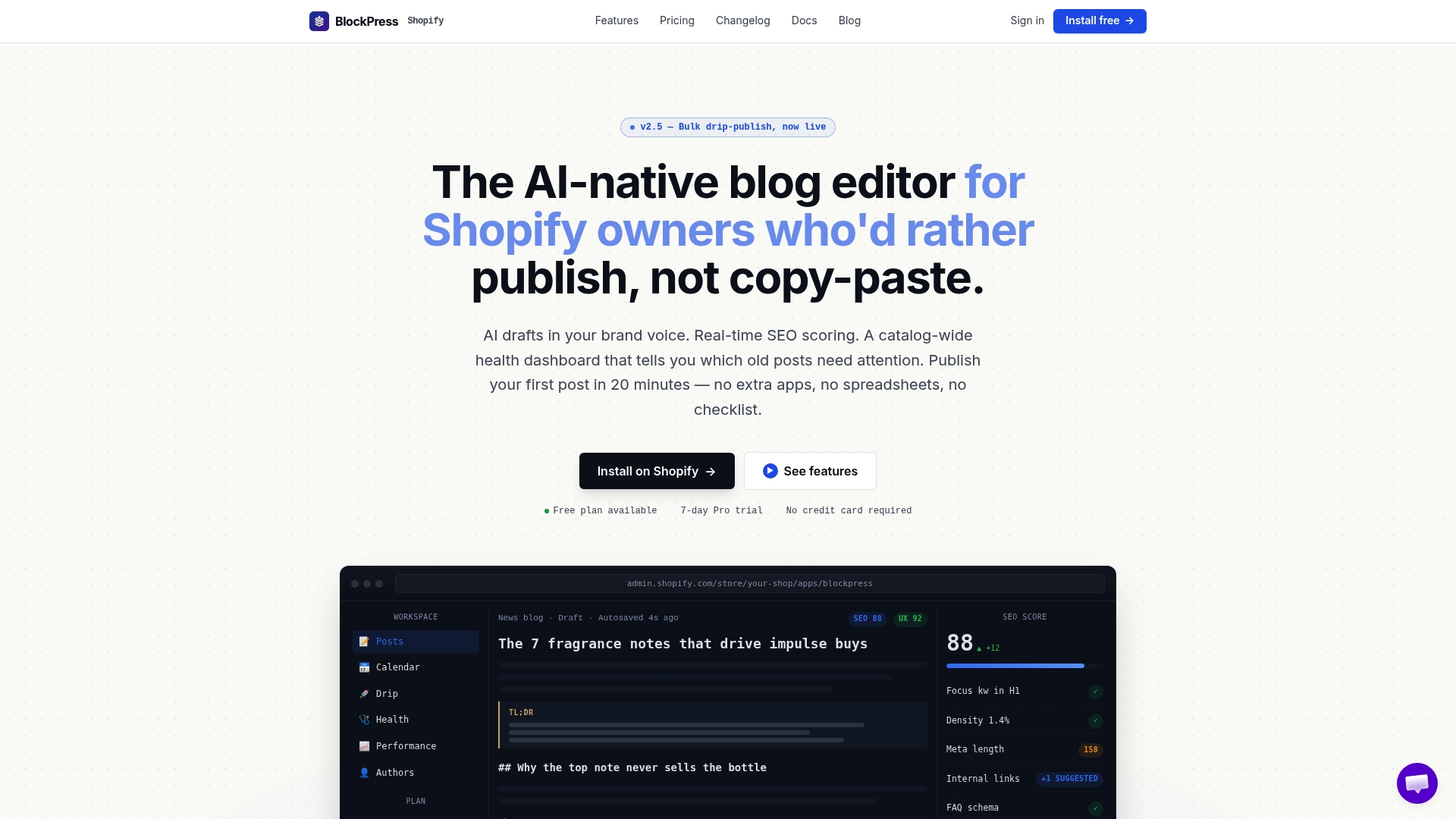
Blockpress is built directly into Shopify and automates the SEO checks that audits surface most often. Live SEO and UX scoring flags metadata gaps, internal linking issues, and content quality problems as you write. Per-article performance analytics track clicks and impressions without leaving your store. The article health audit feature runs the same checks a manual audit would catch, but on every post, continuously. If you are ready to stop managing three separate apps and start acting on audit findings faster, Blockpress is worth a look.
FAQ
What is an SEO audit for a blog?
An SEO audit is a structured review of your blog's technical health, content quality, internal linking, and search visibility that identifies the specific issues blocking your posts from ranking. HubSpot defines it as a step-by-step process that produces a prioritized fix roadmap tied to measurable traffic improvements.
How long does it take to see results from an SEO audit?
Technical fixes like resolving indexation errors and improving page speed typically show results within 30 days. Content improvements and internal linking changes take 60 to 90 days to reflect in Search Console data, based on The Seo Engine's analysis of 600 audited blogs.
How often should I audit my blog's SEO?
Semrush recommends a quarterly audit cadence for most blogs. This balances resource investment with the pace at which technical issues accumulate and search intent shifts.
What tools do I need to run a blog SEO audit?
Google Search Console covers indexation, CTR, and keyword performance at no cost. Semrush or similar crawl tools handle technical site health. Together, these two sources cover the majority of issues a full audit needs to diagnose.
Does fixing old blog posts really improve traffic?
Yes. Rewriting posts with intent mismatch and recovering orphaned content are among the highest-impact fixes identified in large-scale blog audits. The Seo Engine's data shows organic clicks can increase by up to 52% after resolving thin content and structural issues on existing posts.