
Make your pages crawlable and answer-first, back every claim with a verifiable source, and get your structured data in order. That combination is the fastest, most reliable path to appearing in AI Overviews. Fix crawlability first, rewrite your top pages to open with a direct answer, and add real citations and stats to your existing content within the next 72 hours. Together, those three moves target exactly what Google's retrieval systems reward.
TL;DR:
- Ensuring pages are crawlable, properly rendered, and have accurate schema is essential for them to be considered for AI Overviews.
- Writing answer-first, direct opening sentences and embedding specific, sourced statistics significantly increase the chances of content being cited in AI summaries.
- Optimizing both content structure and technical factors on high-traffic pages, particularly those already ranking well, yields the best results within a six- to ten-week period.
- Content that includes clear fan-out subtopics with independent answers and relevant facts is favored over generic or overly broad pages.
- Regular technical and content audits, integrated into publishing workflows, help maintain eligibility as AI models and search features evolve over time.
Table of Contents
- What Are AI Overviews and When Do They Show Up?
- How Do AI Overviews Actually Work?
- Technical Prerequisites: Crawlability, Rendering, and Schema
- Content Structure Tactics That Get You Cited
- Ecommerce and Product Feeds: The Separate Track
- How Do You Measure AI Visibility?
- Common Myths and What Not to Do
- What a Practical Checklist Looks Like Day to Day
- What Timeline Should You Actually Expect?
- Let BlockPress Handle the Heavy Lifting on Shopify
- Sources
- FAQ
What Are AI Overviews and When Do They Show Up?
AI Overviews are the AI-generated summaries Google places above traditional search results, pulling together information from multiple sources into a single synthesized answer with supporting links underneath. You've seen them on searches like "best time to water tomatoes" or "how does invoice matching work." They typically show up on informational and comparison queries where Google's systems detect that a synthesized answer serves the searcher better than a list of ten blue links.
They appear less often on highly transactional queries ("buy Nike Air Max size 10") or queries with strong local intent, where a map pack or shopping carousel already does the job. Google decides case by case, and the same query can trigger an AI Overview one week and not the next as the underlying models get updated.
Here's how AI Overviews differ from the features you already know:
- Featured snippets pull one passage from one page. AI Overviews synthesize passages from several pages into a new, generated summary.
- Knowledge panels pull structured facts about a known entity. AI Overviews answer open-ended questions that don't map to a single entity.
- Traditional rankings reward the page. AI Overviews reward the passage — a page can rank on page two and still get cited if one paragraph answers the question cleanly.
That last point matters more than most marketers realize. According to Google Search Central's own guidance, a page only needs to be indexed and technically eligible for standard Search to be considered for citation. There's no separate submission process and no special file required.
How Do AI Overviews Actually Work?
AI Overviews run on a process called query fan-out. When you search for something like "does collagen powder actually work," Google doesn't just match your exact words. It silently generates several related sub-queries (mechanism, dosage, side effects, study quality) and retrieves passages for each one before assembling a single synthesized response.
That's why a single well-optimized page rarely wins an AI Overview citation on its own. Google's system is stitching together the best-matching passage for each sub-question, and different domains often get cited for different sub-questions within the same overview.
The pipeline draws from three main layers:
- The indexed web — the same crawl and index Google uses for classic search results.
- The Knowledge Graph — structured facts about entities, brands, and products that ground the summary in verified relationships.
- Third-party citations and mentions — signals that a claim is corroborated elsewhere, not just asserted on one site.
Google's own documentation on AI Overviews and AI Mode confirms these features run on top of core ranking systems, and the outputs get continually evaluated for factuality, clarity, and length. That evaluation loop is why extractability matters so much: a model choosing between two candidate passages will usually favor the one that states a fact plainly, attaches a number, and doesn't require three paragraphs of throat-clearing to reach the point. Passages loaded with hedging or buried under intro fluff simply lose the extraction race, even when the underlying information is accurate.
Technical Prerequisites: Crawlability, Rendering, and Schema
Before content tactics matter at all, AI crawlers need to reach your pages and read them the same way a human would. Skip this step and no amount of BLUF writing will save you.
Run through this sequence on your top revenue and traffic pages:
- Check robots.txt for AI crawler access. Confirm you're not accidentally blocking GPTBot, Google-Extended, or Googlebot itself while trying to keep out scrapers. Many sites lock down crawlers broadly for security reasons and unintentionally cut off the exact bots that feed AI Overviews.
- Audit for JavaScript-only content. If your critical text (product descriptions, key answers, pricing) only renders after client-side JavaScript executes, many AI crawlers never see it. Generative engine optimization guidance is blunt about this: server-side rendering, or at minimum a static HTML fallback, is what keeps your most important text visible to bots that don't run a full browser.
- Confirm the page is indexed and eligible for standard Search. Google's guidance is explicit that eligibility for AI Overviews requires nothing beyond normal indexing and standard technical SEO health. Check Search Console for indexing errors before doing anything else.
- Add schema where it earns its keep. For content pages,
ArticleandFAQPageschema help. For product pages, prioritizeProduct,Offer,AggregateRating, andReviewmarkup. Schema doesn't guarantee citation, but it removes ambiguity for systems trying to parse what a page is actually claiming.
Pro Tip: Run a quick "view source" check on your five highest-traffic blog posts. If the answer paragraph you'd want cited isn't visible in the raw HTML before JavaScript runs, that page is functionally invisible to a large share of AI crawlers, no matter how good the writing is.
Schema matters most on pages making factual or transactional claims: prices, availability, ratings, dosages, specs. A purely narrative opinion piece can skip heavy markup without much downside. A comparison guide or product page cannot.
Content Structure Tactics That Get You Cited
Write every section so the first sentence could stand alone as the answer, even if someone deleted everything else on the page. That's the single highest-leverage habit for AI Overview optimization, and it's the one most content teams skip because it feels blunt compared to a warmed-up intro.
Compare the two approaches directly:
| Approach | Opening sentence | Extractability |
|---|---|---|
| Traditional blog structure | "When it comes to choosing the right running shoe, there are a lot of factors to think about." | Low. No answer present, nothing to extract. |
| BLUF structure | "Runners with flat feet need stability shoes with medial posting, not neutral cushioning shoes." | High. A model can lift this sentence directly. |
According to Semrush's analysis of AI Overview optimization, this answer-first pattern, combined with clean crawlability, is consistently cited as the practical lever most within a content team's control. It costs nothing to implement and doesn't require new tooling, just editorial discipline.
Beyond structure, four tactics compound the effect:
- Embed named statistics with a linked source, not vague quantifiers. "Conversion rates improved" tells a model nothing extractable; "conversion rates rose 18% after adding trust badges, per [named study]" gives it something to cite.
- Add short, attributable quotes from real named sources where you have them. A quote gives a model a distinct, citable unit separate from your own prose.
- Cover the fan-out questions directly. If your topic is "AI overview optimization," don't just write about the concept. Answer the adjacent questions (how it differs from SEO, what tools measure it, how long results take) in their own clearly headed sections so each is independently extractable.
- Skip commodity framing. A generic "10 tips for X" post competes against thousands of nearly identical pages. A page with a specific data point, an original test, or a contrarian angle gives the model a reason to prefer your passage over a competitor's.
Research from Similarweb's overview of generative engine optimization backs this pattern: pages built around BLUF openers, sourced statistics, and topic-complete fan-out coverage show up more often in AI-generated answers than pages optimized purely for keyword density. Content teams chasing GEO/AEO tactics without addressing crawlability first are optimizing the wrong layer of the stack.
Ecommerce and Product Feeds: The Separate Track
Text citations and shopping cards run through different systems, and treating them as one problem is the most common mistake Shopify merchants make with AI overview optimization. A blog post gets cited because a passage answers a question well. A product shows up in a shopping card because Google's Shopping Graph trusts your feed data.
That means ecommerce teams need to work both tracks simultaneously:
- Merchant Center feed completeness drives shopping card eligibility. Missing GTIN, inconsistent pricing between feed and page, or stale availability data will quietly disqualify products from AI-driven shopping surfaces even if the product page itself reads beautifully.
- In-page product schema needs to match the feed exactly. Price, availability, and identifiers (GTIN, MPN) should be identical in both places. Guidance on ecommerce AI search points out that Shopping Graph and card features specifically cross-check feed data against on-page structured data, and mismatches erode trust in both.
- Agentic commerce is the next layer. As AI assistants start completing purchases on a shopper's behalf, the merchants with clean, consistent, machine-readable product data are the ones positioned to participate. That means auditing feed and schema parity now, before agentic checkout becomes standard rather than experimental.
Practical next step for a Shopify store: pull your Merchant Center diagnostics report this week and cross-reference the top 20 flagged issues against your live product pages. Price and availability mismatches are almost always the biggest offender, and they're usually a caching or sync problem rather than a content problem.
How Do You Measure AI Visibility?
You can't optimize what you don't track, and AI Overview citations don't show up in your normal rank-tracking dashboard. Here's where to look and what to track:
- Check the Generative AI performance report in Search Console. This is Google's own reporting surface for how your pages perform specifically within AI-powered search features, separate from traditional Search performance.
- Track AI mentions and citation frequency, not just impressions. A page can gain visibility in an AI Overview without a corresponding click, so citation count matters as its own metric.
- Watch referral quality and time on page for AI-driven traffic. Pew Research found that users are measurably less likely to click through when an AI summary answers their query directly. The traffic you do get from an AI citation tends to be higher-intent, so a drop in raw clicks paired with steady or improving time on page is a healthy pattern, not a warning sign.
- Run structured A/B checks on BLUF versus non-BLUF versions of key pages. Rewrite the opening of a handful of underperforming posts into answer-first format, leave a comparable set unchanged, and compare citation frequency over a full monthly cycle before drawing conclusions.
Building a rough AI share-of-voice benchmark, how often your brand gets cited relative to competitors on your core topics, gives you a north star metric that traditional rank tracking simply can't provide.
Common Myths and What Not to Do
The biggest myth in AI overview optimization is that you need to write differently "for AI" instead of writing well for people. You don't. Google's evaluation systems are explicitly built to reward factuality, clarity, and expertise, the same E-E-A-T principles that have driven classic SEO for years. Chasing a model's presumed preferences instead of writing accurately for a human reader tends to backfire.
A few specific traps to avoid:
- Don't over-chunk content into disconnected fragments. Short, choppy sections built purely to look "extractable" often lose the context a model needs to trust the claim. Answer-first doesn't mean context-free.
- Don't build pages that mimic prompt formats or fake Q&A structures just to bait citation. Google's core ranking systems still evaluate these pages for genuine usefulness, and thin, formulaic content gets filtered out the same way it always has.
- Don't scale AI-generated content without editorial review. Mass-produced, low-oversight content is the definition of scaled-content abuse, and it puts your entire domain's trust signals at risk, not just the one weak page.
- Don't manufacture "third-party mentions." Fake reviews, paid inauthentic citations, and link schemes aimed at gaming AI citation signals violate the same policies that govern classic search spam, and the risk isn't worth the marginal citation gain.
What a Practical Checklist Looks Like Day to Day
Turning all of this into a routine, rather than a one-time audit, is what separates teams that actually gain AI visibility from teams that read one guide and move on. Here's the recurring checklist worth running on every new and refreshed post:
- Run a quick technical pass: confirm indexing status, check for JS-dependent critical content, verify robots.txt isn't blocking AI crawlers.
- Confirm the opening sentence of every major section stands alone as a direct answer.
- Add at least one named statistic with a linked source and, where possible, one attributable quote per page.
- For product pages, cross-check schema against your live Merchant Center feed for price and availability parity.
- Log the page's fan-out subtopics and confirm each has its own clearly headed, independently answerable section.
BlockPress builds several of these checks directly into the editor: live SEO and UX scoring flags missing structure before you publish, article health audits catch stale or incomplete pages after the fact, and internal-link suggestions help you connect fan-out subtopics so each one stays discoverable. The BlockPress changelog shows this isn't a static feature set either. New scoring and audit capabilities ship regularly as Google's AI features evolve.
Pro Tip: Treat your article health audit results as a monthly habit, not a one-time cleanup. AI Overview eligibility can shift when Google updates its underlying models, so a page that was extractable last quarter can quietly lose ground without any edits on your end.
For teams building out this workflow from scratch, BlockPress's guide to AI content workflow integration walks through how editorial and technical checks fit into a single publishing routine on Shopify.
What Timeline Should You Actually Expect?
Most teams see measurable movement in AI citation frequency within six to ten weeks of fixing crawlability and rewriting top-page openers into BLUF format, though a full quarter is a more realistic window for confirming a durable pattern rather than noise. The tradeoff for small teams is almost always time versus coverage: you can rewrite five pages thoroughly, with real citations and fan-out coverage, or spend the same hours doing shallow touch-ups on fifty. Pick five. Thin edits across your whole catalog rarely move the needle, while five pages rebuilt around a specific data point and a genuinely useful answer routinely do. Start with the pages already ranking on page one or two of classic Search. They've already cleared Google's quality bar once, which makes them the cheapest wins for AI citation, too.
— Rodney
Let BlockPress Handle the Heavy Lifting on Shopify
BlockPress gives Shopify merchants a faster path to everything in the checklist above without juggling three separate apps to get there. The live SEO and UX scoring flags missing BLUF structure and thin sections as you draft, so you catch extractability problems before publishing instead of during a quarterly audit. Internal-link suggestions help you build out fan-out coverage automatically, connecting related subtopics the way AI retrieval systems expect to see them linked. And because it's built natively into Shopify's admin, there's no separate login, no data sync issues between your store and your content tool, and no mismatch between your product pages and what your blog says about them.
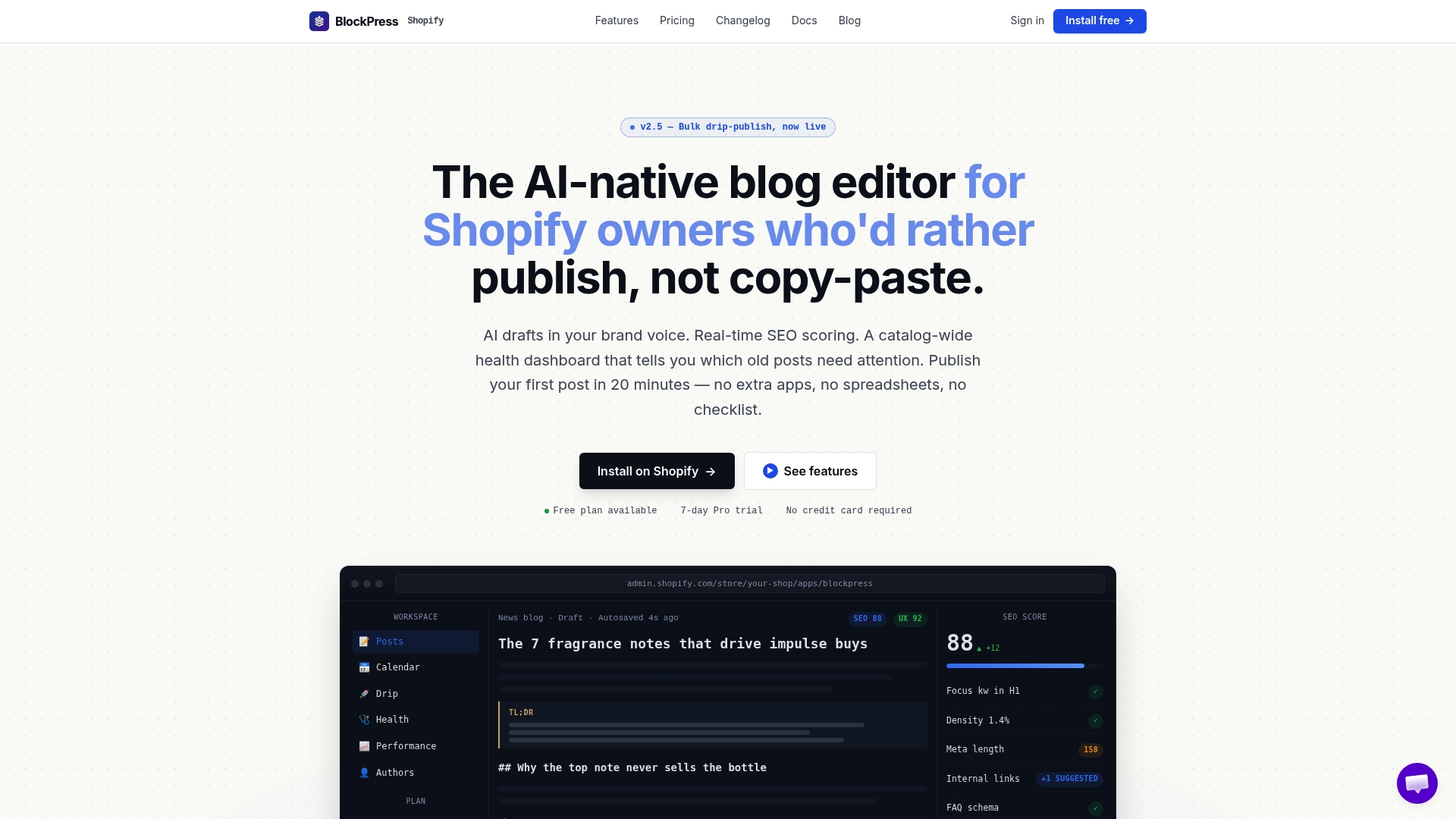
Article health audits run continuously, not just at launch, catching pages that quietly lose extractability as Google's models change. Per-article performance analytics show you which posts are earning traffic and engagement worth protecting. If you're managing a Shopify blog and want your content actually structured for how AI Overviews retrieve and cite information, start with the BlockPress features page to see how the SEO scoring and audit tools map to the checklist, or head straight to Blockpress to start a trial on your own store.
Sources
The tactics in this guide draw on official documentation and independent industry analysis rather than speculation. Google's AI Features and Your Website guidance is the closest thing to a primary source on eligibility requirements, and it's worth rereading whenever Google updates its Search Central documentation. Semrush's breakdown of AI Overview optimization offers the clearest practical translation of that guidance into editorial tactics. For the ecommerce-specific mechanics, the store owner guide to AI Overviews and Similarweb's overview of generative engine optimization both cover the feed and schema requirements in more depth than a general SEO guide typically will. The Pew Research data on click behavior is essential context for why measurement strategy has to change alongside content strategy.
- AI Features and Your Website | Google Search Central
- Google users are less likely to click on links when an AI summary appears
- AI Overviews and eCommerce Search: Store Owner Guide
- Generative engine optimization (GEO) overview
FAQ
How Do You Optimize Content for AI Overviews?
Focus on three things in order: confirm your pages are indexed and crawlable, rewrite key sections to open with a direct answer, and add verifiable statistics with linked sources. Google's own guidance confirms no special markup is required beyond standard SEO health and eligibility for AI Features.
What Is the 30% Rule in AI Content?
There's no official Google standard called the "30% rule." It's typically used informally to describe front-loading roughly the first third of an article with your core claims and key facts, since that's where extraction models pull from most heavily, a practice this guide's BLUF approach follows directly.
What Is the 80/20 Rule in SEO?
The 80/20 rule in SEO generally refers to focusing 80% of your effort on the 20% of pages or fixes that drive the most traffic and citations, rather than spreading thin edits across an entire site. For AI overview optimization specifically, that usually means prioritizing pages already ranking on page one or two of classic Search, since they've cleared Google's quality bar once already.
How Do You Track AI Search Content Performance?
Use the Generative AI performance report inside Search Console to see how pages perform specifically in AI-powered features, and pair it with referral quality and time-on-page metrics since AI Overview traffic tends to convert clicks into fewer but higher-intent visits.
Does BlockPress Help With AI Overview Optimization?
Yes. BlockPress flags missing BLUF structure and thin sections through live SEO and UX scoring during drafting, and its article health audits catch pages that lose extractability over time, addressing two of the most common technical gaps covered in this guide.