
Semantic search retrieves documents by meaning, not by matching character strings. It converts your query and every document into dense numerical vectors, then finds the closest vectors using approximate nearest-neighbor (ANN) search. Google describes this as understanding the contextual meaning and intent behind a query rather than relying on keyword overlap alone. The result: a query like "how do I fix a slow checkout" surfaces relevant help articles even when none of them contain those exact words.
When does semantic search win? Conceptual, conversational, and paraphrase-heavy queries. When does keyword search still win? Exact identifiers: product SKUs, error codes, legal citations. In practice, production systems use both.
Here is the three-stage pipeline at a glance:
- Index: chunk documents, run each chunk through an embedding model, store vectors in a vector database with associated metadata.
- Query: embed the incoming query with the same model, run ANN retrieval to pull top-K candidate chunks.
- Rank and surface: fuse dense and sparse scores (hybrid), apply a reranker, return ordered results to the application layer.
Key Takeaways
Semantic search retrieves by meaning using embeddings and vector similarity, and hybrid dense+sparse pipelines are the production standard in 2026.
| Point | Details |
|---|---|
| Embeddings drive everything | Your embedding model choice bounds retrieval quality more than any other single component. |
| Hybrid retrieval is the default | Combine dense ANN search with BM25 to handle both conceptual queries and exact identifiers. |
| Reranking improves precision | A cross-encoder reranker on top-K candidates significantly improves final result quality. |
| Evaluation before production | Build a labeled evaluation harness before launch; precision@k and recall@k are your primary signals. |
| PoC in two weeks | A retriever + reranker stack can be validated in 1–2 weeks using a managed vector DB and an open-source embedding model. |
Table of Contents
- How does semantic search work differently from keyword search?
- The full semantic search pipeline, step by step
- What technologies power semantic search under the hood?
- How do LLMs fit into a semantic search architecture?
- A minimal implementation example
- Where does semantic search actually make a difference?
- Limitations and best practices you need to know
- Deployment checklist for teams going to production
- The part most teams get wrong about semantic search
- Useful sources
- FAQ
How does semantic search work differently from keyword search?
The core distinction is representation. Keyword search, the kind powered by BM25 or TF-IDF, builds an inverted index: a map from every term to the documents that contain it. Retrieval is fast and exact, but the system has no concept of meaning. Ask for "affordable running shoes" and you miss every document that says "budget jogging footwear."
Elastic describes semantic search as using context clues and vector techniques to close that gap. Instead of a term-frequency score, each piece of text is encoded into a dense vector, typically 384–1536 dimensions, where geometrically close vectors share meaning. Two sentences can be far apart lexically yet land near each other in vector space because they express the same idea.
Two short examples show the behavioral difference clearly:
| Query | Keyword (BM25) result | Semantic result |
|---|---|---|
| "budget jogging footwear" | Misses docs that say "affordable running shoes" | Retrieves "affordable running shoes" via synonym proximity |
| — | Exact match, correct | May retrieve unrelated products if embeddings blur the identifier |
Weaviate draws a useful distinction between vector search (the low-level ANN similarity operation) and semantic search (the user-facing retrieval behavior). You can run vector search without semantic meaning if your embeddings are poor. Good embeddings are what make the geometry meaningful.
BM25 still earns its place for exact-match recall, which is why hybrid pipelines dominate production systems in 2026.
The full semantic search pipeline, step by step
Every production semantic search system follows roughly the same sequence. Here is where each stage lives and what it must guarantee.
-
Embedding and indexing — Pass each chunk through an embedding model to produce a dense vector. Store the vector alongside its metadata in a vector database (Pinecone, Weaviate, Qdrant, pgvector). This is your offline, pre-built index.
-
ANN retrieval (top-K). Run approximate nearest-neighbor search against the vector index to retrieve a set of top candidates ranked by vector similarity. The canonical pipeline described by Hakia confirms this top-K stage as the standard before reranking.
-
Hybrid fusion. Run a parallel BM25 query on the same corpus. Merge the two ranked lists using Reciprocal Rank Fusion (RRF) or weighted score combination. Hybrid retrieval handles exact-identifier failures that dense-only systems miss.
Key engineering trade-offs at each stage:
What technologies power semantic search under the hood?
Embeddings and model choice
An embedding is a dense floating-point vector that encodes the semantic content of a text chunk. The model you choose determines the geometry of your vector space, and therefore bounds your retrieval ceiling. Common options include open-source SBERT variants (all-MiniLM-L6-v2 for speed, all-mpnet-base-v2 for quality), managed APIs like OpenAI's text-embedding-3-small and text-embedding-3-large, and domain-specific fine-tuned encoders for legal, medical, or e-commerce corpora. Production guidance consistently emphasizes that embedding model selection is the single most influential choice in the stack.
Similarity metrics
| Metric | Formula basis | Best for |
|---|---|---|
| Cosine similarity | Angle between vectors | Most NLP tasks; length-invariant |
| Dot product | Magnitude × angle | When vectors are normalized (same as cosine) |
| Euclidean (L2) | Absolute distance | Image embeddings, some structured data |
For text retrieval, cosine similarity is the default. Dot product is equivalent when vectors are L2-normalized, and many ANN libraries normalize at index time.
ANN index types
ANN algorithms trade a small accuracy loss for large speed gains at scale, making them practical for millions or billions of vectors.
| Index type | Speed | Memory | Accuracy | Best for |
|---|---|---|---|---|
| HNSW | Very fast | High | Very high | Low-latency production search |
| IVF-PQ | Fast | Low | High | Large-scale, memory-constrained |
| Annoy | Fast (read) | Medium | Medium | Static indexes, read-heavy workloads |
HNSW (Hierarchical Navigable Small World) is the most common choice for real-time search. IVF-PQ (Inverted File with Product Quantization) compresses vectors aggressively, making it practical for billion-scale corpora where HNSW's memory footprint would be prohibitive.
How do LLMs fit into a semantic search architecture?
The standard production architecture follows a retriever → reranker → reader chain. Each component has a distinct job.
The retriever (bi-encoder) runs at query time and must be fast. It embeds the query and fetches top-K candidates via ANN. Bi-encoders encode query and document independently, so you can pre-compute document embeddings offline. The trade-off: they sacrifice some accuracy for speed.
The reranker (cross-encoder) scores each (query, candidate) pair together, seeing both texts simultaneously. This joint attention makes cross-encoders much more accurate than bi-encoders, but also much slower. You only run the reranker on the top-K candidates from the retriever, not the full corpus.
The reader is where an LLM enters. In a RAG (Retrieval-Augmented Generation) pipeline, the reader receives the reranked chunks as context and generates a final natural-language answer. Academic IR surveys confirm that LLMs are increasingly used for query rewriting, reranking, and reading steps, improving conversational search and closing the gap between short queries and long documents.
LLMs also serve as query rewriters: they expand a terse query into a richer form before retrieval, which improves recall on short or ambiguous inputs. In agentic systems, an LLM decides when to re-retrieve, re-rank, or escalate to a human.
Pro Tip: Run your LLM reader only on the top reranked candidates, not the full retrieval set. This keeps inference costs predictable and latency under control without sacrificing answer quality.
When to use an LLM reranker versus a lightweight cross-encoder: if latency is under 200ms and cost per query matters, a fine-tuned cross-encoder (ms-marco-MiniLM-L-6-v2) is usually the right call. Reserve LLM-based reranking for high-value, low-volume queries where answer quality justifies the cost.
A minimal implementation example
Here is a concise pseudo-code flow you can use as a proof-of-concept skeleton.
Offline (index build):
- Load and chunk documents (256–512 tokens, 10% overlap).
- Batch-embed chunks:
embeddings = model.encode(chunks, batch_size=64). - Insert into vector DB:
collection.add(ids, embeddings, metadatas). - Build BM25 index on the same corpus for hybrid retrieval.
Online (query time):
- Receive user query string.
- Embed query:
q_vec = model.encode([query]). - ANN search:
dense_results = collection.query(q_vec, n_results=100). - BM25 search:
sparse_results = bm25_index.get_top_n(query, n=100). - Fuse with RRF: merge and re-score both ranked lists.
- Rerank fused top-20 with a cross-encoder.
- Return top-5 to the application.
Pro Tip: Cache embeddings for your 500 most frequent queries. ANN retrieval is fast, but embedding the query still adds latency. A simple Redis cache with a 24-hour TTL cuts p99 latency noticeably on high-traffic endpoints.
Production tips worth keeping:
- Batch embeddings at index time (batch size 32–128) to maximize GPU utilization.
- Shard your vector index by document category or date range to keep per-shard size manageable and enable parallel queries.
- Monitor cold-start behavior after a fresh deploy: the first queries before the ANN graph warms up can be slower than steady-state.
- Version your embedding model in the metadata store. When you upgrade the model, re-index before serving.
Common pitfalls: embedding drift after a model update without re-indexing, mixing embeddings from two different models in the same index, and using chunks that are too large (over 1,000 tokens), which dilutes the semantic signal and hurts precision.
Where does semantic search actually make a difference?
Semantic search earns its infrastructure cost in specific scenarios. Here are the use cases where the improvement is most visible.
- E-commerce product discovery. A shopper types "something warm for a winter hike" and expects relevant jackets and base layers, not a literal string match. Search intent alignment is the core value driver here, and semantic retrieval handles it where BM25 cannot.
Before/after example: a user searches "return policy for damaged items." A BM25 system returns nothing if the policy document says "refund procedure for defective merchandise." A semantic system retrieves it with high confidence because the embeddings for both phrases are geometrically close.
Hybrid approaches are preferable when your corpus contains a mix of conceptual content and exact identifiers (part numbers, legal codes, product SKUs). Semantic SEO strategy guides make a similar point: content that serves both intent-based and exact-match queries performs best in retrieval systems of all kinds.
Limitations and best practices you need to know
Semantic search is not a universal upgrade. Understanding where it breaks is as important as knowing where it shines.
Core limitations:
- Exact-identifier failures. Dense embeddings blur short, unique strings like SKUs, error codes, and proper names. BM25 handles these better.
- Out-of-vocabulary (OOV) tokens. Rare domain terms not well-represented in training data produce poor embeddings. Fine-tuning or hybrid retrieval compensates.
- Hallucination risk. When an LLM reader generates answers from retrieved chunks, it can confabulate details not present in the source. Retrieval quality directly affects answer quality.
- Cost and latency. Embedding at query time, running ANN search, and reranking all add latency. GPU-based embedding inference and managed vector DBs add cost.
Top 10 best practices:
- Use hybrid retrieval (dense + BM25) as the default, not dense-only.
- Choose your embedding model before tuning anything else in the stack.
- Chunk with overlap (10–20%) to avoid splitting relevant context across boundaries.
- Store rich metadata with each chunk and use pre-filtering to reduce ANN search space.
- Run a cross-encoder reranker on top-K candidates before surfacing results.
- Build an evaluation harness with labeled query-document pairs before going to production.
- Version your embedding model and re-index the full corpus on every model update.
- Monitor precision@k, recall@k, and query success rate continuously.
- Test for embedding drift quarterly, especially after fine-tuning or model swaps.
- Set up A/B testing infrastructure before launch so you can measure retrieval changes against a baseline.
Monitoring checklist:
- Precision@k and recall@k on a held-out evaluation set
- p50, p95, and p99 query latency
- Query success rate (queries returning at least one relevant result)
- Index freshness lag (time from document update to vector availability)
- Embedding drift score (cosine distance between old and new model embeddings on a reference set)
Deployment checklist for teams going to production
Getting from a working proof-of-concept to a reliable production system takes deliberate sequencing. This checklist keeps teams from skipping steps that cause failures later.
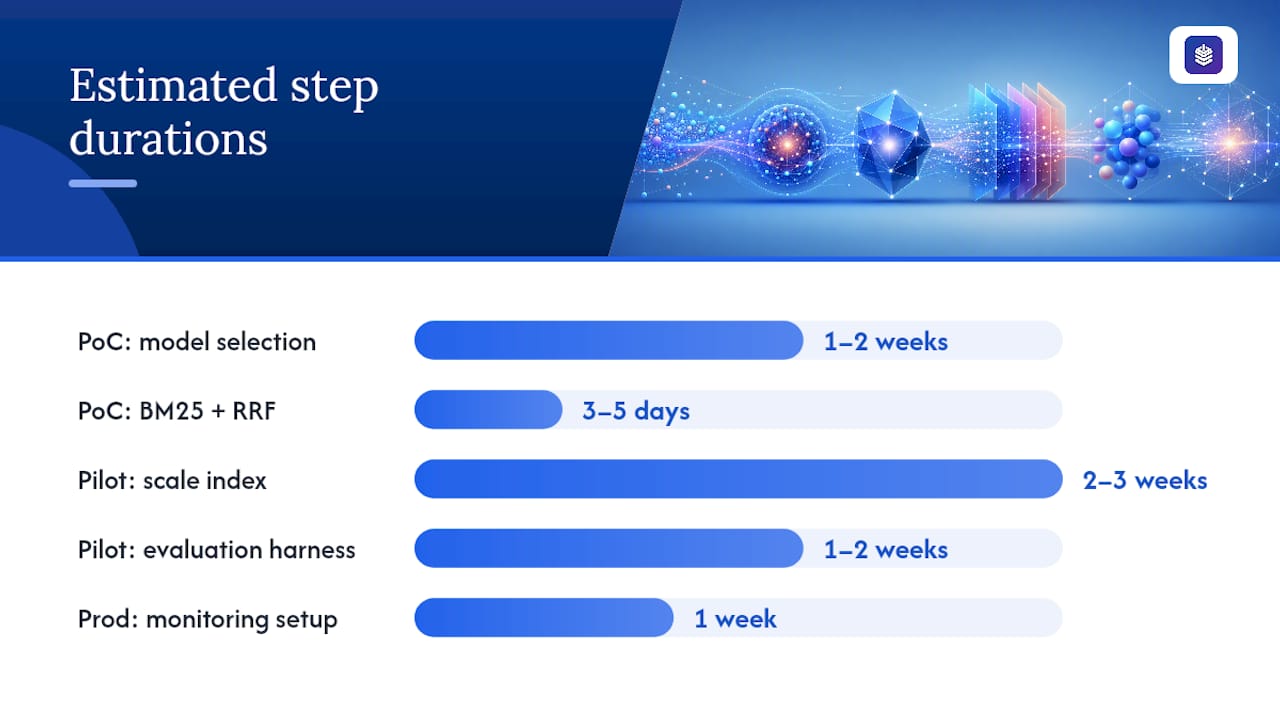
| Phase | Step | Estimated time | Key decision |
|---|---|---|---|
| PoC | Select embedding model; build small index; test 20 queries | 1–2 weeks | Model family (open-source vs. API) |
| PoC | Add BM25 index; implement RRF fusion | 3–5 days | Fusion weight tuning |
| Pilot | Scale index to full corpus; add metadata filtering | 2–3 weeks | Vector DB selection |
| Pilot | Integrate cross-encoder reranker | 1 week | Latency budget |
| Pilot | Build evaluation harness with labeled pairs | 1–2 weeks | Evaluation metric (NDCG, MRR) |
| Production | ANN parameter tuning (ef, M for HNSW) | 3–5 days | Recall vs. latency trade-off |
| Production | Set up monitoring, alerting, and A/B framework | 1 week | Rollback trigger thresholds |
| Production | Define reindex cadence and model versioning policy | Ongoing | Freshness SLA |
Staffing signal: a PoC needs one ML engineer part-time. Moving to production realistically requires one full-time ML engineer plus a backend engineer for infrastructure, with a data engineer if your corpus exceeds a few million documents.
Cost sketch: open-source embedding models (SBERT variants) running on a single GPU instance cost a fraction of managed API embeddings at scale. For corpora under 1 million chunks, managed APIs (OpenAI, Cohere) are often cheaper than self-hosting when you factor in engineering time. Above that threshold, self-hosted models typically become more economical.
Pro Tip: Run your PoC with a managed vector DB (Pinecone, Weaviate Cloud) even if you plan to self-host later. Managed services remove infrastructure variables so you can validate retrieval quality in isolation before adding operational complexity.
Operational items to lock in before launch: a reindex cadence tied to your document update frequency, a model versioning policy that prevents mixed-model indexes, an A/B testing framework that lets you compare retrieval configurations against a baseline, and a rollback plan that can revert to the previous index version within minutes.
The part most teams get wrong about semantic search
Most teams treat semantic search as a drop-in replacement for keyword search. They swap BM25 for a vector index, run a few informal tests, and ship. Then they wonder why recall dropped on product SKUs and error codes.
The real architecture decision is not "semantic or keyword" — it is "where does each method earn its place in the same pipeline?" Dense retrieval handles conceptual and paraphrase-heavy queries. BM25 handles exact identifiers. A cross-encoder reranker reconciles the two. Skip any leg of that tripod and you will have a system that is worse than what you replaced.
The second mistake is treating the embedding model as an afterthought. Teams spend weeks tuning HNSW parameters and chunk sizes while running a generic model that was never trained on their domain. The model sets the ceiling. Tune everything else only after you have validated that the model's geometry actually reflects your corpus's meaning structure.
My practical recommendations: start every project by evaluating at least three embedding models on a sample of your real queries before touching infrastructure. And build your evaluation harness in week one, not week six. You cannot improve what you cannot measure, and informal "looks good" testing is how retrieval regressions go undetected for months.
Useful sources
- What is semantic search, and how does it work?
- What is Semantic Search?
- A survey on neural information retrieval and LLM integration
- Vector search explained
- What Is Semantic Search? Engineer's Guide (2026) | Respan
- Vector Search Fundamentals: Embeddings, Similarity Metrics, and Approximate Nearest Neighbors
- Semantic Search Systems - Arun Baby
- How Semantic Search Actually Works: A Technical Deep Dive | Hakia
FAQ
What is semantic search in simple terms?
Semantic search retrieves documents based on the meaning of a query rather than exact word matches. It converts text into numerical vectors and finds the closest matches in that vector space.
How does semantic search differ from keyword search?
Keyword search (BM25/TF-IDF) matches exact terms using an inverted index. Semantic search encodes meaning into dense vectors, so synonyms and paraphrases retrieve relevant results even when no words overlap.
What is a vector database and why does semantic search need one?
A vector database (Pinecone, Weaviate, Qdrant, pgvector) stores dense embeddings and supports fast ANN queries. Standard relational databases cannot efficiently compute nearest-neighbor similarity across millions of high-dimensional vectors.
When should you use hybrid search instead of pure semantic search?
Use hybrid search whenever your corpus contains exact identifiers like SKUs, error codes, or proper names. Dense-only retrieval blurs short unique strings; adding a BM25 layer and fusing results with RRF recovers that exact-match recall.
How long does it take to build a production semantic search system?
A proof-of-concept with a managed vector DB and open-source embedding model takes a few weeks. Moving to a fully monitored production system including evaluation harness, reranker, and A/B testing typically takes multiple weeks with a small engineering team.