

Organic search delivers superior long-term economic value because it builds compounding, owned assets — paid ads buy visibility that stops the moment your budget does. Once a well-optimized page earns a ranking, it keeps generating traffic without a per-click fee attached to every visitor. That structural difference is what makes organic search the stronger strategic investment for most businesses with a 12-month or longer horizon.
Here is why the gap widens over time:
- Compounding traffic: Each new piece of content, backlink, and internal link builds on existing domain authority, so your cost-per-visit falls as rankings grow.
- Lower marginal cost: After the initial investment, organic traffic compounds without proportional cost increases — paid search never achieves that.
- Trust and authority effects: Users consistently trust organic results more than sponsored listings, especially for research-heavy queries.
- AI search visibility: AI tools like ChatGPT, Perplexity, and Google's AI Overviews cite organic content, not paid ads. Your ad spend does nothing for your visibility in those results.
Table of Contents
- How do organic and paid search compare across key decision factors?
- How organic search creates durable, compounding value
- What paid search does well — and where it falls short
- Head-to-head: ROI, timeline, attribution, and breakeven math
- How to prioritize budget: when to build, when to buy, and how to sequence
- Why measurement asymmetry causes teams to cut SEO too early
- Key Takeaways
- The asset mindset is what most marketers are missing
- Blockpress helps you build organic momentum faster
- Useful sources
- FAQ
How do organic and paid search compare across key decision factors?
| Dimension | Paid Search | Organic SEO |
|---|---|---|
| Cost over time | Pay per click indefinitely; costs rise with competition | Front-loaded investment; marginal cost falls as rankings compound |
| Time to results | Immediate (Day 1) | Several months to meaningful volume; full authority typically develops over a longer period |
| Scalability | Scales with budget, not with asset value | Scales with content depth and authority — no auction ceiling |
| Targeting precision | Precise by location, device, demographics, time of day | Intent-based; less granular but reaches research-phase buyers |
| Control and ownership | Full control; zero residual value when paused | You own the content; rankings decay slowly after investment stops |
| Trust and brand effect | Lower — users see the "Sponsored" label | Higher — organic placement is perceived as earned |
| Measurement and attribution | Clean, immediate, last-click attributable | Cumulative, assisted-conversion driven, harder to forecast short-term |
| AI search visibility | None — AI tools don't cite ads | Yes — organic content is citable by LLMs and AI Overviews |
Strategic verdict: Paid wins on speed and targeting precision. Organic wins on every dimension that compounds over time. The shift in AI-driven discovery makes organic presence even more critical: a brand that ranks well organically is more likely to be cited in AI summaries; a brand that only runs ads is typically not cited.
How organic search creates durable, compounding value
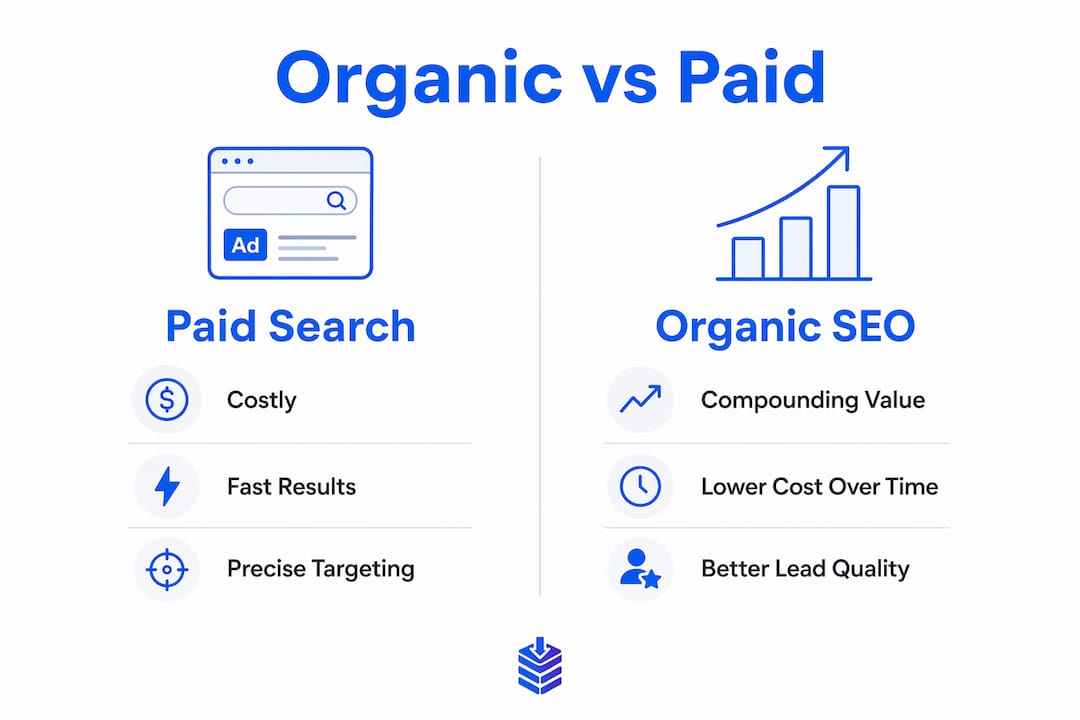
Think of SEO investment the way you think of a capital asset, not a recurring expense. The upfront cost covers content creation, technical fixes, and link building. Once that foundation is in place, the same pages keep generating traffic for years with only periodic refreshes.
The compounding mechanics work like this:
- Ranking improvements reduce cost-per-visit over time because the same content serves more searchers.
- Cumulative backlinks raise domain authority, which lifts newer pages faster than they would rank on a fresh domain.
- Internal linking passes authority across your content cluster, so a strong pillar page lifts supporting posts.
- Content refreshes extend the life of existing rankings rather than requiring net-new investment.
A simple illustration: assume you spend $3,000 per month on SEO for 12 months. In months 1–3, traffic is near zero. By months 4–6, you start ranking for long-tail terms and see 200–400 monthly visits. By months 9–12, the compounding effect produces 1,200–1,800 monthly visits, and your cost per lead drops to roughly $30–$40 versus a substantially higher cost in a comparable paid search scenario. The rankings continue generating traffic even if you reduce investment after month 12.
HubSpot research shows SEO often outperforms paid search in B2B lead quality, not just volume. That matters because a lower-cost lead that converts at a higher rate changes your unit economics faster than raw traffic numbers suggest.

Pro Tip: Run a 60-day paid campaign first. Use the conversion data to identify which keywords actually produce leads, then build your content cluster around those terms. You validate demand with paid before committing to organic investment — and you use paid data to prioritize your SEO roadmap.
What paid search does well — and where it falls short
Paid search has real strengths. Dismissing it entirely is a strategic mistake, especially early in a business's life.
- Immediate traffic: A Google Ads campaign can generate clicks within 24 hours of launch. No other channel matches that speed.
- Precise targeting: You can target by location, device, time of day, and demographic signals — useful for local campaigns and narrow audience segments.
- Fast test-and-learn loops: Paid campaigns surface conversion data in days, not months. That feedback loop is genuinely valuable for validating messaging and offers.
- Predictable short-term ROI: If your cost-per-click and conversion rate are stable, you can forecast revenue from a paid campaign with reasonable accuracy.
Where paid falls short structurally:
- Linear cost curve: Every additional visitor costs the same. There is no compounding, no residual value, and no asset being built.
- Rising CPCs: Keyword auction prices increase annually as more advertisers compete for the same terms. Your budget buys less traffic each year.
- Zero residual value: Pause the campaign and traffic drops to zero immediately. There is no slow decay, no carryover — nothing.
The right use cases for paid as the primary channel: a product launch where you need traffic before organic has any chance to rank; a seasonal ecommerce campaign with a hard end date; a startup with a short runway that needs leads now to survive long enough for SEO to mature.

Head-to-head: ROI, timeline, attribution, and breakeven math
The crossover point is the number every marketer needs to know. For most B2B companies, organic SEO matches paid search in traffic volume after several months, assuming consistent investment in content quality, technical SEO, and link building. After that, organic produces better economics.
| Period | Paid Search | Organic SEO |
|---|---|---|
| Month 1–3 | Immediate traffic; full CPC cost | Near-zero traffic; investment phase |
| Month 4–6 | Consistent traffic; costs compounding | Initial rankings; begins ramping monthly visits |
| Month 6–9 | ROI plateaus; CPC costs ongoing | Break-even point; organic matches paid volume |
| Month 9–12 | Rising CPCs erode margin | Monthly visits expand significantly; CPA drops further |
| Month 12+ | Indefinite spend required | Rankings persist; reduced ongoing cost |
Research finding: A peer-reviewed study in Information Systems Research found that organic presence and paid search have complementary effects on conversion performance. Organic competition can reduce sponsored click-through rates, but when both channels run together, overall conversion outcomes improve.
Attribution is where most teams get this wrong. Paid search is cleanly attributable: cost in, clicks out, conversions tracked. Organic ROI is cumulative and shows up across multiple touchpoints. Last-click attribution models systematically undervalue organic because a searcher might read three organic blog posts over two weeks before clicking a paid retargeting ad that gets the conversion credit. Multi-touch attribution and assisted-conversion reporting give you a more accurate picture. Without those models, you will consistently underestimate what organic is contributing and over-invest in paid.
How to prioritize budget: when to build, when to buy, and how to sequence
The right allocation depends on where your business is right now.
Scenario-based budget splits:
- Startup with short runway (under 12 months): the majority paid, minority SEO. You need leads now. Use paid to survive; use the conversion data to build your organic keyword list.
- Growth-stage B2B (12–36 months): a balanced split between paid and SEO. You have enough runway to let organic compound while paid maintains pipeline.
- Seasonal ecommerce: Heavy paid during peak season; SEO investment in the off-season to build authority before the next cycle.
- Established brand: a notable portion of budget to paid for competitive defense and remarketing; a larger portion to SEO for compounding growth and AI visibility.
Short-term action checklist:
- Audit your paid keyword list against your organic rankings. Nearly 41% of advertised pages already rank #1 organically — you may be paying for clicks you would get for free.
- Identify your top 10 converting paid keywords and build content clusters around them for organic.
- Set a 90-day paid test budget specifically to validate new keyword opportunities before committing to organic content production pricing.
- Track your combined customer acquisition cost (CAC) across both channels monthly, not per-channel in isolation.
Pro Tip: Before you write a single blog post, run a two-week paid campaign on your target keywords. Check which ad copy variants produce the highest conversion rate, then use those exact phrases in your organic title tags and meta descriptions. You get A/B-tested messaging for free.
KPIs to track when shifting budget from paid to organic:
- Multi-touch assisted conversions from organic (not just last-click)
- Organic traffic trend by cohort month (are rankings compounding?)
- Combined CAC trend over 12 months
- Cost-per-lead comparison at month 6, 9, and 12
Why measurement asymmetry causes teams to cut SEO too early
The single most common strategic mistake is canceling SEO investment at month 4 or 5, right before compounding begins. Measurement asymmetry drives this: paid ROI shows up in your dashboard on day one; organic ROI is cumulative, messy, and takes months to read accurately. Boards and executives see a clean paid ROAS and a murky organic attribution report, and they cut the wrong channel.
Measurement changes to adopt:
- Switch from last-click to multi-touch attribution for all organic reporting.
- Track cohort-based lifetime value (LTV) for customers acquired through organic vs. paid — organic customers often show higher LTV.
- Set a minimum 9-month test window before evaluating SEO program performance.
- Add assisted-conversion reporting to every organic channel dashboard.
Operational cadence recommendations:
- Publish new content on a consistent editorial calendar (weekly or bi-weekly minimum).
- Run monthly PPC-to-content experiments: take your top-converting paid keywords and assign each one a content brief.
- Conduct a quarterly SEO audit to catch ranking decay before it compounds negatively.
- Enforce a governance rule: no SEO program gets evaluated for ROI before month 9. Present this rule to stakeholders with the breakeven data from the comparative analysis above.
When presenting to stakeholders, lead with these metrics: combined CAC trend (not per-channel), multi-touch LTV/CAC ratio at 12 months, and the organic traffic cohort curve showing month-over-month compounding. Those three numbers tell the real story that last-click dashboards hide. You can also point to the common pitfalls small businesses face when they abandon SEO prematurely — the pattern is recognized.
Key Takeaways
Organic search beats paid ads long term because it builds compounding, owned assets that lower your cost-per-acquisition over time while paid search requires indefinite spend with no residual value.
| Point | Details |
|---|---|
| SEO as a capital asset | Organic rankings compound over time; cost-per-visit falls as authority grows. |
| Paid for speed, not scale | Use paid search in the first 6 months or for launches; it delivers ROI faster but never compounds. |
| Breakeven after several months | For most B2B companies, organic matches paid traffic volume after several months and outperforms it after. |
| Use paid to validate SEO | Run short paid campaigns to identify converting keywords before investing in organic content clusters. |
| Fix your attribution model | Switch to multi-touch attribution; last-click models systematically undervalue organic's contribution. |
| Blockpress accelerates the ramp | Blockpress's AI-native editor gives Shopify merchants live SEO scoring and keyword data to produce optimized content faster. |
The asset mindset is what most marketers are missing
Most budget conversations treat SEO as a cost line and paid ads as an investment. That framing is backwards. Paid search is the expense — you pay for every unit of output and own nothing when you stop. SEO is the investment — you build something that appreciates and keeps working.
The practical implication: if you are currently running paid campaigns and not yet investing in organic, you are renting your traffic at full price every month. The businesses that consistently win in search are the ones that use paid to fund the survival window while organic ramps, then systematically shift budget as compounding kicks in. That is not a theory. The breakeven math after several months is documented across B2B operator analyses, and the AI visibility gap makes the case even stronger now that LLMs cite organic content exclusively.
My recommendation: run a 90-day paid test tied to specific organic KPIs. If the unit economics validate, execute the transition plan. Do not wait for organic to prove itself under a last-click attribution model that was never designed to measure it.
Blockpress helps you build organic momentum faster
If you are a Shopify merchant trying to close the gap between "we should do SEO" and "our content is actually ranking," the bottleneck is usually production speed and optimization consistency, not strategy. Blockpress is an AI-native blog editor built directly into Shopify that gives you real Google keyword data, live SEO scoring, and AI-generated article drafts without leaving your store.
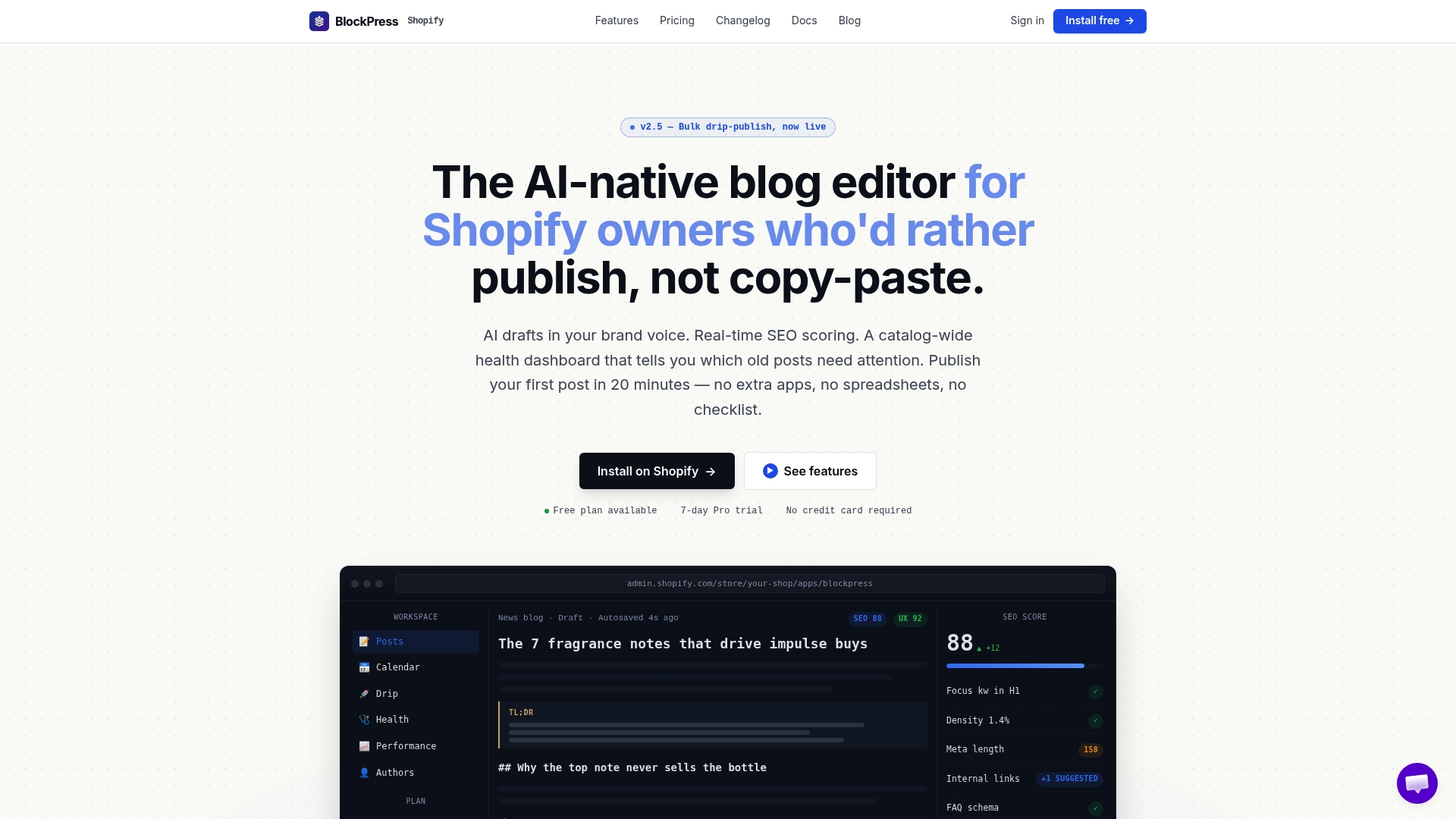
Where most merchants juggle three separate apps to replicate basic SEO workflow, Blockpress handles keyword research, content drafting, on-page scoring, and per-article performance analytics in one place. That means you can produce optimized content at the pace organic compounding actually requires, not at the pace a disconnected tool stack allows. If you are ready to start building organic assets instead of renting traffic, see Blockpress pricing and get started today.
Useful sources
- Information Systems Research — channel complementarity study: Peer-reviewed research demonstrating that organic and paid search have complementary conversion effects when run together. The foundational academic source for multi-channel attribution arguments.
- Fuel Online — paid search vs. organic SEO ROI comparison: Detailed operator-level breakdown of the month-by-month cost and traffic trajectories for both channels, including the month several months crossover point and cost-per-lead figures.
- Ahrefs — PPC vs. SEO keyword overlap study: Data showing that 40.66% of advertised pages already rank #1 organically — the primary source for the redundant spend audit recommendation.
- Eigemy — organic growth compounding: Practitioner analysis of measurement asymmetry and the governance risks of canceling SEO before compounding begins.
- AHAeCommerce — the real math on paid vs. organic: Operator-level breakeven analysis with conservative assumptions; supports the month 9–12 CPA crossover figures used in the comparative analysis.
- Blockpress blog — content strategy and SEO alignment: Practical guidance on building content clusters that drive sustainable organic growth for Shopify merchants.
FAQ
Does paid search affect organic search rankings?
No. Running or pausing paid ads has no direct effect on your organic rankings. Google's algorithm evaluates organic positions independently of ad spend.
Do paid search ads last longer than SEO results?
The opposite is true. Paid ads stop generating traffic the moment your budget runs out, while organic rankings decay slowly over months even after you reduce investment.
Is it smart to start with paid ads and then grow organic?
Yes, for most businesses this is the right sequence. Use paid search to generate leads during the first 6–9 months while organic builds momentum, then shift budget as organic reaches the breakeven point after several months.
Do paid search ads get higher click-through rates than organic results?
Generally, no. Users consistently trust organic results more than sponsored listings, particularly for research-phase queries. Organic listings for high-intent terms typically outperform paid CTR once rankings are established.