
TL;DR:
- Small businesses struggle with SEO because they lack proper technical setup, aligned content, and accurate local data. Without foundational tracking and targeted content matching search intent, their efforts yield no measurable revenue. Focusing on fixing technical issues, local data accuracy, and connection to meaningful metrics can significantly improve results.
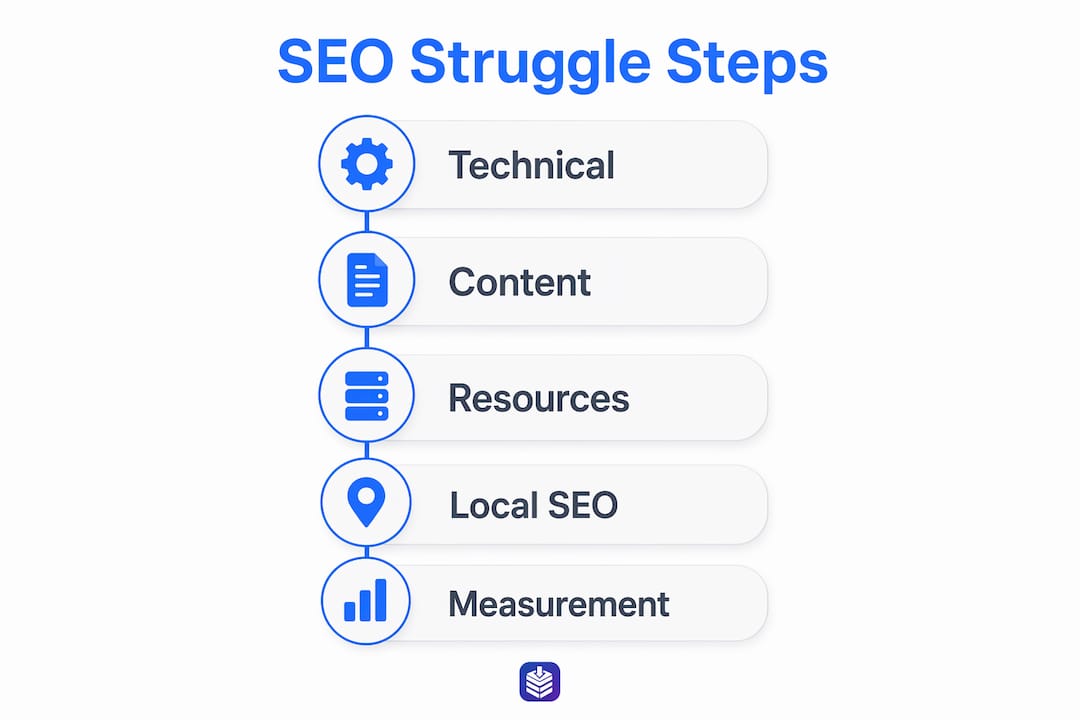
Small businesses struggle with SEO primarily because they lack three foundational elements: connected measurement, technically sound websites, and content that matches what buyers actually search for. A 2026 LocaliQ survey of 300+ SMBs found that 42% cite generating traffic and leads as their biggest SEO challenge. That number points to a deeper problem. Most small business owners invest time and money into SEO without first confirming that their site can be found, tracked, or trusted by Google. The result is invisible effort with no measurable return.
Why small businesses struggle with SEO: the technical barriers
Technical SEO is the foundation every other SEO effort depends on. If Google cannot crawl or index your pages, no amount of content or keyword work will produce rankings. This is where many small business websites fail silently.
The crawl versus index distinction is one of the most misunderstood concepts in SEO. Blocking a page with robots.txt prevents Google from crawling it. Adding a noindex tag prevents Google from indexing it. These are two separate controls, and confusing them causes pages to disappear from search results without any obvious warning.
Common technical issues blocking rankings include:
- robots.txt errors that accidentally block key pages or entire site sections
- Sitemap misconfigurations that exclude important URLs from Google's discovery queue
- noindex tags left on live pages after development or migration
- Duplicate content from URL parameter variations that split ranking signals
Pro Tip: Open Google Search Console and run a Coverage report. Any pages listed under "Excluded" or "Crawled but not indexed" need your attention before you write another blog post.
The practical fix is a technical audit before any content investment. Tools like Google Search Console, Screaming Frog, and Ahrefs Site Audit identify these issues quickly. SEO eligibility is binary at the pipeline level. If your pages cannot be accessed or indexed, rankings will not happen regardless of content quality.
| Technical Issue | Impact | Fix |
|---|---|---|
| robots.txt blocking key pages | Google cannot crawl them | Review and update robots.txt rules |
| noindex on live pages | Pages excluded from search results | Remove noindex from production pages |
| Sitemap errors | Pages missed in Google's queue | Regenerate and resubmit sitemap |
| Duplicate URLs | Split ranking signals | Implement canonical tags |
How content misalignment kills small business SEO performance
Content is the second place small businesses lose ground. The problem is rarely a lack of content. It is content that does not match what buyers are actually searching for.

Search intent is the reason behind a query. A user searching "emergency plumber near me" wants a phone number and a fast response. A page that only lists services without a clear call to action, location details, or FAQs fails that intent completely. Service pages with 400–600 words plus FAQ sections perform better in Google's evaluation than thin pages with minimal text.
The most common content mistakes on small business websites include:
- Thin service pages with fewer than 300 words and no supporting detail
- Contact-form-only pages that give Google nothing to evaluate
- Missing FAQs that leave common buyer questions unanswered
- No internal links connecting related service or location pages
Internal linking between related pages reinforces topical authority. A plumber with separate pages for "drain cleaning," "pipe repair," and "emergency services" should link those pages to each other. Google uses those connections to understand the depth of your expertise.
Pro Tip: Review your top five service pages. If any are under 400 words and lack at least three internal links, treat them as your highest-priority content updates.
A well-structured content strategy aligned with SEO targets specific buyer questions at each stage of the purchase decision. Generic pages about "our services" do not rank. Specific pages answering "how much does X cost in [city]" do.
How resource constraints and competition block small business SEO
Limited resources compound every other SEO challenge. Most small business owners manage SEO themselves alongside operations, sales, and customer service. That split attention makes consistency nearly impossible.
The competitive side of the problem is just as serious. 96.55% of pages across 14 billion analyzed by Ahrefs receive zero organic traffic from Google. That figure reflects how crowded search results are and how difficult it is to rank without a deliberate strategy.
Here is the resource challenge broken down in order of impact:
- Algorithm volatility. Google updates its ranking systems hundreds of times per year. Ongoing algorithm changes disproportionately affect smaller teams that cannot monitor and respond quickly.
- Domain authority gaps. Competing against established brands for broad keywords like "best accounting software" is not realistic for a new or small site. Narrow, intent-specific keywords are far more achievable.
- Tool access. Enterprise SEO platforms like Semrush and Ahrefs cost hundreds of dollars per month. Many small businesses skip them entirely and operate without keyword data.
- Fragmented effort. DIY SEO fails small businesses when tasks are spread across too many owners with no consistent process or measurement.
The fix is prioritization, not more effort. Focus on a narrow set of keywords with clear buyer intent and realistic difficulty scores. Build authority in one topic area before expanding.
Why local SEO failures hurt small businesses most
Local SEO is where many small businesses have their best opportunity, and where they make the most preventable mistakes. Google Maps rankings depend heavily on accurate, consistent business data across your Google Business Profile and local directories.
Inaccurate business listings cause 53% of consumers to avoid visiting a business. That is not just a rankings problem. It is a direct revenue problem.
Common local SEO execution failures include:
- Inconsistent NAP data (name, address, phone number) across Google, Yelp, and other directories
- Unclaimed or outdated Google Business Profiles with wrong hours or missing service categories
- No review strategy to build social proof and local ranking signals
- Missing location pages for businesses that serve multiple areas
Managing data drift in Google Business Profiles requires consistent updates to hours, categories, and services. A business that changed its hours six months ago but never updated Google is actively losing customers and ranking signals. Pair your Google Business Profile with blog content that supports local rankings to build a stronger local presence.
How a measurement-driven SEO foundation changes your results
Most small business SEO fails before it starts because foundational tracking is missing or disconnected from business goals. Traffic metrics can look healthy while revenue impact stays invisible.
The three pieces that must work together are:
- Tracking pixel installation on every key page, including thank-you pages and contact confirmations
- GA4 event connections tied to qualified business actions like form submissions, calls, and purchases
- Keyword-targeted content mapped to the specific queries that bring buyers, not just visitors
Without analytics tied to qualified actions, SEO looks productive but wastes budget without delivering revenue. You cannot improve what you cannot measure.
Pro Tip: Before publishing your next piece of content, confirm that GA4 is tracking the conversion event that content is meant to drive. If you cannot connect the content to a measurable outcome, reconsider the priority.
Start with a 2026 SEO content checklist to verify your measurement setup alongside your content quality. Both need to be in place before scaling.
Key takeaways
Small businesses fail at SEO when they skip the foundation: technical access, intent-matched content, accurate local data, and connected measurement must all work together before results follow.
| Point | Details |
|---|---|
| Fix technical issues first | Crawl errors and noindex tags block rankings regardless of content quality. |
| Match content to search intent | Service pages need 400+ words, FAQs, and internal links to rank effectively. |
| Target narrow keywords | Broad keywords without domain authority produce zero traffic for most small sites. |
| Audit local listings regularly | Inaccurate business data causes 53% of consumers to avoid visiting a business. |
| Connect analytics to revenue | GA4 events must tie to qualified actions, not just pageviews, to measure real SEO ROI. |
The part most small business owners skip until it's too late
I have worked with dozens of small business owners who came to me frustrated that SEO "wasn't working." In almost every case, the problem was not their content or their keywords. It was that they had never confirmed their site was properly indexed in the first place.
The instinct is to write more content. The right move is to open Search Console first. I have seen businesses publish 40 blog posts on a site where the entire blog folder was accidentally blocked by a robots.txt rule from a developer's staging setup. Every post was invisible to Google.
My honest recommendation: run a technical audit before you spend another hour on content. Then build your measurement layer. Then, and only then, invest in content at scale. The businesses I see succeed with SEO are not the ones with the biggest budgets. They are the ones who treat SEO as a system with checkpoints, not a content treadmill.
Local and niche keywords are where small businesses win. A bakery in Austin ranking for "custom birthday cakes Austin" will outperform a generic food blog targeting "best cakes" every time. Specificity beats volume when authority is limited.
— Rodney
How Blockpress helps small businesses build SEO that actually works
Consistent, keyword-targeted content connected to real measurement is what separates small businesses that grow through SEO from those that spin their wheels. Blockpress is an AI-native blog editor built directly into Shopify that gives you real Google keyword data, live SEO scoring, AI-generated article drafts, and per-article performance analytics without leaving your store.
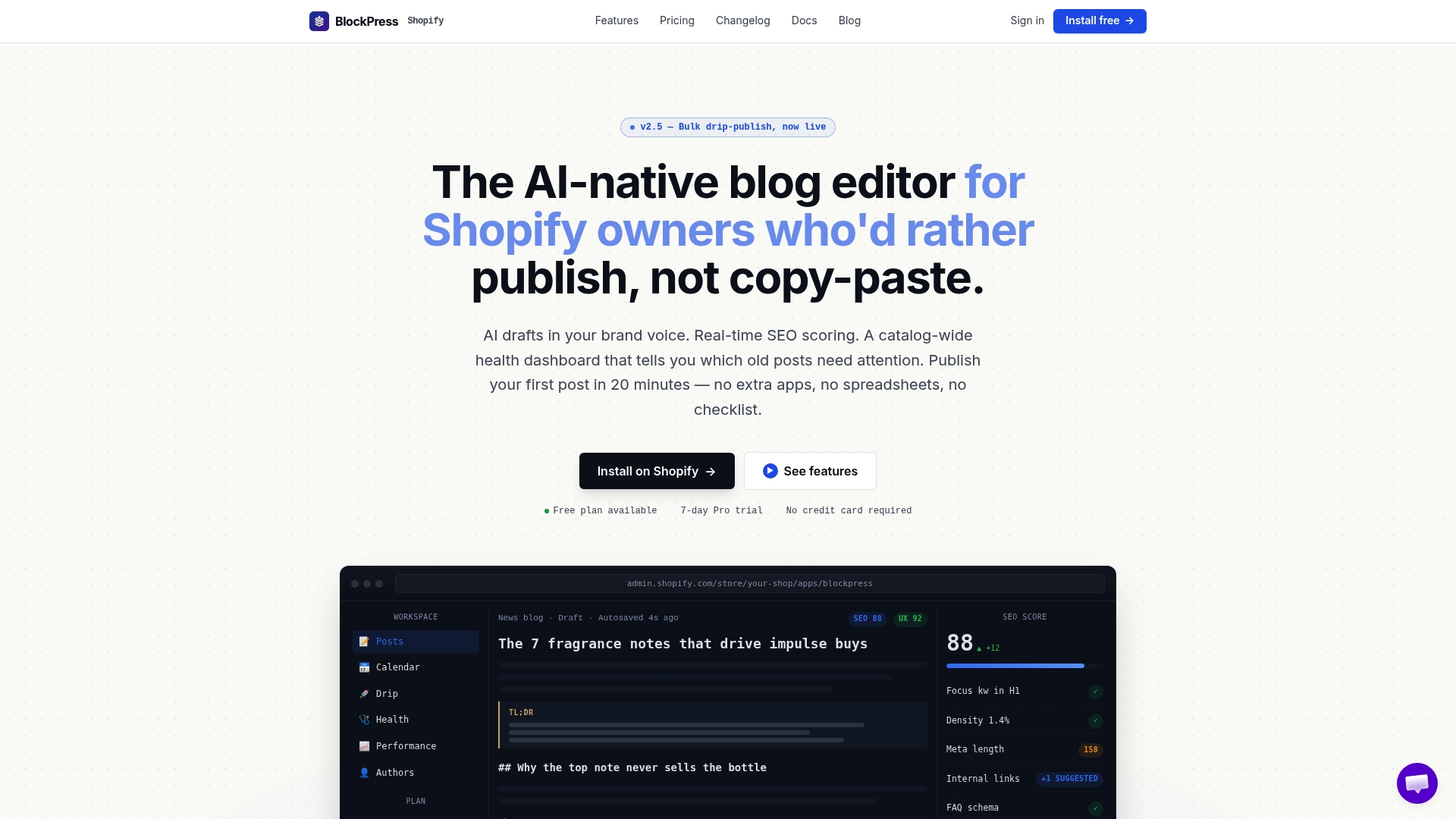
You do not need three separate apps to cover what Blockpress handles natively. From keyword targeting and SEO audits to bulk publishing and article health checks, Blockpress is built for store owners who want results without the complexity. Explore Blockpress pricing to find a plan that fits your budget and start building an SEO foundation that connects content to revenue.
FAQ
Why do most small businesses fail at SEO?
Most small businesses fail at SEO because foundational tracking, technical indexation, and keyword-targeted content are missing or disconnected. Without these three elements working together, traffic metrics look active but revenue impact stays invisible.
What are the biggest technical SEO mistakes small businesses make?
The most common technical mistakes are robots.txt errors that block key pages, noindex tags left on live pages, and sitemap misconfigurations that exclude URLs from Google's discovery queue.
How does local SEO affect small business rankings?
Inaccurate or inconsistent business listings cause 53% of consumers to avoid visiting a business, directly hurting both rankings and revenue. Keeping your Google Business Profile updated with correct hours, categories, and services is a core local SEO requirement.
What keywords should small businesses target for SEO?
Small businesses should target narrow, intent-specific keywords rather than broad high-volume terms. Competing for broad keywords without established domain authority leads to wasted effort, since the vast majority of pages receive zero organic traffic.
How can small businesses measure SEO success?
Connect GA4 event tracking to qualified business actions like form submissions, phone calls, and purchases. Pageviews alone do not indicate SEO success. Revenue-connected events give you the data needed to make smarter content and budget decisions.