
TL;DR:
- An ecommerce blog increases organic traffic by building authority and attracting high-intent shoppers. Consistent, structured content using the pillar-cluster model and schema markup boosts ranking and revenue. Regular updates and strategic internal linking are essential to sustain long-term growth.
Ecommerce blogging is the most cost-effective channel to drive organic traffic to your store without paying for every click. Stores with active blogs attract 55% more organic traffic than those without one. That gap compounds over time. A well-structured blog builds topical authority, feeds your internal linking structure, and pulls high-intent shoppers directly into your conversion funnel. This guide covers the keyword strategy, content formats, and maintenance habits that produce measurable results when you grow organic traffic on your ecommerce blog.
What fundamentals do you need to grow organic traffic on your ecommerce blog?
The foundation of organic traffic growth is keyword strategy. The most effective approach uses 70% long-tail keywords, 20% mid-tail, and 10% short-tail terms. Long-tail keywords like "best running shoes for flat feet under $100" attract buyers who are ready to purchase, not just browse. Short-tail terms build brand authority over time but rarely convert on the first visit.

The pillar-cluster content model
Structure your blog around pillar pages and supporting cluster articles. A pillar-cluster model uses one 3,000-plus word pillar page linked to 5–15 shorter cluster articles, each targeting a related long-tail keyword. Every cluster article links back to the pillar and forward to 2–3 relevant product or collection pages. This structure distributes link equity across your site and signals topical authority to Google.
Tools every ecommerce blog needs
| Tool category | Purpose | Example use |
|---|---|---|
| Keyword research | Find search volume and difficulty | Identify long-tail buying queries |
| Analytics platform | Track organic sessions and conversions | Measure which posts drive revenue |
| Content calendar | Plan and schedule posts | Maintain consistent publishing cadence |
| Schema markup tool | Add structured data to posts | Enable rich results in Google Search |
| SEO scoring | Audit live posts for on-page gaps | Fix thin content before it ranks poorly |
Structured data matters more than most store owners realize. Stores with complete schema generate 3.2x more organic revenue than those without it. Schema tells Google and AI search engines exactly what your content covers, which improves your chances of appearing in rich results and AI Overviews.
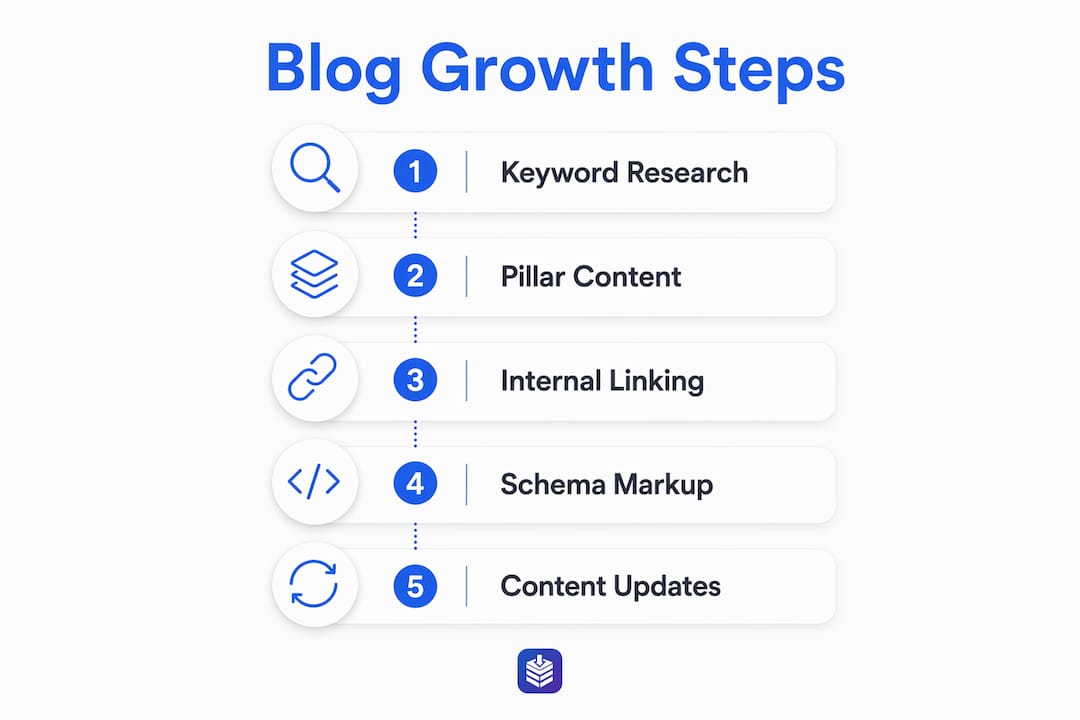
Pro Tip: Audit your existing posts for missing schema before publishing new ones. Fixing ten underperforming posts often delivers faster traffic gains than writing ten new articles from scratch.
How do you create ecommerce blog content that attracts high-intent traffic?
High-intent traffic comes from content that matches what buyers search for at each stage of their decision. Ecommerce SEO works best when you treat your blog as a product-information resource, not a promotional channel. The content types that consistently convert are buying guides, product comparisons, how-to articles, and FAQ sections built around real buyer questions.
Here is the process for creating content that ranks and converts:
- Identify the buyer's question. Start with the specific question a shopper types into Google before buying. "What is the difference between X and Y?" or "Is X worth it?" are high-converting query formats.
- Lead with the answer. Place your direct answer in the first paragraph. Google's information gain algorithm rewards content that answers the query immediately, without burying the response in background context.
- Add comparison tables and clear recommendations. A single 3,000-word pillar page with original data and comparison tables consistently outperforms short generic content. Tables give readers a fast decision path and give Google structured content to parse.
- Include FAQPage schema. Wrapping your FAQ section in FAQPage schema increases your chances of appearing in AI Overviews and featured snippets. AI-driven traffic converts at up to 1.8x the rate of standard organic clicks.
- Link to product pages with descriptive anchor text. Each blog post should link to at least three relevant commercial pages. Use anchor text like "waterproof hiking boots for women" instead of "click here" or "learn more."
Pro Tip: Your customer service inbox is a content goldmine. Buyer intent queries pulled from support tickets and DMs produce blog topics with double the conversion potential because they reflect real purchase friction.
How do you scale and maintain your ecommerce blog for sustained growth?
Consistent publishing and regular content updates are what separate stores that plateau from those that keep growing. Agile 90-day content cycles outperform static annual calendars because the SEO landscape shifts too fast for year-long plans to stay relevant. Plan your content in quarterly sprints, review performance data monthly, and adjust your keyword targets based on what is actually ranking.
Track these KPIs every month:
- Organic sessions by post. Identify which articles drive the most traffic and replicate their structure.
- Keyword rankings. Monitor position changes for your target terms using a rank tracker.
- Assisted conversions. Blog posts rarely get direct-purchase credit. Check your analytics for assisted conversion paths where a blog post appeared before checkout.
- Click-through rate (CTR) from search. A post ranking in position 4 with a 12% CTR beats one in position 2 with a 4% CTR. Rewrite meta titles and descriptions for low-CTR posts.
- Content freshness date. AI search engines prioritize content updated within the last 30 days. Schedule quarterly refreshes for your top-performing evergreen posts.
New stores should publish two posts per week to build topical authority faster. Established stores with existing authority can maintain momentum with one high-quality post per week. Prioritize keywords by revenue potential versus ranking difficulty to focus your effort on terms that pay off quickly.
What mistakes are killing your ecommerce blog's organic growth?
Most underperforming ecommerce blogs share the same set of fixable problems. Recognizing them early saves months of wasted effort.
- Thin content. Posts under 800 words rarely rank for competitive queries. Google's information gain update penalizes content that adds nothing new to what already exists on the topic.
- Weak internal linking. Blogs that do not link to product or collection pages waste their authority. Internal linking from blog to product pages is one of the most underused ranking levers in ecommerce SEO.
- No schema markup. Skipping structured data means missing out on rich results and AI Overview inclusion. Both drive higher-quality traffic than standard blue-link results.
- Stale content. Posts that have not been updated in over six months lose visibility in AI-assisted search. Content freshness is a direct ranking signal for both Google and AI search engines.
"Treating your ecommerce blog as a set-it-and-forget-it channel is the fastest way to lose rankings. The stores that win organic traffic in 2026 treat every published post as a living asset that needs regular attention, updated data, and tighter links to their product catalog."
Fix these issues before adding new content. A technical SEO audit of your existing posts will surface the highest-impact fixes in under an hour.
Key Takeaways
An ecommerce blog drives sustained organic traffic only when keyword strategy, internal linking, structured data, and content freshness work together as a system.
| Point | Details |
|---|---|
| Blog content drives measurable traffic | Stores with active blogs attract 55% more organic traffic than those without one. |
| Use the pillar-cluster model | Build one 3,000-plus word pillar page supported by 5–15 cluster articles, each linking to product pages. |
| Long-tail keywords convert the best | Target 70% long-tail keywords to attract buyers with clear purchase intent. |
| Content freshness is a ranking signal | Update evergreen posts quarterly to stay visible in Google and AI search results. |
| Internal links move authority | Each blog post should link to at least three product or collection pages with descriptive anchor text. |
The discipline most ecommerce blogs skip
After years of watching Shopify stores invest in blog content and then wonder why it does not convert, I keep seeing the same gap. Store owners treat SEO as a promotion problem when it is actually a product-information problem. Shoppers do not search for your brand. They search for answers to questions they have before they know your brand exists. The stores that win organic traffic write for that moment, not for themselves.
AI search is accelerating this shift. ChatGPT, Perplexity, and Google's AI Overviews now surface answers before users click anything. If your blog content does not answer questions directly, with structured data and fresh information, you are invisible in that channel. The stores I see growing fastest in 2026 treat their blog as a living knowledge base, not a publishing schedule. They update posts, add schema, and track which articles actually move revenue. That discipline is rare, and it is exactly why it works.
Blockpress makes ecommerce blog SEO manageable
Running a high-performing ecommerce blog requires keyword research, live SEO scoring, internal linking, schema support, and performance tracking. Most Shopify merchants piece this together across three or four separate apps.
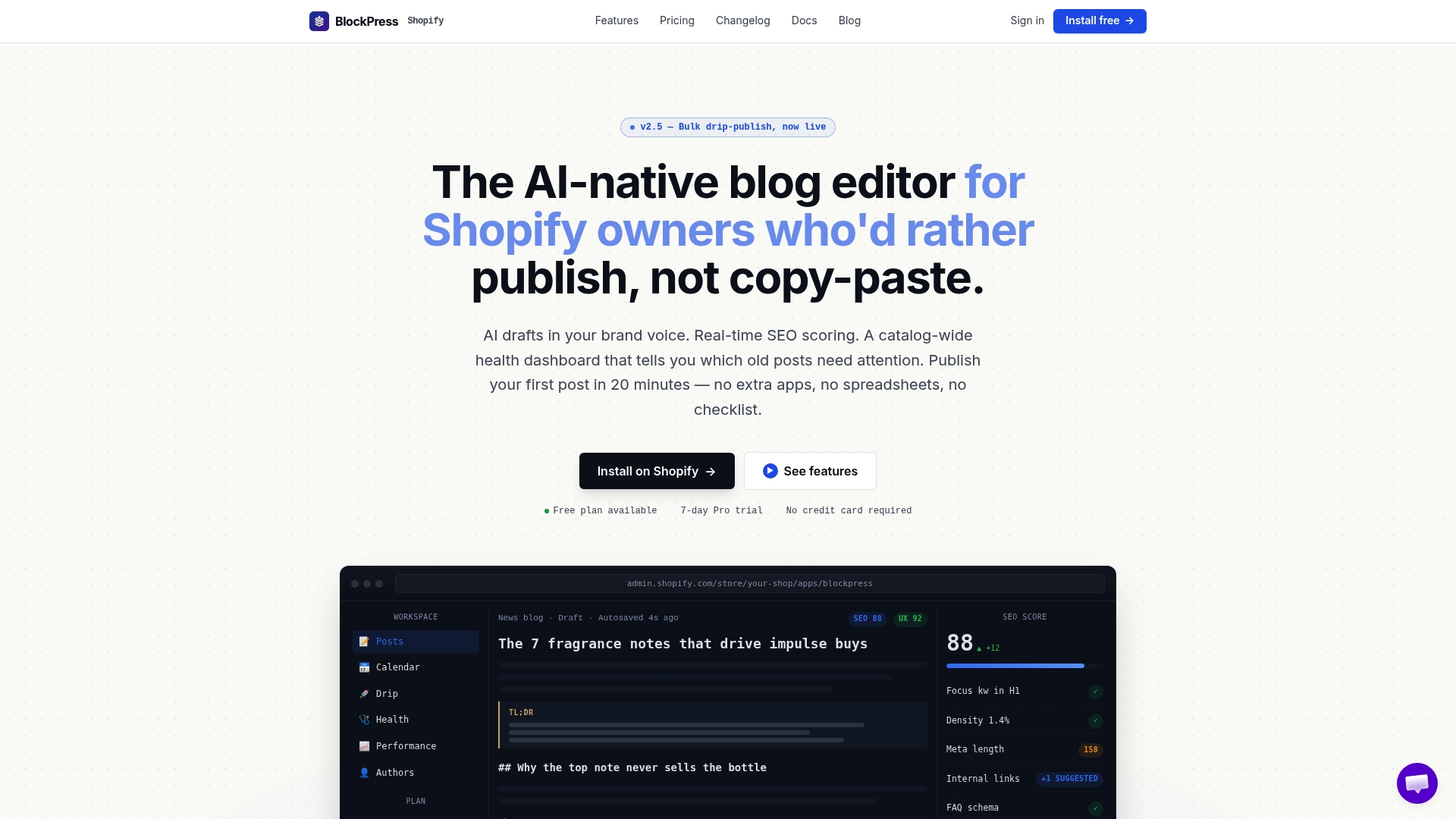
Blockpress brings all of it into one AI-native editor built directly inside Shopify. You get real Google keyword data, AI-generated article drafts, live SEO and UX scoring, bulk drip-publishing, article health audits, and per-article performance analytics without leaving your store. The full feature set covers everything from keyword targeting to author bio pages. If you want to increase organic traffic without managing a stack of disconnected tools, Blockpress is built for exactly that.
FAQ
How long does it take to grow organic traffic from a blog?
New content takes 3–6 months to gain meaningful traction on established domains and 6–12 months on new ones. Consistent publishing and internal linking speed up the process.
What type of blog content converts best for ecommerce?
Buying guides, product comparisons, and FAQ articles built around real buyer questions generate the highest-converting traffic. Pairing these with FAQPage schema increases visibility in AI Overviews.
How often should I update existing blog posts?
Update your top-performing evergreen posts at least once per quarter. AI search engines prioritize recently updated content, and content freshness directly affects your ranking position.
How many internal links should each blog post include?
Each post should include at least three links to relevant product or collection pages. Use descriptive anchor text that reflects the target keyword rather than generic phrases like "click here."
Do I need schema markup on my ecommerce blog?
Yes. Stores with complete schema markup generate significantly more organic revenue than those without it. FAQPage and Product schema improve your eligibility for rich results and AI-generated summaries.
— Rodney