

TL;DR:
- Matching content to search intent is essential for improving rankings and conversions in ecommerce.
- Analyzing Google’s top results helps identify the correct intent and the appropriate page format.
Search intent in ecommerce is defined as the specific goal a shopper aims to achieve when entering a query into Google, and matching your content to that goal is the single most reliable way to improve both rankings and conversion rates. Shopify, Ahrefs, and EcomSEO Academy all treat intent alignment as a foundational requirement before any keyword targeting decision is made. Get it right and your product pages rank for buyers. Get it wrong and you attract traffic that never converts. This guide covers the four core intent types, how to identify them from SERP analysis, and how to assign the right page format to every keyword in your catalog.
What is search intent in ecommerce and why does it matter?
Search intent in ecommerce reflects the shopper's underlying goal for a query, and content must match the page types Google rewards in the search results. Google classifies queries into four intent categories: informational, navigational, commercial investigation, and transactional. Each one maps to a different stage of the buying journey and a different type of page. A merchant who ignores this mapping ends up with blog posts competing against product pages, or category pages trying to answer how-to questions. Neither ranks well, and neither converts.

The importance of search intent in ecommerce goes beyond SEO theory. Intent alignment is a go/no-go filter for every keyword you consider targeting. If you cannot serve the dominant intent for a keyword with the page type you have, you should not target that keyword at all. This is how top-performing Shopify stores avoid wasting content budgets on traffic that bounces.
What are the types of search intent for ecommerce content?
Each intent type calls for a specific page format. The table below maps all four to real ecommerce examples.
| Intent type | Example query | Recommended page type |
|---|---|---|
| Informational | "how to choose running shoes" | Blog post, buying guide |
| Navigational | "Nike official store" | Brand homepage, store landing page |
| Commercial investigation | "best trail running shoes under $100" | Category page, comparison article |
| Transactional | "buy Brooks Ghost 16 size 10" | Product page, deal page |
Informational intent covers queries where the shopper is learning, not buying yet. Content like "how to care for leather boots" or "what is SPF in sunscreen" belongs in your blog. These posts build trust and capture top-of-funnel demand. They should link internally to relevant category or product pages to guide readers toward a purchase without forcing it.
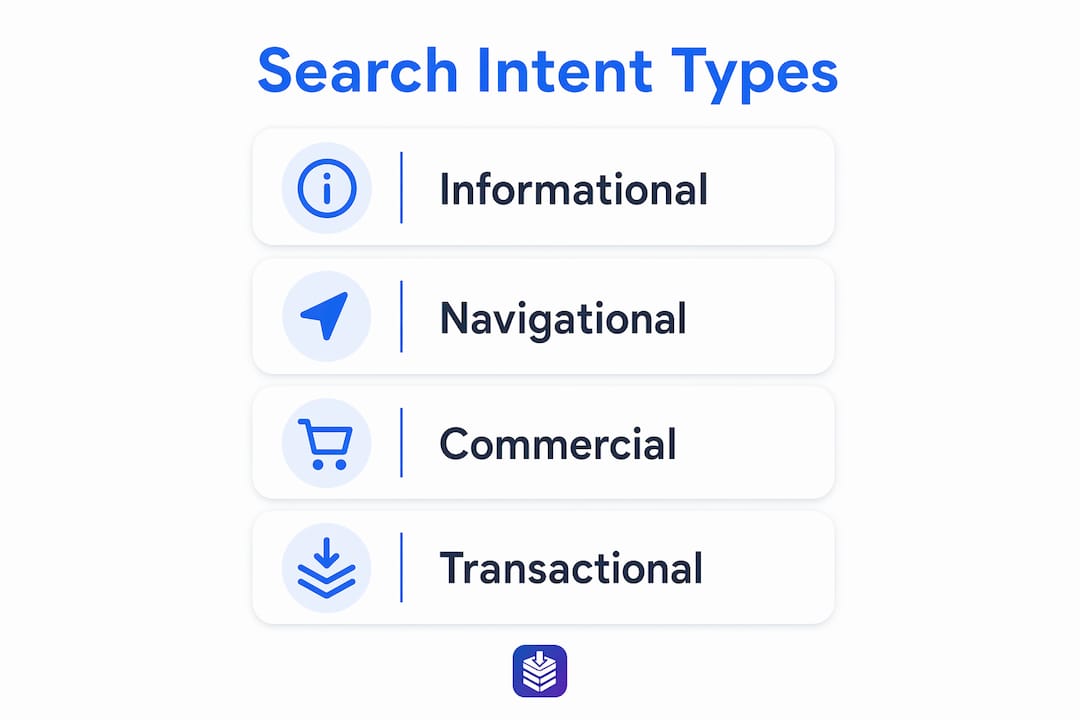
Navigational intent is brand-specific. A user searching "Allbirds shoe store" already knows where they want to go. Your job here is to make sure your homepage and brand pages are technically clean and rank for your own brand terms. On-page SEO errors on these pages are especially costly because the searcher already intends to visit you.
Commercial investigation intent is where shoppers compare options before committing. Queries like "best standing desk for home office" or "Vitamix vs Blendtec" belong on category pages or dedicated comparison articles. These pages need clear product specs, honest pros and cons, and strong internal links to product pages.
Transactional intent is the closest signal to a purchase. Queries include words like "buy," "price," "deal," or a specific product model number. Product pages and deal pages serve this intent. They need fast load times, clear pricing, trust signals, and a frictionless path to checkout.
Pro Tip: If a keyword feels transactional but the top Google results are all comparison articles, trust the SERP over your instinct. The SERP composition tells you what Google has decided the dominant intent is.
How to identify search intent from SERP analysis
Keyword words alone do not reveal intent reliably. Shopify recommends reverse-engineering intent from the composition of the first page of Google results rather than guessing from the query text. This method works because Google has already done the intent classification work for you.
Follow these steps for any keyword you want to target:
- Search the keyword in Google using a private or incognito window to avoid personalization bias.
- Scan the top 5–10 results. Note whether they are product pages, category pages, blog posts, or comparison articles.
- Identify the dominant page type. If 7 of the top 10 results are product pages, the intent is transactional. If guides and listicles dominate, the intent is informational or commercial investigation.
- Check the content format. Look at heading structures, word counts, and whether pages include prices, reviews, or how-to steps.
- Classify the keyword into one of the four intent buckets based on what you found.
- Assign the keyword to the correct page type in your store or content plan.
Tools like Semrush and Ahrefs annotate keyword intent directly in their keyword reports, which speeds up this process at scale. Still, manual SERP checks catch nuances that automated labels miss, especially for niche product categories.
Pro Tip: Run this SERP check every 6–12 months for your top keywords. Google's intent classification for a query can shift as search behavior changes, and a page that matched intent perfectly in 2024 may be misaligned by 2026.
Why intent mismatch kills conversions even with strong traffic
Intent mismatch occurs when the page type you rank does not match what the searcher actually wanted. EcomSEO Academy identifies intent mismatch as the primary cause of "high traffic, zero revenue" outcomes in ecommerce. A blog post ranking for a transactional query will attract buyers who immediately bounce because they wanted a product page, not an article. Google reads that bounce signal and eventually demotes the page.
Common intent mismatches to avoid:
- Ranking a blog post for a query like "buy protein powder bulk" where shoppers expect a product or category page
- Sending a category page to rank for "how to set up a standing desk" where shoppers expect a guide
- Using a homepage to target a specific product query like "Sony WH-1000XM5 price"
- Targeting commercial investigation keywords with thin product pages that lack comparison content
- Publishing duplicate product descriptions that fail to address the specific question behind a long-tail transactional query
Google's engagement signals, including click-through rate, time on page, and return-to-SERP rate, all reward pages that satisfy the searcher's goal immediately. When your page matches intent, Google ranks ecommerce content higher because users stay, engage, and convert. When it does not match, rankings drop regardless of how strong your backlink profile is.
Practical strategies for optimizing ecommerce pages by keyword intent
Assigning keywords to the right page types is the core of any intent-based content strategy. 2POINT Agency frames this as mapping each keyword to a product, category, blog, or comparison page based on the query's motivation, not its surface-level topic.
Here is how to put that into practice:
- Informational keywords: Create genuinely educational blog posts. Do not pitch products mid-article. Instead, use internal links to guide readers toward relevant category or product pages naturally. Educational content with internal links captures top-of-funnel demand and feeds it into your commercial pages without intent conflict.
- Commercial investigation keywords: Build out category pages with filters, comparison tables, and editorial summaries. These pages should answer "which is best for me" before the shopper clicks through to a product.
- Transactional keywords: Keep product pages focused. Clear title, price, images, reviews, and a single call to action. Remove anything that distracts from the purchase decision.
- Navigational keywords: Protect your brand terms with clean, fast-loading brand pages. Make sure your store name and product line names rank for your own queries.
Pro Tip: Build a simple keyword intent spreadsheet with columns for keyword, SERP-confirmed intent, assigned page URL, and last review date. Review it quarterly. This single habit prevents keyword cannibalization and keeps your content funnel aligned as your catalog grows.
A well-structured content strategy aligned with SEO treats intent buckets as the architecture for your entire site, not just a filter for blog topics. Internal linking between intent layers, from informational posts to commercial category pages to transactional product pages, creates a natural path that guides shoppers from research to purchase.
Key takeaways
Search intent in ecommerce is the most direct lever you have for improving both organic rankings and conversion rates at the same time.
| Point | Details |
|---|---|
| Four intent types | Informational, navigational, commercial investigation, and transactional each require a different page format. |
| SERP analysis over guesswork | Check the top 10 Google results to confirm dominant intent before assigning a keyword to a page. |
| Intent mismatch costs revenue | Ranking the wrong page type for a query drives traffic that bounces and signals poor quality to Google. |
| Internal linking connects intent layers | Link informational posts to category and product pages to move shoppers through the funnel without intent conflict. |
| Review intent regularly | SERP intent for a keyword can shift over time, so audit your top keywords every 6–12 months. |
The part most ecommerce marketers skip
I have reviewed dozens of Shopify stores where the SEO fundamentals were solid: good keyword research, clean site structure, decent backlinks. But the stores were still underperforming. In almost every case, the root cause was intent mismatch hiding in plain sight. A product page targeting an informational query. A blog post sitting on a transactional keyword. Nobody had ever checked the SERP to confirm what Google actually wanted to rank there.
The shift I always recommend is this: stop thinking about keywords as topics and start thinking about them as user goals. A query like "best yoga mat for beginners" is not just a topic for a blog post. It is a commercial investigation signal that calls for a category page with comparisons, specs, and clear links to buy. Treating it as a blog topic means you are competing with the wrong content format from day one.
Google is getting better at detecting intent satisfaction through engagement data. A page that technically covers a topic but fails to deliver the format the searcher expected will lose ground to a page that nails both. The stores winning in search right now are the ones that treat intent as a design constraint, not an afterthought.
— Rodney
Blockpress makes intent-based content easier for Shopify stores
Aligning every piece of content with the right search intent takes research, structure, and consistent execution. Blockpress is an AI-native blog editor built directly into Shopify that gives you real Google keyword data, live SEO scoring, and AI-generated article drafts without leaving your store.
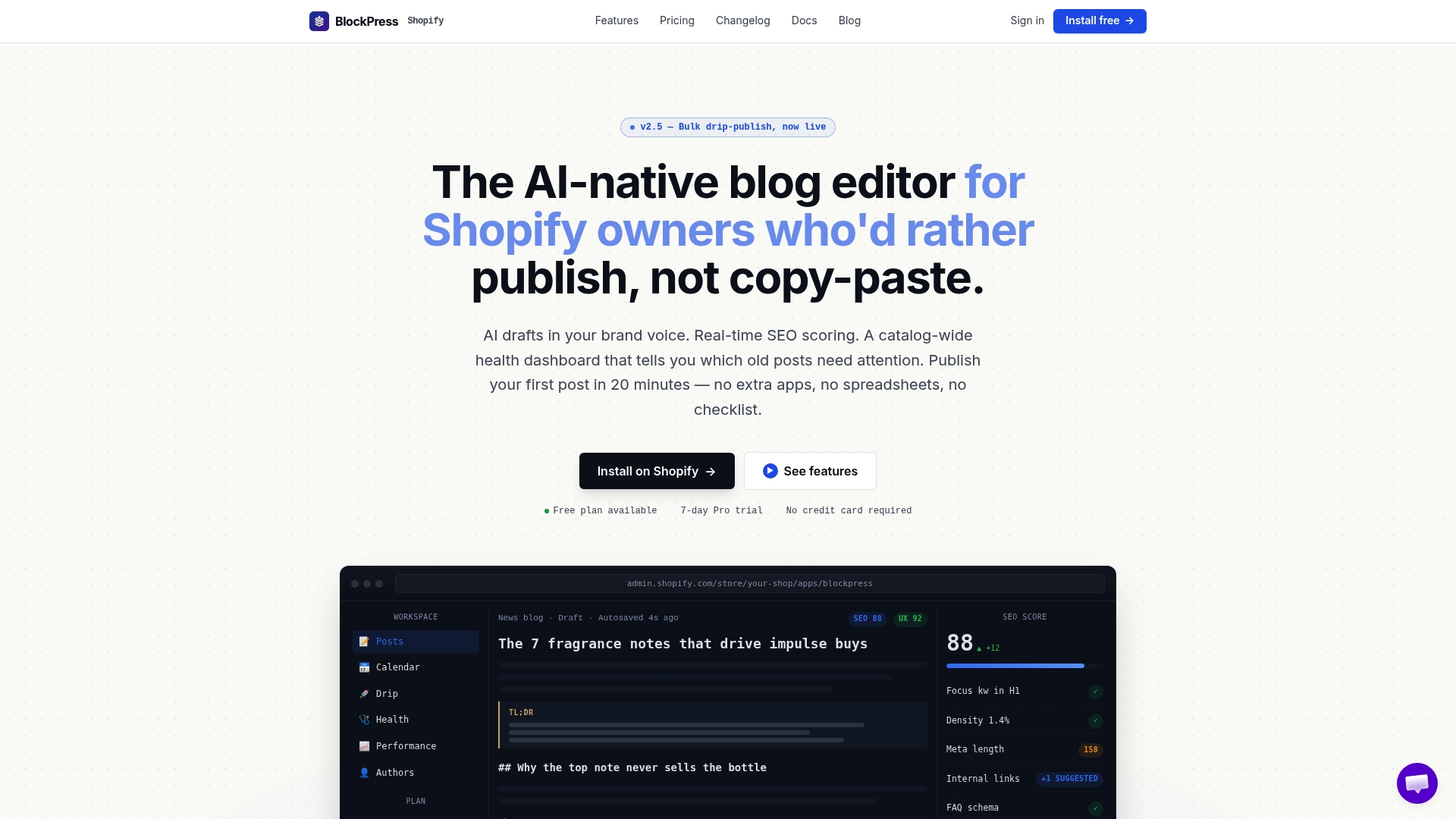
With Blockpress, you can identify keyword intent signals, structure posts for the right page format, and use bulk drip-publishing to build out your informational and commercial content layers at scale. Merchants who use Blockpress replace three separate apps with one editor that handles keyword research, content creation, and performance analytics in a single workflow. If you are serious about turning your Shopify blog into a conversion asset, Blockpress is built for exactly that.
FAQ
What is search intent in ecommerce?
Search intent in ecommerce is the specific goal a shopper has when entering a query into Google. It determines which type of page, such as a product page, category page, or blog post, will best satisfy that query and rank well.
What are the four types of search intent for ecommerce?
The four types are informational, navigational, commercial investigation, and transactional. Each maps to a different content format and stage of the buying journey.
How do I identify the search intent behind a keyword?
Search the keyword in Google and examine the top 5–10 results. If product pages dominate, the intent is transactional. If guides and comparisons dominate, the intent is informational or commercial investigation.
What is keyword intent mismatch and why does it hurt sales?
Keyword intent mismatch happens when the page you rank does not match what the searcher expected. EcomSEO Academy identifies this as the leading cause of high-traffic, low-revenue outcomes in ecommerce stores.
How often should I review keyword intent for my store?
Review your top keywords every 6–12 months. Google's intent classification for a query can shift as search behavior evolves, and pages that matched intent previously may need updating.