

Content velocity is the rate at which you publish and update content over a defined period, typically measured in pages per week or month. Done right, consistent and intent-mapped publishing builds topical authority, signals freshness to Google's crawl systems, and compounds organic growth over time. Done wrong, high-volume bursts of thin or unfocused content trigger index bloat, cannibalization, and crawl budget problems, which can actively suppress rankings.
BriefIQ frames this as "velocity with direction": publish quickly only when each piece maps to a clear search intent and fits a topic cluster strategy. That distinction separates teams that grow from teams that spin their wheels.
Key Takeaways
Sustainable content velocity requires measuring indexed rate and topical coverage, not just raw pages published. Run the spreadsheet benchmark, pick one cluster, and test a 30–60 day velocity increase before scaling further.
| Point | Details |
|---|---|
| Define velocity precisely | Measure publishing frequency, coverage speed, and update velocity as three separate dimensions. |
| Calculate indexed rate first | Divide indexed pages by published pages; a low indexed rate signals a crawl budget problem to fix before adding more content. |
| Use the weighted scoring formula | Weight indexed rate at 0.4, topical coverage at 0.35, and quality proxy at 0.25 to benchmark fairly. |
| Avoid burst-and-fade publishing | Steady, predictable cadence outperforms erratic spikes for crawl frequency and indexing consistency. |
| Blockpress for Shopify velocity | Blockpress combines keyword data, AI drafts, and bulk drip publishing inside Shopify to support a consistent, intent-aligned publishing cadence. |
Table of Contents
- Why does content velocity matter for SEO and business growth?
- What are the core dimensions of content velocity?
- Which tools help you measure content velocity accurately?
- When does high content velocity actually hurt your SEO?
- How do you increase content velocity without sacrificing quality?
- Which industries and situations benefit most from faster publishing?
- How do you build a reproducible velocity benchmark?
- The case for measuring before you scale
- Blockpress makes content velocity practical for Shopify stores
- Sources
- FAQ
Why does content velocity matter for SEO and business growth?
Publishing cadence affects three core SEO mechanisms: crawl frequency, topical authority, and freshness signals. Google's ranking systems factor in how often a site produces new, indexable content when determining how frequently Googlebot revisits it. A site that publishes consistently gives crawlers a reason to return on a predictable schedule. A site that goes quiet for months loses that rhythm.
The SEO benefits compound over time:
- Faster indexing: New pages get discovered and indexed sooner when your crawl frequency is high.
- More keyword entry points: Each new article can rank for a distinct query, widening your organic footprint.
- Topical authority: Covering a subject cluster thoroughly signals expertise to Google and improves rankings across the whole cluster.
- Better internal linking: More published pages create more opportunities to connect related content, distributing link equity and improving crawl paths.
At the business level, higher velocity means more lead-generation surface area, faster channel growth, and the ability to displace competitors who are publishing slowly in the same topic space. A content program that consistently covers emerging queries in your niche tends to capture traffic before competitors even brief the article.
Stat to watch: TheStacc notes that many practitioners cite a practical lower bound for compounding organic growth in competitive niches as a consistent monthly publishing rate appropriate to the domain authority and topic density, though the right number varies by domain authority and topic density.
What are the core dimensions of content velocity?
Ten Speed's content velocity framework identifies three operational dimensions worth tracking separately:
- Publishing frequency: New pages published per week or month. This is your raw output rate.
- Coverage speed: How fast you complete a topic cluster. A cluster of 10 articles finished in 60 days builds authority faster than the same 10 articles spread across a year.
- Update velocity: How often you refresh or expand existing pages. Updates count as velocity because they send freshness signals and can recover ranking losses on aging content.
Simple formulas to calculate your baseline
- Pages per month: Total published URLs ÷ months in the period
- Pages per author per month: Total published URLs ÷ authors ÷ months
- Indexed rate: Indexed pages (from Google Search Console) ÷ published pages × 100
- Updates per quarter: Count of pages with a meaningful revision date in the last 90 days
Search Engine Journal recommends pulling published URLs from your CMS or GSC over the last 90 days, dividing by 13 to get a weekly baseline, then comparing that number against your indexed rate to spot crawl budget gaps immediately.
Sample velocity tracking table
Track these columns in your spreadsheet: publish_date, url, topic_cluster, word_count, author, indexed_flag, traffic_at_publish, update_date, notes. That structure gives you everything you need to compute velocity, spot indexing gaps, and tie output to traffic outcomes.
Which tools help you measure content velocity accurately?
Measurement requires three data streams: publish logs, indexing checks, and an analytics join. Here is a practical stack:
- Google Search Console: Pull the Coverage report to compare submitted vs. indexed URLs. The Performance report shows impressions trends you can correlate with velocity spikes. This is your primary indexing validation tool.
- CMS export / publishing logs: Export your blog post list with publish dates directly from your CMS. This is the cleanest source for raw publish-date data, since GSC sometimes lags on discovery.
- Screaming Frog: Crawl your site to build a full URL inventory, flag canonical issues, and identify thin or duplicate pages that inflate your published count without adding indexable value.
- SEMrush or Ahrefs: Use the organic pages report to benchmark your output against competitors. Both tools show estimated publishing cadence for any domain, which helps you calibrate your own targets.
- Google Sheets + Coupler.io or BigQuery: Aggregate GSC exports, CMS logs, and crawl data in one place. Coupler.io automates the GSC pull on a schedule; BigQuery handles larger datasets where Sheets hits row limits.
Pro Tip: Set up a recurring CMS export (weekly or bi-weekly) that appends new rows to your tracking sheet automatically. Match each URL to its GSC indexing status using a VLOOKUP or a BigQuery join on the URL field. That join is where you spot the gap between what you published and what Google actually indexed, which is the most useful signal in your entire velocity dashboard.
Tie your content marketing KPIs to this same sheet so velocity metrics and performance metrics live in one view.
When does high content velocity actually hurt your SEO?
Velocity can damage rankings when it introduces thin content, index bloat, keyword cannibalization, or crawl budget overload. Google's core update and spam policy guidance is explicit: publishing low-quality or auto-generated content at scale can trigger quality signals that suppress an entire domain, not just the individual pages.
Search Engine Journal points out that a low-authority domain can overwhelm its own crawl budget by publishing many low-quality pages, which means Googlebot spends its crawl allocation on thin content and never reaches the stronger pages.
Red flags to watch
| Metric | What to watch | Diagnostic action |
|---|---|---|
| Indexed rate vs. published rate | Indexed rate drops below a threshold | Audit for thin/duplicate pages; pause new publishing |
| Time to index | New pages take 4+ weeks to appear in GSC | Check crawl budget; reduce publishing rate temporarily |
| Impressions vs. velocity | Impressions flat or falling during a velocity spike | Review content quality and intent alignment |
| Near-zero impression pages | Pages with 0–5 impressions after 60+ days | Consolidate, improve, or noindex |
Three harmful patterns show up repeatedly in practice. The burst-and-fade cycle happens when a team publishes 30 articles in a month, then goes quiet for two months. DEV Community's practitioner analysis notes that search engines respond better to steady, predictable rhythms than erratic spikes. Topic scattering occurs when articles cover unrelated subjects instead of building out a cluster, which prevents topical authority from accumulating. Thin pages published purely to hit a volume target dilute domain quality and can drag down rankings for stronger pages nearby.
If traffic drops after a velocity increase, run this diagnostic immediately: check indexed rate in GSC, pull the impressions trend for pages published in the last 60 days, run a Screaming Frog crawl to flag near-duplicate content, and review your cannibalization report in SEMrush or Ahrefs.
How do you increase content velocity without sacrificing quality?
The goal is a sustainable increase that preserves intent mapping and editorial quality. DEV Community's guidance is direct: structured briefs, batching, role separation, and counting updates as velocity are the four levers that scale output without degrading quality.
- Audit your baseline. Calculate your current pages per month, indexed rate, and topic cluster coverage before setting a new target.
- Build structured briefs. A brief that includes target keyword, search intent, cluster position, outline, and internal link targets cuts writing time and reduces QA cycles.
- Assign roles clearly. Separate the strategist (cluster planning), brief writer, author, editor, SEO reviewer, and publisher. Gated checkpoints between each role prevent low-quality work from reaching publish.
- Batch editorial work. Brief five articles at once, review five at once, publish on a drip schedule. Batching reduces context-switching and keeps the calendar predictable.
- Count updates as velocity. Refreshing an existing article with new data, an updated section, or a better internal link structure sends freshness signals and counts toward your output target.
- Repurpose and splinter. Turn one pillar article into three supporting posts targeting related long-tail queries. Each splinter page adds a keyword entry point and strengthens the cluster.
- Publish on a drip schedule. Consistent daily or weekly publishing beats irregular bursts. Schedule articles two to three weeks ahead so the calendar never goes empty.
- Measure and iterate. After 30 days, check indexed rate and impressions for the new batch. Adjust brief quality or publishing rate based on what you see.
Pro Tip: When repurposing a pillar into splinter posts, map each splinter to a distinct keyword with its own search intent before writing. Two splinter posts targeting nearly identical queries will cannibalize each other. A quick content gap analysis before you write prevents that problem.
For a deeper look at how content strategy aligns with SEO, the cluster-first approach is the foundation that makes velocity sustainable.
Which industries and situations benefit most from faster publishing?
Velocity matters more where query churn is high and topical coverage creates a durable competitive advantage. Not every situation calls for ramping output.
SaaS and B2B product launches benefit from fast velocity around new feature queries. When a product ships a new capability, competitors are often slow to publish supporting content. Publishing three to five articles covering the feature's use cases within the first two weeks captures early search demand before it consolidates around a competitor's page.
Ecommerce with seasonal catalogs should accelerate publishing in the six to eight weeks before peak season. Category pages, buying guides, and comparison articles published in September for a holiday peak have time to index and accumulate impressions before November traffic arrives. After the season, those pages can be updated rather than replaced, which builds compounding authority year over year.

News and trend-driven topics reward response time, the third operational dimension from Ten Speed's framework. A brand that publishes a well-researched article on an emerging trend within 48 hours of the trend breaking can rank for queries that have no established competition yet.
New domains building authority should prioritize cluster completion over raw volume. Publishing 20 articles across 20 unrelated topics builds nothing. Publishing 20 articles that complete three tight topic clusters builds measurable topical authority in those clusters, which is what moves rankings.
When to focus on quality and updates instead: an established domain with strong authority but declining rankings usually needs content refreshes and consolidation, not more new pages.
How do you build a reproducible velocity benchmark?
A reliable benchmark requires four data streams joined in one place: published rate, indexed rate, topical coverage, and quality proxies such as word count, backlinks, and impressions.
Step 1: Pull your data. Export your CMS publish log (URL, publish date, author, topic cluster, word count). Export GSC Coverage and Performance data (URL, indexed status, impressions last 30 days, clicks last 30 days). Run a Screaming Frog crawl to flag canonical issues and thin pages.

Step 2: Join the data. In Google Sheets or BigQuery, join on URL. Add calculated columns: weeks_since_publish (today minus publish date ÷ 7), indexed_flag (1/0 from GSC Coverage), impressions_30d (from GSC Performance).
Step 3: Apply a weighted scoring formula. TheStacc's practitioner approach suggests weighting indexed rate and topical coverage higher than raw volume to avoid rewarding thin-page strategies:
Velocity Score = (indexed_rate × 0.4) + (topical_coverage × 0.35) + (avg_quality_proxy × 0.25)
Where topical_coverage is the percentage of planned cluster articles published, and avg_quality_proxy is a normalized score based on word count and impressions.
Step 4: Apply filters. Exclude auto-generated pages (product variants, tag archives), filter by content type (blog posts only, or landing pages only), and flag any URL published in a burst period so you can separate spike behavior from baseline.
Pro Tip: Add an author_bio_flag column to your sheet. Pages with a linked author bio tend to perform better on EEAT signals. Tracking this alongside velocity data helps you see whether author attribution correlates with faster indexing or higher impressions in your specific domain.
| Benchmark column | Source | What it tells you |
|---|---|---|
| Published rate (pages/month) | CMS export | Raw output baseline |
| Indexed rate (%) | GSC Coverage | Crawl budget health |
| Topical coverage (%) | Manual cluster map | Authority-building progress |
| Avg. impressions at 30 days | GSC Performance | Early quality signal |
| Velocity Score | Calculated formula | Weighted benchmark for comparisons |
The case for measuring before you scale
Most teams that struggle with content velocity skip the measurement step entirely. They set a publishing target based on a competitor's output, hire writers or activate an AI tool, and publish as fast as possible. Three months later, traffic is flat, indexed rate has dropped, and no one can explain why.
The measurement-first approach described in this article is not a bureaucratic overhead. It is the only way to know whether your velocity increase is working or creating new problems. A velocity score that improves month over month, with impressions trending up, is a signal to scale.
DEV Community's analysis puts it plainly: 8 high-intent, well-researched articles consistently outperform 20 rushed posts that miss search intent. Volume is not the metric. Indexed, intent-aligned, cluster-completing output is the metric. That distinction is what separates content programs that compound from ones that plateau.
The 30/60/90 staging plan that works in practice: spend the first 30 days establishing your baseline metrics and completing one topic cluster. Days 31–60, test a modest velocity increase (add two to three articles per month) and watch indexed rate and impressions closely. Days 61–90, review the data and decide whether to scale, hold, or consolidate.
Editorial bandwidth and indexing lag are the two constraints most teams underestimate. Indexing lag means you will not see the full impact of a velocity increase for four to eight weeks. Set your measurement windows accordingly and resist the urge to change strategy before the data has had time to develop.
Blockpress makes content velocity practical for Shopify stores
Publishing faster is straightforward when your keyword data, SEO scoring, and drafting tools live in the same place as your blog. Blockpress is built directly into Shopify, which means you skip the context-switching between a CMS, a keyword tool, and a separate SEO app.
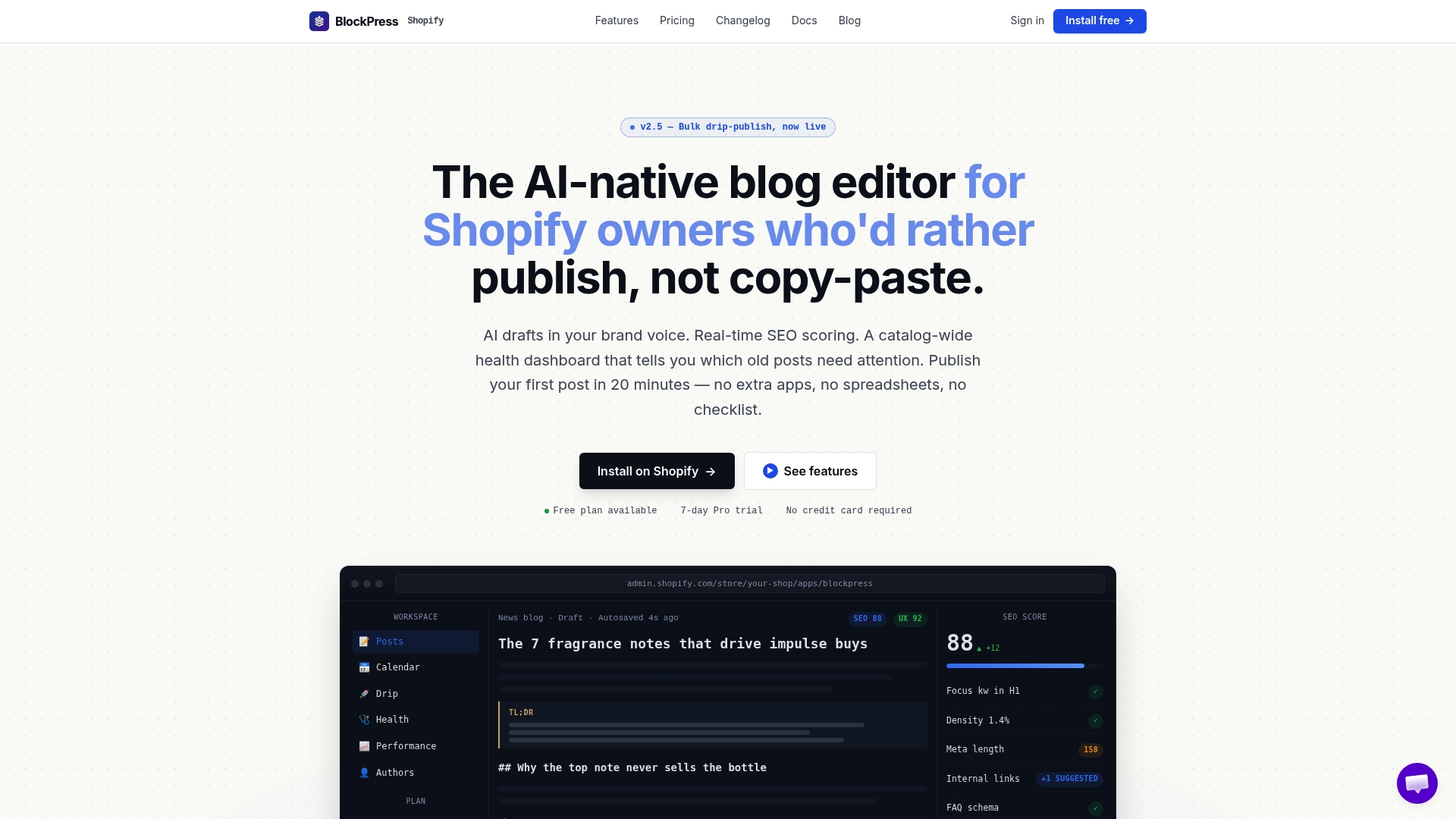
Here is how the feature set maps to velocity gains:
- Live Google keyword data inside the editor means you brief and write against real search demand, not guesswork. Intent alignment happens before the first draft, not after.
- AI-generated drafts in your brand voice compress the time from brief to first draft, so your editors spend time improving content rather than starting from a blank page.
- Internal-link suggestions and article health audits reduce QA cycles. Fewer revision rounds mean more articles move from draft to published each month.
- Bulk drip publishing and a scheduled calendar give you the predictable cadence that search engines reward, without manually queuing each post.
Check Blockpress pricing to see which plan fits your current publishing volume.
Sources
- Developers
- Content velocity: what it is, how to calculate it, and why you should care — Search Engine Journal
- What Content Velocity Is and Whether Publishing More Faster Helps Your SEO - DEV Community
- What Is Content Velocity in SEO and Why It Matters - BriefIQ Blog
- Content Velocity SEO (2026): Strategies, Tactics & Examples — TheStacc
FAQ
What is content velocity in SEO?
Content velocity is the rate at which a site publishes and updates content over a defined period, typically measured in pages per week or month. It affects crawl frequency, topical authority, and organic keyword coverage.
How do you calculate content velocity?
Count published URLs over the last 90 days, divide by 13 for a weekly rate, then compare that figure against your indexed page count in Google Search Console to check your indexed rate.
What is a good content velocity for SEO?
Many practitioners cite roughly 12 articles per month as a practical lower bound for compounding organic growth in competitive niches, though the right target depends on domain authority, topic density, and team capacity.
Can publishing too much content hurt your SEO?
Yes. High-volume publishing without intent alignment can cause index bloat, keyword cannibalization, and crawl budget overload, all of which can suppress rankings across an entire domain.
How does Blockpress help with content velocity for Shopify stores?
Blockpress combines live keyword data, AI-generated drafts, internal-link suggestions, and bulk drip publishing inside Shopify, which reduces the time from brief to published article and supports a consistent, intent-aligned publishing cadence.