
TL;DR:
- Traffic share indicates the percentage of total visits a website earns within a specific market or keyword group. It helps assess competitive positioning and track organic visibility over time. AI-driven changes in search are reducing clicks, making share of search a more reliable measure of brand demand.
Traffic share in SEO is the percentage of total online visits within a defined market or keyword set that your website captures compared to all competing sites. This metric moves analysis beyond raw session counts and into competitive positioning. SEO professionals use it alongside share of voice and share of search to build a complete picture of organic visibility. Understanding traffic share tells you not just how much traffic you get, but how much of the available traffic you actually own.
What is traffic share in SEO and how is it calculated?
Traffic share is calculated by dividing your website's visits by the total visits across all competing sites in a defined category or keyword cluster. The result is a percentage that shows your slice of a fixed audience pool. Traffic share moves analysis from isolated visit counts to competitive performance benchmarking. That shift in framing changes how you interpret growth.

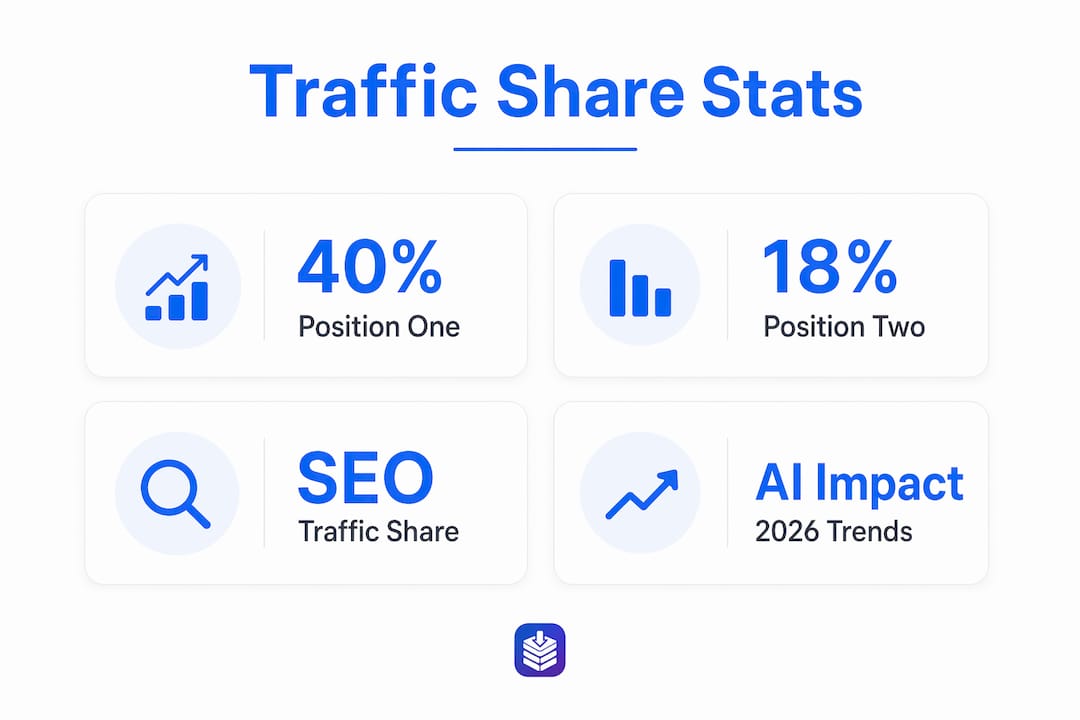
Ranking position drives traffic share more than almost any other factor. Position 1 captures roughly 40% of clicks, while position 2 drops to around 18%. That steep decline means a single ranking jump can meaningfully shift your share within a keyword cluster.
Accurate measurement requires weighting keywords by search volume and click-through rate, not just counting rankings. A keyword with 50,000 monthly searches contributes far more to your traffic share than one with 500. Most SEO analytics platforms apply CTR curves automatically, but you should verify the methodology before trusting the output.
| Keyword | Monthly searches | Your CTR | Your estimated visits | Market total visits | Your traffic share |
|---|---|---|---|---|---|
| running shoes | 90,000 | 4% | 3,600 | 45,000 | 8% |
| trail running shoes | 22,000 | 12% | 2,640 | 11,000 | 24% |
| best running shoes 2026 | 8,000 | 28% | 2,240 | 6,500 | 34% |
Pro Tip: Track traffic share as a trend over rolling 90-day windows rather than point-in-time snapshots. A single month can be distorted by seasonality or algorithm updates. The trend line reveals whether you are genuinely gaining ground.
How does traffic share relate to share of voice and share of search?
These three metrics measure visibility at different stages of the buyer journey, and confusing them leads to poor strategic decisions. Traffic share is a lagging indicator of actual visits, while share of search is a leading indicator that predicts future market demand and brand momentum. Share of voice sits between them, capturing paid and organic impressions across channels.
Share of search tracks how often users search for your brand relative to competitors. It reflects genuine consumer interest and cannot be easily manipulated through content tactics. As AI-powered search reduces click-through traffic, share of search becomes a more reliable forward-looking signal for brand health. Traffic share, by contrast, only registers after the click happens.
The role of AI in search rankings is reshaping how each metric behaves. AI-generated answers absorb clicks that previously went to organic results, compressing traffic share figures industry-wide. Share of search holds its value because it measures intent, not clicks.
| Metric | What it measures | Indicator type | Best use case |
|---|---|---|---|
| Traffic share | Actual visits vs. market total | Lagging | Competitive benchmarking |
| Share of voice | Impressions across paid and organic | Leading | Brand awareness planning |
| Share of search | Brand search volume vs. competitors | Leading | Demand forecasting |
Why does traffic share matter for SEO strategy in 2026?
Traffic share reveals your competitive position within a market, not just your absolute performance. A site can grow traffic by 20% while losing traffic share if competitors grow faster. Traffic share contextualizes performance within the available industry attention pool. That context is what separates strategic SEO from vanity metric tracking.
The "SOV > SOM" rule adds another layer of strategic value. When share of voice exceeds share of market, brands typically experience future sales growth. Applying this logic to organic traffic share means that gaining visibility now predicts revenue gains later. That forward-looking connection justifies investing in content and technical SEO even before conversion data confirms results.
Common pitfalls to avoid when using traffic share as a KPI:
- Chasing volume over intent. High traffic share on low-intent keywords creates noise without driving growth. Always tie share gains to commercial outcomes.
- Ignoring category definition. Traffic share is only meaningful within a well-defined keyword set or market segment. A loosely defined category produces misleading numbers.
- Measuring too infrequently. Monthly snapshots miss the directional signals that weekly or rolling-window tracking reveals.
Pro Tip: Pair traffic share data with conversion rate by keyword cluster. A cluster where you hold 30% traffic share but convert at half the category average signals a content quality or user experience problem, not a ranking problem.
What steps can you take to measure and grow your traffic share?
Growing traffic share requires a structured approach. Follow these steps to build a repeatable measurement and improvement process.
- Define your keyword universe. Group keywords by topic cluster and commercial intent. Weight each cluster by search volume so your share calculation reflects actual opportunity.
- Pull baseline data. Use Google Search Console for your own CTR and impressions. Cross-reference with an SEO analytics platform to estimate competitor performance within the same clusters.
- Calculate share by cluster. Divide your estimated visits per cluster by the total estimated visits across all ranking sites. Repeat this monthly and track the trend.
- Audit content gaps. Identify clusters where competitors hold significantly more share. SEO audits improve blog performance by surfacing exactly these gaps and prioritizing fixes by traffic potential.
- Optimize for relevance and authority. Increasing traffic share requires technical SEO, comprehensive content that addresses user intent, and a strong user experience. All three must improve together.
- Monitor competitor movements. Tracking where users go after visiting competitor sites, a technique called Share of Destinations, uncovers affiliate and referral sources that affect true market capture. Use this to identify partnership opportunities.
- Balance branded and non-branded traffic. Non-branded traffic share shows your reach with new audiences. Branded share reflects loyalty and awareness. Both matter and both should trend upward over time.
Pro Tip: When measuring SEO performance, connect traffic share trends to pipeline data quarterly. If share rises but pipeline stays flat, your keyword targeting needs a commercial intent review.
Key Takeaways
Traffic share is a competitive metric, not an absolute one. Its value comes from comparing your position within a defined market, not from the raw number itself.
| Point | Details |
|---|---|
| Core definition | Traffic share is your site's visits divided by total market visits within a keyword set. |
| Ranking drives share | Position 1 captures roughly 40% of clicks, making ranking improvements the fastest path to share gains. |
| Pair with share of search | Share of search predicts future demand; traffic share confirms past performance. Use both together. |
| Avoid vanity traps | High share on low-intent keywords does not drive revenue. Always tie share metrics to commercial outcomes. |
| Trend over time | Track traffic share across rolling 90-day windows to filter out seasonal noise and algorithm fluctuations. |
Traffic share in the AI era: what I've actually seen shift
The conventional advice says to grow traffic share by ranking higher and publishing more. That still works. But the more interesting shift I've observed is how AI search is decoupling traffic share from brand health. Sites are losing clicks to AI-generated answers while their share of search stays flat or grows. That gap is real, and it matters.
The mistake I see most often is treating traffic share as the final verdict on SEO performance. It is not. It is one signal in a system. When I work through competitive analyses, the sites that make the best decisions are the ones combining traffic share with share of search and conversion data. They do not panic when traffic share dips slightly if share of search holds steady. They understand the difference between a structural problem and a measurement artifact.
The other thing worth saying plainly: traffic share on the wrong keywords is a trap. I've seen sites celebrate holding 40% share in a cluster that generates zero pipeline. The metric looked great. The business impact was zero. Define your keyword universe around commercial intent first, then measure share within that universe. That sequence changes everything.
— Rodney
How Blockpress helps you track and grow organic visibility
Knowing your traffic share is one thing. Acting on it consistently is another challenge entirely, especially when you are managing a Shopify store alongside everything else.
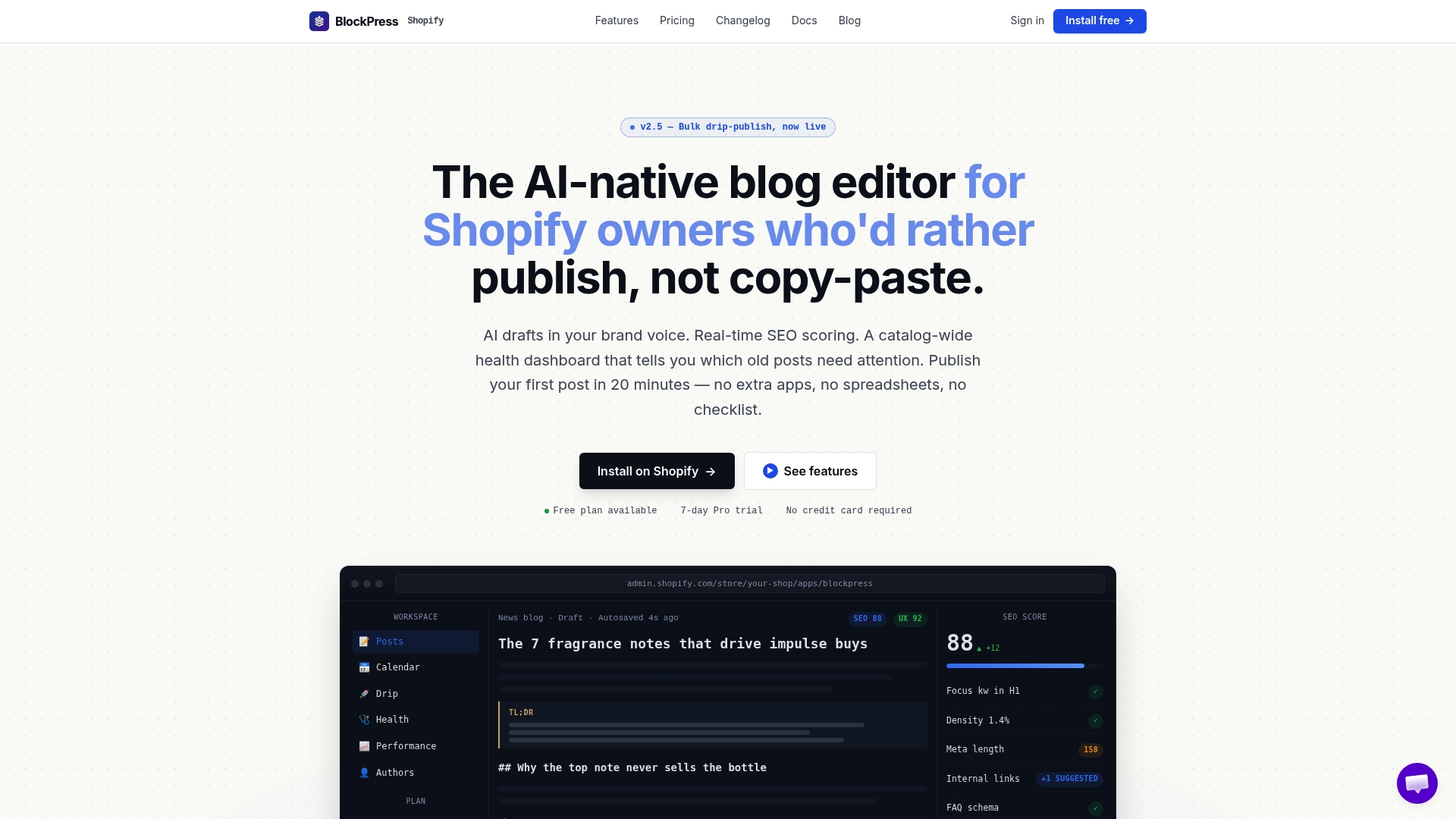
Blockpress is an AI-native blog editor built directly into Shopify. It gives you real Google keyword data, live SEO scoring, AI-generated article drafts, and per-article performance analytics without switching between tools. You can identify which content clusters are losing share and publish targeted articles to recover ground, all inside your store. If you want to close the gap between knowing your traffic share and doing something about it, Blockpress is built for exactly that workflow. Check out the full feature set to see how it fits your SEO process.
FAQ
What is traffic share in SEO?
Traffic share in SEO is the percentage of total visits within a defined market or keyword cluster that your website captures. It measures competitive positioning rather than absolute traffic volume.
How is traffic share different from share of voice?
Traffic share tracks actual visits and is a lagging indicator. Share of voice measures impressions across paid and organic channels and acts as a leading indicator of market influence.
Why does ranking position affect traffic share so much?
Position 1 captures roughly 40% of clicks while position 2 drops to around 18%. That steep CTR decline means small ranking changes produce large swings in traffic share within a keyword cluster.
How does AI search affect traffic share metrics?
AI-generated answers reduce click-through traffic across the board, compressing traffic share figures. Share of search becomes a more reliable metric in this environment because it measures brand intent, not clicks.
What is the fastest way to increase traffic share?
Improving rankings on high-volume, commercially relevant keywords produces the fastest gains. Combine technical SEO fixes, content that fully addresses user intent, and a strong user experience to move rankings and capture more share.