
TL;DR:
- Blog posts increase store traffic by capturing potential buyers early through informational queries that product pages cannot target. They also convert readers into shoppers by linking relevant products and collections, with consistent publishing building long-term growth. Tracking product clicks and purchases from blog traffic proves their return on investment.
Blog posts increase store traffic by creating additional searchable pages that rank for informational queries your product pages can never capture. A product page for "ceramic cookware set" targets buyers ready to purchase. A blog post titled "how to season a ceramic pan" reaches that same buyer three weeks earlier, before they've chosen a brand. That early touchpoint is where organic discovery happens, and it's the core reason why blog posts increase store traffic at a scale paid ads can't replicate cost-effectively. Tools like Google Search Console, Shopify's built-in analytics, and Blockpress give store owners the data to turn that discovery into measurable revenue.
How blog content targets keywords differently than product pages
Product pages are built for transactional keywords. They rank for terms like "buy ceramic pan" or "ceramic cookware set sale." Those terms convert well, but they attract only buyers who already know what they want. Blogs target informational queries, which represent the majority of searches at any given moment.
Informational queries are searches where the user is learning, not buying yet. Examples include:
- "How to style a small kitchen"
- "What cookware is safe for glass stovetops"
- "Difference between ceramic and stainless steel pans"
- "Best way to clean non-stick surfaces"
Each of those queries represents a potential customer. None of them would land on your product page. A blog post answering each question creates a new entry point into your store for a visitor who is moving toward a purchase decision. This is the core SEO mechanic behind how blogs drive store visits at scale.
Matching search intent is what determines whether Google ranks your content. Google prioritizes content that is unique and directly answers what a user is searching for. A blog post that genuinely answers "how to season a ceramic pan" ranks because it matches intent precisely. A generic post about "our great cookware" does not.

Why internal linking from blog posts converts readers into buyers
Internal linking is the mechanism that turns blog traffic into store revenue. Without links pointing readers to relevant products and collections, blog visitors read and leave. With links, they click through to product pages, add items to their cart, and buy.
Internal links connect informational content directly to commerce pages. A post about "how to season a ceramic pan" should link to your ceramic cookware collection. A post about "best cookware for glass stovetops" should link to the specific products you recommend. The link makes the transition from reader to shopper natural and frictionless.
Internal linking also builds topical authority. Google evaluates sites with well-structured topical connections more favorably over time. When your blog posts link to each other and to product pages in a logical cluster, your entire site gains authority, not just individual pages. This is the compounding effect that makes blogging a long-term SEO asset.
Best practices for internal linking in e-commerce blogs:
- Use descriptive anchor text that names the product or topic, not "click here"
- Link to the most relevant collection or product page, not just the homepage
- Include at least one link to a related blog post to keep readers on your site
- Avoid linking the same URL more than twice in a single post
Pro Tip: Link every blog post to at least one product or collection page and one related blog post. This two-link minimum keeps readers moving through your site and signals topical depth to Google. A detailed Shopify internal linking guide can help you build this habit systematically.
Practical strategies to increase store visits with blogging
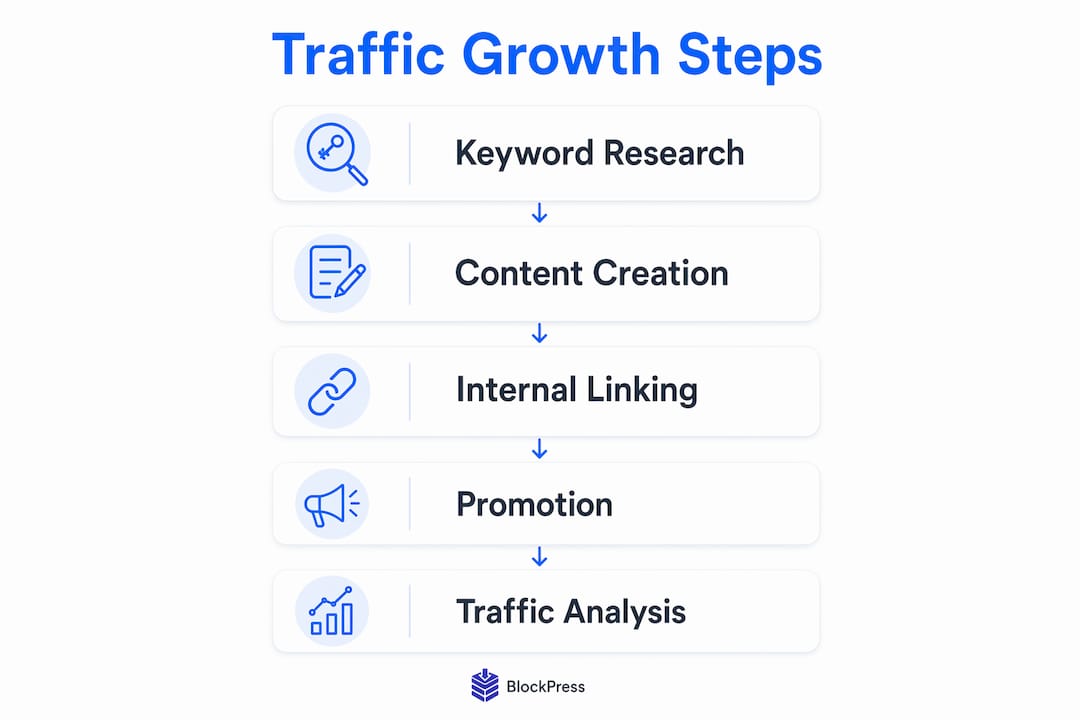
Consistent, well-targeted publishing is the engine behind long-term traffic growth. One blog post ranking for a moderately searched keyword can generate 50–100 visitors monthly. Publishing 50 posts over a year can result in 1,250–2,500 free monthly visitors, reducing your dependence on paid ads significantly.
-
Research informational keywords tied to your products. Use tools like Google Search Console or Blockpress's built-in keyword data to find questions your potential customers are already asking. Focus on terms with clear purchase-adjacent intent, not broad awareness topics.
-
Publish on a consistent schedule. Publishing once or twice weekly builds search engine trust faster than sporadic bursts. Regularity signals that your site is active and authoritative.
-
Write content that is genuinely useful, not generic. Google rewards unique content that answers a specific question better than competing pages. Commodity posts that repeat what every other site says will not rank.
-
Promote new posts through email and social media. Early promotion drives traffic signals that help Google evaluate and rank new posts faster. Your email list and social following are your fastest path to initial engagement.
-
Audit underperforming posts regularly. A post that ranked six months ago may have slipped. Refreshing content with updated information and stronger internal links recovers lost rankings.
Pro Tip: When you publish a new post, send it to your email list within 48 hours. That initial traffic spike tells Google the content is relevant and worth ranking. Pair this with optimizing existing posts to compound results over time.
Page views vs. conversion metrics: what actually measures blog ROI
Page views are the most commonly reported blog metric. They are also the least useful for measuring whether your blog actually increases store traffic that converts.
| Metric | What it measures | Why it matters |
|---|---|---|
| Page views | Total visits to a blog post | Shows reach, not intent or value |
| Product page clicks from blog | Readers moving toward purchase | Indicates content is driving commerce |
| Add-to-cart events from blog sessions | Purchase intent triggered by content | Directly ties blog to revenue pipeline |
| Purchases attributed to blog | Completed sales from blog-originated sessions | Proves ROI of content investment |
| Bounce rate on blog posts | Readers who leave without engaging | Signals content or UX problems |
UTMs and event tracking let you link blog sessions to specific store actions like product clicks, add-to-cart events, and completed purchases. That attribution is what separates a blog that earns its keep from one that just generates traffic with no commercial outcome. Tools like Google Analytics 4 and Shopify's native analytics support this tracking when set up correctly. You can also review how blog traffic converts to sales to build a measurement framework specific to your store.
Key Takeaways
Blog posts increase store traffic by expanding your keyword reach beyond transactional terms, creating entry points earlier in the buyer journey, and converting readers into shoppers through deliberate internal linking.
| Point | Details |
|---|---|
| Informational keywords drive discovery | Blog posts rank for queries product pages cannot, capturing buyers before purchase intent is strong. |
| Internal links convert readers to buyers | Every post needs at least one link to a product or collection page to make traffic commercially useful. |
| Consistent publishing compounds traffic | Publishing once or twice weekly builds search engine trust and multiplies organic reach over time. |
| Intent-based metrics prove ROI | Track product clicks, add-to-cart events, and purchases from blog sessions, not just page views. |
| Topical clusters build site authority | Linking related posts and products together signals depth to Google and improves rankings across your store. |
Blogging as an SEO asset library, not a content calendar
Most store owners treat their blog like a social media feed. They post when they have news, skip weeks when they're busy, and write about topics that feel interesting rather than topics their customers are searching for. That approach produces traffic spikes that fade and no compounding growth.
The stores I've seen grow consistently through content treat their blog as an SEO asset library. Every post is a permanent, searchable page that earns traffic month after month. The question before publishing is never "is this interesting?" It's "what specific query does this answer, and does it lead a reader toward a product?"
The other mistake I see constantly is writing for broad awareness. A post titled "The History of Ceramic Cookware" might get shares, but it attracts readers with no purchase intent. A post titled "Is Ceramic Cookware Safe for Induction Stovetops?" attracts someone who is actively evaluating a purchase. That distinction determines whether your blog drives revenue or just traffic.
Measurement is where most stores give up too early. Organic content takes time to rank. The stores that stick with consistent publishing and track intent-based metrics, not just page views, are the ones that see traffic compound into a reliable, low-cost acquisition channel. The technical SEO fundamentals matter too, but strategy and patience are what separate stores that blog successfully from those that abandon it after three months.
— Rodney
Blockpress: built for Shopify stores that blog to grow
Blockpress is an AI-native blog editor built directly inside Shopify. It gives you real Google keyword data, live SEO scoring, AI-generated article drafts, and per-article performance analytics without switching between apps or tabs.
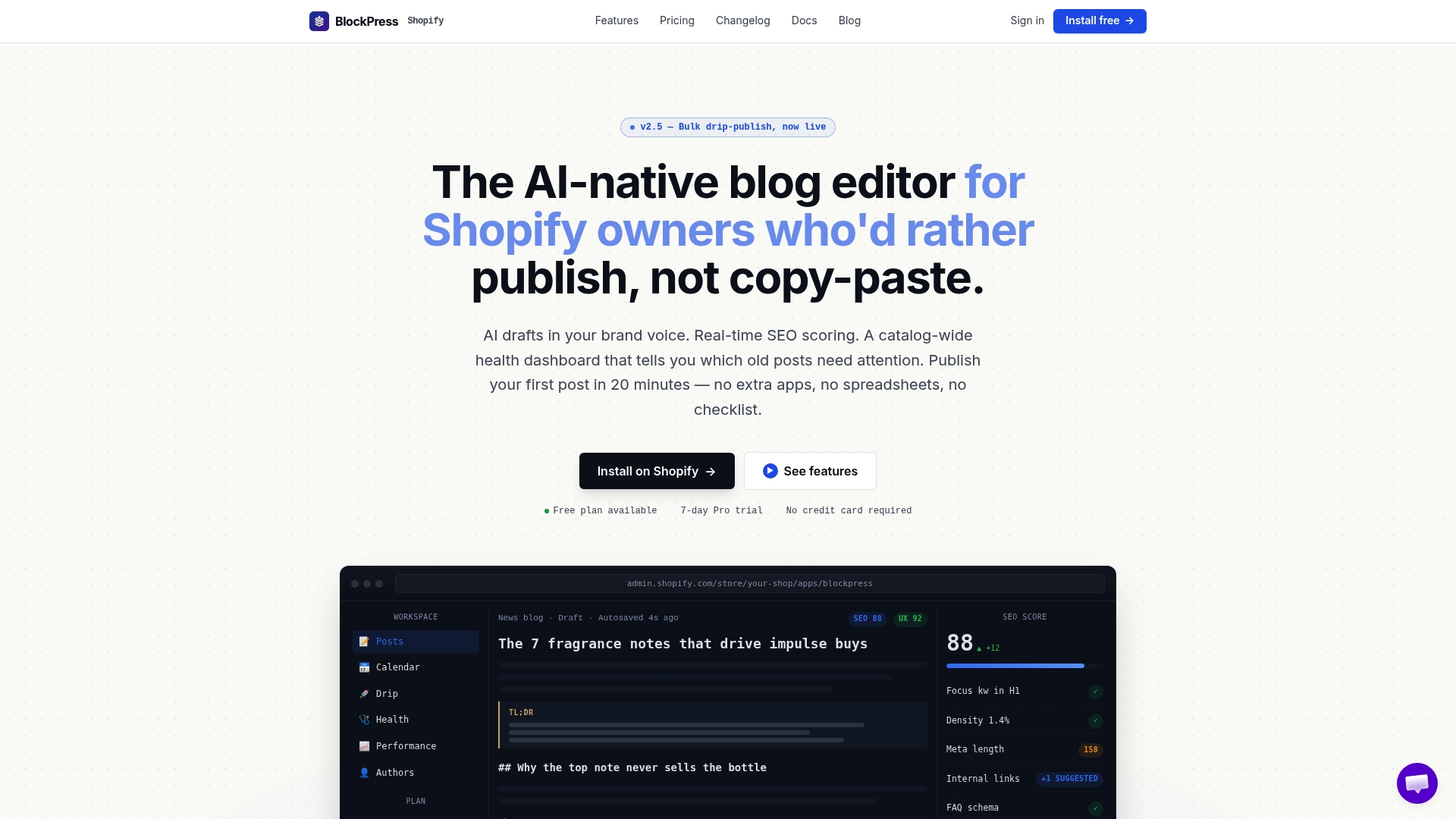
Most Shopify merchants use three separate tools to replicate what Blockpress does natively: a keyword research tool, an SEO grader, and a content scheduler. Blockpress replaces all three inside your store's admin. If you're ready to publish blog content that ranks, converts, and compounds over time, Blockpress is built for exactly that workflow. You can also review the full feature set to see how each tool supports your content strategy.
FAQ
Why do blog posts increase store traffic more than product pages?
Blog posts rank for informational queries that product pages cannot target, capturing potential buyers earlier in the purchase journey. This expands your store's total keyword reach and creates more entry points from organic search.
How many blog posts do I need to see a traffic increase?
One post ranking for a moderately searched keyword can generate 50–100 monthly visitors. Publishing consistently over 12 months compounds that reach significantly across dozens of posts.
Do blog posts help increase sales, or just traffic?
Blog posts drive sales when they include internal links to relevant products and collections. Without those links, traffic stays on the blog and does not convert to purchases.
How do I measure whether my blog is driving store visits?
Use UTMs and event tracking in Google Analytics 4 to attribute product page clicks, add-to-cart events, and purchases to specific blog posts. Page views alone do not measure commercial impact.
How often should I publish blog posts for traffic growth?
Publishing once or twice weekly builds search engine trust faster than irregular posting. Consistent frequency signals that your site is active and helps new posts rank more quickly.