
Niche, product- and category-focused blogging outperforms general-interest content for Shopify and DTC stores because it builds topical authority, captures high-intent long-tail queries, and routes readers directly to the product and category pages that convert. General blogs scatter attention. Niche blogs concentrate it where revenue lives.
Two things you can do in the next 48 hours:
- Topic audit: List every product category in your store. For each one, count how many blog posts you have that link directly to that collection page. Any category with fewer than three posts is a gap.
- Pick one category hub: Choose the category with the highest revenue and the thinnest content coverage. That becomes your first pillar page and cluster target.
Pro Tip: Don't start with your most competitive category. Start with the one where you already rank on page 2, positions 11–20. A focused cluster can push those pages to page 1 faster than building from scratch.
Key Takeaways
Niche, product-focused blogging outperforms general content for Shopify stores because topical authority, long-tail intent, and internal linking work together to route organic traffic directly to revenue pages.
| Point | Details |
|---|---|
| Start with one category hub | Pick the highest-revenue category with thin content coverage and build your first pillar there. |
| Build 6–12 cluster posts | A pillar plus at least 5–7 interlinked spokes creates a measurable topical authority signal. |
| Wire every spoke to a product page | Internal links to collection and product pages are what turn blog traffic into revenue. |
| Expect results in 60–120 days | Low-to-medium-competition clusters typically show ranking movement within this window. |
| Use Blockpress to speed execution | In-editor keyword data, AI drafts, and internal-link suggestions compress the 60–90 day plan. |
Table of Contents
- Why niche blogging outperforms general content for ecommerce SEO
- What high-impact niche content looks like for your Shopify store
- How to choose the right niche topics for your store
- How to structure topic clusters and internal links to build topical authority
- What to measure and realistic timelines for niche blogging ROI
- A 60–90 day rollout plan you can start this week
- How Blockpress accelerates niche blogging on Shopify
- An editorial perspective on niche clusters and what actually trips stores up
- Sources
- FAQ
Why niche blogging outperforms general content for ecommerce SEO
Topical authority is the degree to which Google recognizes your site as a reliable, in-depth source on a specific subject. Google's E-E-A-T signals reward sites that cover a topic thoroughly, not sites that touch dozens of topics lightly. When your blog publishes six interlinked posts about, say, waterproof hiking boots, Google sees semantic completeness. A general lifestyle blog publishing one post on boots, one on travel, and one on recipes signals nothing coherent.
Long-tail, high-intent queries are where the conversion math works in your favor. A shopper searching "best waterproof hiking boots for wide feet under $150" is far closer to buying than someone searching "hiking tips." Niche SEO strategies that target these specific queries rank faster because competition is lower, and they convert better because intent is higher.
Internal linking is the third mechanism. A pillar page links to cluster posts; cluster posts link back to the pillar and to each other; every cluster post links to the relevant product or collection page. This hub-and-spoke architecture concentrates PageRank on your revenue pages instead of letting it dissipate across unconnected posts. Content that sits as an island, with no internal links in or out, contributes almost nothing to your store's authority.
Topical authority also improves your chances of appearing in AI Overviews. Clusters with semantic completeness are more likely to be cited by AI-generated answers because they present a comprehensive answer set on a topic. (Werner Strauch)
Pro Tip: In every buying guide, place at least one contextual link to the relevant collection page within the first 300 words. Readers who click through early are already in purchase mode.
What high-impact niche content looks like for your Shopify store
According to ecommerce content research, product, category, and buying-guide pages capture a large share of organic ecommerce traffic. Blog posts that don't connect to those pages generate visits but rarely generate revenue. The formats below are the ones that actually move product discovery:
- Category pillar page: A long-form resource that covers everything a buyer needs to know about a product category. Links to every relevant collection page and spawns 6–10 cluster posts. Example: "The Complete Guide to Waterproof Hiking Boots" links to your Waterproof Boots collection.
- Buying guide: A comparison-focused post with a product table, use-case breakdowns, and direct product links. Top-to-mid funnel. Example: "Best Hiking Boots for Wide Feet: 2026 Buyer's Guide."
- Product-use post: Shows the product solving a specific problem. Bottom funnel. Example: "How to Break In Waterproof Hiking Boots Without Blisters."
- Comparative feature explainer: Side-by-side feature analysis for shoppers deciding between two options. Mid-to-bottom funnel. Example: "Gore-Tex vs. eVent: Which Waterproofing Actually Lasts?"
- FAQ and glossary pages: Answer the questions your customer support team fields most. These capture zero-click-adjacent queries and build trust. Tie each FAQ to a category page.
A strong format sequence: publish the category pillar first, then a buying guide that links back to it, then two or three product-use posts that link to both. Each post reinforces the others and funnels readers toward a purchase decision.
How to choose the right niche topics for your store
Good topic selection starts with what you already sell, not with what gets the most search volume. Use these criteria to filter candidates:
- Inventory fit: Does a post about this topic lead naturally to a product or collection you stock?
- Buyer intent: Is the query asked by someone researching a purchase, or someone with no buying intent?
- Search volume vs. competition: Prefer queries with modest volume and low keyword difficulty over high-volume head terms you can't realistically rank for.
- Revenue proximity: How many clicks from this post to a product page? Fewer is better.
For the research process, run these steps in order:
- Pull your site search data from Shopify analytics. Queries your visitors type into your store's search bar are almost always high-intent and underserved by your current content.
- Open Google Search Console and filter for queries where you rank in positions 11–30. Those pages need one focused cluster post to push them onto page 1.
- Use a keyword tool (Google Keyword Planner, Ahrefs, or Semrush) to expand each seed term into long-tail variants. Filter for long-tail keywords with clear purchase intent.
- Review customer support transcripts and product reviews. The exact language customers use to describe problems is often a ready-made keyword cluster.
Prioritize topics using a simple impact-versus-effort matrix: high revenue proximity plus low competition equals your first cluster. Save high-competition topics for after your cluster has built authority. For more niche keyword ideas mapped to product stores, this content idea resource is worth bookmarking.
How to structure topic clusters and internal links to build topical authority
A functional cluster has one pillar and 6–12 spoke posts. Research on ecommerce topical authority puts the minimum at a pillar plus several interlinked posts to create a measurable authority signal, with rankings usually moving within a few months of cluster completion.
Cluster architecture:
- The pillar covers the full category topic at a high level and links out to every spoke.
- Each spoke covers one subtopic in depth and links back to the pillar, to at least two sibling spokes, and to the relevant product or collection page.
- Product and collection pages receive links from spokes but generally don't need to link back into the cluster.
Publishing order matters. Follow this sequence:
- Publish the pillar page first so every subsequent spoke has somewhere to link.
- Publish the buying guide next. It's the highest-conversion spoke and establishes the cluster's commercial intent.
- Add product-use posts and feature explainers over the following weeks.
- Refresh the pillar every 90 days to incorporate new spoke content and keep it current.
For a detailed walkthrough of Shopify internal linking within clusters, the hub-and-spoke model translates directly to Shopify's blog and collection architecture. Topical authority compounds: each new interlinked post makes the whole cluster harder for a competitor to replicate quickly.
What to measure and realistic timelines for niche blogging ROI
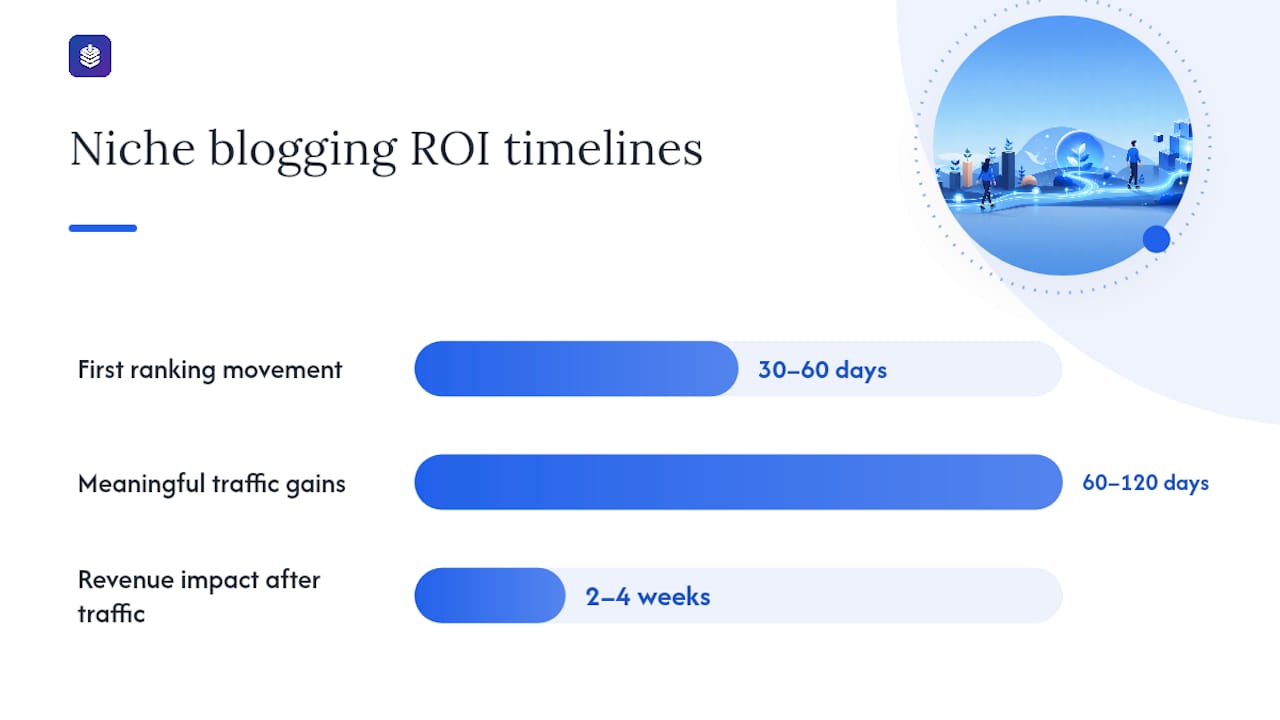
Set expectations clearly. Niche clusters built on low-to-medium-competition queries typically show first ranking movement at 30–60 days and meaningful organic traffic gains at 60–120 days. Revenue impact from organic traffic usually follows traffic gains by 2–4 weeks as Google stabilizes rankings.
| KPI | Why it matters | How to measure |
|---|---|---|
| Organic sessions by page type | Separates blog traffic from collection/product traffic | GSC + GA4 segments |
| Impressions and clicks for target queries | Shows ranking progress before traffic arrives | Google Search Console |
| Conversion rate from organic landing pages | Proves blog-to-product funnel is working | GA4 goal completions |
| Assisted conversions | Captures blog's role in multi-touch paths | GA4 attribution reports |
| Dwell time and bounce rate by post | Signals content quality and intent match | GA4 engagement metrics |
For attribution, create a GA4 funnel that tracks the path: blog post → buying guide → collection page → product page → purchase. Tag internal links with UTM parameters if you need cleaner data on which posts drive the most assisted revenue.
A 60–90 day rollout plan you can start this week
Weeks 1–2: Audit and plan
- Complete the topic audit from the BLUF section above.
- Choose your first cluster category and map 8–10 spoke topics.
- Write content briefs for the pillar and buying guide.
Weeks 3–4: Build the pillar
- Publish the pillar page with placeholder links to spokes you haven't written yet.
- Submit the pillar URL to GSC for indexing.
- Add the pillar link to your store's navigation or collection page description.
Weeks 5–8: Publish cluster spokes
- Publish one to two spoke posts per week, starting with the buying guide.
- After each publish, update the pillar to link to the new spoke.
- Wire each spoke to the relevant product or collection page. Writing posts that rank and convert requires that product link to appear within the body, not just in a sidebar.
Weeks 9–12: Optimize and measure
- Review GSC for ranking movement on target queries.
- Identify the two spokes with the highest impressions and lowest CTR. Rewrite their title tags and meta descriptions.
- Optimize any existing posts that are ranking in positions 11–20 by adding a new section or updating examples.
- Schedule the next cluster for the following quarter.
Post-publish checklist for every spoke: confirm the pillar link is present, confirm the product/collection link is present, check that the post appears in GSC within 72 hours, and verify the internal link appears in the pillar update.
How Blockpress accelerates niche blogging on Shopify
Blockpress is built into Shopify, so you run the entire cluster workflow without switching tabs or exporting drafts. Here's how its features map directly to the 60–90 day plan:
- In-editor Google keyword data: Run your GSC position 11–30 filter and long-tail research without leaving the editor. Cuts the research phase from hours to minutes.
- Live SEO and UX scoring: Get a real-time score as you write each spoke, so you catch thin content and missing headings before publishing.
- AI-generated drafts in brand voice: Generate a first draft for each spoke post and edit to add product specifics. Speeds up the Weeks 5–8 publishing sprint.
- Internal-link suggestions: Blockpress surfaces relevant posts to link to as you write, which means cluster wiring happens during drafting, not as a separate audit step.
- Article health audits: Run a health check on older posts to find missing internal links, thin word counts, and missing meta descriptions.
- Per-article performance analytics: See impressions, clicks, and engagement per post inside the editor. No need to cross-reference GSC manually.
- Bulk drip publishing and scheduling: Queue your spoke posts to publish on a set cadence so the cluster builds steadily without manual publishing each week.
- Author bio pages: Add contributor bios to satisfy E-E-A-T signals directly in the editor.
Pro Tip: Use Blockpress's per-article analytics to sort your cluster posts by impressions. The posts with high impressions but low clicks need title tag and meta description work. The posts with low impressions need more internal links pointing to them from the pillar and sibling spokes.
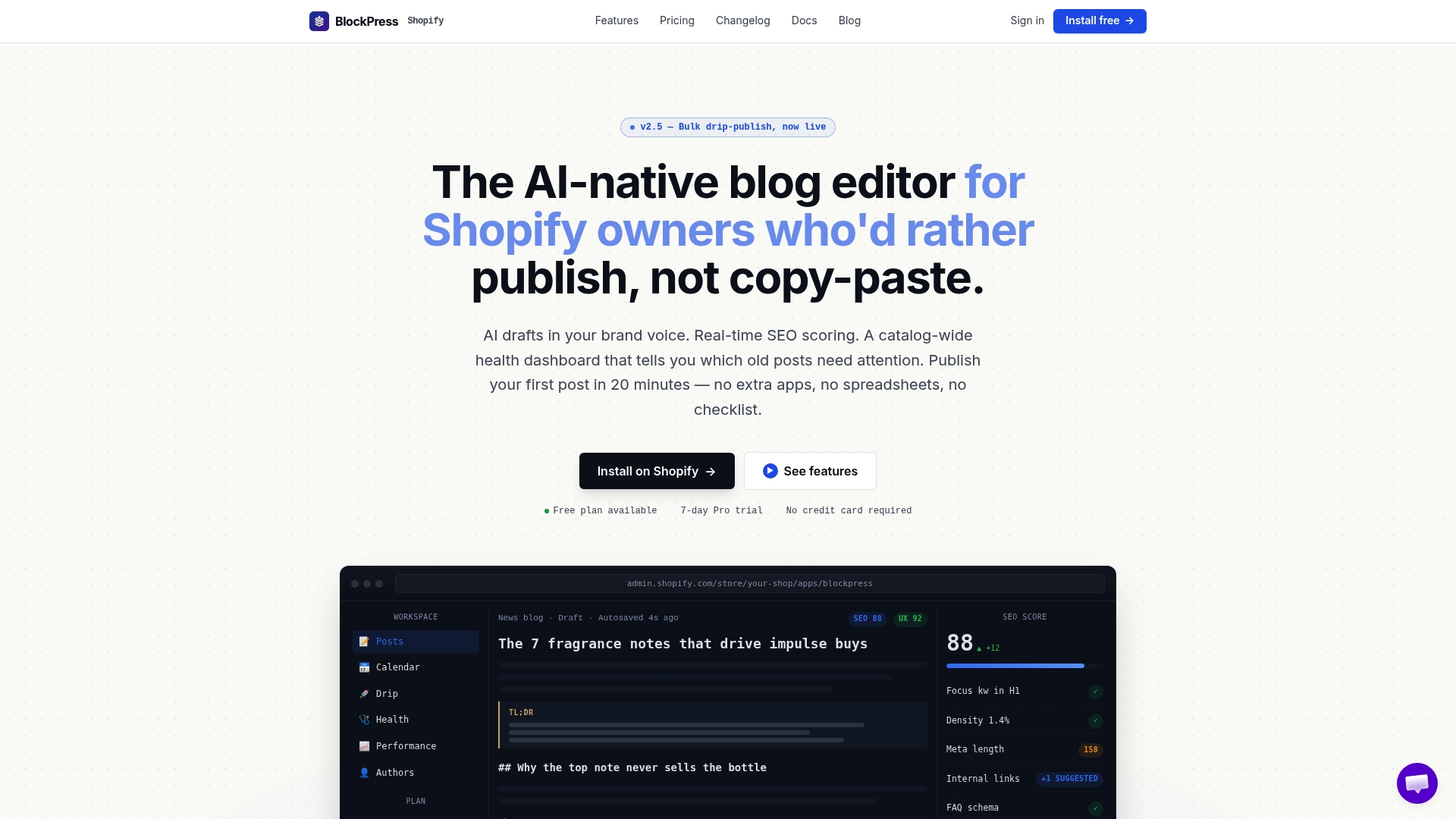
Ready to build your first niche cluster without leaving Shopify? Blockpress gives you keyword data, AI drafts, internal-link suggestions, and per-article analytics in one editor. See plans and pricing and start your first cluster this week.
An editorial perspective on niche clusters and what actually trips stores up
Most stores that fail with niche blogging don't fail because the strategy is wrong. They fail because they publish spokes before the pillar exists, so every new post becomes an orphan with nowhere to route authority. The second most common mistake is treating internal links as an afterthought, buried in a "you might also like" block at the bottom of a post rather than woven into the body where readers and crawlers actually encounter them.
The stores that see the fastest results are the ones that resist the urge to cover every category at once. One complete cluster, properly wired, will outperform five half-built clusters every time. Topical authority compounds within a cluster, not across disconnected topics.
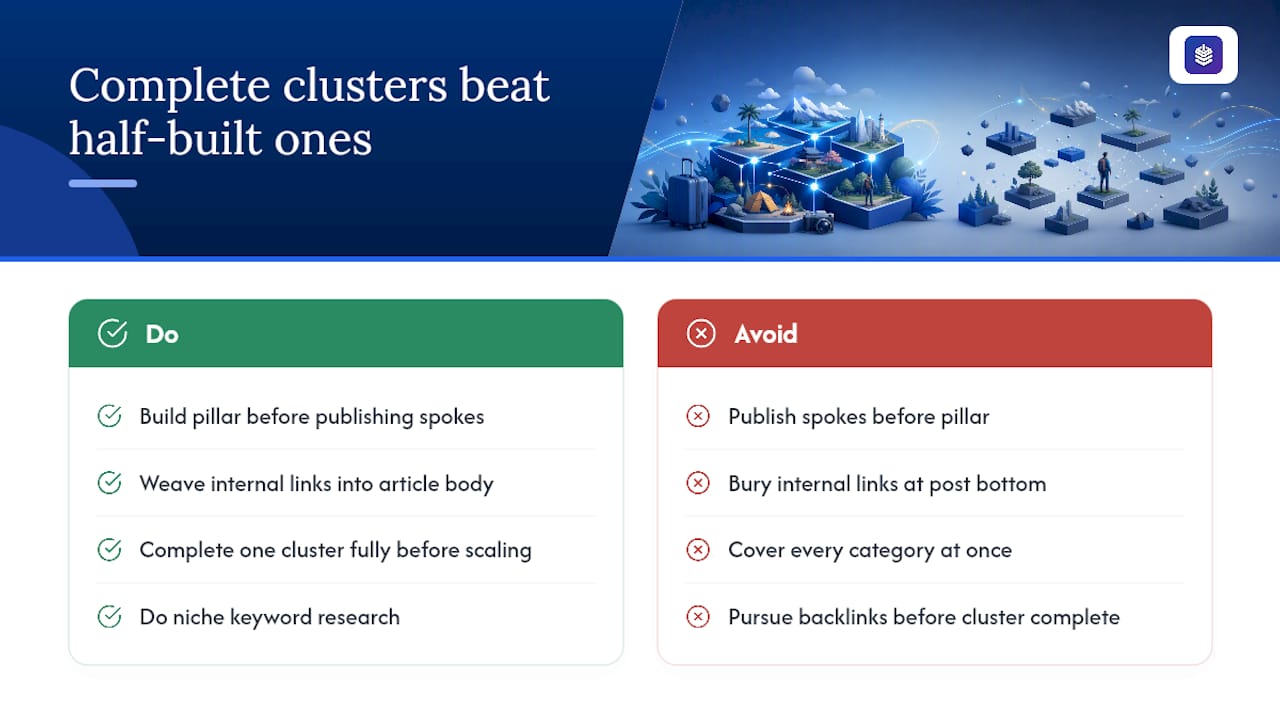
One caution on link building: don't pursue external backlinks until your cluster is complete and indexed. A cluster that lacks internal coherence won't benefit much from external links. Get the architecture right first, then amplify with outreach. Niche keyword research and cluster completion are the foundation; backlinks are the accelerant, not the substitute.
Sources
- Topical authority — Shopify
- E-commerce content strategy most stores get wrong — EdgeBlog
- Topical Authority for Ecommerce: Complete SEO Guide (2026)
FAQ
Why does niche blogging outperform general content for Shopify stores?
Niche blogging builds topical authority by covering a product category in depth, which Google rewards with higher rankings. It also targets long-tail, high-intent queries that convert better than broad informational traffic.
How many posts does a niche content cluster need?
A functional cluster needs a pillar page plus several interlinked spoke posts. Clusters in this range create a measurable topical authority signal and can rank for low-to-medium-competition queries within a few months.
How long before niche blog content drives revenue?
First ranking movement typically appears within one to two months for low-competition queries. Meaningful organic traffic and revenue impact usually follow after that, with revenue lagging traffic gains by a few weeks.
What's the most important internal linking rule for ecommerce clusters?
Every spoke post must link to the relevant product or collection page within the body of the post, not just in a footer or sidebar. That direct link is what converts cluster traffic into product page visits.
Can Blockpress help build niche clusters on Shopify?
Yes. Blockpress provides in-editor keyword data, AI-generated drafts, internal-link suggestions, article health audits, and per-article performance analytics, all inside Shopify, so you can build and manage a full niche cluster without leaving your store.