

TL;DR:
- Long-tail keywords have higher purchase intent, lower costs, and faster rankings than broad head terms for DTC brands. Implementing a targeted long-tail strategy can significantly improve conversion rates, reduce paid search expenses, and build topical authority that benefits broader rankings.
DTC brands prioritize long-tail keywords because those queries carry higher purchase intent, lower acquisition cost, and faster ranking potential than broad head terms. A shopper typing "vegan leather chelsea boots women size 8" is not browsing — they are ready to buy. That specificity is exactly where DTC stores win, and where large marketplaces are structurally slow to compete.
TL;DR — what you can expect from a long-tail strategy:
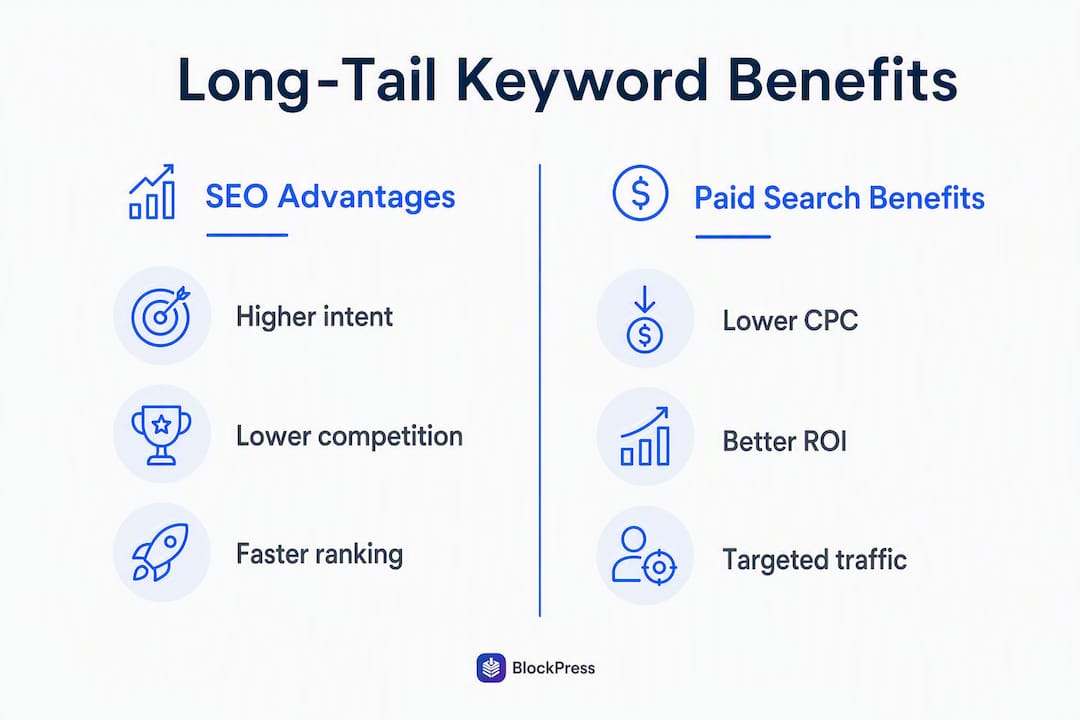
- Higher conversion rates: long-tail keywords convert substantially better than short-tail equivalents
- Lower paid search CPCs, often 80–95% less than comparable head terms
- Faster time to rank, especially for newer Shopify domains with limited authority
- Compounding topical authority that eventually lifts your broader rankings
Recommended next step: Run a 30-day Google Search Console and GA4 audit to surface 50 candidate long-tail queries your store already receives impressions for. That list is your starting content sprint.
Table of Contents
- What are long-tail keywords, and how does the head/body/tail model work?
- Why DTC brands prioritize long-tail keywords — the strategic case
- How do you find the best long-tail keywords for your DTC brand?
- How to use long-tail keywords across product pages, blogs, and topic clusters
- What KPIs and timelines should you expect from long-tail SEO?
- Common mistakes DTC brands make with long-tail keywords
- How AI search increases the value of long-tail keywords for DTC brands
- Key Takeaways
- The long-tail bet most DTC brands are still not making
- Useful sources and further reading
- FAQ
What are long-tail keywords, and how does the head/body/tail model work?
Long-tail keywords are specific, multi-word search queries that reflect clear intent. They sit at the far end of the search demand curve, where individual query volumes are low but the collective volume across thousands of variations is enormous. About 91.8% of all search queries are long-tail, which means the vast majority of your potential customers are typing precise phrases, not single words.
The head/body/tail model maps queries to funnel stages:
- Head terms ("shoes"): extremely high volume, near-zero purchase intent, dominated by major retailers and brand aggregators. Useful for awareness, almost never for direct conversions.
- Body terms ("men's running shoes"): moderate volume, moderate competition, some intent. Category pages and brand landing pages compete here.
- Long-tail terms ("vegan leather chelsea boots for women size 8"): lower individual volume, high specificity, strong purchase intent. Product pages, detailed blog posts, and FAQ content win here.
For a Shopify store, the mapping is practical:
- Product pages target transactional long-tail queries ("buy [specific product] online," "[product] for [use case]")
- Category pages target body-level queries with some filtering intent ("women's vegan leather boots")
- Blog and FAQ pages target informational long-tail queries ("how to care for vegan leather boots," "are chelsea boots good for wide feet")
The key insight is that a single product page can realistically rank for dozens of long-tail variations without any extra content work, simply by writing thorough descriptions that mirror how customers actually search.
Why DTC brands prioritize long-tail keywords — the strategic case
The business case for long-tail SEO is strongest for DTC brands specifically, because the model depends on owning the customer relationship directly. Every organic visit you earn through a precise query is a visit that did not cost you a marketplace commission or a high-CPC paid click.
Higher conversion intent
Specificity signals readiness. A shopper who types a seven-word product query has already done their research. Long-tail keywords convert roughly 2.5x better than short-tail keywords, and that gap widens further when the query includes transactional modifiers like "buy," "best price," or a specific size or color variant.

Lower competition and faster ranking
Head terms are contested by Amazon, Walmart, and established category leaders with domain authority scores your new Shopify store cannot match in the near term. Long-tail queries, by contrast, often have keyword difficulty scores low enough that a well-written product page or blog post can reach page one within weeks. Niche Shopify stores regularly outrank large marketplaces on specific long-tail queries by focusing on depth and intent rather than sheer domain authority.
Cost efficiency in paid search
Long-tail CPCs typically run significantly less than head-term CPCs. That gap makes long-tail paid search an affordable testing ground: run a small paid campaign on a cluster of long-tail queries, confirm the conversion intent, then invest in organic content for the winners. You validate before you build.

UGC as a free long-tail generator
Your customers are already writing long-tail keywords for you. Reviews, Q&A sections, and support tickets contain authentic, conversational phrases that in-house teams rarely think to target. Mining customer-generated content surfaces hundreds of specific, bankable phrases that map directly to real buyer language — and adding that content to product pages improves both SEO and on-page conversion.
Stat to know: 91.8% of search queries are long-tail. That is not a niche opportunity — it is the majority of search behavior.
How do you find the best long-tail keywords for your DTC brand?
Discovery is a repeatable process. Run through these steps in order, and you will have a prioritized list within two weeks.
-
Start with product and brand seeds. List your core product categories, materials, use cases, and customer personas. "Vegan leather," "size-inclusive," "postpartum," and "small-batch" are the kind of seeds that generate dozens of specific long-tail branches.
-
Use Google's native features. Type each seed into Google and collect autocomplete suggestions, "People Also Ask" questions, and "Related Searches" at the bottom of the results page. These are real queries from real users, updated continuously.
-
Pull your own Search Console data. In Google Search Console, filter the Performance report by queries with more than 10 impressions and an average position between 11 and 30. These are terms you almost rank for — a targeted page or content update can move them to page one fast.
-
Check GA4 organic landing pages. Identify which pages already drive organic sessions, then cross-reference with GSC to see which long-tail queries are sending that traffic. Pages with high sessions but low conversion rate often need better intent alignment.
-
Review on-site search logs. What are visitors searching for inside your store? Those queries are unmet demand. If customers search "gift set under $50" and you have no page for it, that is a content gap and a revenue opportunity.
-
Mine reviews, Q&A, and support tickets. Look for recurring phrases, specific product questions, and use-case language. Customer-generated content is one of the highest-ROI sources of long-tail keyword ideas because it reflects authentic buyer language you would not invent yourself.
-
Use an AI-assisted keyword tool to expand your seed list. Tools like the AI keyword research tool from BabyLove Growth can surface long-tail variations quickly, saving hours of manual expansion.
Prioritization checklist — score each candidate on:
- Intent: Is it commercial or transactional? Informational queries need blog content; transactional queries need product or category pages.
- Business value: Does this query map to a high-AOV or high-margin product?
- Ease to rank: What is the current average position in GSC? Under 20 impressions with no ranking means you need to build from scratch; 50+ impressions at position 15–30 means a quick win is possible.
- Seasonal opportunity: Is there a peak window (holiday, back-to-school) where ranking early pays off?
Once scored, tag each keyword with intent type, funnel stage (awareness/consideration/purchase), and target page type (product, category, blog). That tagging makes the list immediately usable for both your content team and your paid search manager.
How to use long-tail keywords across product pages, blogs, and topic clusters
Knowing which keywords to target is half the work. Placing them correctly is the other half.
Page mapping by intent:
- Transactional long-tail queries ("buy [product] [variant] online") belong on product pages and collection pages.
- Consideration queries ("best [product] for [use case]") belong on comparison blog posts or buying guides.
- Informational queries ("how to use [product]," "is [material] sustainable") belong on FAQ pages or cluster blog posts.
On-page writing rules:
- Answer the query in the first sentence of the page or section. Do not bury the answer.
- Use the long-tail phrase naturally in the H1 or H2, the meta title, and the first paragraph. Do not force it into every sentence.
- Add FAQ schema to product pages and blog posts. Short, direct answers to specific questions are exactly what voice search and AI engines extract.
- Surface UGC prominently. A product page with 40 customer reviews containing authentic long-tail language outperforms a page with a polished but generic description.
Internal linking and topic clusters:
Build a pillar page around a body-level topic ("women's vegan leather boots") and link cluster pages to it (care guides, size guides, styling posts). Each cluster page targets a specific long-tail query, and the internal links pass authority back to the pillar. This structure also signals topical depth to Google, which helps the whole cluster rank faster. For a practical checklist on optimizing each page, the small business SEO content checklist covers the on-page steps in detail.
Pro Tip: When two blog posts target closely related long-tail queries and risk cannibalizing each other, add a canonical tag pointing to the stronger page and consolidate the weaker content into it. One thorough page beats two thin ones every time.
What KPIs and timelines should you expect from long-tail SEO?
Set realistic expectations before you start, or you will pull the plug too early.
Staged timeline:
- Weeks 4–8: Low-difficulty long-tail pages begin appearing in GSC impressions. Expect position 15–30 for new content targeting queries with low keyword difficulty.
- Month 3: Meaningful organic traffic uplift on optimized product pages and initial blog cluster posts. Conversion rate data becomes statistically usable.
- Months 6–12: Compounding authority. Cluster pages lift the pillar, the pillar lifts adjacent terms, and a phased approach — long-tail first (months 0–6), body terms next (months 6–18), head terms later — produces sustainable revenue growth without overextending your budget.
KPIs to track:
- GSC: Impressions, clicks, CTR, and average position per query and per landing page
- GA4: Organic sessions, assisted conversions, conversion rate by landing page, revenue per organic session
- On-site: Add-to-cart rate and checkout initiation rate for organic traffic specifically
Attribution setup:
In GA4, create a conversion event for purchase and one for "add to cart." Use the "Assisted Conversions" report to see how organic long-tail pages contribute to sales that close on a different session. Many DTC brands undercount organic SEO value because they only look at last-click attribution.
Cost benchmark: Long-tail CPCs typically run significantly less than head-term CPCs. Run a small paid campaign on your top 10–20 long-tail candidates for two to three weeks before committing to organic content production. Confirmed intent means your content investment is lower-risk.
On cost: Long-tail SEO is not free, but it is far cheaper than competing on head terms. A focused content sprint of 10–15 targeted blog posts and optimized product descriptions costs a fraction of a sustained paid search campaign on broad terms, and the organic asset compounds over time while the paid spend disappears the moment you stop.
Common mistakes DTC brands make with long-tail keywords
Most long-tail SEO programs underperform not because the strategy is wrong, but because execution breaks down in predictable ways.
Mistake 1: Chasing volume over intent. A long-tail query with 500 monthly searches and weak commercial intent will not convert. Always score intent before volume. A query with 80 searches and clear transactional intent is worth more to a DTC store than a 2,000-search informational query.
Fix: Tag every candidate keyword with an intent label (informational, commercial, transactional) before assigning it to a page. Only transactional and commercial queries go on product and category pages.
Mistake 2: Thin content that does not answer the query. Writing a 200-word product description and calling it "optimized" for a long-tail query rarely works. Google's ranking systems reward pages that fully satisfy the search intent, not pages that merely contain the keyword.
Fix: For each target query, ask: "Does this page answer every reasonable follow-up question a buyer would have?" If not, add a FAQ section, size guide, care instructions, or comparison table until it does.
Mistake 3: Ignoring UGC as a content source. Teams spend hours brainstorming keyword ideas while sitting on hundreds of authentic long-tail phrases in their review database. Customer reviews and Q&A generate conversational, specific language that in-house writers rarely replicate naturally.
Fix: Export your reviews monthly, scan for recurring phrases and questions, and add those to your keyword candidate list. Surface the best Q&A directly on product pages.
Mistake 4: Siloed teams that never operationalize findings. The SEO manager finds 50 great long-tail opportunities in GSC, puts them in a spreadsheet, and nothing happens because the content team has no brief and the product team has no context.
Fix: Build a simple brief template that includes the target query, the intent tag, the target page, and the recommended content addition (new section, FAQ, updated description). Assign an owner and a deadline. Without that handoff, keyword research stays theoretical. Understanding why Shopify stores lose Google rankings often comes down to exactly this execution gap.
How AI search increases the value of long-tail keywords for DTC brands
AI-powered search engines, including ChatGPT, Perplexity, and Google's AI Overviews, favor content that answers specific questions directly and concisely. That is precisely what well-executed long-tail content does. Brands that optimize for conversational, specific queries are more likely to be cited by AI-driven responses, which makes long-tail content a direct investment in AI search visibility.
Voice search reinforces this further. Spoken queries are almost always longer and more conversational than typed ones. Voice and conversational search patterns strongly favor question-style, long-tail queries, and that trend continues to grow as smart speakers and AI assistants handle more shopping-related searches.
Practical steps to align your DTC content with AI search:
- Write answer-first sections. Open every H2 or H3 section with a one-to-two sentence direct answer to the implied question. AI engines extract these sentences for citations.
- Add FAQ schema to product pages and blog posts. Structured data makes your answers machine-readable and increases the chance of appearing in featured snippets and AI-generated answers.
- Keep extractable sentences short and specific. A sentence like "Vegan leather chelsea boots run true to size and are suitable for wide feet" is extractable. A paragraph of general brand copy is not.
- Schedule UGC review cycles. Fresh reviews introduce new conversational queries. A monthly pass through new reviews keeps your keyword list current and your product pages updated with authentic language.
- Use an editorial tool with live SEO scoring. Blockpress provides live SEO and UX scoring, integrated Google keyword data, and per-article analytics directly inside Shopify. That means your content team can check keyword alignment and readability before publishing, without switching between tools. For a deeper look at how AI drafting fits into this workflow, the guide on why marketers use AI for blog drafts covers the practical integration.
Pro Tip: Add a short "Quick Answer" block at the top of high-value blog posts — two to three sentences that directly answer the primary query. This format is what AI engines pull for citations, and it also improves featured snippet capture for traditional search.
For a broader view of how AI-driven search is changing online visibility and what that means for DTC content strategy, the shift toward conversational, intent-specific content is accelerating, not slowing.
Key Takeaways
Long-tail keywords deliver higher purchase intent, lower acquisition cost, and faster ranking wins than head terms — making them the highest-ROI SEO investment for most DTC brands.
| Point | Details |
|---|---|
| Long-tail prevalence | About 91.8% of all search queries are long-tail, making them the dominant search behavior to target. |
| Conversion advantage | Long-tail keywords convert roughly 2.5x better than short-tail equivalents, directly improving revenue per organic session. |
| Cost efficiency | Long-tail CPCs typically run 80–95% less than head-term CPCs, enabling low-cost paid validation before content investment. |
| Phased execution | Prioritize long-tail terms in months 0–6, add body terms in months 6–18, then target head terms once authority and revenue exist. |
| AI search alignment | Answer-first content with FAQ schema and short extractable sentences increases the chance of being cited by AI-driven search engines. |
The long-tail bet most DTC brands are still not making
Most DTC brands I see are still allocating the majority of their SEO energy toward a handful of broad category terms they have almost no chance of ranking for in the next 12 months. The logic is understandable: those terms have the biggest search volumes, so they feel like the biggest prizes. But that framing ignores the math.
A product page ranking for 40 long-tail variants at modest traffic each can outperform a single head-term ranking that took 18 months and significant link-building budget to achieve. The long-tail approach also compounds: each piece of content you publish adds to your topical authority, which eventually makes the harder terms more attainable. You are not choosing between long-tail and head terms permanently. You are choosing which one funds the other.
The brands that figure this out early build a content moat that is genuinely hard for larger competitors to replicate quickly. A marketplace can undercut your price. It cannot easily replicate 200 pages of specific, intent-matched content written in your brand's voice, backed by real customer language, and optimized for the exact queries your buyers use.
If you are running a Shopify store and have not yet run a GSC audit to find your existing long-tail impressions, that is the single highest-leverage hour you can spend on SEO this month.
Useful sources and further reading
- Long-Tail Keyword Strategy for Ecommerce Websites — Shopify's own guide covering how long-tail keywords reduce advertising costs and boost conversion rates for ecommerce stores.
- Short Tail vs Long Tail Keywords: Conversion Rate Analysis — Real-world conversion rate comparison with examples of instant-conversion long-tail queries.
- Head vs. Long Tail Keywords Analyzed — Analysis of 1.5 million keywords across multiple verticals comparing impressions, clicks, conversions, and profitability.
- Long-Tail Keywords: The Ultimate Guide — Semrush's comprehensive guide on selecting and prioritizing long-tail keywords for SEO.
- Long-Tail Keywords: The Ultimate 2026 Guide — Covers UGC as a long-tail source, AI search alignment, and paid search cost efficiency.
- Blockpress — AI-native blog editor for Shopify — Blockpress's editorial platform with integrated keyword data, live SEO scoring, and per-article analytics for Shopify stores.
FAQ
Why are long-tail keywords important for DTC brands?
Long-tail keywords attract buyers with specific, high-purchase intent rather than casual browsers. They are easier to rank for, convert roughly 2.5x better than short-tail terms, and cost significantly less in paid search, making them the most efficient SEO investment for DTC stores with limited budgets.
What does the long-tail concept in digital marketing focus on?
The long-tail concept focuses on the large volume of low-frequency, highly specific search queries that collectively outweigh the traffic from a small number of high-volume head terms. In ecommerce, these queries map directly to buyer intent and product-level searches.
What is the 80/20 rule in SEO?
In SEO, the 80/20 principle suggests that a small number of high-volume head terms drive a large share of visible search traffic, but the majority of actual conversions come from the long tail of specific, lower-volume queries. For DTC brands, this means the 80% of queries you might overlook often deliver better ROI than the 20% you compete hardest for.
Are long-tail keywords worth the effort for a Shopify store?
Yes. Niche Shopify stores regularly outrank large marketplaces on specific long-tail queries because they can publish deeper, more intent-matched content. A single well-optimized product page can rank for dozens of long-tail variations, generating steady organic revenue without ongoing ad spend.