
TL;DR:
- Content for niche product stores should focus on solving specific customer problems with storytelling and internal links. Tracking assisted revenue and conversion rates offers better insight into success than raw traffic. Effective strategies include problem-solving guides, honest buying guides, and seasonal content aligned with customer needs.
The most effective blog content ideas for niche product stores solve a specific customer problem and link directly to the product that fixes it through proven SEO оптимизация tactics. Generic "product feature" posts rarely convert. What works is product-led storytelling built around real-world scenarios, backed by niche keyword research, and wired to your product pages through intentional internal links. Here are the content types that actually move buyers:
- Problem-solving how-to guides tied to a specific use case your product addresses
- Buying guides that compare options honestly and recommend your product with clear reasoning
- Customer scenario posts showing the product in a real situation (commute, hobby, home project)
- Seasonal and promotional content timed to buying cycles like back-to-school or holiday gifting
- Niche trend explainers that build topical authority and attract early-stage researchers
- Product comparison posts targeting shoppers actively weighing their options
Each of these works best when you target long-tail, purchase-intent keywords specific to your niche, link posts to several related product pages, and plan topics around your promotional calendar.
Table of Contents
- What are the top content ideas for niche product stores?
- Blog content themes that attract and convert niche buyers
- How Blockpress helps you execute this content strategy
- How to measure blog success beyond traffic volume
- Key Takeaways
- FAQ
What are the top content ideas for niche product stores?
Generating blog topics that actually convert starts with a structured process, not a brainstorm session. Follow these steps to build a repeatable ideation workflow.
-
Run niche-specific keyword research first. Use Google Search Console to find what queries already bring visitors to your store, then expand with tools like Google Keyword Planner or SEMrush to surface long-tail, purchase-intent phrases. A query like "waterproof cycling gloves for sub-zero temperatures" converts far better than "gloves" because the searcher already knows what they need.
-
Apply the lived-experience test. Before committing to a topic, ask: have you or your customers actually encountered this problem? Content that passes this test provides unique angles, personal insights, or tested results that AI alone cannot generate. If the answer is forced, the post will read forced.
-
Use AI to surface angles you would miss. Feed a structured prompt into ChatGPT or a similar tool with your niche, audience description, and three past posts that performed well. Ask for 30 topic angles grouped by reader intent: educational, how-to, comparison, opinion, story, and resource. Then filter aggressively. AI generates volume; you supply the judgment.
-
Run a competitor content gap analysis. Pick three to five stores selling to a similar audience. Scan their blogs for what they cover well and, more importantly, what they skip. If competitors only write about product specs, you own the conversation around lifestyle, use cases, and honest tradeoffs.
-
Plan topics around a content calendar. Map posts to seasonal peaks, product launches, and promotional windows. A consistent publishing cadence compounds SEO authority over time. One quality post per week beats a burst of twenty posts followed by silence.
-
Optimize every topic for voice search and mobile. Structure posts around natural questions ("What is the best X for Y?") and keep paragraphs short. Mobile-first indexing means a post that reads well on a phone ranks better than one designed for desktop.
Pro Tip: Combine AI-generated topic lists with your customer service inbox. The questions your support team answers every week are ready-made blog topics with proven demand and zero keyword research required.
Blog content themes that attract and convert niche buyers
Not all content themes perform equally for niche stores. These categories consistently earn traffic and drive product page clicks.
-
Problem-solving tutorials. A post titled "How to Keep Your Cast Iron Skillet from Rusting" does two things: it answers a real question and it positions your seasoning oil or scrubber brush as the solution. Link every tutorial to the relevant product collection.
-
Honest buying guides. Buyers researching a niche purchase want tradeoffs, not marketing copy. A guide that says "this option is better for beginners, this one for experienced users" builds trust and converts better than a promotional blurb. For SEO-driven blog strategies that show how this works in practice, the pattern holds across categories.
-
Customer scenario posts. Show the product in a specific, relatable situation. "How a weekend cyclist stays warm on a 6 AM ride" is more compelling than "our jacket has four-way stretch." The product is the protagonist solving a defined problem.
-
Seasonal and promotional content. Time posts to buying cycles. A "Best Gifts for Home Brewers Under $75" post published in early November captures holiday search traffic. Plan these six to eight weeks ahead so they have time to rank.
-
Niche trend explainers. Posts covering emerging trends in your category attract early-stage researchers and build topical authority. A store selling eco-friendly kitchenware can own searches around zero-waste cooking long before a competitor thinks to write about it.
-
Cornerstone long-form guides. Comprehensive guides of 2,000 words or more earn backlinks, rank for multiple keyword variations, and serve as the hub of a content cluster. Link them to your category pages and let them pass authority downward.
-
Lifestyle and interest alignment posts. Content that connects your product to a reader's identity ("gear for serious home baristas") attracts buyers who self-select as your ideal customer before they ever see a product page.
How Blockpress helps you execute this content strategy
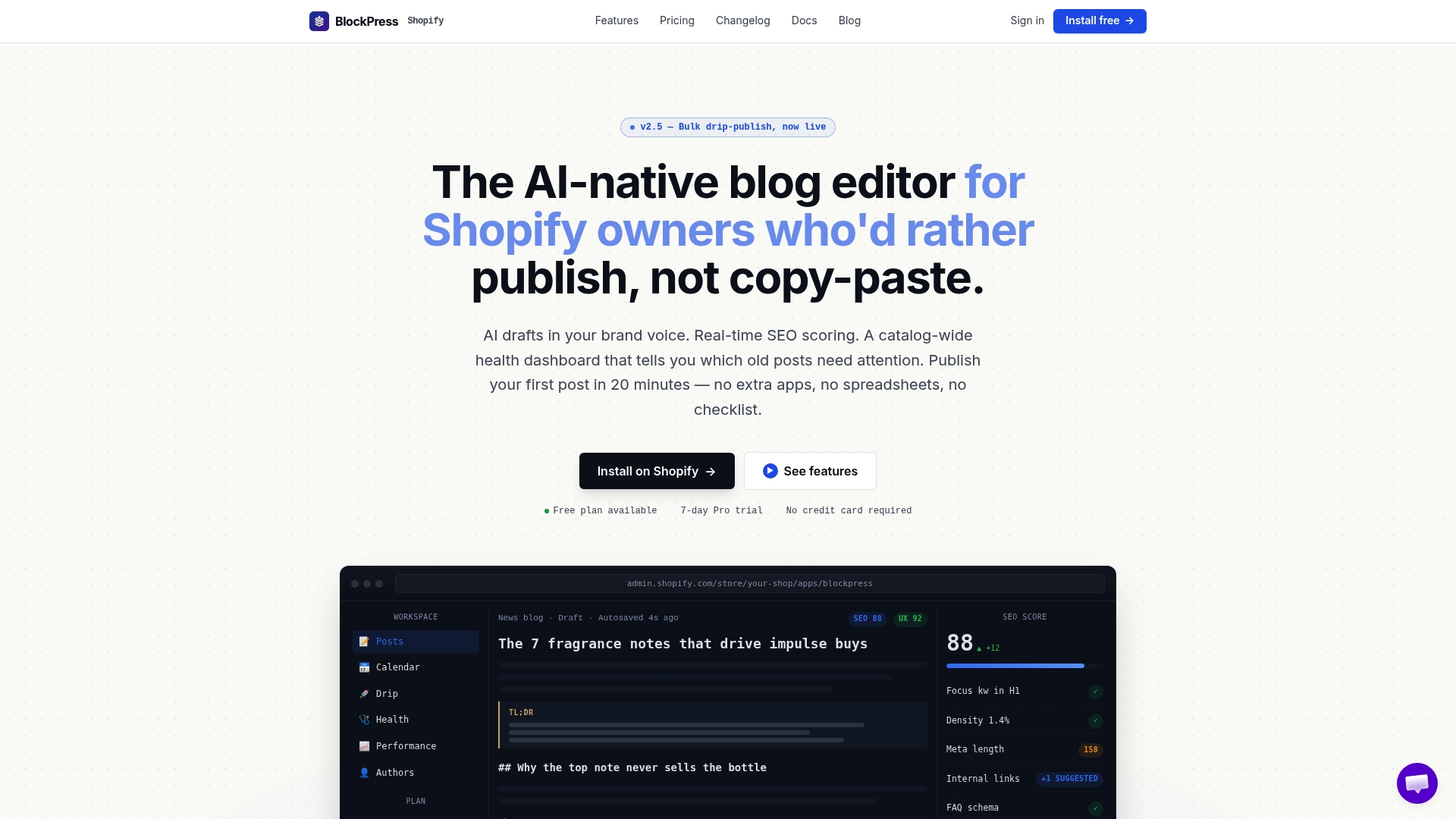
Blockpress is built directly into Shopify, which means you plan, write, optimize, and publish without switching between apps. That matters because most Shopify store owners currently patch together a keyword tool, a writing assistant, and a separate analytics platform. Blockpress replaces all three.
- Real Google keyword data inside the editor. You see actual search volume and keyword difficulty as you write, so you can confirm a topic has demand before you spend time on it.
- AI-generated article drafts. Blockpress generates a structured draft from your target keyword, giving you a starting point you can shape with your own product knowledge and lived experience.
- Live SEO and UX scoring. The editor scores your post in real time, flagging thin sections, missing meta descriptions, and weak internal linking before you publish.
- Bulk drip-publishing. Schedule a month of posts in one session. Blockpress releases them on your chosen cadence, keeping your publishing consistent without daily manual effort.
- Article health audits and per-article analytics. See which posts drive product page clicks, not just page views. This is how you identify which content themes earn their place and which need a refresh.
- Author bio pages. These build E-E-A-T signals that help your content rank in competitive niches where Google weighs demonstrated expertise.
Blockpress replaces the disjointed workflow most merchants use and puts every content production step in one place, inside the store you already manage.

How to measure blog success beyond traffic volume
Traffic is a vanity metric if it does not move buyers toward a purchase. The metrics that matter for niche stores are assisted revenue and product page conversion rates driven by blog content.
-
Track assisted conversions. In Google Analytics 4, set up goals for add-to-cart events and purchases, then look at the assisted conversions report to see which blog posts influenced a sale even when they were not the last click.
-
Monitor internal link click-through rates. If a post gets solid traffic but nobody clicks through to the linked product page, the internal link placement or anchor text needs work. Internal links from blog posts should include several contextual links per post to related product and collection pages.
-
Run quarterly content audits. Posts ranking on page two of Google often need only a few updates to reach page one. Refresh statistics, add a new section addressing a question you have seen from customers, and update the publish date. For a practical process, the guide on optimizing existing Shopify blog posts covers the exact steps.
-
Promote posts through email and social media. A blog post that earns organic traffic also works as an email newsletter, a Pinterest infographic, and a short-form video script. Repurposing extends reach without starting from scratch. Segment your email list by purchase behavior and send relevant guides to the right subscribers.
-
Prioritize conversion-driven metrics over raw traffic. Ecommerce SEO specialists recommend tracking conversion rates and average order value from organic blog traffic rather than total sessions. A post that sends 200 targeted visitors to a product page and converts 4% of them outperforms a post with 2,000 visitors and no product clicks.
Key Takeaways
The most effective niche store blog strategy combines AI-assisted topic ideation, product-led storytelling, and internal linking to product pages, measured by assisted revenue rather than traffic volume.
| Point | Details |
|---|---|
| Lead with problem-solving content | Blog posts that solve a specific customer problem and link to the product convert better than feature-focused posts. |
| Apply the lived-experience test | Only publish topics you or your customers have genuinely encountered; forced topics produce generic content that does not rank. |
| Use several internal links per post | Linking each blog post to multiple related product or collection pages transfers authority and guides buyers toward a purchase. |
| Measure assisted revenue, not just traffic | Track which posts influence add-to-cart events and purchases, not just page views, to identify what content earns its place. |
| Publish on a consistent cadence | A steady publishing schedule compounds SEO authority over time; sporadic bursts followed by silence undermine domain trust. |
FAQ
What blog content types convert best for niche Shopify stores?
Buying guides, problem-solving tutorials, and product comparison posts consistently drive the highest conversion rates because they target buyers who are actively researching a purchase decision.
How many internal links should a niche store blog post include?
Include several contextual internal links per post, pointing to related product pages and collection pages, so blog traffic flows toward your commercial pages rather than leaving the site.
How do I use AI to generate blog topic ideas for my store?
Feed a structured prompt into a tool like ChatGPT with your niche, audience description, and examples of past posts that performed well. Ask for topic angles grouped by reader intent, then filter the list using the lived-experience test to keep only topics you can write with genuine expertise.
Should I measure blog success by traffic or conversions?
Focus on assisted revenue and product page conversion rates. A post that sends targeted visitors to a product page and converts them outperforms a high-traffic post with no commercial impact.
How often should a niche Shopify store publish blog content?
One quality post per week is the standard that builds meaningful SEO authority. If that pace is not sustainable, two posts per month published consistently will still compound over time.