
TL;DR:
- Bulk content publishing helps online stores build SEO authority and enhance organic traffic over time. Publishing 8 to 12 high-quality posts monthly improves crawl efficiency, internal linking, and topical depth, leading to steady growth. Adding structured data and user content optimizes bulk posts for AI-driven search in the evolving e-commerce landscape.
Bulk content publishing is the practice of creating and releasing multiple pieces of content simultaneously or in scheduled batches to maximize SEO impact, operational efficiency, and brand consistency for online stores. The bulk content publishing benefits for stores go well beyond saving time. Done right, this approach builds topical authority, compounds organic traffic over months, and gives your store a structural SEO advantage that single posts cannot replicate. Tools like Blockpress, structured data standards like JSON-LD Schema, and frameworks like Generative Engine Optimization (GEO) make this strategy accessible to Shopify merchants of any size.
1. How bulk content publishing builds SEO authority for stores
Consistent publishing is the single most reliable way to grow a store's organic search presence. Brands with consistent content marketing see 30–40% higher year-over-year organic traffic growth. That gap exists because Google rewards topical depth, not one-off posts.

The optimal cadence for Shopify stores is 8–12 high-quality posts per month. This volume builds topical authority over 6–12 months without producing thin content that triggers ranking penalties. Bulk publishing lets you hit that cadence without scrambling every week.
Maintaining 8–12 articles per month with gaps under 60 days yields 18–22% annual traffic growth for mature sites. That compounding effect is the real payoff. Each new post strengthens the ones around it through internal linking and shared topical signals.
Bulk publishing also improves crawl budget utilization. When Google's crawler visits your store and finds a steady stream of new, interlinked content, it indexes more pages per visit. The result is faster ranking for new posts and stronger authority flow across your entire blog.
| Publishing frequency | Estimated annual traffic growth | Topical authority impact |
|---|---|---|
| 1–3 posts/month | Low | Minimal |
| 4–7 posts/month | Moderate | Developing |
| 8–12 posts/month | 18–22% | Strong |
| 13+ posts/month (low quality) | Declining | Negative |
2. Operational advantages of bulk publishing for e-commerce teams
Batching content creation cuts the hidden cost of context-switching. Every time your team shifts from writing to editing to publishing and back, productivity drops. Bulk scheduling removes that friction by grouping similar tasks together.
The operational benefits of mass content creation include:
- Reduced workflow bottlenecks: Editors, writers, and designers work in parallel rather than sequentially.
- Better brand messaging consistency: All posts in a batch share the same tone review and style pass.
- Predictable publishing cadence: Scheduled drip-publishing means your blog stays active even during busy sales periods.
- Lower per-post production cost: Fixed setup time spreads across more pieces when you batch.
- Easier performance tracking: Publishing in cohorts makes it simpler to compare results across groups of posts.
A content publishing workflow built around batching also reduces the scramble before peak sales events. Your team produces content in calm periods and schedules it to publish at the right moment.
Pro Tip: Set a weekly "content day" where your team writes, edits, and queues an entire week's posts at once. This single habit cuts daily publishing overhead and keeps your calendar full without burning anyone out.
3. How GEO and structured data multiply bulk content value
Generative Engine Optimization (GEO) is the practice of structuring content so AI assistants and generative search engines can cite it directly. It is the evolution of traditional SEO, and it changes how bulk-published content needs to be built.
"The era of 'bulk for volume's sake' is over. Modern strategy requires Generative Engine Optimization with structured data and user-generated content to rank well in AI-driven search. Stores that ignore this shift will find their bulk content invisible to the next generation of search tools." How to Scale E-commerce SEO
Over 30% of product research is projected to happen via voice and AI assistants by 2026. That means your bulk-published posts need to be machine-readable, not just human-readable.
The key elements for GEO-ready bulk content are:
- JSON-LD Schema markup: Adds structured data to each post so search engines understand product context, reviews, and FAQs.
- User-generated content (UGC): Embedding real customer reviews and Q&A sections signals authenticity to AI ranking systems.
- Content uniqueness: Each post must cover a distinct angle. Duplicate or near-duplicate content across a bulk batch triggers thin content penalties.
- Hub and spoke internal linking: Automating internal link structures at scale prevents orphan pages and keeps authority flowing across your blog.
High-growth ecommerce brands using programmatic SEO report a 30–80% surge in organic traffic and a 25–35% increase in conversion rates within 3–6 months. Structured data and UGC are the two factors most consistently tied to those results. For a deeper look at the technical side, the technical SEO guide for ecommerce blogs covers implementation in detail.
4. How to plan and schedule bulk content for maximum impact
Strategic scheduling separates stores that grow from stores that publish and hope. The goal is to align your content calendar with inventory data, seasonal peaks, and sustainable production capacity.
Planning content 8–10 weeks before major shopping events gives posts enough time to rank and build momentum before peak traffic arrives. A post published the week before Black Friday has almost no chance of ranking. One published 10 weeks earlier does.
Scheduling best practices for bulk publishing:
- Map your sales calendar first. Identify your top 5–6 peak periods and work backward 8–10 weeks to set content deadlines.
- Assign themes to each month. Thematic batches improve internal linking and give your blog a coherent narrative.
- Set a sustainable volume target. Eight posts per month is achievable for a two-person team. Twelve requires dedicated resources or AI assistance.
- Use drip-scheduling. Queue posts to publish at regular intervals rather than releasing a batch all at once.
- Review and adjust quarterly. Check which topics drove traffic and shift your next quarter's plan accordingly.
The Shopify blog content calendar guide walks through this process with templates built for Shopify merchants.
| Scheduling approach | Best for | Risk |
|---|---|---|
| Daily publishing | High-volume teams | Quality drops fast |
| Batch and drip | Most stores | Requires planning discipline |
| Mixed (batch + reactive) | Seasonal retailers | Harder to maintain consistency |
The batch-and-drip approach wins for most stores. It combines the efficiency of bulk creation with the consistency of a steady publishing cadence. Understanding why Shopify stores lose Google rankings often comes down to inconsistent publishing gaps, which this model directly prevents. For stores focused on local markets, pairing this with local SEO strategies adds another layer of visibility. Modern product page optimization also benefits from the topical authority your bulk blog content builds around core product categories.
Key takeaways
Bulk content publishing benefits stores most when volume, quality, and scheduling work together to build compounding SEO authority over time.
| Point | Details |
|---|---|
| Optimal publishing cadence | Publish 8–12 posts per month to build topical authority without thin content penalties. |
| Compounding traffic growth | Consistent velocity at this cadence yields 18–22% annual organic traffic growth for mature sites. |
| GEO readiness matters | Add JSON-LD Schema and UGC to bulk posts so AI assistants can cite and surface them. |
| Plan 8–10 weeks ahead | Content needs time to rank before peak sales events; late publishing wastes production effort. |
| Batch and drip wins | Grouping creation tasks and drip-scheduling posts cuts overhead and maintains publishing consistency. |
What I've learned from watching stores publish at scale
Most stores that struggle with bulk content publishing make the same mistake: they treat volume as the goal. They hit 12 posts a month, see modest results, and either push harder or give up entirely. Neither response addresses the real problem.
Google's John Mueller confirmed that publishing frequency is not a direct ranking factor. Quality, topical depth, and user satisfaction drive rankings. That means 12 deep, well-structured posts will outperform 30 shallow ones every time. Volume is only valuable when it carries substance.
The stores I've seen grow fastest are the ones that adopted technology early. Blockpress, for example, gives Shopify merchants AI-generated drafts, live SEO scoring, and bulk drip-publishing inside a single editor. That combination removes the bottleneck between "we have a content plan" and "we have published content." Without that kind of tooling, bulk publishing often collapses under its own weight.
My honest advice: start at eight posts per month, not twelve. Get your workflow tight, your internal linking consistent, and your structured data in place. Then scale. Data-driven decisions at a smaller volume beat ambitious targets that produce mediocre content.
— Rodney
Blockpress makes bulk publishing practical for Shopify stores
Executing a bulk content strategy inside Shopify's default blog editor is genuinely difficult. You need keyword research, SEO scoring, scheduling, and performance tracking. Most merchants end up stitching together three or four separate apps to get there.
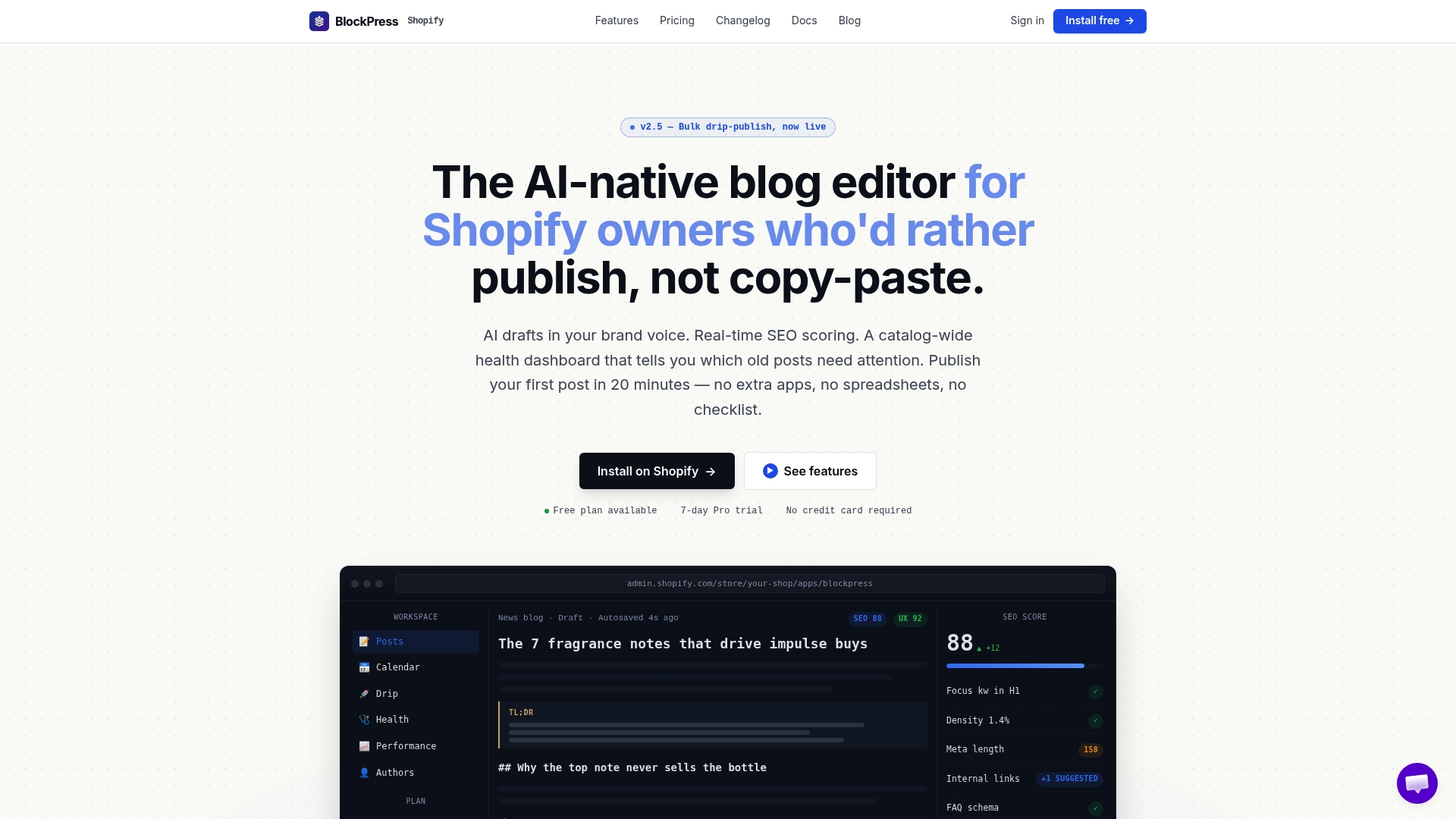
Blockpress is built to replace that patchwork. It is an AI-native blog editor that lives inside Shopify and gives you real Google keyword data, AI-generated article drafts, live SEO and UX scoring, bulk drip-publishing, and per-article performance analytics in one place. You can plan, write, optimize, and schedule an entire month of content without leaving your store. If you are ready to publish at scale without the overhead, Blockpress is built for exactly that.
FAQ
What are the main bulk content publishing benefits for stores?
Bulk content publishing builds topical authority, improves crawl budget utilization, and creates a consistent publishing cadence that compounds organic traffic over time. Stores publishing 8–12 posts per month see 18–22% annual traffic growth.
How many posts per month should a Shopify store publish?
The optimal range is 8–12 high-quality posts per month. This volume builds authority without producing thin content that triggers Google penalties.
What is Generative Engine Optimization and why does it matter for bulk content?
GEO is the practice of structuring content with JSON-LD Schema and user-generated content so AI assistants can cite it in search results. With over 30% of product research projected via AI assistants by 2026, GEO readiness is a core part of any bulk content strategy.
How far in advance should stores plan bulk content?
Plan content 8–10 weeks before major shopping events. This gives posts enough time to rank and build momentum before peak traffic arrives.
Does publishing more content always improve SEO?
No. Google ranks on quality, topical depth, and user satisfaction, not volume. Publishing 12 deep posts per month outperforms 30 shallow ones in search rankings.