
A brand voice guideline is a short, testable playbook that lets any writer or AI tool produce recognizably on-brand copy on the first try. To work, it needs three to five traits with clear do/don't examples, four tactical dimensions (pace, register, posture, lexicon), a channel adaptation matrix, and a named owner who runs regular audits. Skip any one of those and the document turns into a mood board nobody actually uses.
TL;DR:
- Building a brand voice guideline requires defining 3–5 core traits, each with do/don’t examples, and assigning measurable rules to pace, register, posture, and lexicon.
- Separating voice from tone ensures consistent personality while enabling appropriate context-driven expression, preventing copy from sounding either flat or inconsistent across channels.
- A compact channel adaptation matrix with two tone rules per platform helps writers quickly apply voice traits and maintain consistency during content creation.
- Regular audits of recent content and assigning a dedicated owner are essential to prevent voice drift and ensure compliance over time.
- Integrating voice rules into content briefs, AI prompts, and onboarding processes improves adherence and helps scale brand consistency across internal and external creators.
Table of Contents
- Voice vs Tone: Why Separating Them Matters
- How to Choose 3–5 Core Voice Traits and Document Each
- Tactical Dimensions: Turning Adjectives Into Measurable Rules
- Channel Adaptation: A Compact Matrix for Every Format
- Governance and Audits: How to Keep the Voice From Drifting
- Why Brand Voice Became a Marketing Discipline
- Steps to Develop a Brand Voice From Scratch
- Fitting Voice Guidelines Into Your Content Strategy
- Training Writers and Teams to Use the Voice Consistently
- Applying This in an AI-Assisted Editing Workflow
- Sources
- FAQ
Voice vs Tone: Why Separating Them Matters
Voice is who your brand is on the page. Tone is how that personality shows up depending on the moment. Confuse the two, and you get guidelines that either flatten every piece of copy into the same register or drift so much between channels that nobody recognizes the brand at all.
Voice stays constant while tone flexes by context, and the demand state of the reader is what should move the dial, not the writer's mood. A support team responding to a shipping outage and a marketing team announcing a product launch should sound like the same company, just in different registers. That's the whole test.
Picture two emails from the same Shopify brand:
- Incident response: "We found the bug that broke checkout for some of you last night. Here's exactly what happened and what we fixed." Direct, calm, no jokes.
- Product launch: "The restock you've been waiting on just landed. Same fabric, better fit, still selling out fast." Same directness, more energy.
Same voice traits (direct, plain-spoken, confident), different tone dials (measured vs. upbeat). Guidelines that separate these two layers stop writers from either apologizing too casually during a crisis or sounding funereal during a sale. Guidelines that blur them produce copy that reads tone-deaf in one direction or the other, almost every time.
How to Choose 3–5 Core Voice Traits and Document Each
Three to five traits is the number that sticks. Fewer than three and the voice feels thin; more than five and writers can't hold them in memory while drafting, so the traits quietly get ignored. Sprinklr's brand voice framework recommends pairing each trait with a definition, a do example, a don't example, and a rationale tied back to positioning, so the trait isn't just an adjective floating in space.
Here's the format for documenting one trait properly:
- Name the trait in one word or short phrase. "Direct," not "we communicate with clarity and purpose."
- Write a one-line definition. What does "direct" mean in practice, in your brand's context?
- Give a do example. A real sentence that hits the trait.
- Give a don't example. A real sentence that violates it, ideally pulled from an actual draft you've rejected.
- State the rationale. Why does this trait connect to how you're positioned against competitors or perceived by your buyers?
Run this as a half-day workshop with whoever owns brand, product, and support. Put fifteen candidate adjectives on a wall, then force the group to cut to five by asking: "If a competitor could claim this trait too, it's not distinctive enough." Mining real sales calls and support transcripts for language your buyers already use beats inventing adjectives from a whiteboard, every time.
Tactical Dimensions: Turning Adjectives Into Measurable Rules
"Friendly" and "confident" mean nothing to a writer without numbers attached. Operational voice documents break voice into four tactical dimensions: pace, register, posture, and lexicon. Each one needs a measurable spec, not a vibe.
- Pace: Average sentence length (say, 12 to 18 words), variance between short punchy lines and longer explanatory ones, and paragraph length caps.
- Register: Formality rules. Contractions allowed or not? Second person ("you") mandatory or optional? Slang permitted in social but banned in legal copy?
- Posture: Is the brand teaching, defending, celebrating, or apologizing in this piece? Give writers two or three approved postures per channel.
- Lexicon: An approved word list ("customers," never "users," if that's your call) paired with a forbidden list ("leverage," "seamless," "revolutionary").
Cadence becomes testable once you measure it quantitatively: sentence length distribution, not just a gut feeling that something "sounds off." Record all four dimensions on one shared reference page writers can pull up mid-draft.
Pro Tip: Build a two-column "approved vs. forbidden" lexicon table and pin it inside your CMS or editor. Writers check it faster than they'd remember a rule buried on page nine of a PDF.
The most common failure mode: a trait exists but nobody wrote down what it forbids. Document the don'ts as specifically as the dos.

Channel Adaptation: A Compact Matrix for Every Format
A channel matrix maps your fixed voice traits against a small set of tone dials, one row per channel, so a writer can glance at it before drafting instead of guessing. Keep it compact. A matrix with twenty rows never gets opened twice.
Two rules per channel is usually enough to start:
- Web: Longer sentences allowed for SEO context; lexicon strictly enforced since this copy lives longest.
- Email: Subject lines drop the formal register; body copy keeps it.
- Social: Posture shifts toward celebratory or reactive; pace tightens to shorter sentences.
- Sales: Posture leans persuasive but lexicon rules never relax, even under deal pressure.
- Support: Warmth increases, jokes decrease; posture defaults to reassuring.
- Incident: Formality rises, contractions may drop entirely, posture is strictly accountable, not defensive.
Paste this matrix directly into content briefs and into the prompt wrapper you feed an AI drafting tool. An AI model has no memory of your last campaign, so the channel row has to travel with every prompt, every time.
Governance and Audits: How to Keep the Voice From Drifting
A guideline without an owner decays within two quarters. Someone specific needs to run the audit, and it needs to happen on a calendar, not "whenever we remember."
The standard governance sequence starts with an initial audit of 40 to 60 existing artifacts, scored against your traits, followed by quarterly re-audits once the baseline is set.
- Pull 40 to 60 recent artifacts across channels (blog posts, emails, social captions, support macros).
- Score each one against your 3 to 5 traits on a simple 1 to 5 scale per trait.
- Average the scores to get a baseline compliance number for the whole set.
- Assign a named owner (usually the brand or content lead) who signs off on corrections within a set turnaround, commonly a few business days.
- Re-run the audit quarterly and track whether the average score moves up.
New writers should run their first three pieces through this scorecard before publishing unsupervised. It catches drift before it compounds.
Why Brand Voice Became a Marketing Discipline
Brand voice as a formal discipline grew out of a simple problem: as companies scaled content production across more writers, freelancers, and eventually AI tools, a single founder's ear for "how we sound" stopped being enough to keep copy consistent. What used to live in one person's head had to become documented rules other people could follow without asking permission for every sentence.
The shift accelerated once brands started publishing across many channels at once, web, email, social, support macros, sales scripts, where the same company might sound sharp and witty on social and stiff and corporate in a support ticket. Readers notice that inconsistency even when they can't name it. It reads as a brand that doesn't know itself.
Today the stakes are higher, not lower. AI drafting tools default to a flattened, generic internet voice unless you constrain them with explicit rules, which means the brands with a documented, testable voice have an actual advantage: they can feed that voice into a prompt and get usable drafts back. Brands without documentation get median-internet copy that technically mentions the product but sounds like nobody in particular wrote it. The guideline isn't decoration anymore. It's the input that makes AI-assisted content production actually work.
Steps to Develop a Brand Voice From Scratch
Starting with a blank page is easier than editing a stale one. Follow this order and resist skipping steps to get to the "fun" trait-naming part faster.
Step 1: Gather raw material. Pull sales call transcripts, support tickets, and your best-performing existing copy. Real language beats invented language.
Step 2: Define positioning first. Voice should express how you're different, not just how you'd like to sound. If your positioning is "the fast, no-frills option," your voice traits should reflect speed and plainness, not warmth and elaboration.
Step 3: Run the trait workshop. Cut candidate adjectives down to three to five, as covered earlier, with a do/don't example for each.
Step 4: Build the tactical spec. Assign measurable rules to pace, register, posture, and lexicon.
Step 5: Draft the channel matrix. Two rules per channel, compact enough to fit on one page.
Step 6: Test on real drafts. Take three recent pieces and score them against the new traits before publishing the guideline internally. If your own best copy fails the test, the traits are wrong, not the copy.
Step 7: Set the audit cadence and assign the owner. Nothing in this list matters if nobody checks it later.
Most teams try to finish this in an afternoon. Give it a week, spread across the workshop, the spec draft, and one round of testing against real copy.
Fitting Voice Guidelines Into Your Content Strategy
A voice guideline that lives in a separate binder from your content calendar gets ignored within a month. It has to be built into the actual production workflow, not treated as a reference document writers consult only when they remember to.
The most direct integration point is the brief. Every content brief, whether it's for a blog post, a product description, or an email sequence, should carry the relevant channel row from your matrix and a reminder of the three to five core traits. That's a much stronger signal than a link to a 40-page PDF nobody opens.
The second integration point is your editorial calendar itself. If you're running AI-assisted drafting workflows at any volume, the voice traits and lexicon rules belong inside the prompt template, not in a separate style guide the AI never sees. A tool that generates drafts without that context will produce technically correct copy that still needs a full rewrite to sound like you.
The third point is SEO strategy. Keyword-targeted content still has to pass the voice test, and briefs built from keyword research should specify voice constraints alongside target terms so writers aren't choosing between ranking well and sounding on-brand.
Training Writers and Teams to Use the Voice Consistently
Documentation alone doesn't create adoption. Somebody has to teach it, and new hires need a structured first few weeks, not a PDF dropped in their inbox on day one.
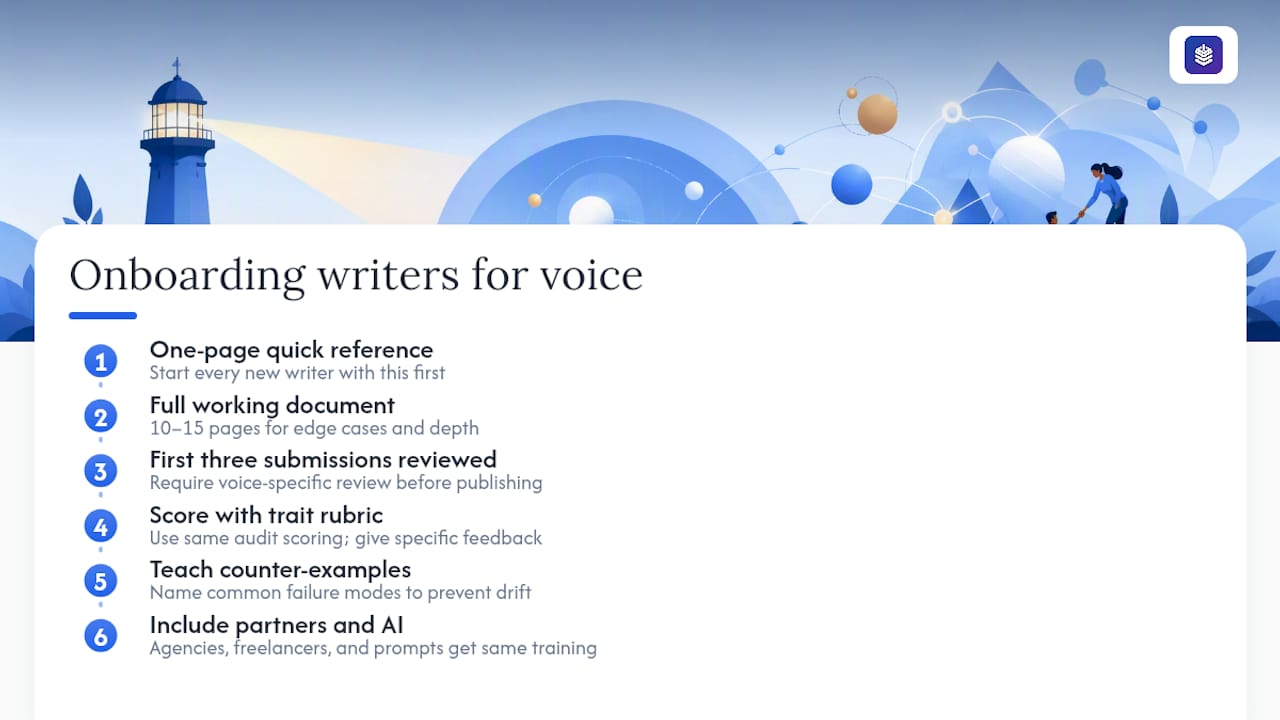
Start every new writer, whether staff or freelance, with the one-page quick reference before they see the full working document. Shorter, more operational voice documents get better adoption than long manifestos, because writers can actually hold a one-pager in mind while drafting. The full 10 to 15 page working doc exists for edge cases and onboarding depth, not daily use.
Have new writers submit their first three pieces for a voice-specific review before anything publishes unsupervised. Score those pieces against your trait rubric the same way you'd score the quarterly audit, and give specific feedback tied to the do/don't examples, not vague notes like "make it sound more like us."
Counter-examples matter more here than positive examples. Explicitly naming the failure modes your team tends to fall into, like over-explaining in support replies or getting overly formal in social captions, prevents drift faster than another round of "here's what good looks like." Writers remember what they were warned against better than what they were shown as ideal.
Partner agencies and freelancers should get the same onboarding sequence as internal hires. A voice guideline that only trains internal staff leaves the exact seams (outsourced blog posts, agency-run social) where inconsistency shows up first. Teams exploring AI-driven brand-building workflows run into this same gap: the AI only sounds consistent if every human and every prompt template feeding it got the same training.
Applying This in an AI-Assisted Editing Workflow
Most brand voice guides die in a shared drive because nothing forces writers back to them mid-draft. That's the actual failure mode, not a lack of good traits. Blockpress builds voice enforcement into the drafting step itself: the editor's AI prompt wrapper can carry your trait list, lexicon rules, and channel dial directly into every generated draft, and its live SEO and UX scoring flags copy that drifts from your specs before it publishes to your Shopify blog.
The practical next step is small. Load your five traits and forbidden lexicon into a prompt snippet, run it against three recent posts inside Blockpress, and score the output against your own rubric. That fifteen-minute test tells you more about whether your guideline actually works than another round of internal debate about adjectives.
— Rodney
Sources
- How to define your brand voice (Hootsuite)
- Brand voice guidance and framework (Sprinklr)
- Brand voice vs tone and four-dimension framework (BrandVM)
- Document your brand voice in 5 components (Semalytics)
- B2B brand voice execution procedures (The Starr Conspiracy)
FAQ
What Is the Difference Between Brand Voice and Tone?
Voice is the stable personality that stays consistent everywhere your brand shows up. Tone is how that personality gets dialed up or down depending on context, like a calm tone during an incident versus an upbeat tone during a launch.
How Many Brand Voice Traits Should a Guideline Have?
Three to five traits works best. Fewer feels thin, and more than five becomes too much for writers to hold in mind while drafting.
What Should a Brand Voice Guidelines Template Include?
A working template needs three to five traits with do/don't examples, four tactical dimensions (pace, register, posture, lexicon), a channel adaptation matrix, and a named owner with a set audit cadence.
How Often Should You Audit Brand Voice Compliance?
Run an initial audit of 40 to 60 existing artifacts to set a baseline, then re-audit quarterly to track whether your compliance score is improving.
Can AI Tools Follow Brand Voice Guidelines?
Yes, if the traits, lexicon, and channel rules are written into the AI prompt itself. Without that context, AI drafting tools default to a generic tone that won't match your brand.