
Narrative-first, customer-rooted storytelling is the fastest way for DTC founders and marketers to turn one-off ads into repeatable growth. The DTC brands winning right now don't just describe products, they build a main character, a conflict, and a resolution your product solves, then repeat that structure across every channel.
Start with these five formats: founder arc video, customer transformation story, origin/mission narrative, packaging as a creative brief, and narrative-first UGC.
Your 72-hour checklist:
- Pull three customer quotes from reviews or DMs that describe a "before and after."
- Write one founder-arc script using the hero template below.
- Audit your packaging for one line of story copy you could add this week.
Pro Tip: Story-mine your post-purchase survey answers before you write a single script. Customers usually hand you better copy than your creative team will invent.
Key Takeaways
DTC brand storytelling works when a brand systematizes narrative across channels instead of treating it as a one-off campaign.
| Point | Details |
|---|---|
| Lead with a main character | Build content around a founder or customer, never the product itself. |
| Packaging drives organic UGC | Story cards and mission inserts turned unboxing into a shareable moment for brands like Cotopaxi. |
| Emotion-first briefs beat spec briefs | Creator briefs that lead with feeling produced higher saves and completion rates for Deux. |
| Measure repeat purchase, not just CTR | Track 30/90-day LTV lift and organic UGC rate alongside standard ad metrics. |
| Publish with BlockPress | Use BlockPress to draft, SEO-score, and bulk-publish story-led content directly inside Shopify. |
Table of Contents
- Why DTC Brand Storytelling Content Examples Outperform Feature-First Ads
- How Do You Build a DTC Brand Story Step by Step?
- What Should You Post on Each Channel?
- Six DTC Brand Storytelling Examples Worth Studying
- Copy-and-Paste Storytelling Templates and Prompts
- What Storytelling Mistakes Should You Avoid?
- How Do You Measure Storytelling Success?
- What I've Learned Watching DTC Brands Tell Their Stories
- How BlockPress Turns Storytelling Strategy Into Published Content
- Sources
- FAQ
Why DTC Brand Storytelling Content Examples Outperform Feature-First Ads
Stories stick because of how the brain encodes them. Cognitive research from Stanford's teaching center shows narrative information is easier to recall than disconnected facts, which is exactly why a founder-arc video outlasts a spec-sheet ad in a media buyer's rotation.

That memory advantage shows up in hard numbers once brands rebuild their creative around a single narrative thread. Graza saw a 340% jump in branded hashtag volume in six weeks after turning its packaging into a story prompt instead of a label. Deux reported 62% higher saves and 41% higher video completion after switching creator briefs from product specs to emotional truths.
Two numbers worth repeating in your next planning meeting:
- Packaging-as-story-prompt drove a 340% rise in organic branded content for Graza in six weeks.
- Emotion-first UGC briefs lowered Deux's CPM while improving completion rates.
Story-driven creative costs more up front to plan. It pays back in creative lifespan and lower acquisition costs over time.
How Do You Build a DTC Brand Story Step by Step?
Define the truth, pick your main character, build repeatable story beats, then distribute those beats everywhere your customer already looks.
- Define your brand truth. The founder or head of brand owns this. Deliverable: one sentence describing the problem you exist to solve. Week 1 milestone: a truth statement everyone on the team can repeat without reading it.
- Pick your main character. Usually the founder or a real customer, never the product itself. Deliverable: a one-page character brief with their want, obstacle, and change. 30-day milestone: three pieces of content built around that character.
- Create repeatable story beats. Marketing owns this. Deliverable: a beat sheet (setup, tension, product as resolution, proof) reused across formats.
- Distribute by channel. Content and paid teams own this. Deliverable: a channel map showing which beat runs where.
Micro-story checklist before you greenlight anything:
- A clear main character (not the product).
- Real tension or conflict, not manufactured drama.
- The product positioned as resolution, not hero.
- At least one value signal (sourcing, mission, process).
- One piece of evidence (review, data point, before/after).
Pro Tip: Your best story seeds are already sitting in review software, post-purchase surveys, and customer DMs. Search for the phrase "I didn't expect" across your review platform. That's usually where the real conflict lives.
What Should You Post on Each Channel?
Every channel needs a different cut of the same story, not a different story.
- Website (About + homepage): Write a founder-arc narrative with a clear before/after. Elavi's site leans into ingredient transparency paired with a personal founder story to build trust from the first scroll. Test first: swap your generic "About Us" paragraph for a three-act founder story and watch time-on-page.
- Product pages: Add sourcing micro-stories next to specs. Fly By Jing pairs chili crisp product copy with the founder's family recipe history, turning a condiment page into a heritage story. Test first: add one sourcing sentence to your top three product pages.
- Social: Post short founder arcs and customer transformations. Megababe built its Instagram presence on body-positive, humor-forward founder content rather than polished product shots. Test first: replace one scheduled product post with a 30-second founder clip.
- Email: Run serial storytelling across your welcome flow. Then I Met You uses a multi-part email sequence that reveals its founder's skincare journey one message at a time. Test first: split-test a story-first welcome email against your current promo-first version.
- Paid social: Cut your hero film into 6 to 15 second emotional entries. Oatly's disruptive, personality-driven ad cuts work because the tone survives even in a 6-second clip. Test first: run two ad cuts, one feature-led, one emotion-led.
- Packaging and unboxing: Add story cards inside the box. Rocky's Matcha includes origin and ritual language on packaging that doubles as an unboxing prop. Test first: add one printed story card to your next packaging run.
- Community: Recruit creators for narrative-first UGC. Avocado runs sustainability-driven creator programs that turn its mattress sourcing into shareable content, per Shopify's brand storytelling examples roundup. Test first: brief three creators on a feeling, not a feature list.
Six DTC Brand Storytelling Examples Worth Studying
Real brands, real moves, real outcomes. Steal the mechanism, not the exact execution.
- Kloo rebuilt its oral care content around a taboo-breaking mission story instead of product benefits, using founder-led social content to normalize a category most brands treat clinically. Outcome to expect: higher share rate on mission-driven posts versus product-only posts.
- Elavi paired ingredient transparency with a personal skincare journey across its website and email, turning technical formulation copy into a relatable narrative. Outcome to expect: longer email read time and higher click-through on story-led sends.
- Oatly leaned fully into an irreverent brand voice across packaging and paid social, making its personality the through-line across every touchpoint. Outcome to expect: stronger recall in category-crowded feeds.
- Fly By Jing used founder heritage storytelling on product pages to justify a premium price point in a commodity category. Outcome to expect: higher average order value tied to story-rich product pages.
- Cotopaxi rebuilt its entire creative system around one mission thread and added grant-recipient stories to packaging inserts, which made customers 23% more likely to share an unboxing clip.
- Fishwife invested in long-form brand film instead of short promotional cuts, and customers acquired through that brand film showed stronger 90-day lifetime value than customers acquired through standard product ads.
That's the shift worth internalizing: the box, the email subject line, and the ad cut aren't separate assets. They're the same story, cut for different attention spans.
Copy-and-Paste Storytelling Templates and Prompts
Use these as starting points, not finished scripts.
- Hero video (90 to 120 seconds): Open on the problem the founder personally faced, cut to the moment of realization, show the product as resolution, close on a customer's transformation.
- Short ad cut A (6 to 10s): Text on screen: "I didn't expect this to change how I [daily action]." Cut to product in use.
- Short ad cut B (10 to 15s): Start mid-conversation, as if the viewer walked into a real moment, then reveal the product.
- Short ad cut C (6s): Single emotional statement, no voiceover, captioned only.
- UGC brief prompt 1: "Tell us about a moment you almost gave up on [problem] before you found us."
- UGC brief prompt 2: "Show us your morning without narrating it. Let the routine tell the story."
- Email subject templates: Welcome: "The problem I couldn't fix until [year]." Retention: "What happened after your first order."
- Packaging card prompt: "This isn't just [product]. It's [origin detail]. Here's why that matters to you."
Template 5 works because it turns a review line directly into a script opener. If a customer wrote "I almost returned this until week two," that sentence is your ad's first line, unedited.
Pro Tip: Never rewrite a customer's original phrasing into "marketing speak." The clunkier, more specific version usually converts better than your polished rewrite.
What Storytelling Mistakes Should You Avoid?
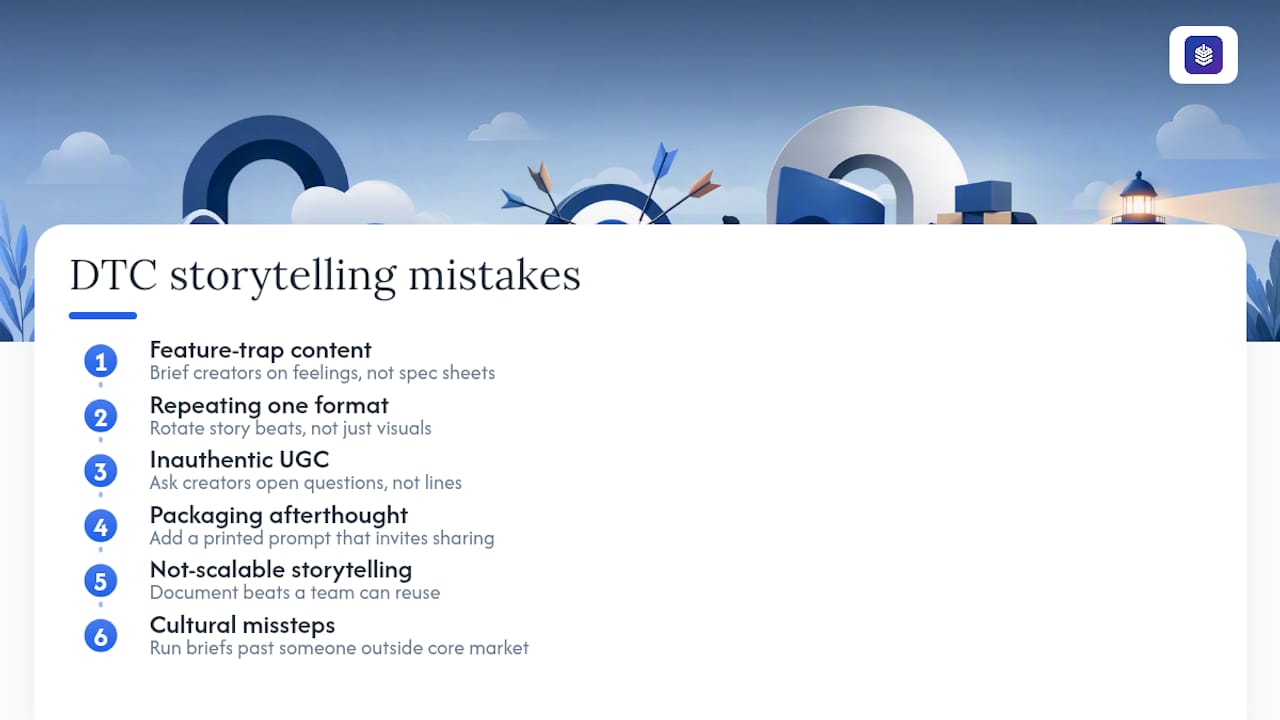
Six mistakes show up again and again in DTC creative audits. Feature-trap content lists specs instead of a story; fix it by briefing creators on feelings, not spec sheets. Same-habit creative volume repeats one format until it dies; fix it by rotating story beats, not just visuals. Inauthentic UGC reads as scripted; fix it by asking creators open questions instead of handing them lines. Packaging gets treated as an afterthought; fix it with a printed prompt that invites sharing. Storytelling that doesn't scale relies on one founder's bandwidth; fix it by documenting beats a team can reuse. Cultural missteps happen when sourcing or imagery ignores local context, as seen when a luxury brand's ad provoked public backlash in China over cultural insensitivity.
Pro Tip: Run every creator brief and packaging line past someone outside your core market before it ships.
How Do You Measure Storytelling Success?
Track repeat purchase rate, 30/90-day LTV lift, and organic UGC rate as your primary KPIs. Watch CTR, video completion, share rate, and earned impressions as secondary signals.
A simple six-week test plan:
- Split budget between a control (feature-first) and a treatment (narrative-first) creative set.
- Hold minimum spend equal across both groups.
- Track repeat purchase rate and organic mentions weekly, not just CTR.
- Report results biweekly to creative, growth, and founder stakeholders together, since story decisions cut across all three.
Content that drives these numbers usually compounds revenue over time rather than spiking and decaying like a standard promotional post.
What I've Learned Watching DTC Brands Tell Their Stories
The brands that win at storytelling treat it as infrastructure, not inspiration. They document beats, brief creators on emotion, and let packaging do work most brands leave to ad budgets. The mistake I see most often isn't bad writing. It's brands hiring for "content creation" when what they actually need is someone who thinks in narrative systems.
How BlockPress Turns Storytelling Strategy Into Published Content
Blockpress is the fastest way to turn the templates above into published, SEO-scored content without hiring a separate writer for every founder-arc blog post or product story page. It generates on-brand drafts from your own voice, scores each post for SEO and UX before it goes live, and bulk-publishes an entire content calendar in one sitting.
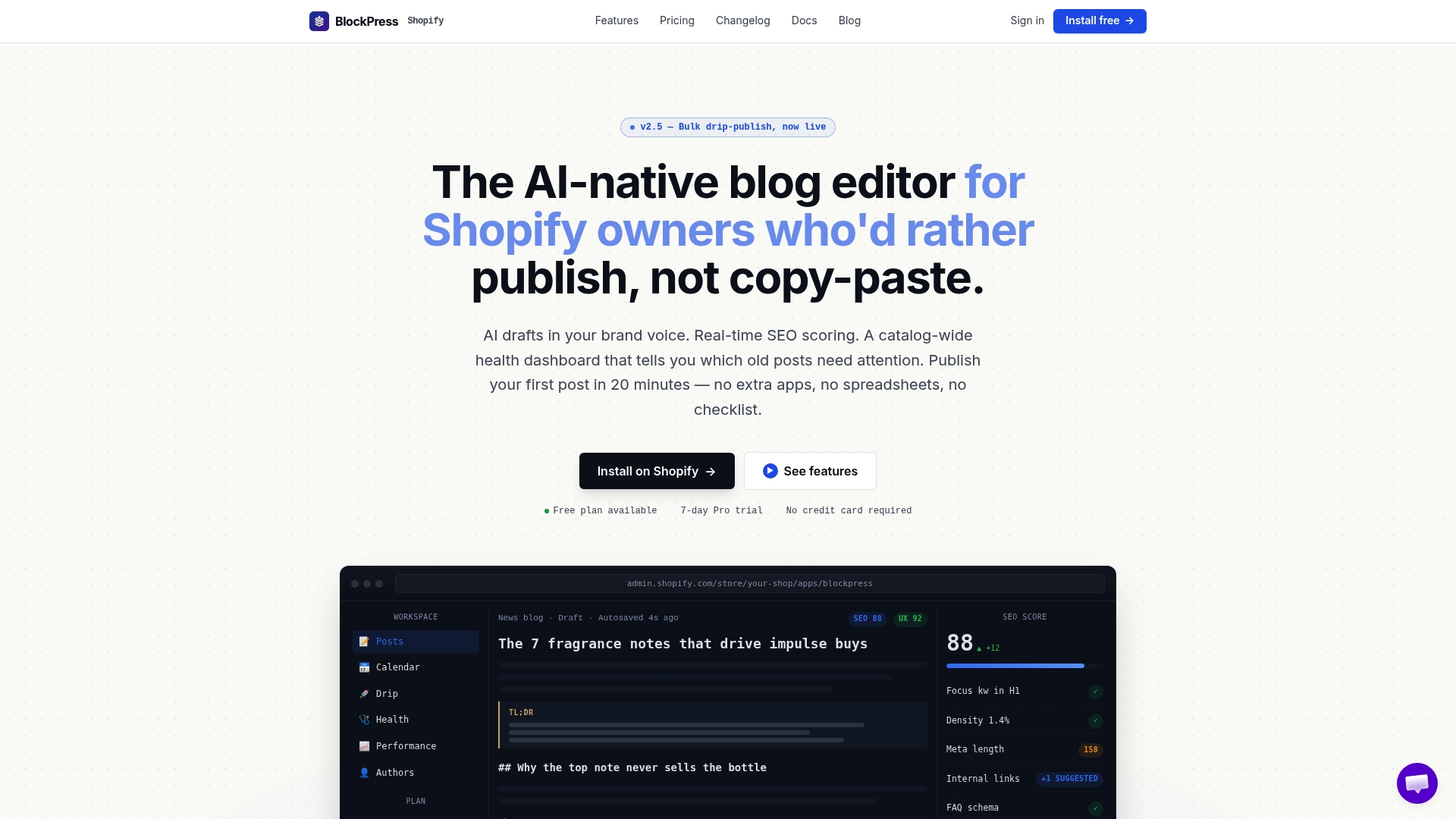
Two features map directly to what this guide just covered. Use AI-generated drafts in your brand voice to convert a story-mined customer quote into a full blog post in minutes, and use bulk drip-publishing to roll out a six-part founder-arc series without manually scheduling each entry. Author bio pages also give your founder's story a permanent home readers can click into from every post.
If you're ready to stop writing story content from scratch, check the BlockPress plans and get your first narrative-led post drafted today.
Sources
Start with the Stanford research if you're building the internal case for story-first budget. Move to the Shopify guides if you're auditing existing channels. Read the D2C Times case studies if you're planning a full creative rebuild.
- Memory and storytelling (Stanford CTL)
- 5 Brand Storytelling Examples for Ecommerce Stores (2026) - Shopify
- How Won and Graza Are Winning With Narrative-First UGC in 2026 – D2C Times
- How Cotopaxi Rebuilt Its Entire Creative System Around a Single Brand Truth – D2C Times
FAQ
What are some great examples of brand storytelling?
Cotopaxi's mission-thread packaging, Deux's founder-arc video series, and Fly By Jing's heritage-driven product pages are strong current examples because each ties a real narrative to a measurable outcome.

What is the 3-7-27 rule of branding?
Definitions vary across marketing sources, and this article's research doesn't confirm a single standard version, so treat any specific claim about this rule with caution until you check the original source.
What are some examples of DTC brands doing storytelling well?
Avocado, Megababe, Oatly, and Elavi each build content around a distinct narrative thread, sustainability, humor, disruption, and personal journey, rather than product features alone.
Can you give examples of business storytelling outside DTC?
Yes. Business storytelling shows up in nonprofit mission videos, B2B case studies, and founder keynotes, all using the same structure DTC brands use: a character, a conflict, and a resolution.
How can I start publishing story-led content faster?
Use a tool like Blockpress to draft on-brand story content, score it for SEO before publishing, and bulk-schedule a series so your team isn't writing every post manually.