
TL;DR:
- Product-related blog content connects products to buyer needs and influences purchase decisions. Different formats like reviews, guides, and comparisons should match the buyer's stage and product price point for maximum effectiveness. Proper internal linking and timing are essential to convert and retain readers into customers.
Product-related blog content is defined as any article that connects a product to a buyer's need, question, or decision point. The types of product-related blog content you choose directly determine whether readers browse and leave or browse and buy. Blog posts with natural product bridges convert 2–3 times better than posts without them. That single fact should shape every editorial decision you make. The key is matching your content format to your buyer's intent and your product's price point.
1. What are product review articles and why do they work?
Product review articles are the most direct form of conversion content in ecommerce blogging. They work because buyers searching for reviews are already close to a purchase decision. Your job is to give them the confidence to act.
A strong review follows a clear structure:
- Product overview: What it is and who it is for
- Key features: Specific specs or capabilities, not vague claims
- Pros and cons: Honest assessment builds trust faster than praise alone
- Verdict: A clear recommendation with a reason
The Feature-Benefit-Emotion chain is the most effective framework for writing review content. A feature tells the reader what the product does. A benefit explains why that matters. The emotion closes the gap between interest and purchase. For example: "This blender has a 1,200-watt motor (feature), so it handles frozen ingredients without stopping (benefit), which means no more frustrating mid-blend jams (emotion)."
Product reviews work best for mid to high-priced items where buyers need research before committing. Every review should include at least one contextual internal link to the product page or a related collection.

Pro Tip: Place your product link after you have established the problem or need, not in the opening paragraph. Introducing the product after 300–500 words of context consistently improves reader trust and conversion.
2. How-to guides and tutorials as top-of-funnel content
How-to guides attract readers who are solving a problem, not actively shopping. That makes them one of the best product blogging ideas for building early buyer awareness. You educate first, then introduce your product as the natural solution.
Effective how-to content for products includes:
- A specific, searchable problem as the title (e.g., "How to Remove Stains from a White Sofa")
- Step-by-step instructions with images or video embeds
- A product mention placed after the problem context is established
- A call to action that feels like a helpful next step, not a sales push
Impulse buys suit shorter listicles of 800–1,200 words, while higher-priced items need longer, research-heavy guides. Match your word count and depth to what your buyer actually needs to feel ready.
How-to posts also support keyword targeting at the top of the funnel. A reader searching "how to clean a cast iron pan" is a strong candidate for your cast iron cleaner product, but only if you earn their trust first.
Pro Tip: Add a "What you'll need" section near the top of every tutorial. It is the most natural place to introduce your product without disrupting the instructional flow.
3. Comparison posts: driving decisions through product contrasts
Comparison posts target buyers who have narrowed their options and need a final push. These are high-intent readers, and the right post structure converts them efficiently.
| Feature | Option A | Option B |
|---|---|---|
| Price range | Budget | Mid-range |
| Best for | Beginners | Advanced users |
| Key strength | Ease of use | Performance |
| Verdict | Good starting point | Better long-term value |
Comparison posts with clear winner recommendations convert better than neutral, fence-sitting posts. Readers come to comparison content because they want someone to make the call. If you hedge, they leave. If you commit to a recommendation with a clear reason, they trust you.
Place your comparison table above the fold so readers can scan it immediately. Then use the body of the post to explain the reasoning behind your verdict. This structure works especially well for product variants, bundles, or category comparisons within your own store.
Pro Tip: Always state your recommended pick in the first two paragraphs. Readers who scroll past a comparison table without seeing a recommendation will often bounce before reaching your product link.
4. Seasonal and trend-focused posts for timely traffic
Seasonal product posts generate short bursts of high-intent traffic tied to calendar events, holidays, or trending topics. They are among the most effective types of blog content for products when timed correctly.
Key practices for seasonal content:
- Publish 4–6 weeks before the target date to allow time for indexing
- Include a clearly visible "last updated" date to signal freshness
- Add updateable sections (e.g., "2026 picks") so you can revise without rewriting
- Link directly to relevant collections with a clear call to action
Google's helpful content guidelines prioritize content that demonstrates first-hand experience and currency. A seasonal post from two years ago with no updates signals low quality to both readers and search engines. Build a content calendar that schedules annual revisions for every seasonal post you publish.
Trending content follows the same logic. If a product category is gaining search volume, a well-timed post can capture traffic before competition builds. Use Google Trends or your store's search data to spot these windows early.
5. Educational posts that build brand authority
Educational posts are the least salesy format in your content mix, and that is exactly why they work. Readers trust content that teaches without pushing. That trust transfers to your brand and, eventually, to your products.
The right balance is 70–80% educational content with subtle product mentions woven in naturally. A post titled "What to Look for in a Running Shoe" can mention your shoe line once or twice without feeling like an ad. The educational framing does the heavy lifting.
These posts are ideal for broad, top-of-funnel keywords with high search volume. They attract readers who are not yet ready to buy but are forming opinions about product categories. Consistent internal linking from these posts to product pages and deeper content keeps readers moving through your funnel.
Pro Tip: Answer the single most common question your customer service team receives. That question is almost always a high-traffic keyword with low competition, and it maps directly to a product your store sells.
Key Takeaways
The most effective product blog strategy pairs each content type with the right buyer intent and product price point, then links every post to a product or collection.
| Point | Details |
|---|---|
| Match format to intent | Use reviews for high-intent buyers, how-to guides for early-stage awareness. |
| Product bridges convert | Introduce products after 300–500 words of context for the best conversion results. |
| Comparison posts need a verdict | Fence-sitting comparisons lose readers; clear recommendations build trust and drive clicks. |
| Seasonal posts need updates | Add a revision schedule and visible dates to keep seasonal content ranking year after year. |
| Education builds trust | Keep product mentions subtle in informational posts to preserve reader credibility. |
Why I stopped using one blog template for every product
Most content creators pick one blog format and apply it to every product, every price point, and every funnel stage. I did the same thing early on, and the results were flat. A 900-word listicle works well for a $15 impulse buy. It fails completely for a $400 piece of equipment that buyers research for weeks.
The shift that changed my results was treating content type as a product decision, not a writing preference. Mark Stevens advises against using one generic blog template for all products. Multiple intent-specific templates aligned to funnel stages consistently outperform a one-size-fits-all approach. That advice holds up.
What I have found is that internal linking strategy matters as much as content type. A great review post with no link to the product page is a missed conversion. A strong educational post with no path to a collection page is a dead end. Every post needs a clear next step for the reader. The internal linking structure you build across your blog is what turns individual posts into a sales system.
Test two or three content types for the same product category. The format that earns the most time-on-page and the most product page clicks is the one worth scaling.
— Rodney
Blockpress makes product blog content easier to get right
Writing the right type of product blog post is only half the work. Publishing it with proper SEO, internal links, and performance tracking is where most Shopify merchants lose time.
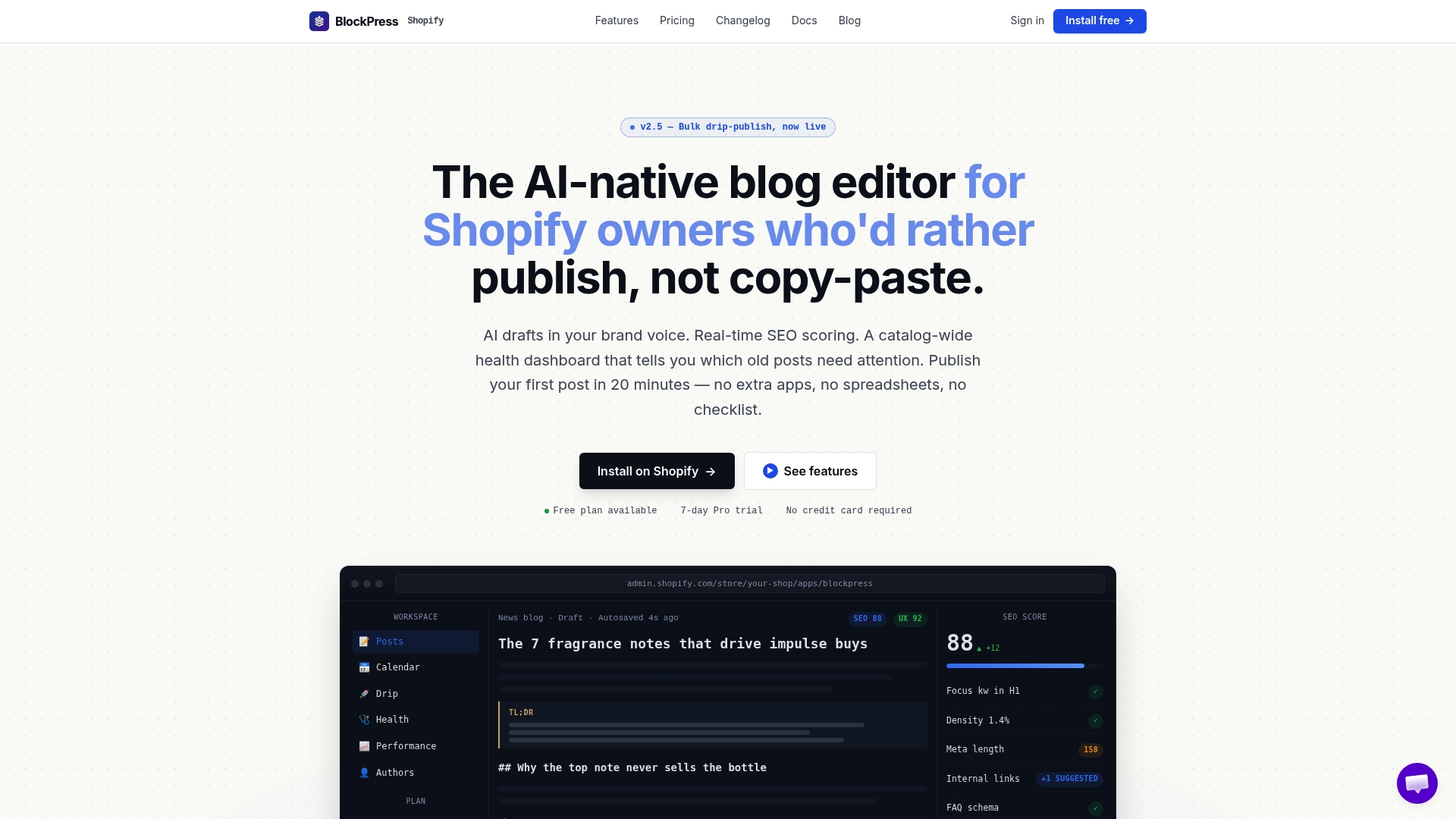
Blockpress is an AI-native blog editor built directly into Shopify. It gives you real Google keyword data, live SEO scoring, AI-generated article drafts, and per-article performance analytics, all without leaving your store. You can build your internal linking structure, run article health audits, and publish on a consistent cadence using bulk drip-publishing. If you are ready to turn your product blog into a real traffic and sales channel, explore the Blockpress features or check pricing plans to find the right fit.
FAQ
What are the main types of product-related blog content?
The main types are product reviews, how-to guides, comparison posts, seasonal posts, and educational articles. Each format serves a different buyer intent and funnel stage.
How do I choose the right blog format for my product?
Match content complexity to product price. Impulse buys suit shorter listicles, while higher-priced items need longer, research-heavy guides.
When should I mention a product in a blog post?
Introduce the product after 300–500 words of educational or problem-context content. Opening paragraphs with product links reduce reader trust and lower conversion rates.
How often should I publish product blog posts?
One high-quality post per week is the gold standard for authority building and broad keyword targeting. Consistency matters more than volume.
Do comparison posts work for all product types?
Comparison posts work best for mid to high-ticket items where buyers evaluate multiple options before purchasing. They are less effective for low-cost impulse products where buyers decide quickly.