
Generative engine optimization (GEO) is the practice of structuring content so AI search engines like ChatGPT, Perplexity, and Google AI Overviews retrieve and cite your passages instead of a competitor's. The single highest-impact move is writing short, self-contained, fact-dense answer blocks that a model can lift word for word. Everything else in your GEO program supports that one habit.
TL;DR:
- The most effective GEO strategy involves creating self-contained answer blocks of 134 to 167 words that state a single claim backed by a specific source or fact.
- Passing AI crawlers requires server-side rendering, thorough schema markup, and ensuring that robot access is not blocked by your site's robots.txt.
- Building entity authority through consistent mentions, author bios, and credible third-party coverage significantly increases citation chances across AI engines.
- Prioritize optimizing pages already ranking in the top 10 organic results or those targeting high-value buyer questions for quicker results.
- Most improvements become measurable within two to three months, with a focus on citation rate, mention rate, and crawl coverage as key performance indicators.
Table of Contents
- What Is Generative Engine Optimization?
- GEO Vs SEO: What Stays and What Changes
- How GEO Works: Four Levers That Move Citation Share
- Practical GEO Tactics: An Implementation Checklist
- Which Tactics Work Best for Each AI Engine?
- How Do You Measure GEO Performance?
- The 30 to 90 Day GEO Playbook
- Technical Checklist for Engineers and Publishers
- Why Named Authorship Improves Your GEO Odds
- Editorial Take: Where GEO Advice Goes Wrong
- Sources
- FAQ
What Is Generative Engine Optimization?
GEO treats the passage, not the page, as the unit of optimization. Traditional SEO ranks whole URLs against a query; generative engines break your content into chunks, retrieve the chunks that best match a prompt, and stitch them into an answer with a citation attached. That means a 100 word block buried on page four of your article can outperform your title tag if it answers the question cleanly. Research on generative engine optimization confirms the unit that gets cited is typically a self-contained passage of roughly 50 to 150 words.
Retrieval and grounding work differently than classic ranking. A search engine ranks documents by relevance signals across the whole page. A generative engine retrieves candidate passages, grounds its answer in a handful of them, and then decides which source earns the visible citation. Entity authority, meaning how consistently your brand and named contributors show up across the web, influences which candidate passage wins that final selection.
- Passages, not pages, get retrieved and cited
- Grounding picks sources; ranking picks pages
- Entity signals break ties between similar passages
GEO Vs SEO: What Stays and What Changes
Most of what already works in SEO still works in GEO.
Keep doing this from your existing SEO playbook:
- Target keyword research and search intent matching
- Fast, mobile-friendly pages with clean on-page structure
- Internal linking that establishes topical authority
- Earning a spot in the organic top 10, since AI Overviews commonly pull from pages that already rank there
Add these GEO-only items on top:
- An
llms.txtfile that tells AI crawlers what to prioritize - TL;DR or answer blocks positioned at the top of key sections
- FAQ schema markup on every page that answers a discrete question
- Deliberate entity building through bios, mentions, and citations elsewhere
How GEO Works: Four Levers That Move Citation Share
Four mechanisms determine whether your content gets pulled into an AI answer. Understanding each one tells you where to spend your time.
Passage engineering is the foundation. Self-contained H2 sections that state a claim, back it with a number or named source, and stop, are far more citable than sprawling paragraphs that bury the answer three sentences in. Passage-first structure with named facts consistently raises the odds a model will lift and attribute your text, according to Coursera's breakdown of GEO.
Structured data tells engines what type of answer you're offering. Article, FAQPage, and HowTo schema each map to different query types, and Microsoft Ads' guide to AEO and GEO recommends all three as baseline structural signals.
Entity authority comes from consistent mentions of your brand and named authors across other credible sites, not just your own domain.
Crawler access is the gate everything else passes through. If GPTBot, PerplexityBot, or ClaudeBot can't reach your page, none of the above matters.
- Write answer-first passages, one claim per block
- Apply Article, FAQPage, and HowTo schema
- Build entity mentions through bios and third-party coverage
- Confirm crawler access before optimizing anything else
Pro Tip: Check your server logs for GPTBot and PerplexityBot hits before you touch your content. If they're not visiting, no amount of passage engineering will get you cited.
Practical GEO Tactics: An Implementation Checklist
Turn the four levers above into edits you can make this week. Start with your highest-traffic or highest-intent pages, not your entire archive.
- Rewrite your top answer block. Aim for 134 to 167 words, a range Coursera's GEO guide ties to higher lift rates, and pack in a specific number, date, or named source.
- Add JSON-LD for Article, FAQPage, and HowTo. Populate
headline,datePublished,author, andmainEntityfields completely. A schema markup explainer walks through the required properties if your team is new to structured data. - Convert vague attributions into named-source statements. Replace "studies show" with the actual publication, author, or organization behind the claim.
- Publish or update your
llms.txt. List your most important sections and note which paths are open to AI crawlers. - Confirm robots.txt doesn't block AI bots you want visiting. Many sites accidentally block GPTBot or ClaudeBot while chasing traditional crawler settings.
Once the top pages are done, roll the same checklist down your content list in priority order:
- Pages already ranking in the organic top 10 (easiest wins)
- Pages targeting high-value buyer questions
- Cornerstone or pillar content that anchors your topic authority
Which Tactics Work Best for Each AI Engine?
Not every generative engine weighs the same signals. Spreading effort evenly across all of them wastes time when your buyers mostly use one or two.
- Google AI Overviews and AI Mode pull heavily from pages already ranking in the organic top 10. The single highest-impact move is earning that ranking, then adding a TL;DR block near the top of the page.
- ChatGPT leans on entity authority and editorial or encyclopedic sources. Consistent mentions of your brand across credible third-party sites matter more here than fresh publish dates.
- Perplexity favors recency and inline citations. Update dates and named sources inside your own text increase your odds of being the cited link.
- Claude behaves closer to ChatGPT, favoring established, well-cited sources over recently published pages.
Different engines really do run on distinct trust hierarchies, a pattern RankScope's GEO playbook lays out clearly across all four. If your buyers research primarily through one engine, a ChatGPT visibility guide is worth a closer read before you split effort four ways. Pick the engine your analytics show is already sending referral traffic, and optimize there first.
How Do You Measure GEO Performance?
You can't improve what you don't track, and GEO has its own metric stack separate from rankings and organic clicks.
Citation rate is the share of test prompts where an engine cites your domain. Run the same prompt 30 to 50 times per engine before trusting the number. A single lucky citation isn't a trend.
Mention rate and AI share-of-voice measure how often your brand appears in an answer at all, cited or not, compared against competitors mentioned for the same prompts. This tells you whether you're building entity presence even before citations catch up.
Crawl coverage is your leading indicator. If AI bots are crawling more of your site each week, citation gains tend to follow within a couple of monitoring cycles.
Wait a few weeks after publishing or restructuring a page before measuring change, since AI engines refresh their indexes on a delay rather than in real time.
- Sample multiple runs per engine for citation rate, ideally between thirty and fifty to ensure reliability
- Track mention rate and share-of-voice against named competitors
- Watch crawl logs weekly as a leading signal
- Hold off on judgment for 2 to 4 weeks post-publish
The 30 to 90 Day GEO Playbook
A GEO program doesn't need a quarter-long roadmap to show results. Most teams see a measurable shift within a two to three month cycle.
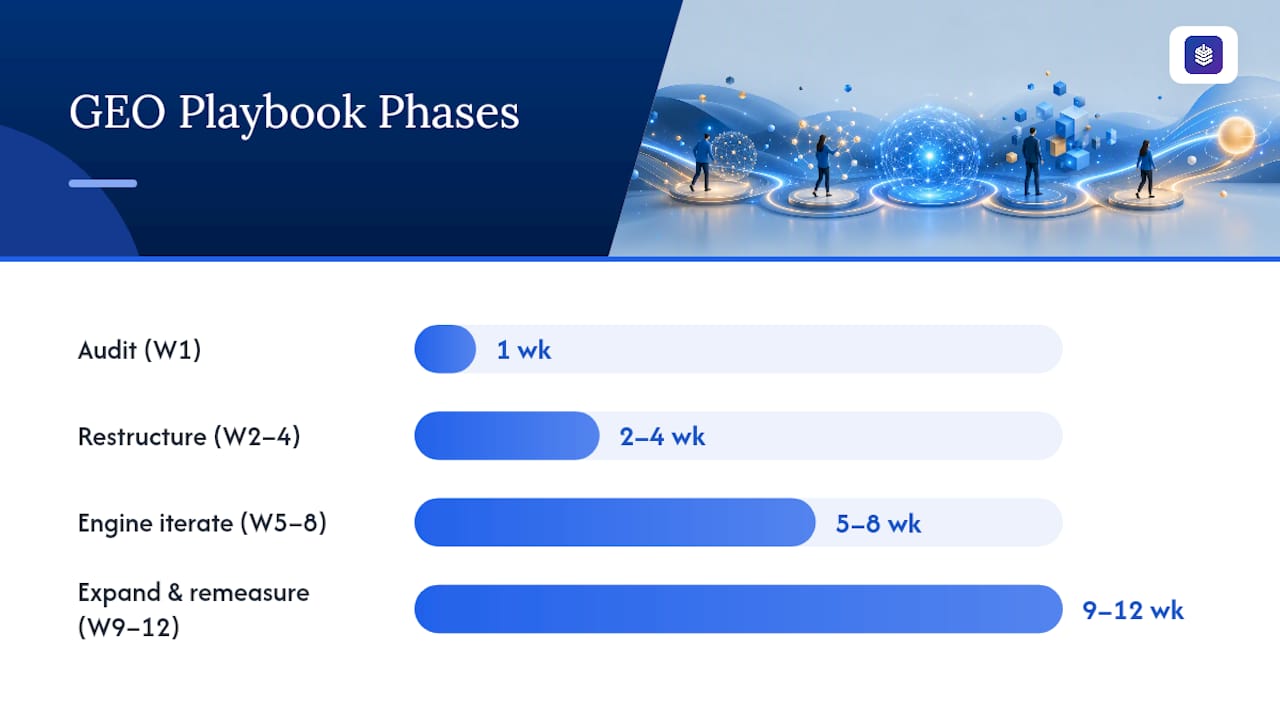
- Week 1: Audit. Build a prompt library of 20 to 30 real buyer questions, check your
robots.txtandllms.txtfor AI crawler access, and confirm GPTBot and PerplexityBot are actually hitting your server logs. - Weeks 2 to 4: Restructure. Rewrite the answer blocks on your top three pages, add Article and FAQPage schema, and convert vague claims into named-source statements.
- Weeks 5 to 8: Engine-specific iteration. Adjust each page toward the engine sending you the most referral traffic, whether that means chasing organic top 10 for AI Overviews or building entity mentions for ChatGPT.
- Weeks 9 to 12: Expand and remeasure. Roll the checklist down your next tier of pages and rerun your citation rate sampling to confirm the trend holds.
Prioritize pages already close to the organic top 10 or already getting AI referral traffic. Those are the cheapest wins in the entire cycle.
Pro Tip: Don't restructure your whole blog in week one. Fix three pages, measure the citation rate shift, then scale what actually worked.
Technical Checklist for Engineers and Publishers
Content teams can write perfect answer blocks and still get zero citations if the technical layer blocks access. A few checks close that gap.
- Render critical passages server-side or as static HTML. If your answer block only appears after client-side JavaScript executes, many AI crawlers never see it.
- Deploy
llms.txtat your root domain listing your most important sections, similar in spirit to howsitemap.xmlguides traditional crawlers. - Validate every schema block with Google's Rich Results Test or Schema.org's validator before publishing, since malformed JSON-LD gets ignored entirely.
- Check server logs monthly for GPTBot, PerplexityBot, and ClaudeBot activity to confirm crawl coverage is growing, not stalling.
Pro Tip: A schema block with one typo in a required field is the same as no schema block at all. Validate before you ship, every time.
Why Named Authorship Improves Your GEO Odds
Entity authority isn't abstract. It's built from concrete signals: a named author with a consistent bio, a page that links back to their other published work, and structured data that tells engines who wrote what.
Publishing a real author page, with credentials and a photo, gives generative engines a person to anchor trust to instead of an anonymous brand voice. Brand authority research ties this kind of consistent attribution directly to higher citation odds over time.
Certain blog editors include live SEO and UX scoring that flag missing schema before publishing, article health audits to detect thin or outdated answer blocks, and per-article analytics to show which pages are earning engine traffic. Some editors generate author bio pages automatically, so articles carry bylines and structured author JSON-LD without extra manual work.
- Publish a dedicated author page with a real bio and credentials
- Link every article back to that author's bio page
- Add structured
authorfields to your Article schema - Use health audits to catch answer blocks that have gone stale
Editorial Take: Where GEO Advice Goes Wrong
Most GEO content treats citation as a numbers game: publish more, structure everything, and hope volume wins. That's backwards. The research is consistent that a handful of tightly engineered passages on your highest-intent pages will outperform a hundred mediocre ones, because engines cite the passage that answers the question most cleanly, not the site that published the most words about it.
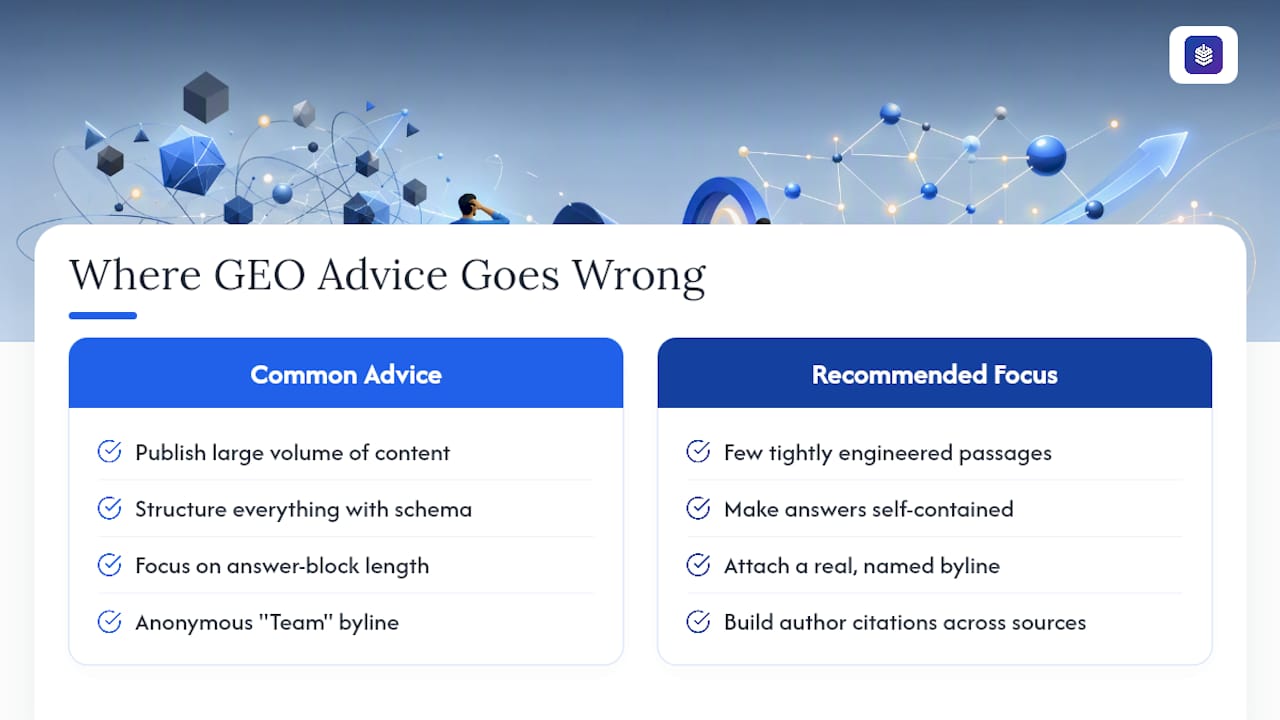
The bigger blind spot is entity authority. Marketers pour effort into schema markup and answer-block length while ignoring the simplest lever: putting a real, named person behind the content. Generative engines are, at their core, trying to decide who to trust. An anonymous "Team" byline gives them nothing to anchor that trust to. A consistent author with a real bio, cited across a few credible sources, does.
If you only have time to do one thing this quarter, skip the full-site schema audit. Rewrite your three best pages into tight, self-contained answer blocks, attach a real byline, and check your crawl logs in four weeks. That's where the actual return lives.
— Rodney
FAQ
What Is Generative Engine Optimization in Simple Terms?
Generative engine optimization is writing and structuring content so AI engines like ChatGPT and Perplexity retrieve and cite your passages when answering user questions, rather than just ranking your page.
How Long Does It Take to See GEO Results?
Wait 2 to 4 weeks after restructuring a page before measuring citation changes, and expect a full GEO cycle of 8 to 12 weeks to show a clear trend.
What Length Should an Answer Block Be?
Aim for a self-contained passage of roughly 134 to 167 words that states one claim and backs it with a specific fact or named source.
Which AI Engine Should I Optimize for First?
Check your analytics for which engine already sends referral traffic, then prioritize accordingly. Google AI Overviews rewards organic top 10 rankings, ChatGPT rewards entity authority, and Perplexity rewards recency and inline citations.