
Your blog's backlink profile directly shapes both page and domain authority. Google and third-party metrics like Moz Domain Authority and Ahrefs Domain Rating use link signals as core trust indicators, and the composition of that profile determines how much authority you actually gain. According to WordStream's analysis of Google ranking factors, backlinks remain a major ranking signal, with quality and topical relevance now outweighing raw link counts.
Three signals determine how much your backlink profile moves the needle:
- Referring domains: Unique linking root domains carry far more weight than multiple links from the same site. Top-ranking pages consistently show higher referring-domain counts than lower-ranking competitors, per Rankability's ranking factor analysis.
- Topical relevance: A link from a niche-relevant site in your industry signals context and expertise, not just popularity.
- Link placement and growth velocity: Editorial in-body links on high-traffic pages outperform footer or sidebar links, and steady organic link growth looks natural to algorithms like SpamBrain.
Key Takeaways
A blog's backlink profile shapes both page and domain authority through referring-domain diversity, topical relevance, contextual placement, and steady link growth — and improving those signals consistently raises DA and rankings over time.
| Point | Details |
|---|---|
| Referring domains over link count | Unique linking root domains correlate more strongly with rankings than total link volume. |
| Topical relevance beats raw DR | A niche-relevant DR40 link in editorial context often outperforms an off-topic DR80 link. |
| Audit before you build | Export from Google Search Console and Ahrefs or Semrush, deduplicate by domain, and flag toxic links first. |
| Natural growth velocity matters | Steady monthly referring-domain gains look organic; sudden spikes trigger SpamBrain pattern detection. |
| Blockpress for link equity distribution | Blockpress's article health audits and internal-link suggestions help distribute earned link equity across your Shopify blog. |
Table of Contents
- What a backlink profile is and how it maps to domain vs page authority
- Which backlink signals most affect your blog's authority
- Profile-level signals search engines look for
- How to audit your blog's backlink profile step by step
- Proven tactics to earn high-quality backlinks for your blog
- What to expect: timeline for link changes to affect authority
- Common link-building mistakes and how to recover
- Why a natural backlink profile matters more in the AI era
- Quick summary: what to do next
- What actually works for blogs building authority through links
- Blockpress helps you track and prioritize link-driven improvements
- Sources
- FAQ
What a backlink profile is and how it maps to domain vs page authority
A backlink profile is the complete collection of external links pointing to your site, viewed as a system rather than a list. It includes referring root domains (unique sites linking to you), individual inbound URLs, anchor text used in each link, link attributes (follow, nofollow, sponsored, UGC), and the placement context of each link within the linking page.
Understanding the difference between domain authority and page authority matters because they respond to different link signals. Domain Authority (DA), as Moz defines it, is a relative benchmark calculated from your entire site's backlink data. It reflects the cumulative trust of all pages combined. Page Authority, by contrast, measures the strength of a single URL. A strong editorial link pointing to one blog post boosts that post's page authority first. That equity then flows to other pages through internal linking, gradually lifting domain-level signals over time.
According to the Shopify blog's analysis, backlinks affect domain authority through link quantity, diversity, relevance, domain popularity, and growth. No single link flips a DA score. The profile as a whole is what moves it.
| Term | Practical meaning |
|---|---|
| Referring domain | One unique website linking to you — each new domain is a distinct endorsement |
| Inbound link | A single URL pointing to your site — multiple links from one domain count less |
| Anchor text | The clickable words used in the link — signals topical context to search engines |
| Follow link | Passes link equity to your page — the default for editorial links |
| Nofollow / sponsored | Does not pass equity directly — still useful for traffic and profile diversity |
| Link placement | Where on the linking page the link appears — in-body editorial links outperform footers |
Which backlink signals most affect your blog's authority
Not all link signals carry equal weight. Here is how they rank by practical impact on blog authority:
- Referring-domain count: The number of unique domains linking to you correlates more strongly with first-page rankings than total link count. Ten links from ten different sites beat ten links from one site every time.
- Topical relevance of linking domains: A DR40 site in your exact niche often delivers more ranking benefit than a DR80 site in an unrelated industry. Relevance signals expertise to Google's systems.
- Contextual placement: An in-body editorial link within a relevant paragraph carries more weight than the same link placed in a site-wide footer or sidebar. Google's search documentation confirms that prominent editorial links help search systems evaluate content quality.
- Link quality (authority + traffic): The linking page's own organic traffic and authority matter. A link from a page that ranks well and receives real visitors is worth more than a link from a high-DR domain on a page nobody reads. Topical relevance and organic traffic of the linking page strongly correlate with link impact.
- Anchor text distribution: A natural anchor profile mixes branded anchors, partial-match phrases, generic terms ("click here," "read more"), and bare URLs. Over-optimizing toward exact-match anchors is a toxicity signal.
Example contrast: A DR40 food blog linking to your recipe content in the third paragraph of a well-trafficked article will typically outperform a DR80 news aggregator linking to your homepage in a sidebar widget. The niche link wins on relevance and placement.
Pro Tip: Prioritize editorial in-content links from topically relevant sites over high-DR links from unrelated domains. One relevant link from a niche authority often moves rankings faster than three off-topic links from larger sites.
Profile-level signals search engines look for
Search engines evaluate your backlink profile as a pattern, not just a collection of individual links. The patterns that matter most are diversity, velocity, and toxicity signals.

Diversity and referring-domain distribution mean that links concentrated on a handful of domains look weak even if those domains are authoritative. Algorithms weight unique endorsements. A blog with 200 links from 150 different domains signals broader trust than one with 200 links from 5 domains.
Growth velocity is how quickly you acquire new referring domains over time. Steady, organic growth looks natural. Sudden spikes, especially after a period of no activity, trigger pattern-detection systems like Google's SpamBrain. A consistent monthly cadence of new referring domains from varied sources is the target. Spikes from link purchases or PBN campaigns are a red flag even when the individual links look clean.
Toxicity signals include links from known spam networks, unnatural anchor-text ratios (heavy exact-match), IP clustering (many links from the same server block), and links from sites with no organic traffic. Any one of these alone rarely causes a penalty. A cluster of them together raises algorithmic risk significantly.
A natural backlink profile features diversity across linking domains, steady organic link growth, and topical relevance — traits that reinforce E-E-A-T and brand trust in AI-driven search systems. — Search Engine Land
How to audit your blog's backlink profile step by step
A structured audit gives you a clear picture of your current link health before you spend time building new links. Run this process quarterly, or immediately after any ranking drop.
- Export your backlinks. Pull data from at least two sources: Google Search Console (Links report) and either Ahrefs, Semrush, or Moz Link Explorer. Each crawler indexes different links, so combining sources reduces blind spots. For a deeper operational view, backlink analysis guides recommend cross-referencing at least two tools before drawing conclusions.
- Deduplicate by root domain. Consolidate multiple links from the same domain into one row. You want to work at the referring-domain level, not the individual-link level.
- Score each referring domain. Add columns for Domain Rating (Ahrefs) or Domain Authority (Moz), organic traffic of the linking page, and topical relevance (manual judgment: is this site in your niche?).
- Flag toxic links. Mark any referring domain with zero organic traffic, a spam score above 30% in Moz, or obvious PBN/directory characteristics. These are candidates for outreach or disavow.
- Map links to high-value pages. Identify which blog posts receive the most external links. Those pages are your authority hubs. Use internal linking to distribute that equity to product pages or other posts that need ranking support.
Your audit spreadsheet should include these columns:
| Column | What it tells you |
|---|---|
| Referring domain | The unique site linking to you |
| Linking page URL | The exact page where your link appears |
| Anchor text | The topical signal being sent |
| Follow / nofollow | Whether link equity passes |
| Domain Rating / DA | Relative authority of the linking site |
| Organic traffic (linking page) | Whether real users see this link |
| Placement | In-body, footer, sidebar, or nav |
Pro Tip: *Check Google Search Console first for a free baseline, then layer in Ahrefs or Semrush data to catch links GSC misses.
Proven tactics to earn high-quality backlinks for your blog
The tactics that produce durable editorial links share one trait: they give journalists, bloggers, and editors a reason to link that serves their audience, not just yours.
Research-backed original content is the highest-ROI tactic. Original data, surveys, or industry studies give other writers a citable source. A single well-promoted data post can earn dozens of editorial links over months. This is the foundation of SEO-driven blog strategies that generate compounding authority.
Digital PR through HARO and Qwoted connects you with journalists actively seeking expert sources. HARO (now operating as Connectively) and Qwoted both send daily query emails. The selection rate is low, but a single placement in a major publication can deliver a DR70+ editorial link. Respond quickly, be specific, and lead with your most quotable insight.
Targeted guest contributions on niche-relevant blogs work when you pitch genuinely useful content rather than thinly veiled promotions. Focus on sites your audience already reads. One well-placed guest post on a respected industry blog outperforms ten posts on low-traffic directories.
Link reclamation is the fastest win available. Search for unlinked brand mentions using Ahrefs Content Explorer or Google alerts, then email the author asking them to add a link. Conversion rates are high because the writer already knows your brand.
Resource page outreach targets pages that curate tools, guides, or references in your niche. A short, personalized pitch explaining why your content fits their list converts better than generic outreach. For more tactical depth on building editorial links, this backlink-building guide covers outreach sequencing in detail.
Pro Tip: Send five highly personalized outreach emails per week rather than fifty generic ones. Personalization hooks — referencing a specific article the recipient wrote, or tying your pitch to a recent news angle — consistently outperform volume-based campaigns.
What to expect: timeline for link changes to affect authority
New backlinks do not move rankings overnight. The process has three distinct phases, and confusing them leads to premature decisions.
Raw indexing happens within days to a few weeks. Google's crawler discovers the new link, indexes it, and registers it in Search Console. You can verify this in the Links report.
Authority signal propagation takes weeks to months. After indexing, the link's equity flows through Google's systems and begins influencing rankings. A single high-quality editorial link from a DR70 publication can produce measurable ranking movement within four to eight weeks for a well-optimized post.
Domain-level shifts take longer. Moving Moz DA or Ahrefs DR requires a sustained pattern of new referring domains over months. A small niche blog gaining ten relevant referring domains over three months will typically see a DA increase of a few points. An ecommerce store earning one DR70 editorial link sees a page-level ranking boost faster, but domain-level metrics shift more slowly.
Patience is the most underused link-building tactic. Most authority gains from a new link become visible within 90 days, but domain-level metric shifts often require six months of consistent acquisition. — Shopify blog on domain authority
Practical monitoring cadence: Check Google Search Console weekly for new link indexing. Track referring-domain counts and DA/DR monthly in Ahrefs or Moz. Run a full audit quarterly. For ecommerce blogs specifically, how Google ranks ecommerce blog posts explains how these signals interact with product page authority.
Common link-building mistakes and how to recover
Most link-related penalties come from patterns, not individual links. Here is how to identify and fix the most common ones.
- Buying links or using link schemes. Paid links that pass equity violate Google's guidelines. The pattern is usually detectable through velocity spikes and anchor-text uniformity.
- Over-optimized anchor text. If 40% or more of your anchors are exact-match keywords, that ratio is a toxicity signal. Natural profiles have mostly branded and generic anchors.
- Rapid identical-link velocity. Acquiring 50 links in a week from similar-looking domains triggers SpamBrain. Slow, steady growth is the target.
- Low-quality directory submissions. Bulk directory links add no topical relevance and inflate your spam ratio.
- Automated PBN-style patterns. Private blog networks leave footprints: similar IP ranges, thin content, cross-linking patterns.
Recovery process:
- Run a full audit using Ahrefs or Semrush to identify toxic referring domains.
- Attempt manual removal first. Email the site owner requesting link removal. Document every outreach attempt with dates and responses.
- If removal fails after two attempts, add the domain to your Google Search Console disavow file. Use domain-level disavow entries (domain:example.com) rather than individual URLs.
- Re-audit at 30, 90, and 180 days after submitting the disavow file to track changes in spam score and ranking recovery.
Keep a log of every outreach email and disavow submission. Google's documentation recommends only disavowing links you believe are causing harm, not preemptively disavowing borderline links.
Why a natural backlink profile matters more in the AI era
Algorithm updates over the past two years have made manipulative link patterns harder to sustain. Google's SpamBrain system evaluates anchor-text ratios, velocity patterns, and domain clustering at scale. The siteAuthority concept weights topical relevance of linking domains more heavily than raw link counts. Information Gain scoring rewards pages that add new knowledge, making them more naturally citable.
The practical implication: a natural, diverse backlink profile is now a long-term resilience investment, not just a ranking tactic. Earned editorial links from topically relevant sites hold their value through algorithm updates. Manipulative patterns that worked in 2020 are increasingly detectable and reversible.
In the AI/LLM era, algorithms have become better at detecting manipulative patterns, so earned editorial links and topical relevance are higher priority than ever before. — Search Engine Land
Checklist for AI-era link strategy:
- Build information-gain pages: original research, proprietary data, or unique perspectives that give other writers a reason to cite you.
- Prioritize editorial in-content links from topically relevant sites over high-DR but off-topic placements.
- Diversify referring domains across different topical sites, geographic regions, and IP ranges.
- Monitor your profile for anchor-text concentration monthly.
Blockpress's article health audits and internal-link suggestions help you identify which blog posts are already earning external links and where internal linking can distribute that equity to pages that need ranking support. You can also track author credibility signals that amplify the impact of earned links in E-E-A-T evaluation. For a broader view of how AI search systems evaluate content, testing your content across AI platforms can reveal gaps in your authority signals.
Pro Tip: Use Blockpress's per-article performance analytics to identify posts with strong external link equity but weak internal linking. Those posts are your fastest opportunity to lift related pages without building a single new external link.
Quick summary: what to do next
A strong backlink profile requires consistent action across four areas. Here is your immediate checklist:
- Audit first. Export your backlinks from Google Search Console and Ahrefs or Semrush. Deduplicate by root domain and flag toxic links before building anything new.
- Prioritize high-relevance editorial links. One in-body link from a niche-relevant site with real traffic beats five footer links from unrelated high-DR domains.
- Clean toxic links. Attempt manual removal, then disavow. Re-audit at 30, 90, and 180 days.
- Create information-gain assets. Original data, research, or unique analysis earns editorial links organically and holds value through algorithm updates.
- Measure consistently. Set a monthly KPI for new referring domains, track DA/DR movement quarterly, and monitor ranking changes for your top link-target pages weekly.
What actually works for blogs building authority through links
The conventional wisdom says "get more backlinks." The reality is more specific: the blogs that build durable authority focus on a small number of high-relevance editorial links rather than volume. A niche blog earning two or three in-body links per month from topically aligned publications will outperform one chasing twenty directory links in the same period.
The trade-off most practitioners underestimate is between speed and durability. A single high-quality editorial link from a respected industry publication can move rankings within weeks. But a steady stream of five to ten new relevant referring domains per month compounds over a year in ways a single spike never does. Both matter. The mistake is treating them as alternatives.
Blockpress's article health audits and internal-link suggestions make it practical to operationalize earned link equity across a Shopify blog. When a post earns a strong external link, the internal linking layer determines how much of that equity reaches your product pages and category posts. Without it, the equity sits on one URL. With it, a single earned link can lift rankings across multiple pages.
Blockpress helps you track and prioritize link-driven improvements
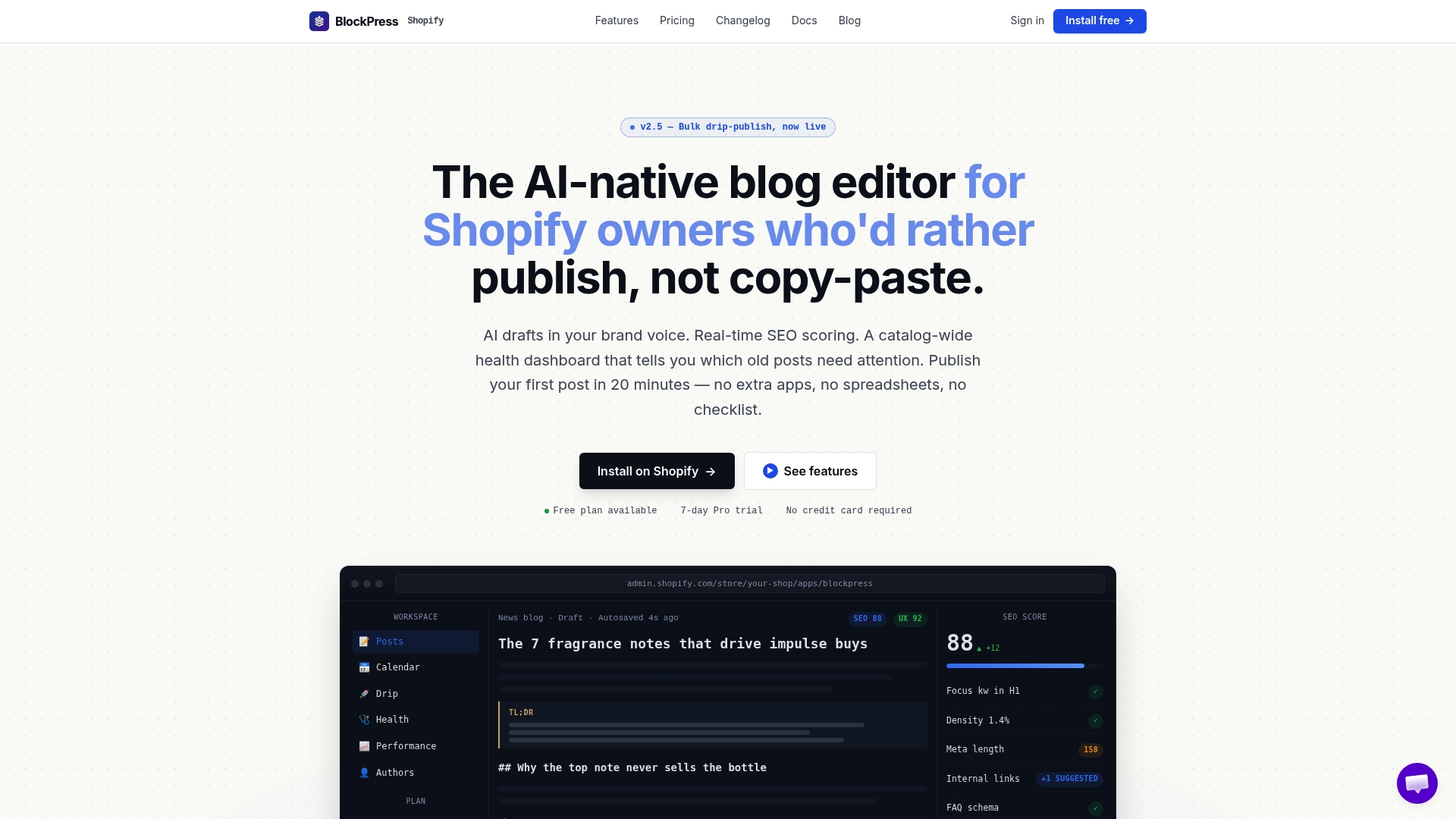
Earning backlinks is only half the work. Knowing which pages deserve those links, and whether your internal linking is distributing their equity effectively, is where most blogs leave ranking gains on the table. Blockpress's article health audits surface exactly that: which posts are underperforming relative to their link equity, where internal links are missing, and which pages should be your next outreach targets.
Built directly into Shopify, Blockpress gives you live SEO scoring, per-article performance analytics, and internal-link suggestions without switching between tools. You can identify your highest-authority posts, optimize their internal linking, and track ranking changes, all from one editor. Start with a free plan or explore paid tiers to see how Blockpress fits your current workflow.
Sources
The tools below cover every stage of the workflow, from initial audit to ongoing monitoring.
Analysis and auditing:
- The Most Important Google Ranking Factors for 2026 | WordStream
- Domain authority — Moz
- Search documentation — Google Developers
- How backlinks affect domain authority — Shopify blog
Outreach and link earning:
Recommended reading:
The most durable link-building programs combine original research content with consistent digital PR outreach — because journalists and authors prefer citable, data-led sources over generic pitches. — WordStream
FAQ
Does backlinking actually improve blog authority?
Yes. Backlinks remain a major Google ranking factor, and a strong profile of diverse, topically relevant referring domains raises both page and domain authority over time.
How many referring domains does a blog need to rank?
There is no universal threshold. Top-ranking pages consistently show more referring domains than lower-ranking competitors in the same niche, so the target is always relative to your competitive set.
What is the difference between Moz DA and Ahrefs DR?
Both are third-party benchmarks calculated from backlink data, not direct Google signals. Moz DA and Ahrefs DR are best used for comparing sites within the same niche rather than as absolute ranking predictors.
How long does it take for a new backlink to affect rankings?
A high-quality editorial link typically influences rankings within four to eight weeks of indexing. Domain-level metric shifts usually require several months of consistent link acquisition.
When should I use Google's disavow tool?
Use disavow only after attempting manual link removal and documenting those attempts. It is a last resort for links you believe are causing algorithmic harm, not a routine cleanup tool.