
Site-level authority signals materially affect organic reach. That verdict holds whether you're running a Shopify store blog or a 10,000-page media site. The catch: the "Domain Authority" score in your SEO tool is a vendor-created proxy, not a Google input. Use it as a directional benchmark, not an operational KPI.
Here's what that means in practice:
- Third-party scores (DA, DR, Authority Score) are useful for benchmarking but not used by Google in its ranking algorithm.
- Google does have internal site-level signals. The 2024 Content Warehouse API leak surfaced an attribute called
siteAuthoritythat functions like a modernized, site-wide popularity score. - The underlying signals are what matter: editorial backlinks, topical depth, branded search demand, and user engagement. Improve those, and both vendor scores and Google's internal signals move in the right direction.
- Your immediate move: stop optimizing to the number. Start auditing the inputs — referring domain diversity, topical cluster coverage, and non-brand organic click growth.
Key Takeaways
Site-level authority signals materially affect organic reach, but third-party scores like DA and DR are directional proxies, not Google inputs — optimize the underlying signals, not the number.
| Point | Details |
|---|---|
| Third-party scores are proxies | Moz DA, Ahrefs DR, and SEMrush Authority Score are vendor metrics; Google does not use them in its ranking algorithm. |
| Google has internal site-level signals | The 2024 Content Warehouse leak confirmed a siteAuthority attribute that functions as a domain-level popularity score. |
| Authority correlates with reach via shared signals | Editorial backlinks, topical depth, and branded demand drive both vendor scores and Google's internal signals simultaneously. |
| Page-level authority still matters most | Moz's 2021 correlation study found page-level link counts are the strongest predictor of ranking in their dataset. |
| Measure inputs, not just scores | Track non-brand GSC clicks, ranking breadth, and referring domain diversity monthly to validate whether authority gains produce real traffic. |
Table of Contents
- How site authority affects organic reach: concept vs. metric
- How DA, DR, and Authority Score are actually calculated
- Why authority correlates with rankings and organic traffic
- What the data and experts say about authority and reach
- How to measure authority and interpret scores for decision-making
- Actionable tactics that reliably build site authority
- How long authority improvements take to show up in traffic
- Common pitfalls that waste time and risk penalties
- Your next 10 steps to improve authority and organic reach
- The part most authority guides skip
- Blockpress makes authority-building work inside Shopify
- Sources
- FAQ
How site authority affects organic reach: concept vs. metric
"Site authority" refers to two distinct things, and mixing them up is where most SEO programs go sideways.
The conceptual version is a site-level reputation signal that Google assembles from backlink topology, topical coverage, brand demand, and user engagement. It's private, composite, and not directly readable. The 2024 Content Warehouse leak confirmed Google uses an internal attribute called siteAuthority that behaves like a domain-level popularity score, separate from page-level PageRank.
The metricized version is what vendors publish. Moz's Domain Authority (DA) is a 0–100 predictive score for ranking potential. Moz is explicit: DA is not a Google ranking factor. Ahrefs Domain Rating (DR) measures the strength of a site's backlink profile relative to others in Ahrefs' index. SEMrush Authority Score combines backlinks, organic traffic estimates, and spam signals into a composite number. Majestic produces two scores: Trust Flow (quality of linking sites) and Citation Flow (volume of links), which together give a quality-versus-quantity read on a backlink profile.
The distinction matters because internal Google signals and public vendor scores can diverge. A site can have a high DA from a legacy link profile while its siteAuthority lags because topical depth is thin and branded demand is flat. Conversely, a newer site with tight topical focus and strong editorial links can outrank a higher-DA competitor on specific queries.
How to read each in practice: use vendor metrics for competitive benchmarking and gap analysis. Use Google Search Console (GSC) and your analytics platform to validate whether authority gains are actually producing non-brand organic traffic.
How DA, DR, and Authority Score are actually calculated
Every major vendor score starts with the same raw material: the links pointing to a domain. From there, the methodologies diverge.
Core inputs across all vendors include linking root domains (unique sites linking to you), total link counts, link quality proxies (spam scores, topical relevance of the linking page), and some form of topical relevance weighting. Scores are then scaled logarithmically to a 0–100 range, which is why the effort required to move from 20 to 30 is not the same as moving from 60 to 70.
Common calculation patterns include dampening for low-quality or spammy links, different weightings for root domains versus individual page links, and periodic full recalculations that can cause score movement unrelated to your own link activity. If a large site that links to thousands of domains drops a few links, scores across those domains can shift.
Practical limitations worth knowing:
- Crawl coverage gaps mean vendor indexes miss links that GSC reports, and vice versa.
- Nofollow, UGC, and sponsored link treatment varies by vendor and has changed over time.
- Update cadence differs: Moz recalculates DA periodically in batches; Ahrefs updates DR more frequently. A spike in your score may reflect a vendor index refresh, not a real authority gain.
- Sampling differences mean two vendors can show meaningfully different scores for the same domain.
Pro Tip: Interpret authority scores logarithmically. A jump from DA 20 to DA 30 represents a significant relative gain; a jump from DA 60 to DA 70 requires substantially more link equity and editorial credibility. Set competitive benchmarks relative to your actual SERP competitors, not round-number targets.
For methodology detail, Moz's DA 2.0 guide explains how the score is built and how Moz recommends using it as a benchmarking tool rather than an absolute measure.
Why authority correlates with rankings and organic traffic
The correlation between authority scores and organic reach isn't coincidental. Both vendor scores and Google's algorithm draw from the same pool of underlying signals. Authority metrics correlate with organic reach because they encode high-quality editorial backlinks, topical authority, and sustained brand interest — the same inputs Google weights heavily.
Four mechanisms drive this relationship:
Link equity distribution. A strong backlink profile passes equity through internal links to product, category, and blog pages. Sites with more high-quality referring domains have more equity to distribute, which raises the floor for how well individual pages can rank. This is the site-level PageRank effect in practice.
Topical coverage and keyword footprint. Sites that publish deep, interconnected content on a topic earn authority across a cluster of related queries. Google's internal signals reward topical depth, so a site covering skincare comprehensively can rank for adjacent queries it hasn't explicitly targeted. Similarweb frames this as website authority being a composite of backlinks, topical depth, and branded demand — and improving those underlying signals moves both vendor scores and Google's internal site-level signals.

Branded search demand. When users search for your brand by name, that signal reinforces trust in Google's systems. Rising branded search velocity tends to accompany authority gains and can accelerate ranking improvements for non-brand queries.
User engagement. Click-through rates, dwell time, and return visits contribute to how Google evaluates page quality. High-authority sites tend to have better-known brands, which drives higher CTR from SERPs, which in turn reinforces ranking position.
One more factor worth noting for 2026: AI citation engines disproportionately pull from high-authority sources. If you're building brand authority for AI citations, a strong authority profile now multiplies visibility across AI-driven surfaces like Perplexity and ChatGPT, not just traditional SERPs.
What the data and experts say about authority and reach
The correlation evidence is directional but not causal, and it's worth being precise about what the data actually shows.
Moz's 2021 links-ranking correlation study found that page-level link counts are the strongest predictor in their dataset, and that DA and Page Authority outperform raw followed link counts as predictors. The implication: page-level authority matters more than domain-level authority for specific query rankings, but domain-level signals set the ceiling for how well pages can compete.
A small-sample analysis of 475 sites found that higher DA buckets tend to show higher estimated organic traffic, with directional differences across the 0–20, 20–40, and 40–60 DA ranges. The caveat: traffic figures in that analysis are tool-estimated, not pulled from GSC, which limits the strength of any causal claim.
On the Google side, John Mueller and other Google representatives have confirmed publicly that third-party domain authority metrics are not used in Google's ranking algorithms. What Google does use are its own internal site-level signals, including the siteAuthority attribute surfaced in the 2024 Content Warehouse leak.
Key limitations to keep in mind:
- Tool-estimated traffic and vendor authority scores are both approximations; neither is ground truth.
- Brand demand and page-level relevance are confounders. A high-DA site may rank well because of brand recognition, not link equity alone.
- Authority is neither necessary nor sufficient for ranking. A low-DR site with exceptional page-level relevance and strong topical focus can outrank a higher-DR competitor on specific queries.
The practical read: use authority scores as a competitive signal, not a ranking guarantee. Pair them with GSC data to confirm whether authority gains are translating into non-brand impressions and clicks.
How to measure authority and interpret scores for decision-making
Measuring authority well means combining vendor metrics with first-party data. Neither source alone tells the full story.
Monthly metrics to track:
- Linking root domains (from Ahrefs, Moz, or SEMrush): track net new referring domains, not just total links.
- Non-brand organic clicks and impressions (from GSC): this is your clearest signal that authority gains are producing real reach.
- Ranking breadth: how many unique queries are you ranking for in positions 1–20? Expanding breadth signals topical authority growth.
- Branded search trends (Google Trends or GSC brand query data): rising branded search velocity often precedes non-brand ranking improvements.
- Referral traffic quality: sessions from editorial placements with low bounce rates confirm link quality.
Triangulating vendor scores with GSC:
Vendor authority scores are useful for benchmarking against competitors. GSC non-brand data tells you whether those scores are translating into actual traffic. If your DR is rising but non-brand clicks are flat, the new links may be low-relevance or the pages they point to lack topical depth.
A repeatable monthly workflow:
- Pull GSC non-brand clicks and ranking breadth for the past 28 days versus the prior period.
- Pull your vendor authority score and net new referring domains for the same window.
- Compare changes: are authority gains accompanied by non-brand impression growth?
- Flag content clusters where ranking breadth is growing but clicks lag (a title/meta optimization opportunity) and link pockets where referring domains are concentrated on a few pages (an internal-link distribution opportunity).
Decision rules: prioritize link earning when your authority score lags your SERP competitors by more than 10–15 points and your referring domain count is significantly lower. Prioritize page-level optimization when authority is competitive but specific pages underperform their topical relevance. For a practical organic traffic growth workflow, this kind of monthly triangulation is what separates teams that move metrics from those that just report them.
Actionable tactics that reliably build site authority
Authority is the output of a program, not a single tactic. Here's how to structure that program across time horizons.
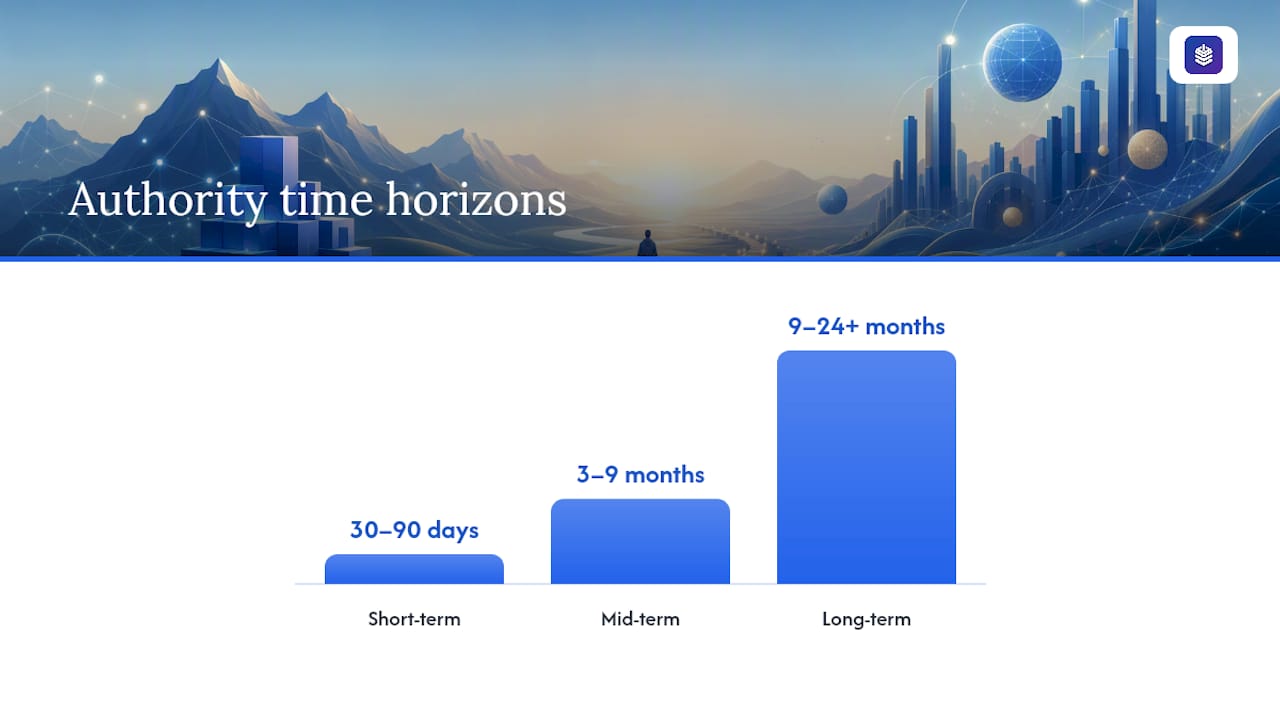
Short-term wins (30–90 days):
- Fix technical issues that suppress crawling and indexation: canonical errors, redirect chains, and orphaned pages.
- Consolidate duplicate or thin content through 301 redirects or canonical tags to concentrate link equity.
- Audit internal links: identify high-authority pages that don't link to related cluster content and add contextual links.
- Convert unlinked brand mentions to editorial links through outreach.
Mid-term work (3–9 months):
- Publish a data-led research asset — an original survey, benchmark report, or dataset — and run targeted editorial outreach. Research assets attract editorial links from journalists and bloggers who cite primary data.
- Build topical hub pages that consolidate your cluster content and link out to supporting articles. A hub-and-spoke structure helps both
siteAuthorityand page discovery. - Launch a digital PR campaign tied to a newsworthy angle in your niche. A single placement in a high-DR publication can move referring domain diversity more than dozens of lower-quality links.
Long-term programs (9–24+ months):
- Build consistent topical depth across your core subject areas. Google rewards sites that cover a topic comprehensively, not just broadly.
- Develop partnerships that generate sustained editorial links and branded search — co-authored research, industry roundups, and expert contributor programs.
- For ecommerce specifically, restructure category and product page internal linking so authority flows from your blog cluster to your commercial pages. A Shopify store that ranks its ecommerce blog posts effectively uses its content authority to lift category page rankings.
Pro Tip: When budgets are constrained, prioritize a data-led content asset over a broad link-building campaign. One well-researched piece with targeted outreach typically generates more high-quality referring domains than 20 generic guest posts, and the links tend to be topically relevant.
Similarweb's framework reinforces this: internal linking architecture matters more than many teams assume. A shallow, flat site leaks authority, while a hub-and-spoke topical structure helps siteAuthority and page discovery simultaneously.
How long authority improvements take to show up in traffic
Set realistic timelines before you start, or you'll misread early results and abandon programs that are working.
- 2–3 months: Technical fixes (canonicals, redirects, internal links) and small link wins from mention conversion. You'll see crawl improvements in GSC and modest non-brand impression gains.
- 6–12 months: Research assets and PR campaigns begin producing referring domain diversity. Non-brand clicks and ranking breadth grow measurably. Vendor authority scores typically move in this window.
- 12+ months: Brand-level authority gains compound. Branded search velocity rises. The site begins ranking for adjacent queries it hasn't explicitly targeted, which is the clearest sign that
siteAuthorityis working in your favor.
Leading indicators to watch before traffic moves:
- Non-brand impressions rising in GSC (precedes click growth by 4–8 weeks).
- Ranking breadth expanding into positions 11–20 for cluster-adjacent queries.
- New editorial referring domains from topically relevant publications.
- Branded search volume trending upward in Google Trends.
Canonicalization and indexation issues can extend the lag between earning a link and seeing traffic. If a linked page has a canonical pointing elsewhere, or isn't indexed, the equity doesn't flow. Fix those before attributing slow results to the authority program itself. For a longer-term view on why this investment pays off, organic SEO's compounding returns make authority-building one of the highest-ROI channels over a 12–24 month horizon.
Common pitfalls that waste time and risk penalties
The most common authority mistake is treating the DA number as the goal. Here's what that looks like in practice, and how to avoid it.
Mistakes that stall programs:
- DA obsession: chasing the score rather than the underlying signals. A DA increase with no non-brand traffic growth is a vanity win.
- Link quantity over quality: 50 links from irrelevant directories move DA less than 3 editorial links from topically relevant publications, and the directories carry penalty risk.
- Buying links: Google's link spam policies are enforced algorithmically and through manual review. Purchased links that look editorial are a liability, not an asset.
- Ignoring page-level relevance: a high-authority domain can't rescue a page that doesn't match search intent. Authority sets the ceiling; on-page relevance determines whether you reach it.
- Neglecting technical SEO while chasing links: links earned to pages with crawl errors, thin content, or poor Core Web Vitals don't produce the ranking lift you'd expect.
Red-flag checklist for authority audits:
- Sudden DA/DR spike without a corresponding increase in referral traffic or GSC impressions.
- High share of nofollow or UGC links in your backlink profile.
- Referring domains concentrated in irrelevant topical categories.
- Referral traffic sessions with high bounce rates and low engagement (signals low-quality link sources).
- Link velocity spikes that don't align with any content or PR activity.
Quick remediation: triage low-quality links with a disavow file for the most egregious cases, shift outreach budget toward editorial placements in topically relevant publications, and reallocate content resources to depth over volume.
Pro Tip: Before any link-building campaign, check whether your target pages have indexation issues, weak internal linking, or thin content. A link to a poorly optimized page underperforms by a wide margin. Fix the page first, then earn the link.
For a practical audit starting point, the on-page SEO mistakes ecommerce blogs must fix checklist covers the page-level issues that most commonly suppress authority gains.
Your next 10 steps to improve authority and organic reach
Work through these in order. The first five are high-impact early wins; the last five are compounding investments.
- Audit indexation and canonicals (2–4 hours): pull GSC's Coverage report and fix any canonical errors or redirect chains suppressing page discovery.
- Map your topical clusters (3–5 hours): identify your core topics and list every published page per cluster. Flag gaps and orphaned pages.
- Fix internal linking (4–8 hours): add contextual links from high-authority pages to cluster content that lacks inbound internal links.
- Find unlinked brand mentions (2–3 hours): use a tool like Ahrefs Content Explorer or Google Alerts to find mentions without links and send outreach to convert them.
- Benchmark authority against SERP competitors (1–2 hours): pull DA/DR for the top 5 ranking competitors on your priority queries. Identify the authority gap and set a realistic 12-month target.
- Plan a data-led content asset (1–2 weeks to produce): identify a question in your niche that lacks primary data, survey your audience or analyze your own data, and publish a citable research piece.
- Build or refresh a topical hub page (1–2 days): create a pillar page for your primary topic cluster that links to all supporting articles and earns internal links from them in return.
- Run a digital PR outreach campaign (ongoing, 4–6 weeks per cycle): pitch your research asset or a newsworthy angle to journalists and bloggers in your niche. Track new referring domains in your vendor tool.
- Set up a monthly authority dashboard (2–3 hours to build): combine GSC non-brand clicks, ranking breadth, referring domain count, and branded search trends in a single view.
- Schedule a quarterly content refresh (ongoing): identify posts ranking in positions 5–15 for high-value queries and update them with new data, internal links, and improved on-page elements.
Steps 1–5 can realistically be completed within the first 30 days. Steps 6–10 are the compounding work that builds authority over 6–18 months. For a broader view of how content strategy and SEO align to produce these gains, the coordination between editorial calendars and authority programs is what separates one-off wins from sustained organic growth.
The part most authority guides skip
Most authority guides tell you to "earn high-quality links" and leave it there. What they skip is the workflow that connects authority metrics to actual editorial decisions.
The way to use authority scores is as a triage tool, not a target. Pull your GSC non-brand data first. Find the queries where you have impressions but low clicks, or rankings in positions 8–15 that haven't moved in 90 days. Those are your authority-constrained pages. Then check the referring domain profile for those specific pages, not the domain overall. A page with zero referring domains on a DA 40 site is still a page with zero referring domains.
From there, the workflow is straightforward: identify the content gap, produce a research-backed asset that earns links to that cluster, and measure referring domain growth alongside non-brand clicks for those pages specifically. That's how authority translates into traffic you can actually attribute.
For Shopify store owners, this workflow is harder to run without the right tools. Blockpress gives you live SEO scoring, internal-link suggestions, and article health audits directly inside your Shopify editor, so you can see which blog posts are underperforming and where internal link equity isn't flowing to your commercial pages. The author bio pages Blockpress generates also contribute to the E-E-A-T signals that support authority at the content level, not just the link level.
Authority is a program output. The teams that move it fastest are the ones who treat it as a measurement discipline, not a link-count exercise.
Blockpress makes authority-building work inside Shopify
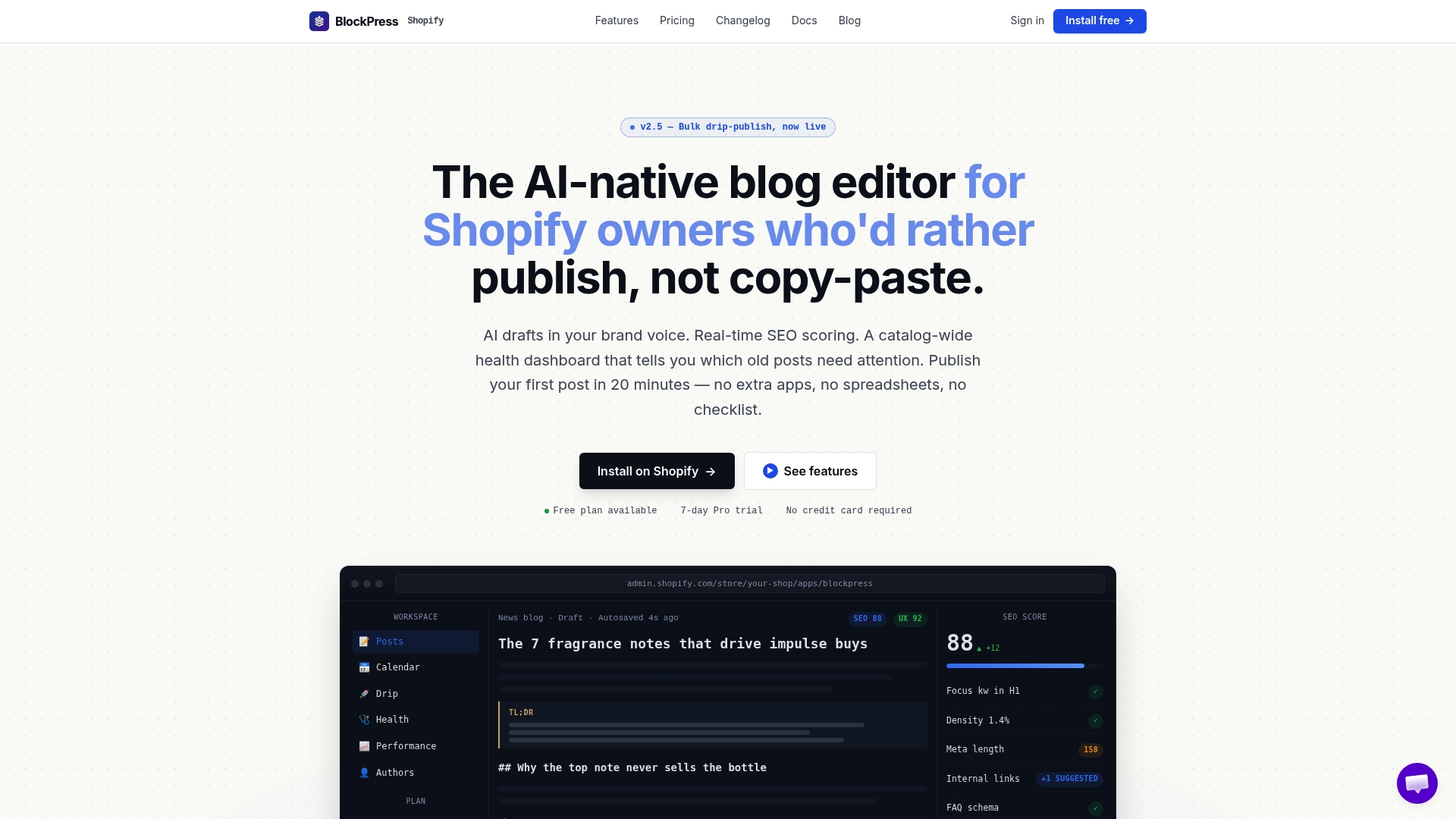
Running an authority program from Shopify's default blog editor means juggling three or four separate apps for keyword research, SEO scoring, internal linking, and analytics. Blockpress replaces all of that with a single AI-native editor built directly into your store.
With Blockpress, you get real Google keyword data, live SEO and UX scoring, AI-generated article drafts in your brand voice, internal-link suggestions, article health audits, per-article performance analytics, and author bio pages — without leaving Shopify. The features built into Blockpress are specifically designed to support the kind of topical depth and on-page quality that moves both vendor authority scores and Google's internal site-level signals.
If you're ready to turn your Shopify blog into an authority-building asset, start with Blockpress.
Sources
- The Most Important Google Ranking Factors for 2026 | WordStream
- Website Authority: How It Works and How to Improve It | Similarweb
- Domain authority: What is it and how is it calculated - Search Engine Journal
- Authoritative links and ranking - Moz blog
FAQ
Does domain authority directly affect Google rankings?
No. Google does not use Moz DA or any third-party authority score in its ranking algorithm. Google uses its own internal site-level signals, including the siteAuthority attribute identified in the 2024 Content Warehouse leak.
Can a low-DA site outrank a high-DA site?
Yes, regularly. Page-level relevance, topical match, and user engagement can outweigh domain-level authority for specific queries. Moz's 2021 correlation study found page-level link counts are the strongest predictor of ranking in their dataset.
Is a DA score of 20 considered good?
It depends entirely on your competitive set. A DA of 20 is competitive in low-authority niches but weak against established publishers. Benchmark your score against the top 5 ranking competitors for your priority queries, not against a round-number target.
How do you improve site authority?
Focus on the underlying signals: earn editorial backlinks from topically relevant publications, build topical depth through interconnected cluster content, improve internal linking architecture, and grow branded search demand. Vendor scores follow those inputs; chasing the score directly rarely works.
What is the 80/20 rule in SEO?
In SEO, the principle generally holds that a small share of pages and links drive the majority of organic traffic. For authority programs, this means a handful of high-quality editorial links from relevant, high-DR publications typically produce more ranking impact than a large volume of low-quality links.