
TL;DR:
- SEO-driven product positioning aligns marketing messaging with SEO infrastructure, enhancing product visibility in search and AI results. Implementing structured data, consistent language, and early infrastructure development boosts rankings, click-through rates, and AI recognition. This approach focuses on clear, repeatable claims that unify all content and improve discoverability and conversions.
SEO-driven product positioning is the practice of combining product marketing strategy with SEO execution to make your products more visible, persuasive, and discoverable in both traditional search and AI-powered results. The standard industry term for the underlying discipline is "product positioning," but the SEO-driven variant goes further: it embeds your product's core message directly into your technical SEO infrastructure. Well-optimized product pages convert 3.2x better, and ecommerce sites lose roughly $89,000 yearly from poor product discoverability. For ecommerce owners and digital marketers, this is not a branding exercise. It is a revenue decision.
What is SEO-driven product positioning and how does it work?
SEO-driven product positioning works by aligning three layers: your product's marketing message, your on-page SEO infrastructure, and your presence in AI-driven search results. Each layer reinforces the others. When they are out of sync, you rank for the wrong terms, attract the wrong buyers, or get ignored by AI models entirely.

The first layer is messaging alignment. Your product copy must reflect how real buyers search, not how your manufacturer describes the item. Merging product marketing and SEO into a single function yields the best results by aligning messaging with distribution across all search surfaces, including AI. That means your product titles, descriptions, and meta content all speak the same language as your target buyer's search query.
The second layer is technical SEO infrastructure. Treat product pages as SEO infrastructure, not isolated content pieces. This includes scalable structured data templates, internal linking to distribute authority across your catalog, and content depth that signals topical expertise to Google. Product pages on Google's first page capture 71% of clicks, while the second page captures only 5.7%. The gap between page one and page two is not a ranking gap. It is a revenue gap.
The third layer is AI search optimization. AI models rely on an information ecosystem that includes consistent messaging across product pages, reviews, and partner content to position products effectively in AI-generated answers. Consistent language matters more than keyword volume for AI visibility. Ecommerce stores that optimize for both traditional search and AI discovery see 127% more organic traffic than those focusing solely on keyword rankings.
Pro Tip: Build what practitioners call "positioning pillars": authentic, defensible product claims that run consistently from your product page through your blog content, FAQ schema, and review responses. These pillars give both search engines and AI models a clear, repeatable signal about what your product does and who it serves.
What are effective product positioning techniques for SEO?
The most effective product positioning techniques combine unique copy, structured data, and internal linking into a repeatable system. Here is how each technique works in practice.
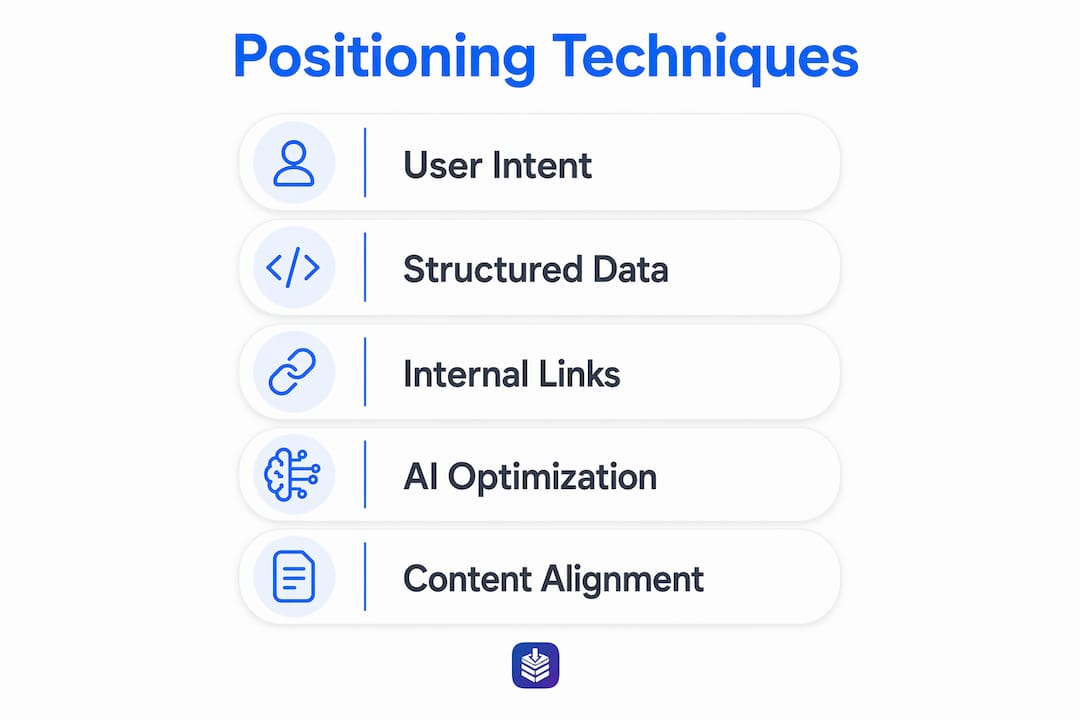
Write copy based on user intent, not manufacturer specs
Using manufacturer-provided boilerplate text leads to thin content penalties and exclusion from AI answers. Instead, write descriptions that answer the specific question a buyer types into Google. A buyer searching "waterproof hiking boots for wide feet" wants to know fit, waterproofing method, and terrain suitability. Your copy should answer all three, in plain language, before they scroll.
Use structured data to earn rich results
Structured data is not a direct ranking signal, but it enables rich results that increase click-through rate and eligibility across multiple search surfaces. Accurate product schema with price, availability, and aggregate ratings directly influences user engagement. FAQ schema placed on product pages also feeds AI answer boxes, giving your positioning language a path into AI-generated responses.
Build internal links with purpose
Internal linking distributes authority from high-traffic pages to product pages that need ranking support. Link from blog posts to relevant product pages, from category pages to subcategories, and from comparison content to individual product listings. This structure tells Google which pages matter most in your catalog.
The table below summarizes the core positioning techniques and their primary SEO benefit.
| Technique | Primary SEO benefit |
|---|---|
| User-intent product copy | Matches buyer language, reduces bounce rate |
| Product schema markup | Enables rich results, boosts click-through rate |
| FAQ schema on product pages | Feeds AI answer boxes with your messaging |
| Internal linking from blog content | Distributes authority to product pages |
| Consistent messaging across reviews and partners | Strengthens AI information ecosystem signals |
Pro Tip: Check your product page optimization against both traditional SEO criteria and AI readability. If your core product claim is buried in the fifth paragraph, AI models will likely miss it entirely.
How to implement an SEO-driven product positioning strategy
A phased approach works best. Rushing SEO infrastructure into a product launch window is one of the most common and costly mistakes in ecommerce marketing.
-
Start SEO infrastructure 3–6 months before launch. Building SEO infrastructure 3–6 months pre-launch allows time for indexing and authority development. High-intent, bottom-funnel content captures immediate demand during the launch window. If you wait until launch day to publish product pages, you are starting from zero when you need traction most.
-
Align your product marketing and SEO teams on messaging. Your product marketer defines the core claim. Your SEO practitioner decides how to distribute it across search surfaces. When these two roles work from the same brief, your product pages, blog posts, and schema all reinforce the same message. Learn how content strategy aligns with SEO to make this workflow repeatable.
-
Prioritize keywords by commercial intent, not search volume alone. A keyword with 500 monthly searches and clear buying intent outperforms a 10,000-search informational term for product pages. Map keywords to the buyer's stage: awareness, consideration, and decision.
-
Build a content ecosystem around each product. A single product page rarely ranks alone. Support it with a buying guide, a comparison post, a use-case article, and an FAQ page. This cluster structure signals topical authority and gives internal linking a natural structure. See how blog content supports product launches for a practical framework.
-
Measure with the right metrics. Track organic traffic to product pages, keyword rankings for commercial-intent terms, and conversion rate from organic sessions. Rankings alone tell you nothing about revenue impact.
Pro Tip: Use your keyword research to write your product's positioning statement before you write a single word of copy. If you cannot express your product's core claim in one sentence that matches a real search query, your positioning is not specific enough.
What challenges do ecommerce businesses face with SEO-driven positioning?
The most common pitfall is thin content at scale. When you run thousands of SKUs, templated product feeds and manufacturer descriptions feel like the only practical option. They are not. Thin, duplicate content suppresses rankings and disqualifies pages from AI answers. Even small improvements to your top 20% of product pages by traffic potential will outperform a generic site-wide template refresh.
Other challenges include:
- Inconsistent messaging across channels. If your product page says "ultra-light," your reviews say "lightweight," and your blog says "featherweight," AI models receive conflicting signals. Pick one term and use it everywhere, including in your review response templates.
- Faceted navigation and crawl budget waste. Filter pages created by size, color, and price combinations can generate thousands of near-duplicate URLs. Use canonical tags and robots directives to focus crawl budget on pages that carry real positioning value.
- Schema accuracy decay. Product prices and availability change. Outdated schema that shows an old price or "in stock" for a discontinued item damages trust and can trigger Google's rich result eligibility review.
- Core Web Vitals conflicts with content depth. Longer, richer product pages can slow load times. Prioritize lazy loading for images and defer non-critical scripts to keep both content depth and page speed intact.
Pro Tip: Audit your AI content optimization alongside your traditional SEO audit. AI models and Google crawlers both reward clarity and consistency, but they evaluate different signals. Running both audits together saves time and surfaces gaps you would otherwise miss.
Key Takeaways
SEO-driven product positioning works because it aligns your product's core message with the exact signals that search engines and AI models use to rank and recommend products.
| Point | Details |
|---|---|
| Messaging and SEO must align | Your product copy, schema, and blog content should all express the same core claim. |
| Build infrastructure before launch | Start SEO work 3–6 months early to allow indexing and authority to develop. |
| Structured data drives rich results | Accurate product and FAQ schema increases click-through rate and AI answer eligibility. |
| Thin content kills discoverability | Manufacturer boilerplate leads to penalties and exclusion from AI-generated answers. |
| Consistency beats keyword volume | Repeating the same positioning language across all surfaces matters more than keyword density. |
Why I think most ecommerce teams are solving this problem backwards
Most ecommerce teams I have seen build their product pages first and then ask SEO to "fix" them afterward. That sequence produces mediocre results every time. The positioning decision, the specific claim you want to own in a buyer's mind, has to come before the copy, before the schema, and before the content plan. When it does, everything downstream gets easier. Your keyword research has a clear filter. Your blog topics write themselves. Your internal linking has an obvious logic.
The shift toward AI-powered search makes this even more urgent. AI models do not just read your product page. They read your reviews, your partner mentions, and your blog. If those sources tell different stories, your product gets a blurry representation in AI answers, or no representation at all. Specificity is the only defense. The brands that will win in AI-driven discovery are the ones with a single, clear, repeated claim that shows up everywhere. That is not a content volume problem. It is a positioning discipline problem. How Google ranks ecommerce blog posts in 2026 reflects this shift: authority and consistency now outweigh raw content output.
— Rodney
Blockpress helps Shopify stores build SEO-driven content at scale
Executing an SEO-driven product positioning strategy requires consistent, well-optimized content published at a pace most Shopify merchants cannot maintain with a basic blog editor.
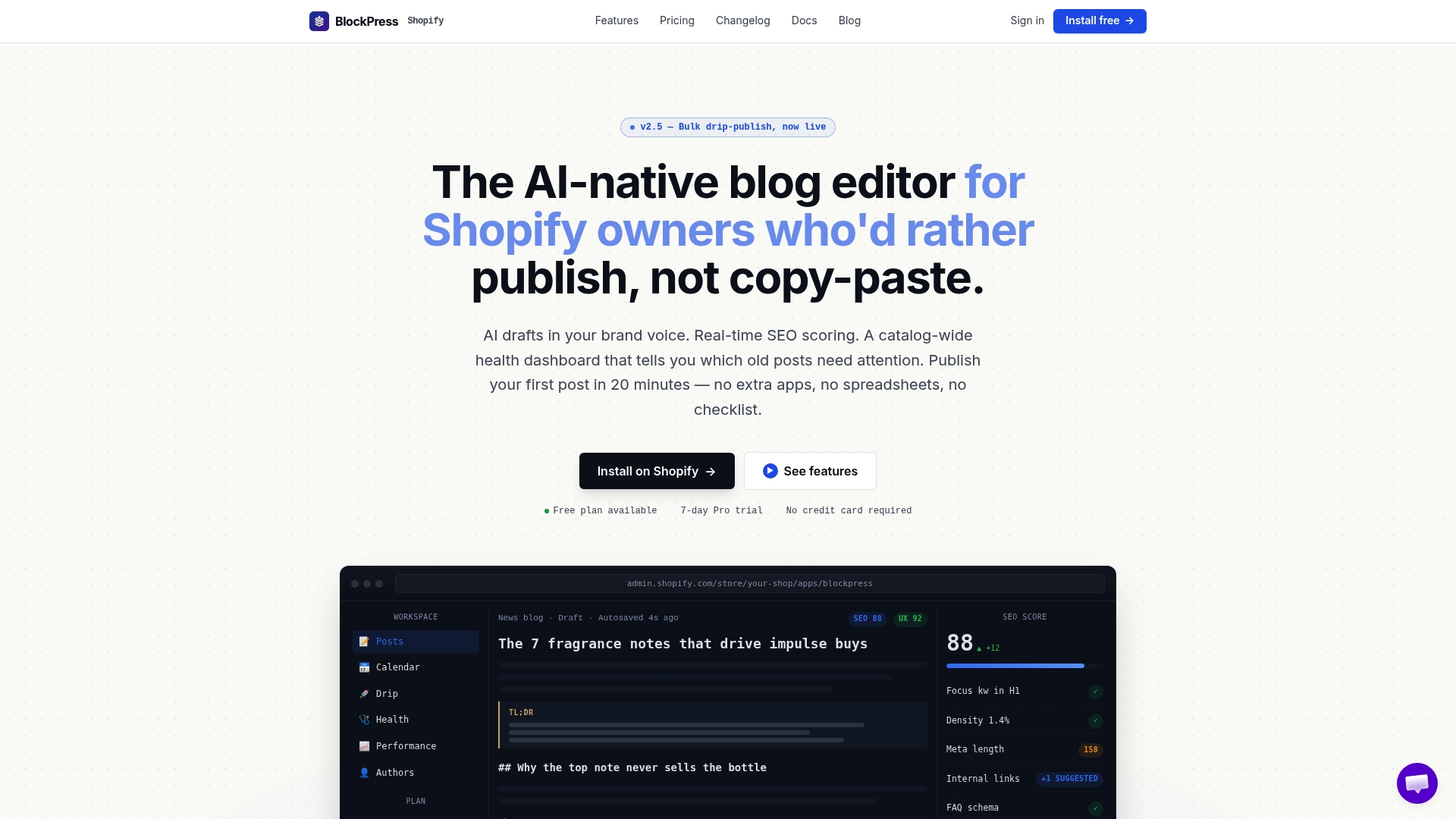
Blockpress is an AI-native blog editor built directly into Shopify. It gives you real Google keyword data, live SEO and UX scoring, AI-generated article drafts, and per-article performance analytics, all without leaving your store. You can build the content ecosystem your product pages need, from buying guides to comparison posts, and publish on a schedule that matches your product launch calendar. Merchants who need to scale unique, optimized content without hiring a full content team use Blockpress to close that gap. See the full Blockpress feature set or check current pricing to find the right plan for your store.
FAQ
What is SEO-driven product positioning?
SEO-driven product positioning is the practice of aligning your product's marketing message with SEO infrastructure so that your product ranks well, converts visitors, and appears in AI-generated search answers.
How does product positioning differ from standard SEO?
Standard SEO focuses on rankings and traffic. Product positioning adds a layer of messaging strategy, defining the specific claim your product owns in a buyer's mind and embedding that claim across every SEO touchpoint.
Why does consistent messaging matter for AI search?
AI models evaluate an information ecosystem that includes product pages, reviews, and partner content. Inconsistent language across those sources produces a blurry or absent product representation in AI-generated answers.
When should I start SEO work for a new product launch?
Start building SEO infrastructure 3–6 months before your launch date. This gives Google time to index your pages and develop enough authority to capture demand when the product goes live.
What is a positioning pillar in SEO?
A positioning pillar is an authentic, defensible product claim that runs consistently from your product page through your blog content, FAQ schema, and review responses, giving search engines and AI models a clear, repeatable signal about your product.