
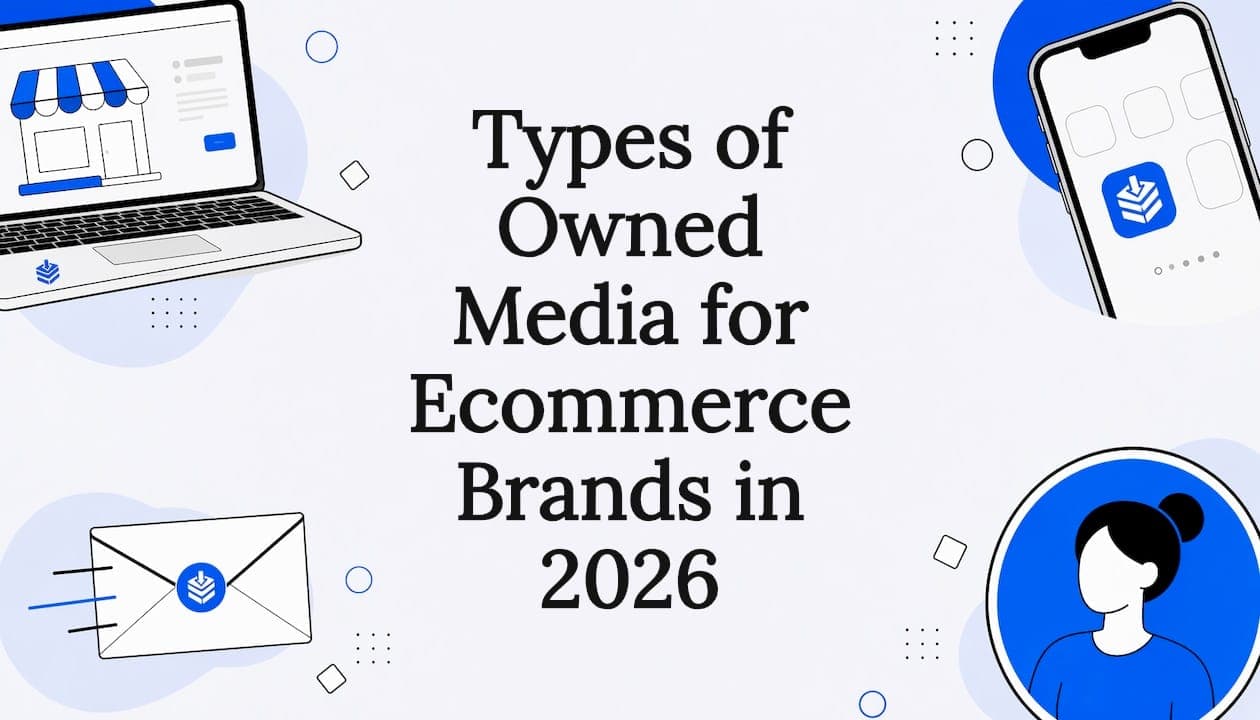
What are the main types of owned media for ecommerce brands?
Ecommerce brands have more control over their marketing than most realize. Your owned media channels are the channels and content assets you fully control, with no platform deciding your reach or charging you per impression. Here is the core list:
- Your website and product pages. The foundation of every ecommerce brand's owned presence. Product pages are not just sales tools; they are owned assets you can continuously test, update, and optimize for both search and conversion.
- Your blog. Long-form content that builds organic traffic over time, answers buyer questions, and supports SEO without ongoing ad spend.
- Email newsletters and subscriber lists. The only channel where you own the audience outright. No algorithm, no feed, no platform fee between you and your subscribers.
- Social media profiles. Your brand accounts on Instagram, TikTok, Pinterest, and similar platforms. You control the messaging and content, even though the platform controls distribution.
- Mobile apps. For brands with repeat buyers, a branded app creates a direct, persistent channel for offers, loyalty rewards, and push notifications.
- Loyalty and rewards programs. Owned engagement infrastructure that keeps customers returning without relying on paid retargeting.
- Community spaces. Brand-owned forums, Facebook Groups, Discord servers, or on-site communities that create continuity between purchases.
Each of these channels compounds in value over time. Unlike a paid ad that stops the moment you cut the budget, a well-optimized product page or a growing email list keeps working.
How owned media differs from paid and earned media
The marketing industry organizes media into three categories: owned, paid, and earned. A fourth category, shared media, is sometimes added to capture social platforms specifically.
Owned media is anything your brand creates and controls directly. You set the message, the format, and the timing. Cost is front-loaded (content creation, development) rather than ongoing per-click.
Paid media is any channel where you pay for placement or reach. Google Shopping ads, Meta retargeting, influencer sponsorships, and display advertising all fall here. Reach is immediate but stops the moment spend stops.
Earned media is coverage or mentions you did not pay for and did not create yourself. Press features, organic reviews, word-of-mouth referrals, and user-generated content are all earned. It is the most credible form of media, but you cannot manufacture it on demand.
Shared media sits between owned and earned. Your brand posts on Instagram, but Instagram controls who sees it. You own the account; you rent the audience.
| Media type | Control | Cost model | Longevity |
|---|---|---|---|
| Owned | Full | Upfront creation cost | Appreciates over time |
| Paid | None | Ongoing per-click or impression | Stops when spend stops |
| Earned | None | No direct cost | Unpredictable |
| Shared | Partial | Free to post, algorithm-dependent | Platform-dependent |
Owned media assets appreciate over time without ongoing direct cost, unlike paid media. That structural difference is what makes owned channels worth building early, even when paid channels deliver faster initial results.
Why owned media is worth the investment for ecommerce brands
The core argument for owned media is simple: rising paid media costs make it unsustainable to rely on rented audiences forever. Industry experts recommend a media split that favors owned and earned channels to reduce exposure to platform volatility and escalating cost-per-click rates.
Beyond cost, owned media builds something paid media cannot: a direct relationship with your customer. Customers acquired through branded search or organic channels show better long-term value than cold paid traffic. They already trust your brand before they buy.
Here is what that means practically for ecommerce brands:
- Lower customer acquisition cost over time. An email list or a ranking blog post keeps generating revenue without incremental spend.
- Better conversion rates. Visitors who arrive through organic search or email are warmer than cold ad traffic.
- Reduced return rates. Optimized product pages with detailed information and social proof reduce buyer uncertainty, which directly cuts returns.
- Compounding SEO growth. Each new blog post or updated product page adds to your organic footprint. The effect builds month over month.
- Resilience against algorithm changes. When Meta changes its feed algorithm or Google updates its ad auction, brands with strong owned channels absorb the impact better.
- Post-purchase engagement. Email sequences, loyalty programs, and community spaces keep customers active between purchases, lifting lifetime value without paid retargeting.
Most ecommerce founders under-invest in owned media early, which drives up customer acquisition costs as they scale. Building owned assets from the start creates structural advantages that get harder for competitors to replicate.
1. Your website: the anchor of all owned media
Your website is the only channel where you control every element, from page speed to checkout flow to meta descriptions. For ecommerce brands, the website splits into two distinct owned assets: the storefront and the blog.

The storefront includes product pages, category pages, and the checkout. These pages are conversion assets first, but they are also SEO assets. A product page with detailed specifications, customer reviews, and structured data can rank for high-intent queries and convert at the same time.
Pro Tip: Treat every product page as a living document. Add customer questions as FAQ sections, update descriptions when you get new reviews, and test your calls to action regularly. Pages that get updated consistently tend to outperform static ones in both rankings and conversion.
Product pages as owned assets provide detailed information, social proof, and measurable data to continuously improve conversions and reduce returns. Conversion rate optimization and owned media management overlap directly here.
2. Your blog: the SEO engine for long-term traffic
A blog is the highest-leverage owned media channel for ecommerce brands that want organic traffic without paying for every click. Regularly updated pages with fresh data and expanded content rank higher than stagnant ones, which means your blog compounds in value the more you maintain it.
For Shopify stores specifically, the blog sits inside your store, meaning every post you publish builds domain authority that benefits your product pages too. A post ranking for "best running shoes for flat feet" lifts the authority of your running shoe category page.
The most effective ecommerce blog content answers real buyer questions at every stage of the funnel: comparison posts, how-to guides, ingredient or material explainers, and buying guides. These posts attract organic visitors who are already researching a purchase. To understand how Google ranks ecommerce blog posts in the current search environment, the signals have shifted toward content depth, freshness, and structured formatting.
3. Email newsletters: your highest-ROI owned channel
Email is the one channel where you own the audience completely. No feed algorithm, no platform policy change, no reach throttling. When someone subscribes to your list, you have a direct line to their inbox.

Email newsletters generate high return on ad spend, making them the most profitable owned media channel in ecommerce when properly executed. The key phrase is "properly executed." A list of 10,000 disengaged subscribers outperforms nothing. Segmentation, personalization, and consistent value delivery are what make email work.
For ecommerce brands, the most effective email sequences include:
- Welcome series that introduce the brand and set expectations
- Abandoned cart flows that recover revenue passively
- Post-purchase sequences that reduce buyer's remorse and encourage reviews
- Re-engagement campaigns for subscribers who have gone quiet
- Product launch announcements to your warmest audience before running paid ads
Building the list matters as much as sending to it. Lead magnets, exit-intent popups, and post-purchase signup prompts are all standard list-building tactics that cost little to implement.
4. Social media profiles: owned messaging on rented platforms
Social media profiles occupy an interesting middle ground. You own the account and control every post, but the platform controls who sees it. That makes social profiles a form of owned media with shared-media distribution constraints.
The practical implication for ecommerce brands: use social profiles to reinforce brand messaging and build community, but do not treat follower counts as a reliable owned asset. Followers are platform-dependent. Your goal on social should always be to funnel engaged followers into channels you fully own, primarily your email list.
Instagram, TikTok, and Pinterest each serve different ecommerce use cases. Instagram works well for lifestyle and product photography. TikTok drives discovery for brands with strong video content. Pinterest functions almost like a search engine for home goods, fashion, and food brands, with pins that drive traffic for months after posting.
5. Mobile apps: direct access for repeat buyers
A branded mobile app is an advanced owned media channel that makes sense once you have a loyal customer base. Apps give you push notification access, which is one of the most direct forms of communication available, and they create a persistent brand presence on your customer's phone.
The ROI case for apps is strongest in categories with high purchase frequency: consumables, apparel, beauty, and pet supplies. For a brand where customers buy once a year, the development and maintenance cost rarely justifies the investment.
Loyalty programs often live inside apps, tying rewards points, exclusive offers, and early access to a single owned channel. That combination of utility and exclusivity is what drives app adoption and retention.
6. Loyalty and rewards programs: retention infrastructure
Loyalty programs are owned media in the truest sense. You design the rules, control the rewards, and own all the data. Unlike a paid retargeting campaign that shows ads to past buyers, a loyalty program gives customers a reason to return on their own.
The most effective loyalty programs for ecommerce brands go beyond points for purchases. Tiered programs that reward engagement, referrals, and reviews create a feedback loop where your most loyal customers also become your most vocal advocates. That overlap between retention and earned media is one of the strongest compounding effects in ecommerce marketing.
7. Community spaces: keeping customers engaged between purchases
Community-owned spaces foster customer interaction and create continuity between purchases, which directly improves retention. A brand-owned forum, a private Facebook Group, or a Discord server gives customers a place to connect with each other and with your brand outside of a transaction.
The ecommerce brands that do this well tend to be in categories where customers have strong shared interests: fitness, outdoor gear, cooking, gaming, and pet care. The community becomes part of the product experience, not just a marketing channel.
Syndicating content on third-party platforms works best when it funnels audiences back into owned channels. A YouTube video, a Reddit post, or a TikTok that drives viewers to sign up for your newsletter converts rented attention into an owned subscriber relationship.
8. Podcasts and video series: long-form owned content
Branded podcasts and video series are owned media assets that build authority and audience over time. They work differently from blog posts because they create a habitual consumption pattern. Subscribers listen weekly or watch regularly, which builds a depth of brand familiarity that a single product page cannot replicate.
For ecommerce brands, the most practical formats are product education series, founder stories, and category-specific content that attracts your ideal buyer. A kitchenware brand running a cooking technique series attracts exactly the audience most likely to buy their products.
Pro Tip: Repurpose every podcast episode or video into at least three other owned media formats: a blog post transcript, an email newsletter summary, and social media clips. One piece of content becomes five touchpoints across your owned channels.
Modern owned media strategy for ecommerce brands in 2026
The strategic context for owned media has shifted in 2026. AI-driven search tools like ChatGPT, Perplexity, and Google's AI Overviews now surface content directly in answers, which means your owned content needs to be structured for AI citation, not just traditional search ranking.
Content with numbered steps, defined terms, comparison tables, and clear headings gets discovered by AI search tools more reliably than dense, unstructured prose. That is a formatting shift with real traffic implications for ecommerce blogs and product pages.
The foundational principle has not changed: build your owned media foundation before scaling paid traffic. Brands that run paid ads to a poorly optimized website or a thin product page are paying to expose their weaknesses. Fix the owned assets first, then amplify with paid.
Key strategic priorities for ecommerce brands right now:
- Audit your product pages for completeness, social proof, and structured data before running any paid campaigns.
- Treat your blog as infrastructure. Update existing posts with fresh statistics and expanded sections rather than only publishing new content. Fresh content ranks higher than stagnant pages.
- Segment your email list by purchase history and engagement level. Sending the same message to everyone leaves revenue on the table.
- Use analytics on every owned channel. Treat analytics as core infrastructure, not an afterthought. You cannot improve what you are not measuring.
- Connect owned and paid channels deliberately. Use paid ads to drive traffic to lead magnet landing pages that build your email list, not just to product pages.
Pro Tip: Syndicating content on platforms like LinkedIn or Medium can expand your reach, but always include a clear path back to your owned channel, whether that is a newsletter signup or a free resource download. Convert rented attention into owned subscribers.
For Shopify brands specifically, growing organic traffic through the blog is one of the highest-leverage owned media investments available. The blog sits inside your store, so every ranking post builds authority that benefits your product pages directly. Pairing that with AI-assisted content creation, as covered in guides on AI-drafted ecommerce posts, lets you publish at a pace that compounds faster.
For brands looking to build their owned media presence with technical SEO best practices, the 2026 environment rewards structured, well-maintained content over volume alone.
Blockpress helps you build your blog as a real owned media asset
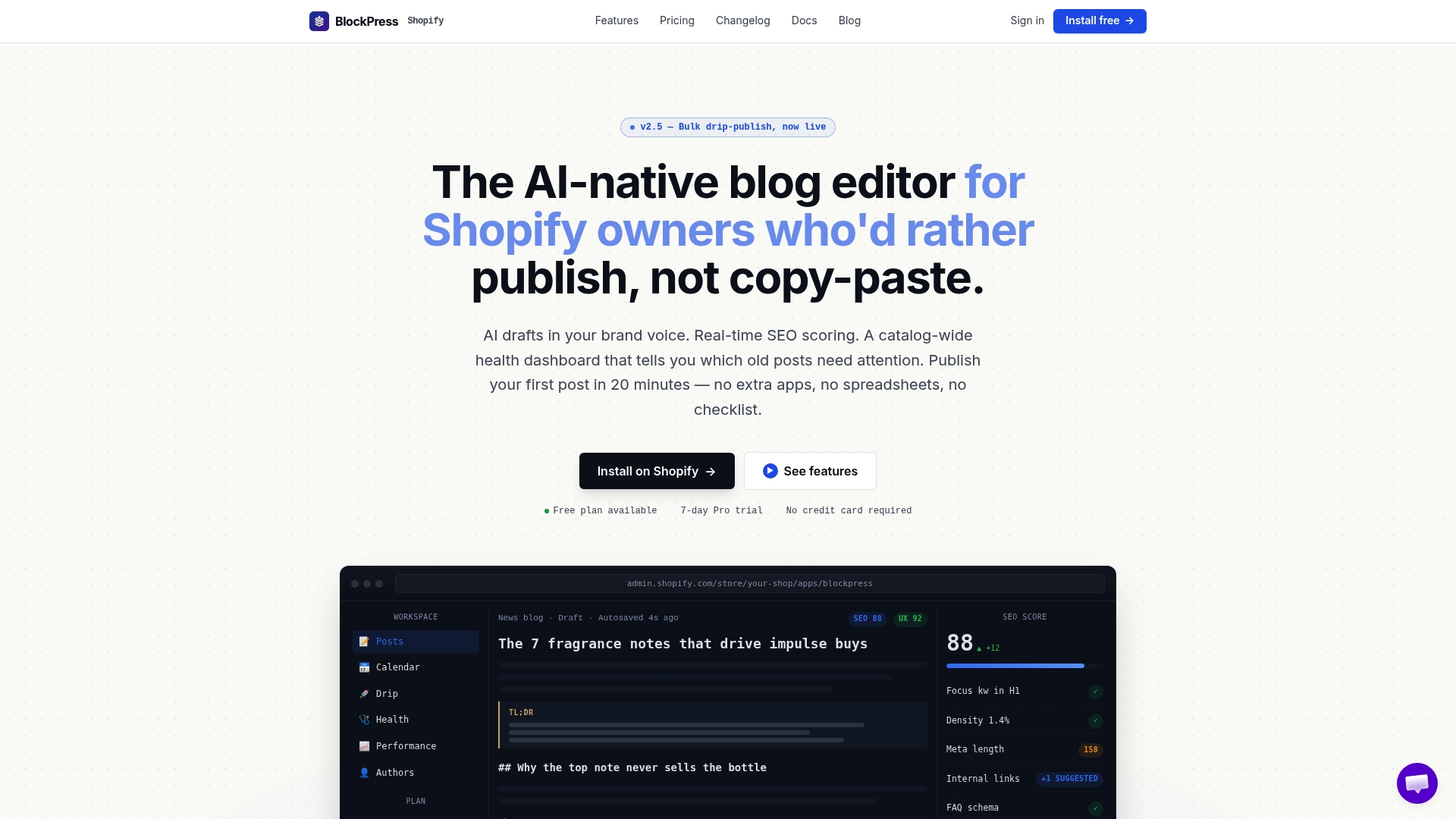
Your blog is one of the most powerful owned media channels you have, and most Shopify stores leave it severely underused. Blockpress is an AI-native blog editor built directly into Shopify, giving you real Google keyword data, live SEO and UX scoring, AI-generated article drafts, bulk drip-publishing, and per-article performance analytics, all without leaving your store.
Most merchants piece together three separate apps to get what Blockpress does natively. If you are serious about building owned media that compounds over time, start with Blockpress and turn your Shopify blog into a traffic and revenue asset.
Key Takeaways
Owned media channels are the only marketing assets that appreciate over time without ongoing direct cost, making them the most sustainable growth foundation for ecommerce brands.
| Point | Details |
|---|---|
| Email is your highest-ROI channel | Email newsletters generate the strongest return among owned media when properly segmented and executed. |
| Product pages are owned assets | Treat product pages as living documents with social proof and structured data to improve both rankings and conversions. |
| Build owned media before scaling paid | A solid SEO and email foundation reduces wasted ad spend and lowers customer acquisition cost over time. |
| Fresh content outranks stagnant pages | Regularly updated blog posts and product pages rank higher than pages left unchanged after initial publication. |
| Community spaces improve retention | Brand-owned communities create continuity between purchases and reduce the need for paid retargeting. |
FAQ
What are the main types of owned media?
Owned media includes websites, blogs, email newsletters, social media profiles, mobile apps, loyalty programs, and brand-owned community spaces. These are channels a brand fully controls, with no platform fee between the brand and its audience.
How does owned media differ from paid and earned media?
Owned media is created and controlled by the brand at an upfront content cost. Paid media requires ongoing spend for reach and stops working when the budget stops. Earned media is unpaid coverage from third parties, like press mentions or organic reviews.
What are the four types of media in marketing?
The four types are owned, paid, earned, and shared media. Owned is brand-controlled content; paid is purchased placement; earned is organic third-party coverage; shared is brand content on platforms where the algorithm controls distribution, like social media feeds.
Which owned media channel has the best ROI for ecommerce?
Email newsletters consistently deliver the highest return among owned media channels in ecommerce when properly executed, because the brand owns the audience list outright and pays no per-send platform fee.
How should ecommerce brands prioritize their owned media investment?
Start with your website and product pages, then build your email list, then invest in blog content for organic search. Mobile apps and community spaces make sense once you have a loyal, repeat-purchase customer base to justify the build cost.