
What is position tracking in SEO?
Position tracking is the systematic, ongoing measurement of where specific URLs rank in search engine results for a defined set of target keywords. You record those rankings regularly, over time, to build a longitudinal picture of your SEO visibility. That's the core of it.

What separates position tracking from a one-off manual rank check is continuity. A single snapshot tells you where you stand today. A tracked series tells you whether your last content update moved the needle, whether a Google algorithm update hit your site, and whether a competitor is closing the gap on your best keywords.
The key dimensions a solid tracking setup covers:
- Keyword rankings for specific URLs across your target keyword set
- SERP features such as featured snippets, People Also Ask boxes, and local packs
- Device variations, since desktop and mobile rankings often differ meaningfully
- Geographic location, because a page ranking #3 in Chicago may rank #11 in Houston
- Trend over time, so you can correlate rank changes with specific SEO actions
Why position tracking is essential for your SEO strategy
Rank is a leading indicator for organic traffic, which in turn predicts revenue. That chain is why position tracking sits at the foundation of any serious SEO program, not at the edges of it.

Think of it as a diagnostic dashboard. When you publish a new article, update a meta description, or earn a batch of backlinks, position tracking is what tells you whether those actions changed your rankings. Without that feedback loop, you're optimizing blind.
The click-through rate data makes the stakes concrete. Position 1 in organic search captures an average of 26.2% of clicks, while position 2 captures 15.5%. That 10.7-percentage-point gap represents real traffic, and it compounds across every keyword you're targeting.
Position 1 earns 26.2% of clicks. Position 2 earns 15.5%. Moving up a single spot on a high-volume keyword can double your traffic from that term.
Tracking also catches problems before they show up in your analytics. A ranking drop often precedes a traffic drop by days or even weeks. Catching it early gives you time to diagnose and respond rather than scramble after the fact.
Key reasons to build position tracking into your SEO workflow:
- Connects SEO actions directly to ranking outcomes, creating accountability in your process
- Surfaces ranking fluctuations before they become traffic losses
- Reveals which device or location segments are underperforming
- Tracks SERP feature wins and losses, not just organic blue-link positions
- Gives you data to justify SEO investment to stakeholders
How to set up and use position tracking effectively
Getting the setup right matters more than most guides admit. A poorly configured tracking project produces noisy, misleading data that leads to bad decisions.
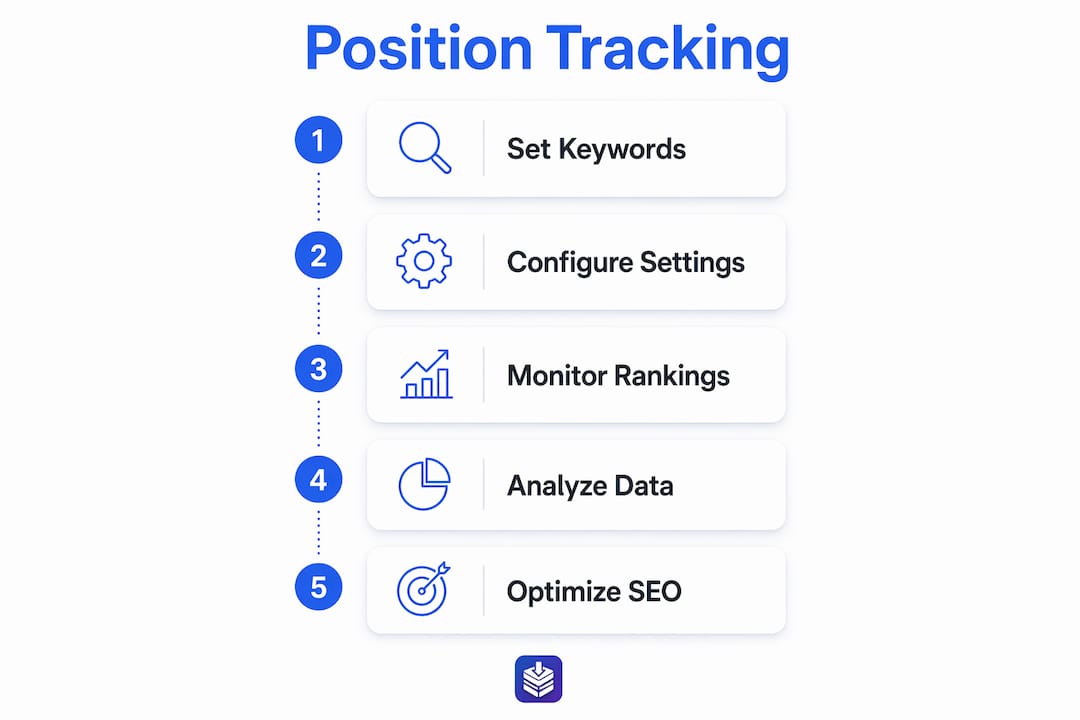
Start with your keyword set. Pull keywords from Google Search Console, your existing content, and keyword research tools. Segment them into groups: branded vs. non-branded, informational vs. transactional, high-priority vs. secondary. Grouping lets you spot patterns at the category level, not just the individual keyword level.
Configure location and device parameters. Desktop and mobile rankings diverge enough that tracking only one gives you an incomplete picture. If your business serves specific cities or regions, set up location-specific tracking for those markets. A national average ranking can mask strong local performance or hide a local gap you need to fix.
Set your tracking frequency. Daily tracking is the standard for active SEO campaigns because rankings can shift day to day after algorithm updates or competitor moves. Weekly tracking is acceptable for stable, lower-priority keyword sets, but you risk missing a significant change during the gap.
Best practices for running position tracking well:
- Track your top 50–100 keywords at minimum; expand as your content library grows
- Separate branded keywords from non-branded to avoid inflating your average position
- Set baseline snapshots before any major site change so you have a clean before/after comparison
- Don't react to single-day fluctuations; look for sustained movement over 5–7 days before acting
- Cross-reference rank changes with Google Search Console data to confirm the signal
Pro Tip: A rank movement is an effect, not a cause. When you see a position change, your first job is to correlate it with a site change, a competitor move, or a known algorithm update. That correlation is where the real SEO insight lives.
Who benefits most from position tracking?
Position tracking isn't a tool for one type of SEO professional. It fits into almost every role that touches organic search.
SEO analysts use it to measure the direct impact of technical fixes, on-page changes, and link-building campaigns. It's their primary feedback mechanism. Digital marketers rely on rank data to report campaign progress to clients or internal stakeholders and to allocate budget toward the channels and content types that are actually gaining ground. Content managers use it to identify which articles are slipping in rank and need a refresh versus which are holding steady.
For e-commerce operators, position tracking connects directly to revenue. A product category page dropping from position 3 to position 8 is a measurable revenue risk, and tracking catches it early. You can read more about how ecommerce product positioning intersects with rank data in the context of a full SEO strategy.
Common use cases across roles and industries:
- Monitoring progress after a site migration or redesign
- Measuring the impact of a content refresh or new article publication
- Identifying which pages were affected by a Google algorithm update
- Tracking competitor rank movements on shared keywords
- Auditing local SEO performance across multiple geographic markets
- Measuring SERP feature capture rates, such as featured snippet wins
SaaS companies, local service businesses, media publishers, and technology brands all use position tracking regularly. The common thread is any business where organic search drives meaningful traffic or leads.
How position tracking supports ongoing SEO growth
Trending rank data does something that a single-point measurement can't: it shows you the direction of your SEO program, not just its current state. When you can see that 15 of your top 30 keywords have moved up over the past 60 days, you have evidence that your strategy is working. When 10 of them are drifting down, you have a clear signal to investigate before the traffic impact hits.
Modern SEO tracking tools have expanded well beyond organic blue links. Platforms like Semrush and Ahrefs now track SERP features including featured snippets, People Also Ask results, and AI-generated overviews, reflecting how search results pages have evolved. Monitoring only your organic rank position while ignoring whether a featured snippet is pushing your result below the fold gives you an incomplete picture of your actual visibility.
Integrating rank data with traffic and conversion metrics is where position tracking pays its biggest dividends. A keyword where you rank #2 but see a low click-through rate signals a search intent mismatch or a weak title tag, not a ranking problem. That distinction changes what you do next entirely.
Growth benefits of consistent position tracking:
- Prioritizes your content calendar around keywords with the most ranking momentum
- Measures ROI on SEO spend by connecting rank improvements to traffic and revenue
- Identifies content decay early, before rankings fall off the first page
- Tracks the impact of on-page SEO changes at the keyword level
- Supports competitive analysis by revealing where competitors are gaining ground
Pro Tip: As AI-generated search results and SERP features take up more of the page in 2026, configure your tracking to include AI visibility and featured snippet monitoring alongside traditional organic positions. Tools that only report a rank number are giving you less than half the picture.
Key Takeaways
Position tracking gives you the longitudinal rank data you need to connect SEO actions to outcomes, catch problems early, and prioritize work that actually moves rankings.
| Point | Details |
|---|---|
| Core definition | Position tracking measures where specific URLs rank for target keywords over time, not just at a single moment. |
| CTR impact | Position 1 captures 26.2% of clicks vs. 15.5% at position 2, making rank movement directly tied to traffic volume. |
| Setup essentials | Configure tracking by keyword group, device type, and location to get accurate, actionable data. |
| Daily tracking standard | Daily frequency catches algorithm-driven fluctuations that weekly tracking misses entirely. |
| Beyond blue links | Track SERP features and AI visibility alongside organic rank to measure your full search presence. |
FAQ
What is position tracking in SEO?
Position tracking is the ongoing measurement of where specific web pages rank in search results for a defined set of keywords, recorded regularly to reveal trends and changes over time.
What does position mean in SEO?
Position refers to where a URL appears in search engine results for a given keyword. Position 1 is the top organic result, and higher positions capture significantly more clicks than lower ones.
What is the best approach to SEO tracking?
Daily tracking of segmented keyword groups, configured for both desktop and mobile and by target location, gives you the most complete and reliable picture of your SEO performance.
What are the core stages of an SEO program?
Most SEO programs move through research, on-page optimization, content creation, and ongoing monitoring. Position tracking belongs to that last stage and feeds back into all the others by showing what's working.
How does Blockpress help with position tracking?
Blockpress gives Shopify store owners real Google keyword data, live SEO scoring, and per-article performance analytics directly inside their blog editor, so you can connect content decisions to ranking outcomes without switching between tools.