
Start with one percent of your projected monthly gross sales, pick one content format you can publish consistently, and follow a six-step plan built around repurposing. That is the core of an affordable content marketing strategy for small businesses.
Here is the plan at a glance:
- Goal: Define one measurable outcome (leads, organic traffic, or email subscribers) before creating anything.
- Audience: Name your buyer specifically — not "women 25–45" but "Shopify store owners selling handmade goods under $100."
- Formats: Choose one or two formats you can sustain for 90 days (blog posts, short video, or email newsletter).
- Distribution: Prioritize SEO and email first; add organic social as a repurposing outlet, not a primary channel.
- Measurement: Track three KPIs weekly and review strategy monthly.
Budget anchor: Content marketing costs 62% less than traditional outbound and generates three times more leads, so even a modest spend goes far.
Key Takeaways
An affordable content marketing strategy works when you anchor your budget to projected sales, commit to one or two formats, repurpose every core asset, and measure three to four KPIs monthly.
| Point | Details |
|---|---|
| Budget anchor | Start at 10% of projected gross sales for total marketing; allocate content's share using the 70/20/10 model. |
| Timeline to results | Organic SEO gains appear in three to six months; paid channels produce results in days but stop when spending stops. |
| Repurpose first | One 1,200-word blog post can generate five to six derivatives across social, email, video, and product pages. |
| ROI target | A healthy content ROI is around 5:1; track CAC monthly and cut topics that show zero engagement after two months. |
| Cadence over volume | One consistent post per month beats four posts in January and none in March for both SEO and audience trust. |
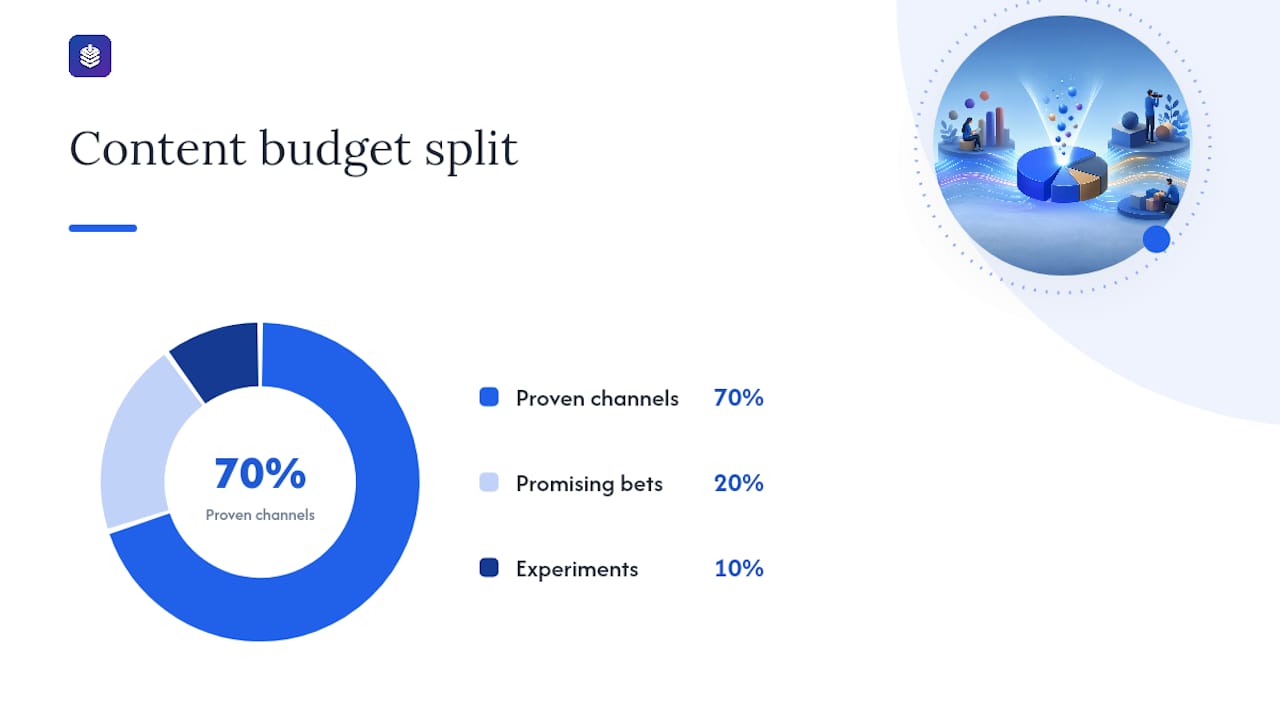
Table of Contents
- What does an affordable content marketing strategy look like step by step?
- How much should you spend on content marketing?
- How do you pick formats and build a repurposing system?
- What does a lean content production workflow look like?
- Which distribution channels give you the best return on a small budget?
- How do you measure content ROI without a big analytics budget?
- What tools and talent do you need to run this on a budget?
- What mistakes should you avoid, and what can you do this week?
- What actually works for small teams running content on a budget
- Sources
- FAQ
What does an affordable content marketing strategy look like step by step?
A six-step execution plan keeps small teams from spinning their wheels. Work through these in order, and you will have a functioning content engine within 90 days.
Step 1: Define one goal with a number attached. "Get more traffic" is not a goal. "Reach 2,000 monthly organic visitors by month six" is. Specific targets let you decide what to create and what to skip.
Step 2: Map your audience and your top five content topics. Interview three existing customers. Ask what questions they had before buying. Those answers become your first five blog or video topics, and they tend to rank because real buyer language matches real search queries.
Step 3: Create one core asset per month. A 1,200-word blog post, a 10-minute video, or a detailed email sequence — pick one format and produce it well. Quality beats volume at this stage. SEO-driven blog formats like comparison posts, how-to guides, and product roundups tend to earn organic traffic faster than general brand stories.
Step 4: Repurpose that asset into four to six derivatives. One blog post becomes three social captions, one email, one short-form video script, and one FAQ addition to a product page. This multiplies your distribution reach without multiplying your production cost.

Step 5: Distribute across two to three channels. Publish the core asset on your site for SEO. Send a version to your email list. Post derivatives on one or two social platforms where your buyers actually spend time.
Step 6: Measure, cut, and scale. At 30 days, check which pieces drove clicks or signups. At 90 days, double down on the format and topics that performed. At 180 days, you should see measurable organic traffic growth and a lower cost per lead than any paid channel you tested early on.
90-day and 180-day milestones
By day 90, expect your first three to five indexed posts, a growing email list (even 100 to 300 subscribers is a working asset), and baseline data on which topics resonate. Organic traffic gains are unlikely yet — SEO typically takes three to six months to show measurable traffic movement.
By day 180, organic traffic should be climbing, email open rates should be stabilizing, and your cost per lead from content should be tracking below what you paid for early paid tests.
For small teams, the minimum viable cadence is one core asset per month and four repurposed derivatives per week. A solo owner can handle this in four to six hours weekly. If that is too much, outsource writing first — it is the highest-leverage task to delegate.
How much should you spend on content marketing?
The budget anchor
Anchor your total marketing spend to 10% of projected gross sales, then split that budget using the 70/20/10 model: 70% to proven channels, 20% to promising bets, and 10% to experiments. Rebalance quarterly. Within that total marketing budget, content typically claims 7–15% for businesses treating it as a secondary channel, or 30–50% for those making organic content their primary growth driver.
Sample content budgets
Line-item percentages reflect practical content budget splits used by small businesses: creation absorbs the largest share because writing and production are where quality is won or lost.
ROI benchmark: A healthy content marketing ROI for small businesses runs around 5:1 — meaning $1 spent returns $5 in revenue. Email marketing often exceeds that benchmark. Organic SEO takes longer to pay off but compounds: expect measurable traffic gains in three to six months and full ROI realization closer to nine to twelve months.
Stretching a small budget
Paid channels produce results in days to weeks but stop the moment you stop spending. Organic content keeps working. That asymmetry is why organic investments compound while paid media accelerates short-term results — and why even a $300/month content budget, spent consistently, outperforms a $1,000/month paid campaign run for only two months.
Practical ways to stretch your budget: batch-produce content in two-day sprints, reuse templates across posts, negotiate milestone-based payments with freelancers, and use free-tier tools until you hit their limits.
How do you pick formats and build a repurposing system?
Format-decision checklist
Before committing to a format, answer these four questions:
- Resources: Can you produce this format consistently with your current time and budget?
- Audience preference: Where does your buyer actually consume content — search, inbox, or social feed?
- Shelf life: Does this format stay relevant for months (blog post, email sequence) or expire in days (trending social audio)?
- Measurability: Can you track traffic, opens, or conversions from this format directly?
If a format fails two or more of these checks, drop it. Blog posts and email newsletters pass all four for most small businesses. Short-form video passes three but requires more production time.
Repurposing matrix
| Core asset | Derivative | Channel | Effort |
|---|---|---|---|
| 1,200-word blog post | 3 social captions | Instagram / LinkedIn | Low |
| 1,200-word blog post | 1 email newsletter | Email list | Low |
| 1,200-word blog post | 1 short-form video script | TikTok / Reels | Medium |
| 1,200-word blog post | FAQ section on product page | Shopify store | Low |
| 1,200-word blog post | 1 Pinterest infographic | Medium |
Repurposing and user-generated content reduce per-piece cost and increase trust, and social UGC can lift conversions compared with polished ad creative. One well-researched blog post, distributed across five formats, costs a fraction of producing five separate pieces.
Sustainability rules
Publish at a cadence you can hold for six months without burning out. One post per month beats four posts in January and zero in March. Batch your content: write two or three posts in a single sitting, schedule them out, and protect that production block on your calendar.
Pro Tip: Run a quarterly "content sprint" — two focused days where you produce the next three months of core assets. Pair it with a scheduling tool and your calendar stays full without weekly scrambling.

What does a lean content production workflow look like?
A reliable workflow prevents the two most common small-business content failures: inconsistent publishing and articles that need expensive rewrites.
Brief template (minimum viable)
Every piece of content needs a brief before anyone writes a word. Include:
- Target keyword and its search intent (informational, commercial, transactional)
- Word count range and format (listicle, how-to, comparison)
- Three to five must-cover points drawn from customer questions or competitor gaps
- Internal link targets (two to three existing pages to link from the new post)
- Call to action (what should the reader do next?)
Writers know exactly what to produce; editors know exactly what to check.
Weekly and monthly calendar model
| Role | Weekly task | Monthly task |
|---|---|---|
| Owner / strategist | Approve briefs, review KPIs | Set topics for next month |
| Writer | Draft one core asset | Deliver all scheduled drafts |
| Editor | Review and approve draft | Audit published content for accuracy |
| Publisher | Schedule and distribute | Report on traffic and conversions |
One person can hold multiple roles. Many solo operators handle owner, editor, and publisher while outsourcing writing.
Outsourcing options and cost ranges
- Freelance writers (Upwork, Fiverr Pro): $50–$200 per 1,000-word article depending on niche expertise.
- Student writers (university journalism programs): $25–$75 per piece; good for straightforward how-to content.
- AI-assisted drafts: Near-zero marginal cost per draft, but require a mandatory human review step. Research found bias or incorrect facts in up to 38.6% of AI-generated outputs, so treat every AI draft as a starting point, not a finished article. AI drafting tools cut production time significantly when paired with a solid brief and a human fact-check pass.
Publish-ready checklist
- Target keyword in title, first paragraph, and one subheading
- Meta description written (150–160 characters)
- Two to three internal links added
- One external authority link included
- Images compressed and alt text written
- CTA present and linked
Which distribution channels give you the best return on a small budget?
Channel priority order
Not all channels are equal at the start. Rank them by return per dollar and effort:
- SEO + organic search — highest long-term ROI; compounds over time. Prioritize this first. Organic search can lower customer acquisition cost significantly versus paid advertising over time, with measurable gains appearing in three to six months.
- Email marketing — direct, owned, and high-converting. Build your list from day one. Even 500 engaged subscribers outperform 5,000 passive social followers for revenue impact.
- Content partnerships — guest posts, co-authored guides, and newsletter swaps cost nothing but time and earn backlinks plus new audiences. Scalable SEO processes often rely on exactly this kind of partnership-driven link building.
- Organic social — use it as a repurposing outlet, not a primary channel. Post derivatives of your core asset; do not create original social-only content until your blog and email are producing results.
- Selective paid tests — small, time-boxed experiments only.
Paid-test checklist
Before spending a dollar on paid promotion, confirm:
- Hypothesis: "Boosting this post will drive X email signups at under $Y per signup."
- Budget cap: Set a hard daily limit ($5–$20/day for a test).
- Measurement window: Run for seven to fourteen days only.
- Stop rule: If cost per result exceeds your target by 50%, pause immediately.
- Scale rule: If cost per result beats your target, increase budget by 50% increments.
Promotion checklist by channel
- SEO: Submit new URLs to Google Search Console; build two to three internal links from existing posts; share on relevant Reddit threads or Quora answers.
- Email: Send every new post to your list within 48 hours of publishing; include one clear CTA per email.
- Partnerships: Pitch one guest post or newsletter swap per month; blog content that supports product launches works especially well as a partnership hook.
- Organic social: Post three derivatives per core asset; engage with comments for the first two hours after posting.
How do you measure content ROI without a big analytics budget?
Core KPIs for small teams
Track these four metrics and nothing else in your first six months:
- Organic sessions — from Google Search Console (free).
- Leads from content — form submissions or email signups attributed to a specific post.
- Email conversion rate — percentage of subscribers who click through and take action.
- Content-assisted revenue — orders where the buyer read at least one piece of content before purchasing (trackable in Google Analytics 4 with basic UTM parameters).
For a deeper framework, content marketing KPIs break down by funnel stage and help you connect top-of-funnel traffic to bottom-of-funnel revenue.
CAC and content ROI formulas
Customer Acquisition Cost (CAC) from content: CAC = Total content spend ÷ New customers acquired from content
Example: $750/month content budget, 15 new customers from content = $50 CAC.
Content ROI: ROI = (Revenue from content – Content spend) ÷ Content spend × 100
Reporting cadence
- Monthly: Review organic sessions, new leads, and email conversion rate. Cut topics that drove zero engagement after two months.
- Quarterly: Review CAC, content ROI, and channel mix. Rebalance your 70/20/10 allocation based on what the data shows. Shopify-specific content ROI tracking adds product-page attribution that standard analytics miss.
What tools and talent do you need to run this on a budget?
Tool stack by price tier
For Shopify stores, Blockpress consolidates writing, SEO scoring, keyword research, and publishing into one editor, replacing the need for three separate tools. That consolidation alone can cut your tools budget by $50–$100/month.
Where to hire talent affordably
- Upwork and Fiverr Pro for freelance writers and designers; always assign a paid test task before a long-term contract.
- LinkedIn for part-time content strategists; many charge $500–$1,500/month for a few hours per week.
- Micro-influencers (1,000–10,000 followers) for UGC and authentic product content; negotiate product-for-post deals before paying cash. Authentic creator partnerships often outperform polished ad creative for conversion on a budget.
Cost-control tips
Pay freelancers in milestones (draft, revision, final) rather than upfront. Reuse brief templates across every piece to cut briefing time.
What mistakes should you avoid, and what can you do this week?
Common small-business content mistakes
- Inconsistent publishing: Posting four times in one week and then going silent for a month destroys SEO momentum and email engagement.
- No measurement: Publishing without tracking means you cannot tell what is working. Set up Google Search Console and UTM parameters before publishing your first post.
- Spreading too thin: Running a blog, YouTube channel, podcast, TikTok, and Instagram simultaneously with a $500/month budget produces mediocre content on every channel. Pick two.
- Skipping the brief: Writers without direction produce off-target drafts that cost more to fix than to rewrite.
- Chasing trends over intent: Trending topics drive spikes; buyer-intent topics drive revenue. Prioritize content scoring frameworks that weight commercial intent and search volume together.
10 quick wins you can implement this week
- Optimize your highest-traffic page — update the title tag, add one internal link, and improve the meta description.
- Send a re-engagement email to inactive subscribers with one useful tip and a clear CTA.
- Repurpose your best blog post into three social captions and schedule them for the next week.
- Add a FAQ section to your top product page using questions from customer emails.
- Set up Google Search Console if you have not already — it is free and shows exactly which queries bring visitors.
- Pitch one guest post to a complementary brand's blog or newsletter.
- Create a content brief template so your next piece takes half the time to assign.
- Add UTM parameters to every link in your next email so you can attribute revenue accurately.
- Compress your site images — page speed affects both SEO rankings and conversion rates.
- Publish one "best of" roundup post that links to your five most useful existing articles, boosting internal linking and time-on-site.
For local businesses: Wins 1, 4, and 5 move the needle fastest because local search intent is highly specific and under-optimized by most competitors.
For e-commerce / Shopify stores: Wins 3, 4, and 8 connect content directly to product pages and revenue attribution. Product-related blog content like comparison guides and buying guides convert especially well.
For B2B small businesses: Wins 2, 6, and 7 build pipeline through relationship-driven distribution and consistent outreach.
What actually works for small teams running content on a budget
The most common mistake small teams make is treating content marketing as a creative exercise rather than a distribution problem. You can write the best article in your niche and still get zero traffic if you publish it with no internal links, no email send, and no outreach. The plan in this guide is deliberately distribution-first: create one strong asset, then spend as much time distributing it as you spent writing it.
The 70/20/10 budget model is worth protecting even when cash is tight. Quarterly rebalancing keeps the model honest without requiring a full strategy overhaul.
For Shopify merchants specifically, the gap between a default blog editor and a proper content workflow is where most organic growth gets lost. Tools like Blockpress close that gap by combining AI-assisted drafting, live SEO scoring, keyword data, and bulk publishing inside a single Shopify-native editor — which means less context-switching and more time spent on the content itself.
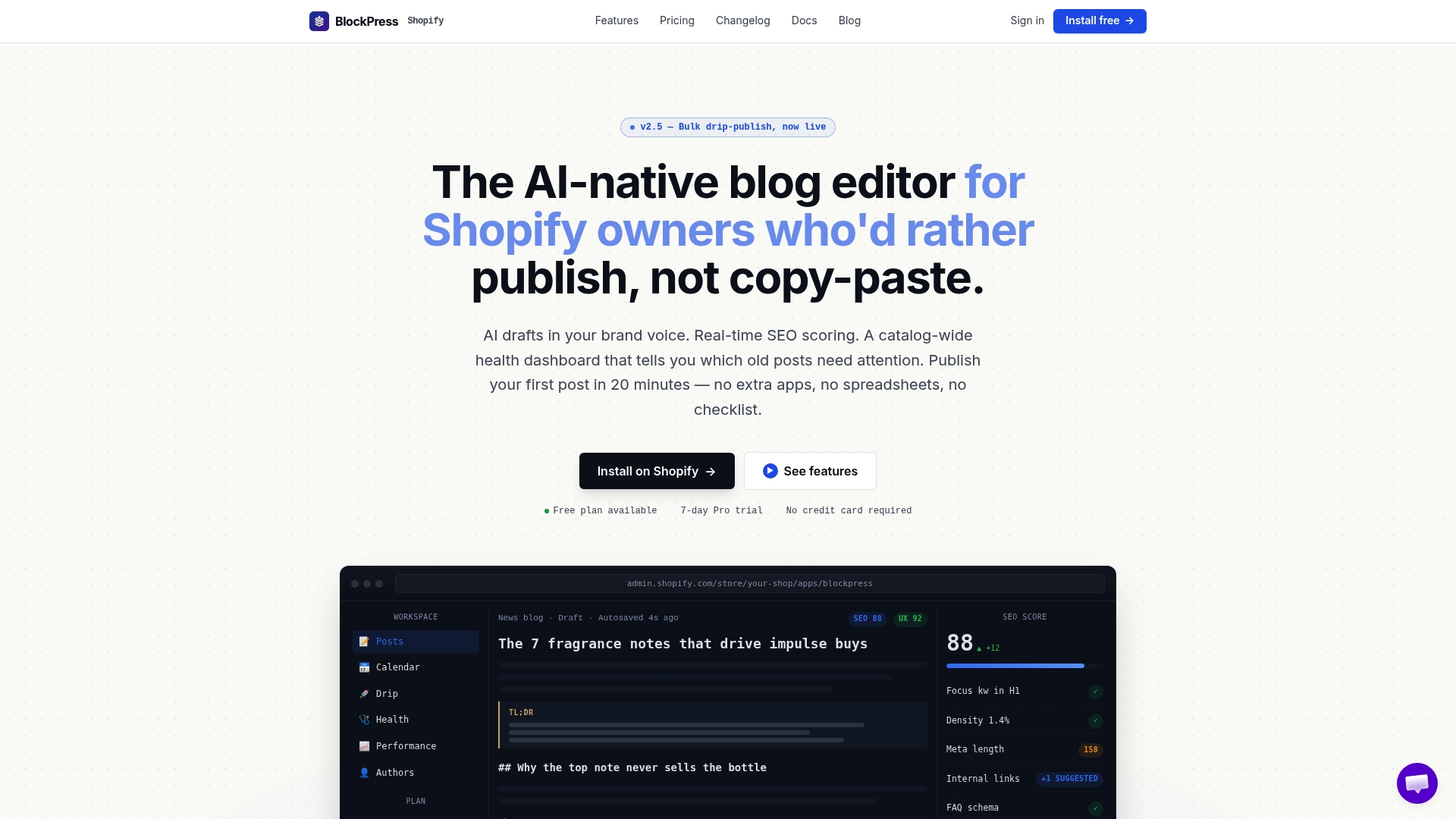
Ready to put this plan into action on your Shopify store? Blockpress gives you AI-generated drafts, real Google keyword data, live SEO scoring, and article health audits — all without leaving your store. See Blockpress plans and pricing and start your first article today.
Sources
- The 70/20/10 Rule That Keeps Your Marketing Budget From Going Stale | Entrepreneur
- Marketing Spend Benchmarks for Small Businesses: What the 2026 Data Shows
- Shopify Marketing Strategy: 2026 SEO & Sales Guide
- Viterbischool
FAQ
What is the 70/20/10 rule for a marketing budget?
How long does content marketing take to show results?
Organic SEO typically takes three to six months to produce measurable traffic gains, with full ROI realization sometimes closer to nine to twelve months. Paid distribution produces results in days to weeks but stops when the spend stops.
What are the five C's of content marketing?
Definitions vary across sources, but a widely used version covers: Content (what you create), Context (where and when it appears), Connection (how it resonates with the audience), Community (the audience you build), and Conversion (the action you want readers to take). These five elements together form a practical content planning checklist.
What is the 3-3-3 rule in marketing?
The 3-3-3 rule is not a single standardized framework; different practitioners define it differently. One common version suggests targeting three audience segments, across three channels, with three pieces of content per segment per period. Treat it as a rough planning heuristic rather than a fixed standard.
How much should a small business spend on content marketing?
At a $750/month content budget, a healthy content marketing ROI typically runs around 5:1, meaning each dollar spent aims to return five dollars in revenue.