
Listicles, blog articles, and product or category pages get cited and reused by Google and AI answer engines more than any other format. Comparison pages punch above their weight too, especially on ChatGPT. The winning move isn't picking one "best" format. It's matching format to search intent, then layering in E‑E‑A‑T and structural signals so both Google and AI systems can extract your answer cleanly.
Here's the shortlist worth prioritizing:
- Listicles and "best of" roundups
- Blog posts and long-form articles (especially with original research)
- Product and category pages
- Comparison pages (X vs. Y)
- How-to guides and step-by-step content
- Videos, images, and infographics
- Podcasts with transcripts
- News and timely content
- User-generated Q&A and reviews
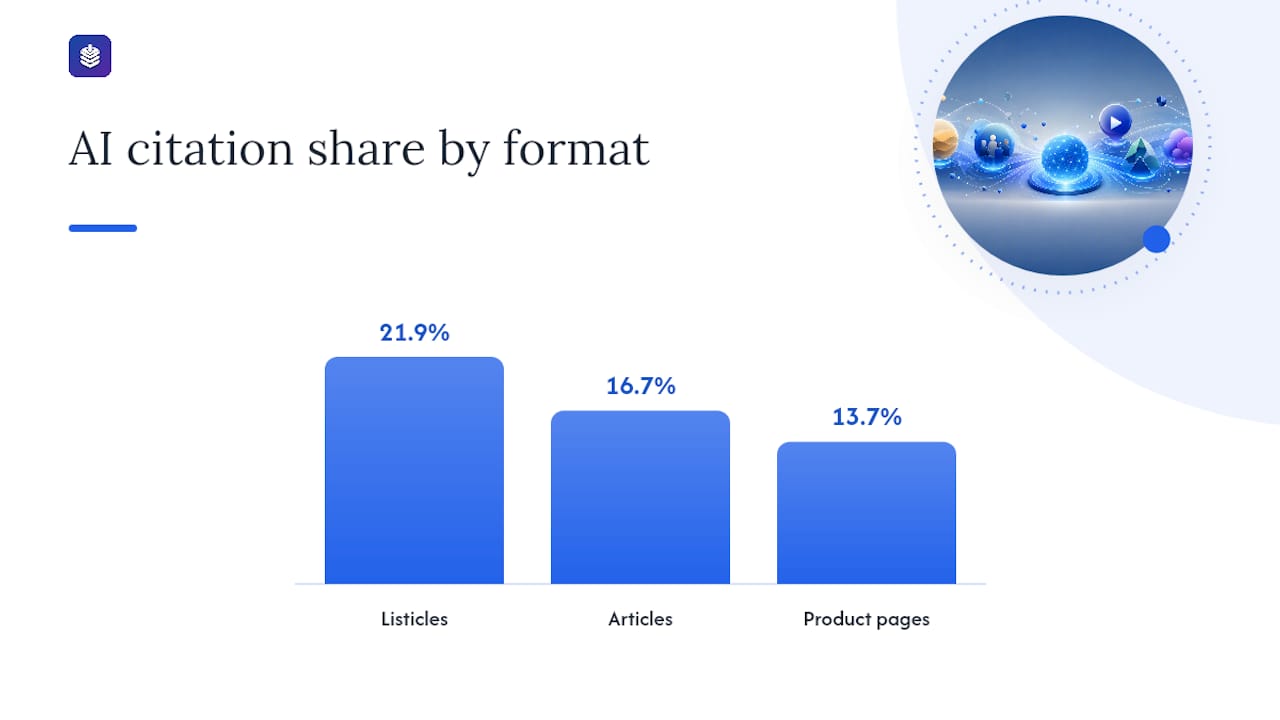
Listicles account for 21.9% of AI citations across engines, articles 16.7%, and product pages 13.7%, according to HubSpot's research.
Pro Tip: Before you write a single word, check what format currently ranks on page one for your target query. If Google's showing five listicles, don't publish a 3,000-word narrative essay.
Key Takeaways
Matching content format to search intent, then layering schema, author credibility, and original data, is what makes a page rank and get cited.
| Point | Details |
|---|---|
| Match format to intent first | Identify informational, commercial, transactional, or procedural intent before choosing listicle, article, or product page. |
| Comparison pages are underproduced | They post the highest citation rate at 1.87 per retrieval, especially on ChatGPT. |
| Structure beats length | Over half of AI-cited pages run under 1,000 words when tightly organized and marked up. |
| Schema is now standard | Structured data appears on 65 to 71% of AI-cited pages across formats. |
| Know your industry fingerprint | Listicles lead B2B tech citations; homepages lead local service citations. |
Table of Contents
- Why Do Certain Content Types Rank Better on Google?
- What Content Types Actually Rank on Google?
- How Do You Choose the Right Content Format?
- How Do You Measure If Content Is Working?
- What Does the Data Say About Content Formats?
- A Note on Producing This at Scale
- Sources
- FAQ
Why Do Certain Content Types Rank Better on Google?
Format alone doesn't win rankings. Google and AI engines reward content built to be found, understood, and extracted, and the formats that dominate search results just happen to make that job easier.
Start with answer-first structure. Google's own guidance on helpful, people-first content pushes publishers to demonstrate real experience and expertise rather than rehash what's already ranking. AI engines take this further: they favor pages with a short, direct answer in the first paragraph followed by a clear H2/H3 hierarchy, because that structure is easiest to lift into a snippet or a chat response.
Then there's E‑E‑A‑T, the framework Google's own Search Quality Evaluator Guidelines use to judge whether a page shows genuine experience, expertise, authoritativeness, and trust. Author bios, cited sources, and original data all feed into this. Structural signals matter just as much:
- Schema markup (Article, HowTo, FAQ, Product, ItemList)
- Visible "last updated" dates
- Linked author bio pages
- Original data, statistics, or research
- Clean, descriptive heading hierarchy
Google also weighs document quality, freshness, and engagement, sometimes described as contentEffort and navBoost in ranking-factor breakdowns for 2026. These aren't separate from format. They're what separates a listicle that ranks from one that doesn't.
Pro Tip: Map the dominant intent behind your target keyword cluster first. If most top results are comparison pieces, don't force a how-to guide into that slot.
What Content Types Actually Rank on Google?
Here's the working list, with what makes each one earn its spot.
1. Listicles and "best of" posts
A listicle organizes options or ideas into a scannable, numbered format, and it's the single most-cited format across AI answer engines. Google and AI systems favor listicles because each numbered item is a self-contained, extractable unit. Use titles like "Best X for Y" or "9 Ways to Z," mark up the list with ItemList schema, and track click-through rate on each ranking position, not just the page overall.

2. Blog posts and long-form articles
Standard articles remain the second-most-cited format overall, and they dominate on Gemini specifically, where 76% of citations point to blog posts. Original research or a unique data point is what pushes a blog post from average to citation-worthy. Use "What is X" or "How X works" titles for informational intent, add Article schema, and measure organic impressions alongside time on page.
3. Product and category pages
These convert AI search traffic directly into transactional intent, and Perplexity leans on product listings and landing pages for 84% of its transactional citations. Add Product schema with price, availability, and review data. Title the page around the product name plus its core benefit, and track conversion rate, not just traffic.
4. Comparison pages
A comparison page is genuinely underproduced relative to how well it performs. It posts the highest citation rate of any format at 1.87 citations per retrieval, roughly 45% above the average across all page types, and it's the format ChatGPT favors most. Use "X vs. Y" titles, structure pros and cons in a clear table or bullet layout, and be honest about tradeoffs. AI engines reward candor over sales pitches here.

5. How-to guides and procedural content
Step-by-step guides answer procedural intent directly. Mark them up with HowTo schema, number each step as its own heading, and open with the expected outcome before the steps themselves. Track scroll depth to confirm readers make it through the full sequence.
6. Video content
Long-form video builds topical depth; short-form drives discovery. Add video transcripts (which double as extractable text for AI engines), structured data for video objects, and thumbnail testing. Measure average view duration against your industry benchmark, not just view count.
7. Images and infographics
Compressed images with descriptive alt text and captions feed both accessibility and image search. Infographics that summarize a process or dataset get shared and linked more than decorative graphics. Add ImageObject schema and track referral traffic from image search specifically.
8. Podcasts
Show notes and full transcripts are what make a podcast episode indexable at all. Add Podcast schema, publish timestamped transcripts, and link out to sources mentioned in the episode.
9. News and timely content
Freshness signals carry real weight here. Update timestamps, cite primary sources, and track how fast a piece climbs and falls in impressions.
10. User-generated content and Q&A
Forum threads, reviews, and community answers show up in AI citations because they read as authentic, unscripted expertise. Moderate for quality, but don't over-edit the voice out of them.
11. FAQ sections with schema
FAQ schema turns a short Q&A block into a snippet-eligible answer. Keep answers to one or two sentences and match the question to how people actually type it into search.
Structured data now appears on 65 to 71% of AI-cited pages, which tells you schema isn't optional anymore if you want AI visibility. For a deeper look at how these signals play out specifically in ecommerce, see how Google ranks ecommerce blog posts.
Pro Tip: Length is not the lever you think it is. Some analyses find 53.4% of AI-cited pages run under 1,000 words when they're tightly structured. Cut the padding before you add more words.
How Do You Choose the Right Content Format?
Match format to intent before you touch structural optimization. Here's the flow:
- Identify the query's dominant intent: informational, commercial, transactional, navigational, or procedural.
- Check what format currently ranks for that query cluster.
- Pick the content type that matches (article for informational, comparison for commercial, product page for transactional, how-to for procedural).
- Choose a title pattern that mirrors the intent.
- Add the schema type that fits the format.
Title patterns by intent:
- Informational: "What Is X?" or "How Does X Work?"
- Commercial: "Best X for Y"
- Comparative: "X vs. Y: Which Is Better?"
- Transactional: Product name plus core benefit
- Procedural: "How to X in [Number] Steps"
Before publishing, confirm three things: the title matches the intent pattern, the schema type matches the format, and the first paragraph answers the query directly instead of building up to it. Schema markup and intent mapping work together, not separately. Skip one and you weaken the other.
How Do You Measure If Content Is Working?
Track these after publishing:
- Organic clicks and impressions
- Click-through rate by position
- Time on page and scroll depth
- Backlink pickups
- AI-citation appearances, where trackable
- Conversion rate for transactional and commercial pages
Run this checklist before anything goes live:
- Does the first paragraph answer the query directly?
- Is the right schema type in place?
- Is there a visible author byline linked to a bio page?
- Is there a last-updated date?
- Does the page cite real data or sources?
- Are images compressed with alt text, and do videos have transcripts?
- Is internal linking in place, and is the canonical tag correct?
Test title and meta description variants over time. Small wording changes move click-through rate, which feeds directly into the engagement signals Google tracks. The Shopify blog SEO checklist covers most of this in one pass if you'd rather automate the review.
What Does the Data Say About Content Formats?
The format mix that wins varies by industry, and that's the finding worth acting on. DeltaV Digital's citation study found listicles make up 61% of citations in B2B tech, homepages dominate at 55% for local service businesses, and program pages lead in higher education.
| Format | Citation Share or Rate |
|---|---|
| Listicles | 21.9% of AI citations overall |
| Articles | 16.7% of AI citations overall |
| Product pages | 13.7% of AI citations overall |
| Comparison pages | 1.87 citations per retrieval (45% above average) |
| Blog posts on Gemini specifically | 76% of Gemini citations |
The practical takeaway: find your industry's format fingerprint before you default to a generic best-practices list, then produce at least one high-effort piece with original data to anchor your E‑E‑A‑T signals. For a broader explainer on how these trust signals compound, PHENYX's breakdown of E‑E‑A‑T mechanics is worth a read.
A Note on Producing This at Scale
AI tools are good at outlines and first drafts. They're not a substitute for human verification, original quotes, or real data. Every AI-assisted draft still needs a person checking facts and adding what a model can't fabricate: genuine expertise.
That's largely why BlockPress builds author bio pages, live SEO scoring, and article health audits directly into its Shopify editor. It's not a shortcut around effort. It's a way to keep the effort visible where Google and AI systems look for it.
Sources
- Create helpful, people-first content — Google Search Central
- AI citation study — DeltaV Digital
- Search Quality Evaluator Guidelines — Google
- The Most Important Google Ranking Factors for 2026 — WordStream
FAQ
Which type of content is most viewed on Google?
Listicles and standard blog articles get cited most often across AI and search answer engines, followed closely by product pages for transactional queries.
How does Google rank content?
Google weighs domain authority, topical authority, document quality, freshness, and engagement, then layers E‑E‑A‑T signals like author expertise and original data on top.
What are the four main types of SEO?
The commonly cited categories are on-page SEO, technical SEO, off-page SEO, and local SEO, each addressing a different layer of how a site gets found and trusted.
What are the top ranking factors on Google?
Content quality and relevance, backlink authority, and technical health (site speed, mobile usability, crawlability) consistently top ranking-factor breakdowns, though Google never publishes an exact weighted list.
Do AI answer engines rank content differently than Google Search?
Yes. Google AI Overviews and Gemini favor blog posts heavily, ChatGPT favors comparison pages, and Perplexity leans on product and landing pages for transactional queries.