
TL;DR:
- Consistent content helps small businesses build trust, attract organic traffic, and generate leads predictably.
- It creates a reinforcing system that improves rankings, brand recognition, and buyer confidence over time.
Consistent content is the single most reliable way a small business builds brand trust, earns compounding organic traffic, and converts strangers into repeat buyers. It is not about publishing more than you can handle. It is about showing up predictably, with a clear voice, on the channels your customers actually use.
Here is what a steady content program delivers:
- Higher brand recognition — repeated, aligned messaging makes your business easier to remember and trust
- More organic traffic — search engines reward topical depth and publishing patterns, not one-off posts
- Stronger lead generation — consistent bloggers generate significantly more leads per month than sporadic publishers
- Better on-site conversions — familiar brands face less buyer hesitation at the decision point
- Predictable measurement — a steady cadence gives you real data to optimize, not noise
Expect the first meaningful signals in months 4–6, and compounding returns after month 7. Sustainability beats frequency every time.
Table of Contents
- Why does content consistency build trust and traffic?
- What concrete business outcomes can you expect?
- Where should you focus your content effort first?
- Frequency vs. cadence: which one actually matters?
- What should you track, and when will you see results?
- Research highlights that quantify consistency's impact
- Key Takeaways
- Why most small businesses get content consistency wrong
- Blockpress makes consistent Shopify content easier to maintain
- Useful sources
- FAQ
Why does content consistency build trust and traffic?
The mechanism behind consistent content is partly psychological and partly algorithmic. On the human side, repeated and unified exposures across visuals, voice, and messaging help the brain encode a brand faster. Each new touchpoint becomes progressively easier for a customer to recognize and trust, which means you need fewer total exposures to move someone from "I've heard of them" to "I'll buy from them." Shopify's brand-consistency research reports that two-thirds of companies see at least a 10% revenue lift from brand consistency, which points directly to this encoding effect.

On the algorithmic side, search engines and AI discovery tools reward topical concentration. A store that publishes 20 posts on a focused niche builds domain-level authority that a store with 20 scattered posts never earns. Google's crawlers return more frequently to sites with predictable publishing patterns, which speeds up indexing and improves ranking velocity.
Trust also grows from predictable behavior rather than one-off viral hits. When your audience can count on you to show up with useful, on-brand content, you lower their uncertainty about who you are and what you stand for. That lowered uncertainty translates directly into higher conversion confidence at checkout.
The Rule of 7 is the classic marketing principle that a prospect needs roughly seven exposures to a brand before taking action. Consistent content is the most cost-effective way to stack those exposures without paying for each one.
Three things reinforce each other when you publish consistently:
- Memory encoding — unified visuals and voice make each post reinforce the last
- Algorithmic trust — search engines and AI models treat topical patterns as a quality signal
- Buyer confidence — predictable brands feel safer to buy from, especially for first-time customers
What concrete business outcomes can you expect?
Publishing consistently does not just improve vanity metrics. It moves numbers that connect directly to revenue.
| Benefit | What moves | Typical driver |
|---|---|---|
| Brand recognition | Direct traffic, branded search volume | Repeated exposure across channels |
| Organic traffic | Organic sessions, keyword rankings | Topical authority and crawl frequency |
| Lead generation | MQLs, email sign-ups, form fills | More indexed pages targeting buyer intent |
| Conversions | On-site conversion rate, AOV | Familiarity reduces purchase hesitation |
| Retention | Repeat purchase rate, LTV | Ongoing content keeps your brand top of mind |
| CAC reduction | Cost per acquired customer | Organic leads cost less than paid over time |
Marketful's analysis of content frequency data shows that daily publishers generate roughly 13x more leads per month than teams publishing one or two posts per month. That gap is extreme at the high end, but the directional truth holds at every frequency level: more consistent output means more indexed pages, more keyword coverage, and more entry points for buyers to find you.
Basch Solutions points out another compounding benefit: small businesses that publish steady, relevant local or product-related content earn backlinks naturally over time, which raises domain authority and makes every future post rank faster. You are not just building traffic. You are building infrastructure.
The long-term ROI picture favors content over paid advertising when measured across multiple years. Paid ads stop the moment you stop paying. A well-optimized blog post keeps driving organic sessions for months or years after publication.
Where should you focus your content effort first?
With limited time and budget, sequence matters. Not all content delivers equal return.
-
Product and category pages first. Bottom-of-funnel content targets buyers who are already close to a decision. A well-written product description or category guide converts better than a top-of-funnel blog post and ranks for high-intent keywords. Start here before anything else. Types of product-related content that drive sales gives you a practical breakdown of which formats work best.
-
Location and service pages second. If you serve a local market, consistent local content helps you dominate neighborhood search terms. A post titled "Best [product] for [city] homeowners" targets a specific, lower-competition keyword and earns local backlinks.
-
Educational blog content third. How-to posts, buying guides, and FAQ articles build topical authority and capture mid-funnel searchers. Aim for 2–4 posts per month as a starting cadence. That is achievable for a solo owner and meaningful enough to build momentum.
-
Repurpose everything. One research-backed blog post can become a social caption, an email newsletter section, a FAQ answer, and a product page callout. This multiplies your output without multiplying your hours. A content publishing workflow makes repurposing repeatable.
-
Build a 90-day rolling calendar. Map out topics, formats, and publish dates three months ahead. This prevents the "what do I write about?" paralysis that kills most content programs in months 1–3.
-
Use templates and content blocks. A product review template, a how-to post template, and a local guide template cover 80% of what most small businesses need to publish. Templates cut production time significantly and keep quality consistent.
Pro Tip: Don't wait until a post is perfect to publish it. A good post published today compounds faster than a great post published in three months. Build a minimum viable content block: a clear headline, 400–600 words of useful information, one internal link, and a meta description. That is enough to index, rank, and improve later.
Frequency vs. cadence: which one actually matters?
Frequency is how often you post. Cadence is whether you can keep doing it. For small teams, cadence wins every time.
A store that publishes two posts per month for 18 months straight will outperform a store that publishes 10 posts in January and then goes quiet. Search engines reward sustained signals. Readers and email subscribers reward predictability. And your own team avoids the burnout that kills most content programs.
Here is a simple framework by team size:
| Team size | Recommended cadence | Expected monthly output | Resource estimate |
|---|---|---|---|
| Solo owner | 1 post every 2 weeks | 2 posts/month | 3–5 hours/week |
| Small in-house team (2–3 people) | 1 post/week | 4 posts/month | 5 hours/week |
| Owner + part-time writer | 2–3 posts/week | 8 posts/month | 8 hours/week |
The key rule: never commit to a cadence you cannot sustain for six months without outside help. If you can only manage one post per month right now, own that cadence and execute it perfectly. A data-driven content strategy platform can help you plan topics and allocate effort so you are not reinventing the wheel each month.
Consistency also applies to channel selection. Spreading thin across five platforms at low frequency is worse than owning one or two channels at a reliable cadence. Pick the channels where your buyers actually spend time, then show up there on schedule.
What should you track, and when will you see results?
Set expectations before you start, or you will abandon the program during the "valley of death" in months 1–3 when results are minimal but the work is real.
| Timeline stage | KPIs that typically move | What to watch for |
|---|---|---|
| Months 1–3 | Pages indexed, crawl frequency, initial impressions | Google Search Console showing new pages being discovered |
| Months 4–6 | Keyword rankings (positions 11–30 moving up), organic sessions | First posts entering page 2 or page 1 for long-tail terms |
| Months 7–12 | Organic leads, email list growth, on-site conversion rate | Compounding traffic from older posts, backlinks appearing |
| Month 12+ | Content-driven revenue, CAC reduction, LTV improvement | ROI clearly exceeding paid channel costs |
Marketful's compounding timeline data aligns with this framework: months 4–6 are typically when programs reach early ROI thresholds, and months 7–12 are when meaningful compounding returns appear.
Your core KPI stack for a small business content program:
- Organic sessions — (Google Analytics 4 or Shopify analytics)
Track these monthly, not weekly. Weekly data is too noisy to act on. Monthly trends tell you whether the program is working. Measuring content ROI on Shopify walks through the exact setup for each of these metrics inside a Shopify store.
Research highlights that quantify consistency's impact
The evidence base for consistent content is strong. Here are the findings worth citing when you need to justify the investment internally.
Shopify's brand-consistency guide cites research showing that two-thirds of companies report at least a 10% revenue lift from brand consistency. That figure covers all brand touchpoints, not just content, but content is the primary delivery mechanism for most small businesses.
Marketful's 67-statistic roundup reports that daily publishers generate roughly 13x more leads per month than teams publishing one or two posts per month. Even moving from one post per month to four posts per month produces a measurable lead-volume increase.
BizIQ's content marketing analysis highlights that organizations with a documented content strategy generate more leads per dollar than those without one. The act of writing down your strategy and cadence is itself a performance variable.
BlogoBot's practitioner research frames consistent content as infrastructure rather than a campaign. Brands that treat publishing as a system rather than a series of one-off efforts build compounding authority that is very difficult for competitors to replicate quickly.
A few caveats worth noting: most frequency-to-leads data comes from B2B studies, and the multipliers are directional rather than precise for any individual business. Your niche, audience, and content quality all affect actual outcomes. Use these figures as planning benchmarks, not guarantees.
Key Takeaways
Consistent content is the highest-ROI content investment a small business can make, provided you choose a cadence you can sustain and measure the right KPIs from month one.
| Point | Details |
|---|---|
| Cadence beats frequency | A sustainable 2–4 posts/month for 12 months outperforms a burst of 20 posts followed by silence. |
| Results compound after month 6 | Months 1–3 are indexing; months 4–6 show early ranking gains; months 7–12 deliver compounding organic leads. |
| Document your strategy | Organizations with a documented content plan generate more leads per dollar than those without one. |
| Repurpose to multiply output | One blog post can become social captions, an email section, and FAQ content without extra research time. |
| Blockpress for Shopify stores | Blockpress gives Shopify merchants AI drafts, keyword data, and bulk scheduling to maintain a consistent cadence without extra staff. |
Why most small businesses get content consistency wrong
The conventional advice is to "post more." That is the wrong frame. The businesses that fail at content consistency are not failing because they post too little. They are failing because they treat every post as a standalone project instead of a repeatable system.
When you approach content as a system, three things change. First, quality compounds: each post builds on the last, reinforcing your topical authority and brand voice. Second, production gets faster: templates and content blocks cut the time per post significantly after the first few iterations. Third, the program survives personnel changes, busy seasons, and motivation dips, because the system carries it forward, not individual willpower.
The other mistake is chasing channels where your audience is not. A Shopify store selling specialty outdoor gear does not need a TikTok presence if its buyers are 45-year-old hikers searching Google for gear comparisons. Consistent content on the wrong channel is wasted effort. Consistent content on the right channel, even at modest frequency, builds a durable competitive advantage.
One more thing: author credibility matters more than most store owners realize. A named author with a bio and a consistent publishing history signals expertise to both readers and search engines. It is a small addition to your content system that pays dividends in E-E-A-T signals over time.
Blockpress makes consistent Shopify content easier to maintain
Keeping a 2–4 posts/month cadence is straightforward in theory and genuinely difficult in practice when you are also running a store. The friction points are predictable: keyword research takes time, drafts stall, and scheduling slips when the week gets busy.
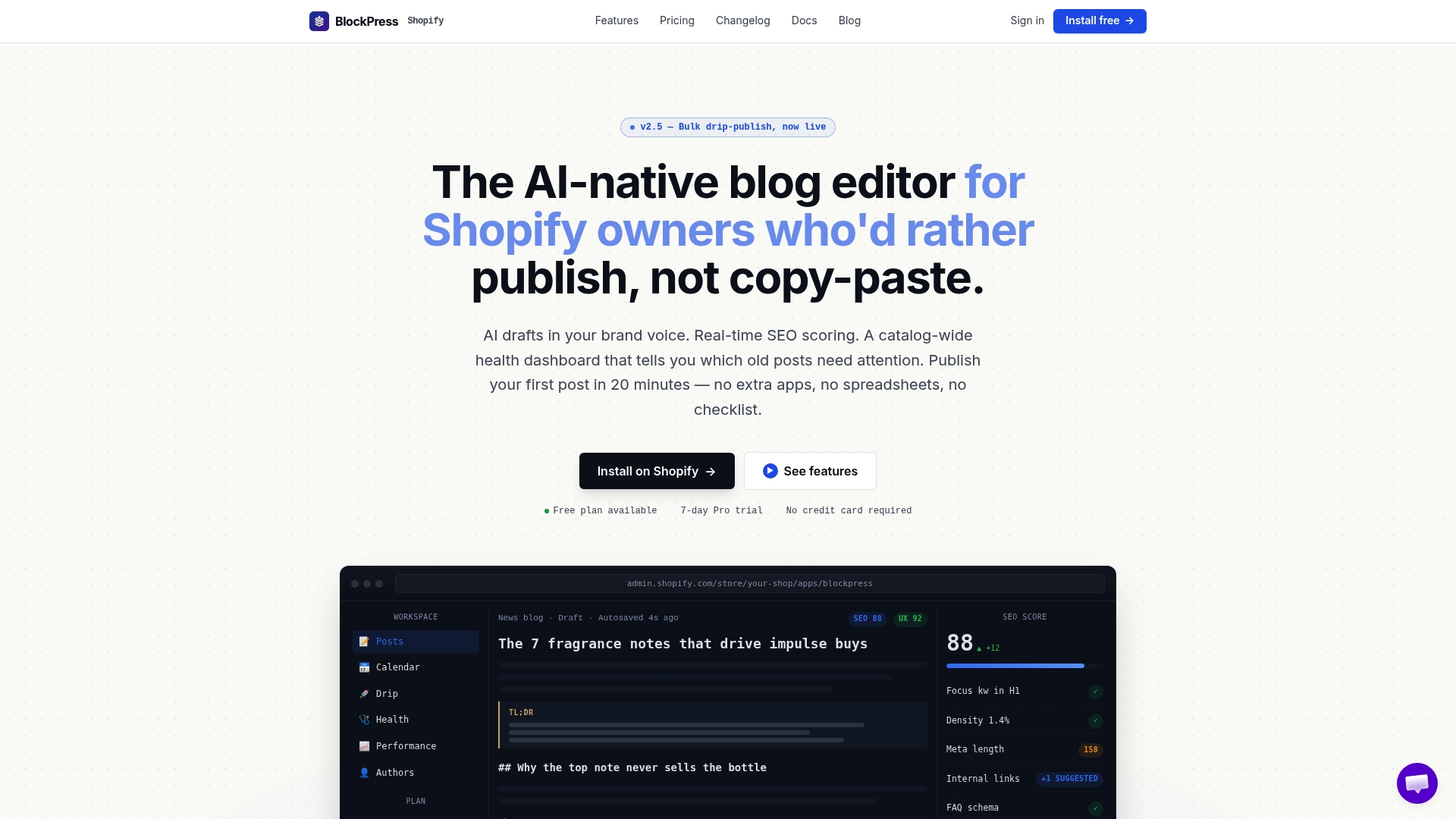
Blockpress removes those friction points from inside Shopify. You get real Google keyword data before you write, AI-generated drafts in your brand voice, live SEO and UX scoring as you edit, and bulk drip-publishing so you can batch a month of content in one session and schedule it to release on cadence. Per-article analytics show you exactly which posts are driving traffic and conversions, so you stop guessing about what to write next.
A realistic workflow for a solo store owner: spend two hours on a Sunday batching three article drafts with Blockpress's AI, review and edit them over the following week, then schedule all three to publish across the month. That is a 2–4 posts/month cadence on roughly four to five hours of total weekly effort.
Try Blockpress to see how it fits your store's content workflow, or check the pricing page to find the plan that matches your publishing volume.
Useful sources
- Consistency in Marketing: Benefits, Elements, and Tips — Shopify: Covers the revenue impact of brand consistency and the encoding principle behind repeated brand exposures.
- Small Business Marketing Statistics — LocaliQ: Aggregates data on blogging frequency, traffic, and lead generation for small businesses.
- Content Marketing Statistics 2026: ROI, Blogging & Video Data — BizIQ: Long-term ROI comparisons between content and paid advertising, plus documented-strategy data.
- Why Consistent Content Is the #1 SEO Strategy for Small Businesses — Basch Solutions: Local content, backlink earning, and crawl-frequency benefits for small businesses.
- Analytics for Content Marketing: Boosting SaaS Growth — BabyLove Growth: Measurement frameworks and analytics best practices for tracking content performance over time.
FAQ
How long before consistent content shows real results?
Most small businesses see initial keyword ranking movement in months 4–6, with meaningful compounding organic traffic and leads appearing after month 7. Months 1–3 are primarily indexing and early-signal building.
What is a realistic content cadence for a solo business owner?
Two to four posts per month is the standard recommendation for a solo owner. That cadence is sustainable at three to five hours per week and produces enough indexed content to build topical authority within 6–12 months.
What are the 4 C's of content marketing?
The 4 C's are commonly listed as Create, Curate, Connect, and Convert — a framework for balancing original content production with sharing relevant third-party material, engaging your audience, and driving them toward a purchase decision.
Does content consistency matter more than content quality?
Neither replaces the other, but consistency without quality stalls, and quality without consistency rarely compounds. The practical answer: publish at a quality level you can sustain on schedule, then improve quality incrementally as your system matures.
How does Blockpress help Shopify stores stay consistent?
Blockpress gives Shopify store owners AI-generated drafts, built-in Google keyword data, live SEO scoring, and bulk drip-publishing, all inside Shopify, so a small team can batch and schedule a full month of content in a single session without juggling separate tools.